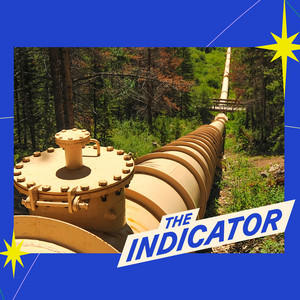
N .P .R. This is The Indicator from Planet Money.
I'm Weyland Wong, and I am joined today by Alex Hager of Member Station KUNC in Colorado.
Welcome to the show, Alex.
Hey, Weyland. Thanks for having me.
It's great to have you.
So there has been a lot of confusion lately over how one of our most precious resources, water, can be moved from regions in the U .S.
that have lots of it to places that don't.
A recent example of that confusion came up after the deadly fires in Los Angeles.
President Trump claimed that the U .S.
military went to California and, quote, turned on the water flowing abundantly from the Pacific Northwest and beyond, end quote.
White House Press Secretary Caroline Levitt repeated that claim to reporters last week.
Water has been turned back on in California, and this comes just days after President Trump visited Pacific Palisades, and as you all saw, applied tremendous pressure to turn on the water and to direct that water to places in the south and in the middle of the state.
In fact, there was no spigot to turn on that could direct water to the Los Angeles region in this way.
Moving water around is complicated.
Still, that hasn't stopped people, including the president, from wondering, if we have a lot of water elsewhere, why don't we just move it to somewhere that needs it more?
That question comes up a lot in California and in the arid West as a whole.
I know you know all about this, Alex, since you cover water infrastructure.
Yeah, I get this question more than anything else.
A lot of people say, look, we've got a lot of water in the eastern U .S.
Why don't we just pipe it to the west, you know, share the wealth a little bit?
Today on the show, we're talking water infrastructure and that tantalizingly simple proposal of piping water from one region to another.
In this case, from the east to the west.
This message comes from Charles Schwab.
When it comes to managing your wealth, Schwab gives you more choices, like full -service wealth management and advice when you need it.
You can also invest on your own and trade on Think or Swim.
Visit Schwab .com to learn more.
This message comes from Charles Schwab.
When it comes to managing your wealth, Schwab gives you more choices, like full -service wealth management and advice when you need it.
You can also invest on your own and trade on Think or Swim.
Visit Schwab .com to learn more.
This message comes from ADP.
Whether it's a last -minute policy change or adding a new company holiday, anything can change the world of work.
From HR to payroll, ADP helps businesses take on the next anything.
ADP, always designing for people.
This message comes from Charles Schwab.
When it comes to managing your wealth, Schwab gives you more choices, like full -service wealth management and advice when you need it.
You can also invest on your own and trade on Think or Swim.
Visit Schwab .com to learn more.
People have thought about moving water around for a long time.
Yeah, especially in the western U .S.
Even before climate change started fueling our present -day drought, it's always been pretty dry.
I mean, big parts of the region are literally a desert.
And for more than a century, that's had farms and cities looking at ways to get water from where it falls naturally to where people need it.
That is something you can hear in this old archival footage from here in northern Colorado.
Farmers on the east side of the Continental Divide said, how about all that water on the west side?
Much of it is just surplus over there.
Down here is where we really need it.
In the 1930s, there was a boom of new pipes, tunnels, and canals that helped the state's water defy gravity.
Engineers carved up the Rockies so they could take water from the Colorado River, pipe it underneath the mountains, and supply all the crop sprinklers and kitchen faucets on the other side.
Throughout the 20th century, there was similar work being done all around the West.
It's how we ended up with a 336 -mile canal carrying the Colorado River across the Arizona desert.
Right. Without ambitious pipelines, we would not have the West as we know it today.
You know, big cities like Denver, Phoenix, they would not look the same today without this complex web of water -moving infrastructure.
So it makes sense why people are asking about building another pipeline today.
A bigger pipeline just supplies about 40 million people across the southwest, and its supply is dwindling thanks to a mega drought going back more than two decades.
But if you ask the experts, there are some real hurdles in the way that make a new pipeline from the east very unlikely.
The reasons break down into three categories.
engineering, politics, and money.
Let's start with that first one, engineering.
Sure, we have all these other pipelines from the last century, but John Fleck says the kind people are thinking of today would be different.
We already did the ones that were feasible, and the ones that are left are the ones that just turned out not to be feasible.
John is a water policy professor at the University of New Mexico.
He says a pipe that big, that long, would have to go through a lot of places that might throw up some red tape about a huge new construction project going through town.
Yeah, and it's worth noting that we do have super long pipelines to carry other fluids.
The longest gasoline, diesel, and jet fuel pipeline in the country, it stretches from Houston to northern New Jersey.
But John says that system, which includes more than 5 ,500 miles of pipe, isn't a good comparison.
It takes so much more water to supply a city than it takes gasoline, So the size of the pipe or the size of the canal has to be a lot bigger, has to be much wider, has to cover a lot more ground.
So we've got engineering, and then there's another reason too, political obstacles.
It basically boils down to this.
Say you're a Western state that wants water from, for example, the Mississippi River.
Who would you even ask for it?
Right. There's no government agency that pulls the strings on the ownership and management of fresh water in this country.
And there's no one agency that runs the Great Lakes or the Mississippi River.
We talk about that river system a lot because it's just so big.
If the Southwest attempted to get some water from the east, there's a good chance they'd be tapping into the Mississippi River Basin.
That stretches from tiny mountain creeks in Montana to a giant river through the heart of Pittsburgh.
Because of that, in the east and the west, water is managed by a messy patchwork of different laws and agencies.
And there's one elephant in the room we haven't mentioned yet.
Even if you could call up someone in the east to ask for some water, who's to say they'd want to give it away?
Exactly. There are cities and farms and boats and wildlife that depend on that water.
And it is not just the Colorado River that experiences drought.
There have been some seriously dry times further east lately.
With climate change throwing curveballs to water supplies everywhere, it's unlikely that most places would want to give away the water they already have.
So let's say the leaders of the West have somehow convinced the East to give up some of its water.
They've gotten all the permits to build a humongous pipeline to get it here, but there is still that third big hurdle.
Money, money, money.
Extraordinarily expensive.
That's Kathleen Ferris.
She's made a career as legal counsel for some of the biggest water agencies in Arizona.
Just for comparison's sake on the costs, the big canal system in Arizona we mentioned earlier, that cost more than $4 billion to build starting in the 70s.
That's about $28 billion in today's dollars.
And any pipeline we build today would have huge maintenance costs, not to mention the energy required to pump all that water uphill.
Not to mention the energy required to pump all that water uphill.
Kathleen says it isn't just that a pipeline would be so expensive.
It is the fact that we have proven solutions that cost less.
Right. Here's one. Paying farmers to pause growing some of their crops.
Or another, like installing high -tech equipment in cities that can safely turn sewage back into drinking water.
Why don't we do the things that we know are possible and that are within our jurisdiction first, before we go looking for some kind of a grand proposal that we don't have any reason to believe could succeed.
All the experts I talked to for this story said some version of just that.
Let's look at pretty much everything else before we even consider a cross -country pipeline.
But just because it's so low on the list of options for solving the Western water crisis doesn't mean nobody is taking it seriously.
Yeah, in 2012, the federal government actually looked pretty deep into this idea.
Engineers analyzed all the places where the Colorado River might be able to get some more water.
That ranged from the imaginable, like pulling from a nearby river in Wyoming.
To the truly wacky, like taking bags full of melted Alaskan icebergs to Los Angeles by boat.
Did you say a bag of icebergs?
Again, we said imaginable to harder to imagine.
Ultimately, those engineers decided even the more reasonable options weren't worth pursuing, at least not yet.
I talked to one retired federal worker who helped put that study together.
He said even if an east -to -west pipeline doesn't make sense now, we shouldn't write it off completely.
The West is full of big cities that want to keep growing.
The whole country stocks its grocery shelves with produce grown with Colorado River water.
And it is not just the people in my inbox calling for a big pipeline to help out the dry Southwest.
President Trump just a few months ago gave a press conference at his L .A.
area golf course suggesting piping in water from Canada.
We have millions of gallons of water pouring down from the north with the snow caps in Canada and all pouring down.
And they have a very large faucet.
That idea did not go over well with our neighbors to the north.
Canadian experts said piping water from Canada is unreasonable for a lot of the same reasons we described here.
But with Trump now in the White House, these kinds of suggestions are sticking around in some of the highest seats of power.
This episode was produced by Julia Ritchie with engineering by James Willits and Sina Lafredo.
It was fact -checked by Sierra Juarez.
Kicking Cannon edits the show and The Indicator is a production of NPR.
This message comes from Tourism Australia.
No matter what you're into, Australia has something for everyone all year round.
Like the Dane Tree rainforest this spring, Melbourne's music scene in the summer, and the wineries of Barossa Valley in the winter.
Come and say good day.
More at Australia .com.
This message comes from ShipBob.
Did your holiday shipping let your customers down?
Partner with ShipBob for better order fulfillment.
ShipBob fulfills all your orders for you and achieves two -day shipping from dozens of fulfillment centers.
Go to ShipBob .com for a free quote.
This message comes from Warby Parker.
If you wear glasses, you know how hard it is to find the perfect pair.
But step into a Warby Parker store and you'll see it doesn't have to be.
Find a Warby Parker store near you at warbyparker .com slash retail.