Until the terrible day Father went away, and nobody would say why, we had all lived in London.
After that we went to stay in the White Cottage by the railway and Mother sold some stories and we met Mr Perks, the porter, and for a while things got better.
Then one day, we found the line blocked, and raced down to the cutting to warn the train.
Don't stand on the line, Bobby!
They don't see us!
They don't see us!
They don't know good!
Bobby, get off the train!
He's still good!
They don't see us!
Mommy!
Oh, stop!
Stop!
Mommy!
Mommy!
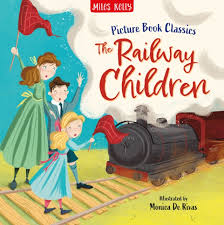
E. Nesbitt's story of the railway children, dramatized in four parts by Marcy Cahan.
Part 3.
Bobby!
Bobby!
Driver, there's been an avalanche up ahead.
Go on.
Who mustn't go on?
Didn't you hear that, Charlie?
There's been an avalanche.
Peter, Bobby's fainted.
Wake up, Bobby.
Wake up.
We did it, Bobby, with our red petticoats.
We saved the train.
For several nights, I had nightmares about the day the trees fell onto the railway line.
I would see the horrible mound of earth and rock on the track and hear the engine chugging towards it, and I would wake up screaming.
Then I'd remember how Peter and Phyllis and I waved our red petticoats and saved the train.
Look, there's a letter here, and it's addressed to us.
Maybe it's from Father.
No, that's not Father's handwriting.
It's a business letter.
Read it, Bobby.
Dear sir and ladies, it is proposed to make a small presentation to you in commemoration of your prompt and courageous action in warning the train on the 18th of August and thus averting a terrible accident.
The presentation will take place at your local station at three o'clock on the 30th of August.
Oh, Bobby!
If this place and time will be convenient to you.
It sounds convenient to me.
Yours faithfully, J. Bez Inglewood, secretary, Great Northern and Southern Railway Company.
A presentation?
That means presents.
It might be anything.
What I've always wanted is a baby elephant.
But I suppose they wouldn't know that.
Suppose it was gold models of steam engines.
Or a big model of the scene of the accident, with little model train and dolls dressed as us.
I'm not sure we should like being rewarded for saving a train.
Well, I do.
And don't pretend you don't either, Bobby.
I know I do.
But oughtn't we to be satisfied with just having done it without asking for anything?
Soldiers don't ask for medals.
Perhaps it will be medals.
Then when I'm old I shall show them to my grandchildren.
You have to be married first or you don't have any grandchildren.
I'd like to marry a lady who had trances and only woke up once or twice a year.
Just to say you were the light of her life and then go back to sleep again.
Exactly.
When I get married, I shall want my husband to be awake all the time so I can hear him say how nice I am.
Mother!
We're getting presents from the railway company.
Look.
Oh, I'm proud of you, darlings.
But if this presentation is money, you must say, thank you, but we'd rather not take it.
Yes, Mother.
Everything that happened at the presentation was like a dream.
Perks was wearing his best clothes and there were roses on the window ledges and a carpet on the platform.
There were dozens of people.
But most surprising of all, the old gentleman.
The same old gentleman who waved to us from the first-class carriage every morning.
It turned out he was a director of the railway.
It was the old gentleman who gave us our presentations.
Three gold watches with chains in blue leather cases.
And these watches are engraved thus from the directors of the Northern and Southern, in grateful recognition of the courageous and prompt action which averted an accident on August, the 18th 1905.
Come on, you must make a speech now, young Peter.
Oh, no, I couldn't possibly.
Oh, dear.
Ladies and gentlemen...
It's awfully good of you and we shall treasure the watches all our lives, but we really don't deserve it.
And what I mean is, thank you all very, very much.
There wasn't time to talk to the old gentleman with all those people there, but as he was leaving, I gave him a letter.
My dearest old gentleman, I want most awfully to ask you something.
If you could get out of the train tomorrow and go by the next, it would do.
I do not want you to give me anything, only to talk to you about a prisoner and a captive.
Your loving friend, Bobby.
She said to start without her.
She's with Mr. Schepanski.
I expect he's feeling sad again.
You'd feel sad Peter, if you knew your wife and children were somewhere in England, but nobody could find them.
If it were me, I'd write to Sherlock Holmes.
I've done something even better.
What do you mean, Bobby?
Come with me to the station tomorrow and you'll see all the light that's going to light There he is.
He's got out of the first-class carriage.
Hello there, Bobby, Peter and Phyllis.
Hello.
Hello, gentlemen.
It was very kind of you to break your journey.
Now, what is it?
The Russian gentleman.
The Russian gentleman?
We found him and now he lives with us.
But he's very sad because his wife and children are lost.
Oh, I see.
And we thought you must be horribly clever or you wouldn't be a director of the railway.
Oh, well, um, so could you find the Russians' wife and children, please?
We'd rather have that than anything.
We'll give the watchers back even.
If you could sell them and find his family with the money.
Oh, I'm sure that won't be necessary.
Now, what is the Russians' name?
Here, I've written it down.
Let me see, huh?
Shapansky.
Well, bless my soul.
I've read his book.
You know, it's translated into every European language.
A fine book.
And so, your mother took him in, eh?
Like the Good Samaritan.
Then you can help us.
I'll certainly try.
I know a great many Russians in London, and every Russian knows Shapansky's name.
Thank you, sir Thank you, children Don't you hate this?
Hate what?
Sitting here day after day waiting for something to happen.
Here comes the 515.
Who cares about the boring old 515?
When I grow up, I shall run a detective agency for lost fathers and children.
Me too.
Phyllis, girls can't be master detectives.
Why not?
Father said girls could be engine drivers.
Stop sniping, you two.
We weren't sniping.
I'm not even sure what sniping is.
Look, somebody's going through our gate.
Perhaps it's father.
No, father's very tall.
It's the old gentleman.
Hello there.
How do you do?
Good news.
I found your Russian friend's wife and children.
Hooray!
Now, you run on and tell him, Bobby.
Yes.
Peter, Phyllis, come and show me the way.
Hooray!
Mr. Schepanski!
Mr. Schepanski!
What is it, darling?
The old gentleman.
He's found Mr. Schepanski's wife and children.
Qu'est-ce que dit la jeune fille?
Tell him, mother.
Votre femme et vos enfants, monsieur, ils sont retrouvés.
Don't cry, Mr. Schepansky.
Oh, please don't cry.
Take them into the house.
Mr. Schepansky and I will be there soon.
When Mr. Schepanski came into the dining room with Mother, we all stood up and cheered.
Then we had tea and cakes.
And in no time at all.
Mr Schepanski had packed his few belongings and was on his way to the station with the old gentleman.
It was almost as wonderful as the day when we saved the train.
Thank you.
Don't you hate it when every day is the same?
It's not the same.
Today's Wednesday.
Yesterday was Tuesday.
Bobby doesn't mean the days of the week, silly.
Who are you calling silly?
I mean that every day we just sit here, waiting for something to happen.
I wish Mother would come down and tell us her story.
Ever since Mr. Schepanski left, she's done nothing but sit up there and scribble.
That's because she's sad.
How do you mean sad?
Phil...
You're too young to understand.
I understand.
Mr. Shapansky got his family back, but we haven't got father.
You two can sit here and mow for all you like.
I'm going fishing down by the canal.
I'm coming with you.
Me too.
Who do those boats belong to?
They're called barges.
People live in them.
Don't they get seasick?
Of course not.
They travel up and down the canals and they sing songs and wave flags at each other.
I wouldn't mind being a bargeman.
You'd have to work hard, loading and unloading things.
Hmm.
My husband would help me.
Look, there are bound to be plenty of fish here.
Peter, are you sure we should fish from the towpath?
Last time we came down, the boys on the barge just threw coal.
Oh, nonsense.
There aren't any boys here now.
If there were, I'd fight them.
You didn't fight them when they were throwing coal.
Shh, Phyllis.
Let Peter cast his line.
Sorry.
Let's hope we have some luck.
Careful, Peter.
There's a man looking at us from the deck of that barge.
Hey, what are you doing there?
We're trying to fish.
You've no business fishing near my barge.
We haven't touched your barge.
Get along with you now.
Get along yourself.
Peter, you shouldn't have said that.
He's heading this way.
Oh, come away, Peter.
Not me, but you'd better.
Darling, don't you know these here waters is preserved?
You ain't no right catching fish here.
I wasn't catching fish.
That's not your fault.
I'll be bound.
Oh, let go of my ear.
Let go of him.
Who are you shoving off?
I'm not shoving on purpose.
Please don't be cross with Peter.
Of course it's your canal.
We won't fish here anymore, but we didn't know it was yours.
Well, cut along then.
Mariah, chuck us a coat.
Here you are, Bill.
Talk.
You'll find me at the Rosencrown, when you put the kid to sleep.
The canal may belong to him, but I don't believe it does.
Come on, Peter.
I'm not going to be driven away by any old bargeman.
Oh, dear, oh, dear.
Don't you take no notice of my bill, dears.
Anyhow, you'll have the water to yourself for a while.
I'm meeting him over at the Rose and Crown.
We won't be back for a good two hours.
Oh, thank you.
You're very kind.
Who knows?
You might catch a power of fisher for that.
Where's your baby?
Asleep in the cabin.
He's all right.
Never wakes before twelve.
Regular as clockwork.
And aren't you afraid to leave it?
Oh, love, you know.
Who'd hate a little thing like him?
Besides, our dog's there.
So long.
Bye.
Bye.
Shall we go home?
You can.
I intend to fish.
Peter, it's getting dark.
Not for hours yet.
Now quiet.
Peter fished and fished, but he didn't catch anything.
And before we knew it, it was almost dark.
Come on, Peter, we should be heading back now.
Two more minutes.
Bobby, what's that?
What?
Smoke from the barge.
It's on fire.
That's all.
Serve him right.
Peter, how can you?
Think of the dear dog.
The baby.
They left their baby in the barge.
Baby baby, baby.
Where are you?
Oh, it's no good, i can't see it.
Baby baby, there you are bundled out of sight.
I found the kid nice job.
Come on, job this way Here.
Give them to me, Peter.
You'd better run straight to the Rosencrown and tell them.
Phil and I will stay here.
Shh.
There's a darling.
Go now, Peter.
Run!
You're the baby!
Bill!
Oh, Bill, the parchment!
Your barge cabin's on fire!
On fire?
Quick!
Reginald Harris!
My Reginald Harris!
The baby's all right.
Got him out safe.
Dog's too.
Go on, he's all alive!
But we'd better...
Children, do you know what time it is?
I have been out of my mind with worry.
Mother, there was a fire.
On a barge in the canal.
Peter saved the baby and dog.
And we watched the bargeman put out the fire.
Well, now.
He's invited us for a day on the canal.
He's promised us 19 locks.
May we go, Mother?
Of course.
Oh, Peter, I'm very proud of you.
And Mother...
The bargeman said he'd tell all the bargees on the canal that we were the real right sort and to treat us like pals.
So you've made another lot of friends.
First the railway and now the canal.
I think everyone in the world has friends.
If you can only get them to see, you don't want to be unfriends.
That night, I thought about the families we had reunited.
Mr. Schepanski and his children, the barge people and their baby.
And I knew that Father, wherever he was, would be very pleased.
Buns for tea this afternoon, darlings.
A very sensible editor has just accepted two of my stories.
Mother, would you mind if we didn't have the buns today, but on Thursday the 15th?
I don't mind when you have them, dear, but why?
Because it's Perks the Railway Porter's birthday on the 15th.
He's 32.
And he said he doesn't keep his birthday anymore because he's got other things to keep.
The kids and the missus.
You mean his wife and children, Phyllis?
Yes, same thing, isn't it?
We could put his name on the buns with pink sugar.
Perks isn't a pretty name.
His other name's Albert.
I asked him once.
We might put AP.
I'll show you how.
Now it's back to the salt mines for me.
She means her writing room, Phil.
I knew that.
Do you think buns will be enough?
What about flowers?
Parks has got a lot of flowers in his garden.
Still, it's always nice to be given flowers.
Buns and flowers.
There has to be something more.
Quiet, everybody.
Nobody to speak until they've thought of something.
Hooray!
I've got it!
Tell us!
Tell us!
Parks is especially nice to everyone, isn't he?
There must be lots of people in the village who would like to contribute to his birthday party.
Mother said we weren't to ask people for things.
For ourselves she meant silly, not for other people.
I think we should check with Mother first.
Mother's busy at her salt mine.
Come on, let's go down to the village and begin.
We'll start with Mrs Harwood at the post office.
Excuse me?
Yes?
We don't want any stamps, but we're collecting contributions for Perks the Railway Porter.
It's his birthday on Thursday.
I don't see why Perks should have a birthday any more than anyone else.
We think everyone should have one.
Well, mine's tomorrow.
Much notice anyone will take of that.
Now get along with you.
No wonder people ignore her birthday.
Come on, let's try the sweet shop.
Not a bad haul.
A tobacco pipe from the sweet shop.
Half a pound of tea from the grocers.
A woolen scarf, slightly faded, from the drapers.
My favourite's the stuffed squirrel from Dr Forest.
Plus five pledges meat from the butcher, six eggs from the woman in the turnpike cottage, a nearly new perambulator from Mrs Ransom and an iron shovel from the blacksmith.
Perks will be as pleased as punch.
Come on, it's nearly supper.
What are you three looking so pleased about?
We've been collecting things for Perks.
His friends in the village donated presents for his birthday.
There's no harm in people giving presents, is there, Mother?
It depends how you do it.
I only hope Perks won't be offended and think it's charity.
Poor people are very proud.
It isn't because he's poor.
It's because we're fond of Perks.
I'll find some things that Phyllis has outgrown for Perks' babies.
Only be sure you don't offend him.
Don't worry, Mother.
Perks will have a jolly time.
Try again, Peter.
What if Mrs Perks isn't home?
She's got to be home.
They have six kiddies.
I hear someone coming.
Oh.
Hello, children.
I was just having an extra clear-up today, along with Perks happening to name it being his birthday.
I don't know what put that into his head.
We keep the children's birthdays, but him and me, we're too old.
We knew it was his birthday, Mrs Perks.
We've got some presents for him here in the perambulator.
The perambulator is a present as well.
We hope we're not intruding.
Intruding?
Yes.
Bless me, you're not intruding.
This is a birthday such as Perks never had, even when he was a boy.
We'll need a plate for these buns, please.
Of course, the buns.
Oh, and we brought you this.
Oh, bless us.
Honey and gooseberries and roses.
To think me getting the place tidy early, and all there was for him was an ounce of his favourite tobacco that I got on Saturday and been saving up for him ever since.
I hear him coming.
Come in quick.
We'll hide you in the back kitchen and surprise him.
But give him the tobacco first because that's your special present.
And then we'll all come in and shout many happy returns.
We'll wait in here till Mrs Perks calls to us.
What if Perks opens the door and sees us hiding?
He's not likely to open his door.
Anyway, if he goes towards it, Mrs Perks will divert him.
Stop humming, Phyllis.
I'm not humming.
Shh.
Oh, no.
Oh, no.
What?
The labels.
They're here in my pocket.
I forgot to put them on the presents.
Perks will think it's all us and that we're being charitable or something.
Shh.
He's here.
Hello, old woman.
Here's a pretty set-out.
It's your birthday tea, Bert.
And here's an ounce of your extra particular.
Oh, good old girl.
Here.
What's that pram?
All these bundles and sweet stuff.
It's them children you make such a fuss about.
The children from the three chimneys.
I don't care if it's from an angel from heaven.
We've got on all right all these years and no favour's asked.
Oh, hush, Bert.
Shut your silly tongue.
I'm not going to begin these sort of charity goings-on at my time of life, so don't you think it now?
For goodness sake, Bert, all three of them's in the back kitchen listening to every word you speak.
Well, I'll give them something to listen to.
Come out.
Come out and tell me what you mean by it.
Have I ever complained to you of being short as you come to this charity nonsense over me?
Oh, we thought you'd be pleased.
I'll never try to be kind to anyone else as long as I live.
It didn't mean any harm.
It ain't what you mean, so much as what you does.
Oh, don't.
We thought you'd love it.
We always have things on our birthdays.
Oh, yes.
Your own relations.
That's different.
Not only our relations.
On my birthday, Mrs Viney gave me two lovely glass pots and nobody thought she was coming.
The charity nonsense over us.
Fine, if it's just glass pots.
Is there being all these heaps and heaps of things?
I can't stand.
No, nor I won't, neither.
But they're not all from us.
We forgot to put the labels on.
They're from all sorts of people in the village.
Who put them up to it, I'd like to know.
Why, we did.
So you've been round telling the neighbours we can't make both ends meet?
Well, now you've disgraced us as deep as you can in the neighbourhood, you can just take the whole bag of tricks back where it came from.
But don't.
I don't doubt but what you meant it kind, but I'd rather not be acquainted with you any longer.
We'll go if you like.
And you needn't be friends with us any more if you don't want.
We shall always be friends with you, however nasty you are to us.
Quiet, Phyllis.
But before we go, do let us show you the labels we wrote to put on the things.
I don't want to see no labels.
But why must you be so stubborn?
Phyllis!
Mother said we ought to be careful.
So Bobby wrote down everything everybody said when they gave us the things.
May I read them, Mr Perks?
Do as you please.
Mother's first.
Baby clothes for the children.
Mother said we're poor ourselves, but she'd like to give something because you've always been so kind to us.
That's all right.
Your ma's a born lady.
We'll keep the little frocks now.
And Mrs Ransom said for you to have the pram, to help you with your fine boy.
I can't send the pram back, Perks, so don't you ask me.
I'm not asking anything.
Then the shovel.
The blacksmith said you tell Mr Perks it's a pleasure to make a little trifle for a man as is so much respected.
The blacksmith's a good enough chap.
And the meat.
The butcher said you respected a man that paid his way.
And so did the cobbler.
And the old gentleman gave me a gold pound for you and said you were a man who knew your work.
We thought you'd love to know how fond people are of you.
But you're not.
And I never was so unhappy in my life.
Goodbye, Pucks.
Goodbye, Pucks.
Goodbye, Mrs. Pucks.
Oh, stop.
Stop.
Come here.
I take back every contrary word I said.
Nell, sit on the kettle.
Well, take the things away if you're unhappy.
Unhappy?
I don't know as ever I was better pleased.
Not so much with the presents, though they are A1, but the kind respect of our neighbours.
That's worth having.
Eh, Nell?
I think it's all worth having.
You've made a ridiculous fuss about nothing, Bert.
Self-respect is not nothing.
Now, I hope you three will stay to tea.
Hooray!
May the garland of friendship be evergreen!
May the garland of friendship be evergreen!
It was a splendid day.
But I couldn't help wondering, when would our own family be happy and united?
And when Mother wanted to talk to me next day, I knew immediately that it was something to do with Father.
In part three of The Railway Children by E Nesbitt, dramatized by Marcy Cahan Victoria Carling was Roberta, Daniel Eisen was Peter, Kate McEnery was Phyllis and Frances Jeter was Mother.
Timothy Bateson was The Old Gentleman, Paul Copley was Perks, Peter Howell was Dr Forrest and Michael Poole was Szczepanski.
Jenny Howe played Mrs. Perks, Michael Kilgariff the bargeman, and Judy Parkin, Mariah.
Other parts were played by members of the cast.
The music was composed by Elizabeth Parker and the railway children was directed by John Taylor.
Next week, in the final part of the story...
After my disaster with Peter and the rake, I tried not to quarrel with him.
And I tried not to be a prig.
But Mother was busy and Peter wasn't able to move about.
And before I knew it, things went from bad to worse.
Hello, Miss Roberta.
How's the young gent?
Peter's better, thanks, Perks.
Good.
But he's most frightfully bored.
I wondered if you got any magazines from your waiting room you could lend him.
Magazines?
I'm afraid I sent the big of them to Snigson's boy.
Him what's getting over the pneumonia.
There's these illustrated papers left.
Oh, Peter'll like those.
Well, you can take them with pleasure.
There's lots of pictures.
If Peter wants to mess them about with his paint box, why, let him.
I don't want them.
You're a dear, Perks.
Bye now.
Bye for now.
I had to wait at the level crossing.
That's when I noticed the article in the newspaper.
It was staring at me from the top of the pile.
There was a photograph of Father.
The headline read, End of trial.
Verdict and sentence.
There was Father's name and the verdict.
Guilty.
Guilty.
And the sentence?
Five years penal servitude.