We were not the railway children to begin with, just ordinary suburban children.
Then, quite suddenly, there was that dreadful night when father went away, with no explanation at all.
And after that, everything changed for us.
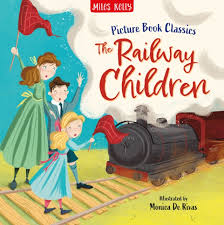
E. Nesbitt's story of the railway children, dramatized in four parts by Marcy Cahan.
Part Two After father went away, we went with mother to live in the country near the railway.
There were no cabs or buses or motor cars.
The only things that went by were the trains.
We called a 9.15 to London, the Green Dragon.
The 1007 to Scotland was the Worm of Wantley and the midnight town express.
We called the fearsome fly-by-night.
It was by the green dragon that the old gentleman travelled.
The green dragon in the distance.
Five and a quarter minutes late.
The green dragon's going where father is.
We don't know that, Phyllis.
If it were a dragon, we could stop it and ask it to take her love to father.
Dragons don't carry people's love.
Yes, they do, if you tame them thoroughly first.
I wonder why Father never writes to us.
Mother says he's too busy.
But he'll write soon, she says.
I know!
Let's all wave to the green dragon as it goes by.
If it's a magic dragon, it will understand and take our loves to Father.
Take our love to Father!
Look!
Someone's waving back!
He's in the first-class carriage!
He's waving his newspaper!
Such sweet-looking children.
Are you acquainted with them?
Never seen them before.
But it seems rude not to wave back.
After that, every morning at 9.15, we would wave to the old gentleman.
And he would always wave back.
Then Perks the Porter would tell us about the railway.
Everything on the railway has a special name.
Those things that hook the carriages together are called couplings.
What about those great serpents that hang over the couplings?
Couplings, Phil.
You mean the pipes?
If you could get a hold of one of them when the train's going and pull them apart, she'd stop dead off with a jerk.
Who's she?
The train, of course.
And...
You know the red handle in the carriages where it says on it, five pounds fine for improper use?
If you was to improperly use that, the train had stopped.
What if you used it properly?
It'd stop just the same.
There was an old lady once.
Someone kidded her on it was a refreshment room bell, and she used it improper.
When the guard came along, she says, Oh, please, mister, I'll take a glass of stout and a bath bun.
Oh, what did the guard say to the old lady?
I don't know, but I'll lay she didn't forget it in a hurry, whatever it was.
MUSIC PLAYS
When we got home to the little white house that day, Mrs Viney met us at the door.
Quiet as you go upstairs, children.
What's happened, Mrs Viney?
Your mother's caught a chill.
Dr Forrest is with her now.
Influenza, Mrs Viney.
Oh, Mother.
We'll have her right as rain in no time.
Now, Lady Gravers, I suppose you'll want to be her nurse.
Of course.
I'll send down some medicine.
Keep up a good fire.
She'll need strong beef tea as soon as the fever goes down.
And grapes instead of water and milk.
And you'd better get in a bottle of brandy.
The best brandy.
The cheap stuff is worse than poison.
I'm head nurse, Mother.
The doctor's given me a list.
Nonsense.
I can't afford all that.
But Dr. Forrest says it's essential.
He told me to buy the best of everything.
That's all very well for Dr. Forrest, but I'm running this household.
And we can't spare a single extra penny.
Maybe we can find someone who would lend us the money.
No, Roberta.
I won't have you go begging to the neighbours.
We can manage nicely on our own.
Mother, I promised the doctor I'd look after you.
And so you shall.
Tell Mrs Viney to boil two pounds of scrag end of the neck for your dinners tomorrow.
I can have some of the broth.
I should like some water, dear.
Mother says forget the list.
All she can afford is a shilling, and that's for our mutton tomorrow.
We can do without the beastly mutton.
Bread and butter will support life indefinitely.
We'll pretend we're on a desert island.
You're right.
I'll ask Mrs Viney to get as much brandy and soda water as she can for a shilling.
What about all the other things on the doctor's list?
We can't afford them.
But Mother needs them.
We must find some other way.
Now think, everybody, just as hard as you can.
We thought and thought.
And talked and talked.
Then Roberta went to sit up with Mother.
And Peter and I got very busy with scissors and a white sheet and a paintbrush and a pot of Brunswick black polish.
All right, everybody wave the banner.
Please sir, look out to the station.
Oh gentlemen, i thought i'd missed you.
Ah, did you see our banner?
My dear, I did.
Most ingenious.
Here, it's a letter from all three of us.
It's ever so urgent.
Thank you, my dear.
Over!
You seem to have acquired a circle of admirers.
I'm afraid it's more serious than that.
Dear Mr. We-Do-Not-Know-Your-Name, Mother is ill, and the doctor says to give her the things at the end of the letter, but she says she cannot afford it.
Young ruffians.
They'd probably want the money to buy sweets.
Oh, no, I don't think so.
No, really.
We do not know anybody here but you because Father is away, only we don't know where.
Father will pay you, or, if he has lost all his money, Peter will pay you when he is a man.
We promise on our honour.
Will you give the parcel to Perks, the station porter?
Say it is for Peter that was sorry about the cold.
And he will know, all right.
Signed, Roberta Phyllis Peter.
Very touching.
It is, isn't it?
If it's genuine, of course.
Of course.
And not an elaborate swindle.
Oh, I think it's genuine.
How can you be sure?
I can't.
But my heart tells me it is.
Ah, special delivery, Master Peter.
A hamper.
Old gent.
He asked me to fetch it up straight away.
Thank you, Perks.
Put it on the table.
I'm awfully sorry I haven't tuppence to give you like Father does.
I wasn't thinking about no tuppences.
I only wanted to ask how your mother was this evening.
I fetched her along a bit of sweetbriar.
Tuppence indeed.
Thanks very much.
I beg your pardon about the tuppence.
No offence.
We're non-intended.
What's in the hamper, Peter?
Lots of straw.
Wood shavings.
Oh, look!
Peaches!
Port wine!
Chicken!
Two chickens!
Red roses!
Lavender water!
And eau de cologne!
There's a letter.
Dear Roberta and Phyllis and Peter, here are the things you want.
Your mother will want to know where they came from.
Let me see it.
Tell her they were sent by a friend who heard she was ill.
When she's well again, you must tell her all about it.
If she says you ought not to have asked for the things, tell her that I say you were quite right.
Ask her to forgive me for taking the liberty of allowing myself a great pleasure.
Signed... GP... something.
I can't read it.
I think we were right.
Of course we were right.
All the same, I don't exactly look forward to telling Mother the whole truth.
Not till she's well, Peter.
And when she's well, we shall be so happy we shan't mind if she's angry.
Look at the roses.
I must take them up to her.
Don't forget Perks of Sweet Briar.
I nursed Mother the whole week long.
I didn't much enjoy it.
Nurses get very little sleep.
But gradually, Mother got stronger.
Mother, you shouldn't be out of bed.
I shall never lie on that bed again.
Oh, Roberta, the bliss of sitting upright in a chair.
You'll catch another chill.
I'm perfectly warm.
Now, all I need is my writing pad and my pens to help us pay off some bills.
It is strange.
Here comes the train.
Ready?
She is nearly well.
Thank you.
The old gentleman's seen it.
He's waving.
Goodbye.
Send our love goodbye.
Splendid!
She's nearly well.
Who's nearly well?
The mother of the three young ruffians.
Now that mother was well, we had to tell her what we'd done.
It's quite true that we're poor, but we have enough to live on.
You mustn't go telling everyone about our affairs.
It's not right.
Yes, Mother.
And you must never, never, never ask strangers to give you things.
Always remember that.
Yes, Mother.
I'll write to the old gentleman and I shall tell him that I do not approve.
Of course I'll thank him for his kindness.
It's you three I don't approve of, not the old gentleman.
Peter can give the letter to the station porter to give him and we won't say any more about it.
Isn't Mother splendid when she's angry?
After that, I did something that would make Mother even angrier if she ever found out.
Hello?
Dr. Forrest?
Hello, Head Nurse.
Want a lift?
I wanted to see you.
Your mother's not worse, I hope?
No.
Well, step in then.
We'll go for a ride.
This is jolly.
You've got a fine view of the aqueduct.
I've read about aqueducts in books.
Roman water bridges.
Now then, what's the trouble?
Come on, Roberta.
Out with it.
It's rather hard, you see, to outwit it, because of what Mother said.
What did Mother say?
She said I wasn't to go telling everyone that we're poor.
But you aren't everyone, are you?
Certainly not.
Well?
Well, I know doctors are extravagant, I mean expensive, and Mrs Viney told me that her doctoring costs her only tuppence a week because she belonged to a club.
Yes?
Yes.
Dr. Forrest, can't we be in the club too?
The same as Mrs. Viney?
I see.
You aren't cross with me, are you?
Cross?
How could I be?
You're a sensible young woman.
Now look here, don't you worry.
I'll make it all right with your mother.
Even if I have to make a special brand new club all for her.
Bobby, there you are.
I've been looking for you everywhere.
I went for a walk, that's all.
You're just in time for the surprise.
Now stand there, wait until the bell rings and then you may turn around.
Phyllis, what's going on?
Happy birthday to you.
Happy birthday to you.
Happy birthday, darling.
How could I have forgotten?
You were too busy nursing mother, that's how.
Here, Bobby, it's a needle book for your sewing kit.
Thank you, Phil.
Mrs Viney has sent you these glass vases.
And this is for me.
Mother, your silver brooch shaped like a butterfly.
I've always loved it.
My present is on the table.
Peter, not your steam engine, your favorite toy of all, course not the engine.
Look, I filled it with sweets.
The sweets are for you, mind you.
If you do on the engine, I'll let you go house if you like.
You're a brick Peter, thank you, thank you all.
Oh, if only father I know darling father loves parties.
Now Let's cut the cake before Phyllis explodes with hunger.
That night, I was too excited to sleep.
I thought about how brave Mother was setting up house in a strange village and not asking help from anybody.
And I thought about Father.
Father?
How happy he would be when he heard how generous everybody was.
The old gentleman, Dr. Forrest, especially Peter, giving me half of his precious engine.
On days when Mother went to Maidbridge, we always came to wait for her at the station at least a good hour before her train was due.
We didn't mind waiting.
There were always trains to watch and people to observe.
Which train is that, Bobby?
It's just a boring old worm of one thing.
Oh, something's happened.
Find the dollar platform.
What are they all looking at?
It's my belief.
If you ask me, it's a police court case.
What's going on, Perks?
Now, move along.
I'll attend to this, if you please.
I'll go and see.
What is it, Peter?
It's a man.
He's more like a creature.
He's got long, dirty hair and wild eyes.
And he's closer than life.
He sounds like French to me.
It isn't French.
What is it, then?
I don't know, but it isn't French.
Well, try him with French, if you know so much about French.
Calm down, calm down, calm down.
Parlez-vous français?
There, that's French.
What's he saying now?
I don't know.
No comprenez.
Mother speaks French, Perks.
She'll be here any minute on the train from Maybridge.
Very well.
You'd better come along to my room now.
No, don't.
Look how frightened he is.
I will.
He thinks you're going to shut him up.
I know he does.
Look at his eyes.
Like a fox's eyes when a beast's in a trap.
Wait.
Let me try.
Vous attendez, monsieur.
Ma mère parle francais.
Nous... What's the French for kind?
Bon is good.
Nous être bon pour vous.
I think he understands, Bobby.
Take him into my room, then.
Now, come on, move along.
Now, ladies and gentlemen, move along, please.
That's right, just sit there.
He looks without visible means to me, travelling without a ticket.
I'm not sure but what I ought to send for the police.
Oh, no, don't, Perks.
I'm sure he hasn't done anything like you're sent to prison for.
Wait till Mother comes.
She does speak French beautifully.
I don't mind waiting.
But I should like to know what nation's got the credit of him.
What about your foreign stamps, Peter?
Phyllis is right.
Show him the stamps.
Here we are, monsieur.
Italy.
Norway.
He's pointing at the stamp from Russia.
There's Mother's train.
I'll stay with him till you bring Mother in.
You're not afraid, Miss Roberta?
No, he wouldn't hurt me.
Look, he's almost smiling.
Are you sure your mother was on this train?
Positive.
There she is.
Mother, over here.
Come quickly.
We found a Russian.
We found him on the platform, Mother.
He speaks French.
Children, please, one at a time.
Where's Rebecca?
She's in my room with the Russian man.
We told him everything would be all right when you got here.
Hello, Mother.
Voici ma mère, monsieur.
Who is this man?
If you could find that out and where he's supposed to be going, the Great Northern and Southern Railway Company will be much obliged.
Of course.
Now, please, give the poor man some space.
We'll wait outside, shall we?
Please.
Out we go, children.
We'll let the French speakers get on with it.
Monsieur Parisi.
What are they saying?
The Russian is talking like mad and gesticulating.
I say, I think he's crying.
Poor man.
Your mother's comforting him.
Here they come.
Well, what's it all about?
It's all right.
He is Russian and he's lost his ticket.
I'm afraid he's very ill.
If you don't mind, I'll take him home with me now.
Now, be sure you're not taking home a frozen viper.
I'm quite sure I'm not, Perks.
He's a great man in his own country.
What kind of great man?
He writes books.
Beautiful books.
I've read some of them.
Venise avec nous, s'il vous plaît.
Merci, madame.
Peter and Phil, run home and light a fire in the sitting room.
Bobby, you had better go for Dr Forrest.
If it isn't my favourite head nurse.
I hate to tell you Doctor, but Mother's found a very shabby Russian and I'm sure he hasn't got any money.
Found him?
Was he lost, then?
That's just what he was.
He's been telling Mother the story of his life in French and she said would you please come directly?
He has a dreadful cough, and he's been crying.
I've made him some tea, Doctor.
Splendid.
The poor man seems worn out, mind and body.
It's hardly surprising.
Imagine it, Doctor, the terrible journey he must have had.
Escaping from a labour camp in Siberia.
He's lucky to be alive.
Doctor Forrest, how ill is he?
Well, the cough is bad, but there's nothing that can't be cured.
It's his emotional stamina I'm worried about.
What can I do to help?
We must take it one day at a time.
You ought to go straight to bed and let him have a fire at night.
Of course.
He can sleep in my room.
It's the only one with a fireplace.
We've come to visit the Russian, if that's all right, Mother.
I put him to bed hours ago, which is where you three belong.
Please, Mother, tell us about the Russian.
Make it our bedtime story.
He's a writer.
He wrote a beautiful book about poor people and how to help them.
I've read it.
Nothing but goodness and kindness.
But they sent him to prison for it.
But they can't.
People only go to prison when they've done wrong.
Or when the judges think they've done wrong.
Yes.
That's so in England, but in Russia it was different.
He spent three years in a horrible dungeon with hardly any light, all damp and dreadful.
How did he get away?
When the war came, some of the Russian prisoners were allowed to volunteer as soldiers.
He volunteered, but he deserted at the first chance he got.
Yes.
And here he is in a strange country, all alone except for us.
Not quite.
He has a wife and children.
He heard they had escaped and come to England.
Has he got their address?
No, just England.
He was going up north to look for them when he lost his ticket in his purse.
Do you think he'll ever find his wife and children again?
I hope so.
Now, I'm very tired, my darling, so off to bed with you.
And...
In your prayers tonight, you might remember to ask God to show his pity on all prisoners and captives.
We'll remember, Mother.
Mother, there's something I have to ask you.
What is it, Bobby?
I know you gave the Russians some of Daddy's clothes.
I had to.
The poor man was in tassels.
Mother, Daddy isn't... isn't dead, is he?
My darling, no!
What makes you think of anything so horrible?
It's just... Well, why did Daddy leave behind his clothes and his new nightshirt and his pipes?
I can't answer that now.
Daddy was quite well when I heard from him last.
Now stop imagining such horrible things, darling.
Good night, Mother.
The Russian gentleman was better the next day.
He smiled at us whenever we saw him.
Mother began writing letters to important people to see whether they knew where his wife and children were.
And we decided to pick wild cherries for him.
There were cherry trees on the face of the cliff near the railway tunnel.
From up here!
It looks like a mountain gorge!
If it wasn't for the railway track at the bottom, it would be as though the foot of man had never been here.
Let's go further down.
I'm sure there are cherries closer to the track.
What's that sound?
What?
Listen!
Look!
The tree over there!
It's moving!
Oh, look, and so are the others.
It's like the woods in Macbeth.
It's magic.
I always knew the railway was enchanted.
Now it's all coming down.
It's just like a mound of coals hurtling through to the cellar.
Look what a great mountain all those trees and earth have made.
Right across the line.
That'll take some sweeping up.
Wait a sec.
The 1129 hasn't gone by yet.
We must let them know at the station, or there'll be a most frightful accident.
Let's run.
No time.
It's ten miles away.
Can we climb up the telegraph post and do something to the wires?
We don't know how.
If we had something red, we could go down to the line and wave it.
We might wave anyway.
Our petticoats.
We're wearing our red petticoats.
Just when we need something red.
Hurry up, Phil.
Let's take them off.
Mother's going to be very angry.
Not when she hears it was for a good cause.
Here, Peter.
Here.
You're not going to tear them, Peter.
Tear them into little bits, don't you see, Phil?
There'll be a real live accident with people killed.
There.
Now we've got four flags.
Quick, it's coming.
Give me two flags to wave.
I shall have two.
It was my idea to wave something big.
Oh, what does it matter who waves what if we can only save the train?
Here she comes.
That firm will wave like mad.
Don't stand on the line, Bobby.
They don't see us.
Mommy, get off the line!
It's no good!
In part two of The Railway Children by E Nesbitt, dramatized by Marcy Cahan Victoria Carling was Roberta, Daniel Eisen was Peter, Kate McEnery was Phyllis and Frances Cheesle was Mother.
Timothy Bateson was The Old Gentleman, Paul Copley was Perks, Peter Howell was Dr Forrest and Michael Poole was Szczepanski.
Mrs. Viney was played by Jenny Howell, other parts were played by Michael Turner and Andrew Wincott.
The music was composed by Elizabeth Parker and The Railway Children was directed by John Taylor.