Hello dear readers and subscribers.
Have you ever wondered when and how language turned from something to describe art to become the art itself?
Today, I would like to take you on a stroll throughout art history to discuss 60 artists and the history of text-based art.
Long before text-based art existed as a named category, Western image-making was already built on a tight alliance between word and image.
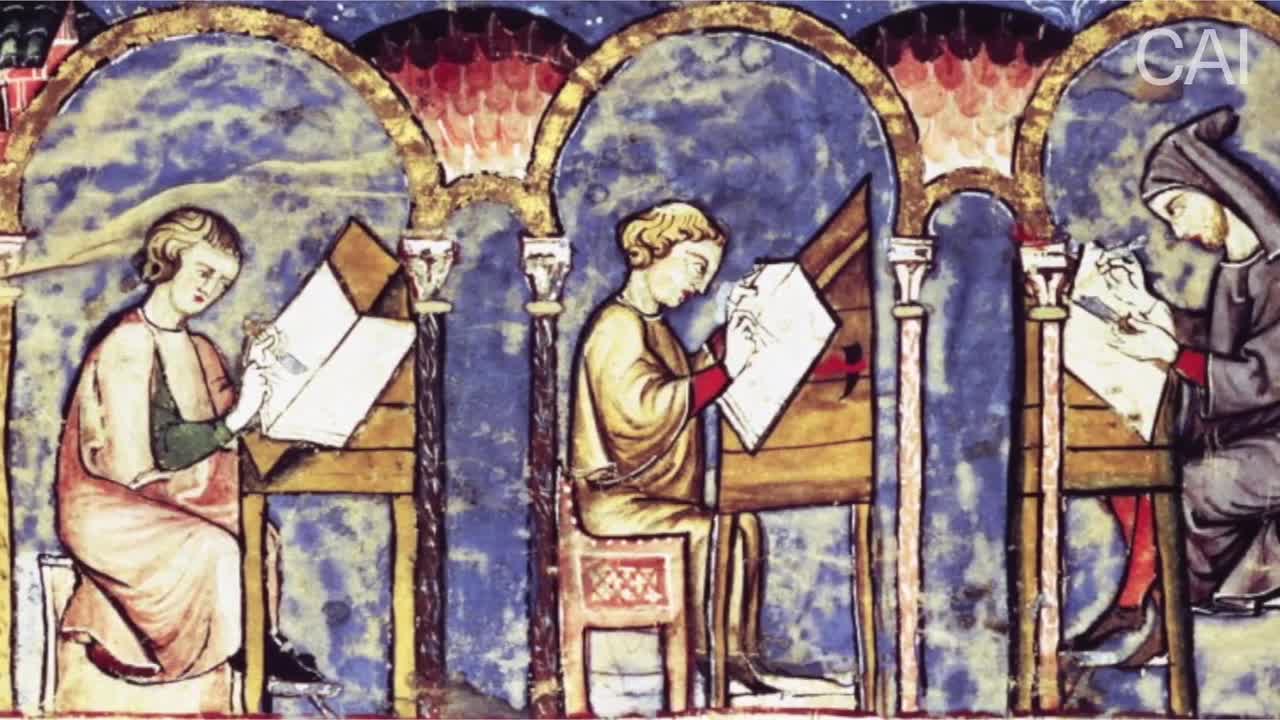
Medieval illuminated manuscripts are the obvious starting point here.
Script ornaments iconography marginalia, rubrication and miniature painting operate as a unified system of meaning.
Western art history and image making in visual art and historical superiority of painting that accompanied them originated in those illuminated manuscripts, a practice that began around 500 in the middle ages and culminated in new heights by 1400 as a rebirth of artistic freedom and image-making.
As painting developed, text remains present in the form of inscriptions that are part of the image.
A canonical example is Jan van Eyck's Arnolfini portrait of 1434, where the inscription Johannes de Eyck voet hyk, which means Jan van Eyck was here, does more than sign the image.
It stages the painter as a conscious agent and witness, foregrounding artistic presence rather than anonymous craftsmanship, and this through language.
This intertwining of language and visual production deepens further with the rise of printmaking woodcuts, engravings and etchings, where text is structurally embedded into how images circulate.
The avant-gardes of the early 20th century push text further to the center through collage and montage.
In Cubism with Pablo Picasso and Georges Braque, where printed fragments, labels and newspaper typography enter the pictorial plane as real material and language becomes a literal piece of the image.
Also part of the 20th century avant-garde and the path towards abstraction was constructivism.
Here, artists such as Alexander Rodchenko and Illicitsky treat graphic language as part of a new social and industrial aesthetic.
With Dadaism we encounter one of the earliest and closest instances of text used in a manner that anticipates conceptual art, although it remained embedded in a very different cultural framework.
Dada poems such as Hugo Ball's Caravana of 1916, typographic experiments by Tristan Tzara or collages by Hannah Huch, where text is a cut-and-paste tool of rupture, satire and media critique.
In the first half of the 20th century.
Text also appears within Surrealism, most decisively in the work of René Magritte, who emerges as a crucial modern precedent for text-based art as we know it today, using words to destabilize the viewer's certainty about representation itself and to force a confrontation between naming and seeing, between the object and its linguistic label.
His most famous example, The Treachery of Images of 1929, bearing the inscription Ceci n'est pas une pipe , makes this logic completely explicit.
The painted pipe is not a real pipe and cannot be smoked, revealing the gap between language, image and reality.
In this sense, Magritte can be understood as a direct predecessor to conceptual art, similar as the Dadaists, establishing the foundational insight that text is not merely a communicative tool but a structural element in the production of meaning itself.
The historical era of conceptual art, primarily spanning the 1960s and 1970s, is defined by a shift in artistic quality from the physical object to the material concept.
Artists began to produce works that functioned primarily as information systems, often presented through pictures of text or text-based statements.
As a result, text-based art booms.
Joseph Kossuth's One and Three Chairs forms a direct conceptual bridge to the investigations initiated by René Magritte.
The installation presents three elements a physical chair, a photograph of that chair and a dictionary definition of the word chair in text, thereby separating the object, its visual representation and its linguistic description into distinct yet interdependent components.
Where Magritte demonstrated that an image is not the object it depicts, Cossuth exposes the semiotic system of it.
And to do this, text is the conceptual artist's natural ally.
Vito Acconci, for example, frequently used text to provide context for his performances.
Art and Language, a British artistic collaboration produced text-only works.
More iconic examples can be found with John Baldessari's I Will Not Make Any More Boring Art from 1971, in which the sentence is handwritten repeatedly as both a conceptual gesture and critical and slightly ironic manifesto
Other iconic text-based practices include, for instance, the work of Marcel Brotars, who repeatedly used his MB signature to satirically mock the role of the artist's signature in determining the value of the artwork.
And the list goes on.
Bruce Nauman, Robert Barry, Douglas Huebler, Dan Graham, Jan Dibets, Hanne Darboven, Lawrence Weiner, etc.
With these iconic conceptual artists implementing text primarily through wall statements, works on paper, found objects or photographic and video documentation supported by language.
It often appeared as if painting had been kicked out of the front door.
Yet a number of conceptual artists used text to allow painting to re-enter the conversation through the back door.
A central example is On Kawara's Today series consisting of meticulously executed Liquitex paintings on canvas that display nothing more than the date on which they were produced, rendered according to the linguistic conventions of the country in which the artist was working at the time.
Over nearly five decades, this concept became the systematic documentation of existence and time itself.
Another crucial artist in this context is Alighiero Boetti, in whose work text becomes central, not only as meaning, but also as visual structure.
In his characteristic grid-based compositions, most notably the embroidered works composed of coloured letters.
Language operates simultaneously as linguistic content and formal element.
A related yet distinct approach can be found in the work of Mel Bochner, with whom text is granted an explicitly aggressive dimension, in works such as Language is Not Transparent of 1970 and also his well-known Blah Blah Blah paintings.
Bochner demonstrates how words can function both as carriers of meaning and as painterly material, where scale repetition, colour and gesture reintroduce the formal concerns of painting into conceptual practice through language.
Whereas conceptual art established language primarily as an idea in art, many artists soon began to explore language again from a visual and painterly perspective.
Within pop art, Roy Lichtenstein elevated comic strip speech bubbles into monumental painting, merging high art and popular culture, while Andy Warhol embraced commercial typography and brand imagery, incorporating the language of advertising into painting itself.
Robert Indiana transformed single words into iconic sculptural and painterly forms.
And Ed Ruscha explored the poetic resonance of isolated phrases and words rendered in controlled typographic compositions, demonstrating how words can operate simultaneously as a linguistic message and as a pictorial subject.
More recently, within this trajectory of combining popular language with painting, Harland Miller transforms the graphic design of mid-20th century Penguin book covers into large-scale typographic paintings.
As a result, calligraphic and typographic exploration, language as form moved to the center of text-based art.
Kay Rosen, for instance, examines grammar, spacing and capitalization as visual systems revealing how linguistic structure becomes composition, while Christopher Woolf's stenciled black and white letter paintings balance readability with abstraction.
Today, a similar approach in the work of Adam Pendleton can be found.
Using stenciled letters, fragmented words and layered black and white compositions, Pendleton treats language less as direct message and more as visual structure, where the typography becomes the rhythm, the density and the painterly form, while remaining subtly tied to historical but also political references.
By doing so, formal aspects of text also developed an expressive dimension in final decades of the 20th century.
Cy Twombly integrated scribbled inscriptions into painterly surfaces where writing functions as drawing.
In Neo-Expressionism, Jean-Michel Basquiat's crossed-out words, lists and symbolic phrases carry intense visual energy, while Anselm Kiefer incorporates writing references to mythology, literature and history into his monumental paintings.
A particularly compelling example is Philip van den Berg, whose text paintings such as Untitled, Kill Them All and Dance or Let's Drink the Sea and Dance, fuse language with emotional intensity, an expressiveness that, especially in works produced shortly before his death, gives the textual elements a profoundly charged psychological dimension.
A comparable intensity appears in the work of Jonathan Meese, whose large-scale paintings incorporate aggressive handwritten slogans, repeated names and ideological phrases into chaotic painterly surfaces, extending gesture and performance while reinforcing painting as a theatrical arena of thought, identity and power instead of a calculated one.
In postmodern art, text has become an essential tool for critique since the 1970s, for instance for activism particularly, for instance also within feminist practices.
The Guerrilla Girls employed bold typographic posters and billboard campaigns to expose gender inequality, transforming language into a direct instrument of institutional critique.
Barbara Kruger combined declarative slogans with appropriated imagery, using the visual authority of advertising language to interrogate power consumerism, authorship and representation.
Post-conceptual artists further expanded the linguistic strategies of conceptual art.
Sophie Kall constructs, for instance, investigative works combining autobiographical text and photographic documentation, while Tracey Emin employs handwritten neon statements that transform personal confession into visual form, which one can also see in her more recent paintings.
Jenny Holzer, on the other hand, inserts language into architectural and public spaces through LED installations and projections, transforming political statements into truly immersive environments.
Roni Horn, Glenn Ligon and many more post-conceptual artists continue to approach text through philosophical reflection, but also identity-based inquiry or participatory frameworks demonstrating the ongoing adaptability of language within contemporary art.
A younger generation continues to expand text-based practices across global cultural contexts.
Jeffrey Gibson, for instance, integrates typographic phrases into rhythmically patterned compositions addressing indigenous identity and resilience.
Shilpa Gupta explores borders, surveillance and linguistic control.
And Hank Willis Thomas employs slogans and media-derived language to critique consumer culture and political representation.
And then there are artists such as Friedrich Cunath, who employ text across painting installation textiles drawing performance, sound and digital media, emphasizing language as social discourse, embodied communication and experiential environments.
Across these practices, postmodern text-based art demonstrates that language is no longer merely a conceptual device or visual motif, but a dynamic medium through which artists negotiate identity power, memory and the conditions of contemporary communication.
Furthermore, if you're interested in text-based art, there is a terrific publication by Phaidon I think it was released last year titled Vitamin Text.
So I will link to that publication in the description below as well for more text, more reading, more art.
Thank you so much for tuning in today.
Feel free to watch our video about the power of writing for artists next.
Support us on Patreon and please consider subscribing to stay posted for more contemporary art.
Bye!