
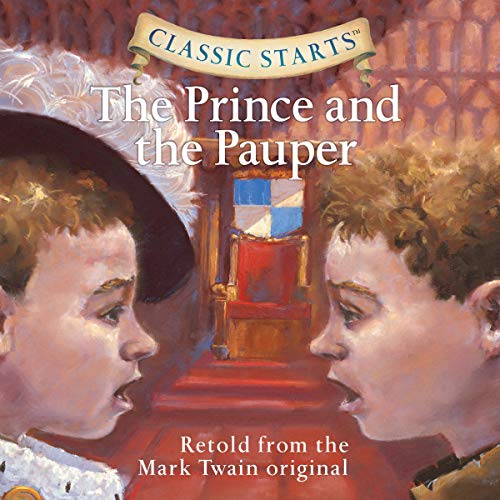
[A Retelling of Mark Twain’s 'The Prince and the Pauper': Exploring Identity and Social Injustice]-[The Prince and the Pauper - Part 01]
📋 Summary
Introduction: A Timeless Tale of Swapped Destinies
In this audio presentation by Oasis Audio, listeners are introduced to a retelling of Mark Twain’s classic masterpiece, The Prince and the Pauper, adapted by Kathleen Olmstead and narrated by Rebecca K. Reynolds. This narrative explores the profound implications of social stratification and the fluidity of identity in 16th-century England. By examining the lives of two boys born on the same day—one into unimaginable wealth and the other into the squalor of Offal Court—the story challenges the rigidity of class structures and the perceived inherent value of individuals based on their upbringing.
The Convergence of Two Worlds
The central premise of the story hinges on a chance encounter between Edward Tudor, the Prince of Wales, and Tom Canty, a pauper. Twain uses this meeting to highlight the stark contrast between their existences. Tom, who lives in "the squalor of Offal Court," harbors dreams of royalty fueled by the tales of his "whipping boy" and his fascination with the "majesty of the throne." Conversely, Edward, insulated by the "gilded cage" of the palace, feels the stifling weight of royal protocol. When they finally meet, the "curiosity of the prince" and the "awe of the pauper" lead to an impulsive decision to trade clothes, setting into motion a series of events that dismantle the foundations of their respective realities.
The Burden of the Crown vs. The Weight of Poverty
As the boys assume each other's identities, the narrative delves into the harsh realities of their new lives. Edward, suddenly thrust into the streets of London, experiences the "brutality of the common folk" and the "indifference of the law." He discovers that his royal decree holds no weight when he is dressed in rags, noting that he is treated as a "madman" or a "beggar" rather than the future King of England.
Meanwhile, Tom Canty finds himself overwhelmed by the "intricate rituals of the court." He struggles to maintain the facade of a prince, constantly fearful of being exposed as an "impostor." This section of the story serves as a critique of the superficiality of social status. Twain illustrates that the "trappings of power"—the robes, the servants, and the titles—do not inherently make one a leader, just as poverty does not strip one of their "innate nobility."
Justice and the Human Condition
One of the most compelling aspects of this retelling is the transformation of the characters' perspectives. Edward’s journey through the lower classes acts as an "educational pilgrimage." By witnessing the "harsh sentencing" and the "injustice of the penal system" firsthand, he gains a level of empathy that a prince raised in isolation could never achieve. He learns that the law is often a tool used against those who lack the "means to defend themselves."
Tom, too, undergoes a significant internal shift. As he learns the responsibilities of the crown, he begins to exercise "mercy and wisdom" in his judgments, proving that his character is not defined by his origins in the slums. The narrative suggests that true leadership is rooted in the "understanding of the human condition," regardless of whether one was born in a palace or a hovel.
Conclusion: The Restoration of Order and Newfound Wisdom
As the story moves toward its climax, the inevitable return to their rightful places does not undo the growth the boys have experienced. The "restoration of the monarchy" is not merely a return to the status quo; it is a transformation of the throne itself. Edward’s reign, shaped by his "hard-won empathy," promises to be one that acknowledges the "suffering of the subjects."
Ultimately, The Prince and the Pauper remains a poignant meditation on the randomness of birth and the necessity of justice. By allowing these two boys to inhabit each other’s lives, Twain—and this retelling—forces the reader to look past the "surface of social hierarchy" and recognize the shared humanity that exists beneath both the royal velvet and the pauper’s rags. The story concludes with the realization that the "wisdom of the heart" is the only true measure of a person’s worth, transcending the rigid boundaries of class and time.

Deep Learning with ListenLeap


