This week on.
Consider This, the bigger story behind President Trump's trip to the World Economic Forum in Davos, how he's rewriting the rules of the economy and how the rest of the world is coming to terms with a global order not led by the United States.
Listen every afternoon to Consider This on the NPR app or wherever you get your podcasts.
You're listening to Shortwave from NPR.
Hey Shore Wavers, Regina Barber here.
And Emily Kwong.
With our bi-weekly science news roundup featuring the hosts of All Things Considered.
And today we have the glamorous, the brilliant Elsa Chang.
Aw, thank you guys.
Hi Elsa.
So glad to be here.
Okay, so I heard that we are talking about penguins adapting to climate change in the Antarctic today.
Yes.
And we're going to get into a debate about ice skating that may now have an answer.
Huh.
And how dirty diapers train parents in the art of disgust.
Oh, interesting.
I can't wait.
All of that on this episode of Shortwave, the science podcast from NPR, and many more delicious and lean protein options.
For wellness when you need it.
Shop Smart Meal Shortcuts to stay motivated, like Ready to Eat Salad Kits.
This message comes from Charles Schwab.
When it comes to managing your wealth.
Schwab gives you more choices, like full-service wealth management and advice when you need it.
You can also invest on your own and trade on Thinkorswim.
Visit Schwab.com to learn more.
NPR's podcast Trump's Terms is your source for same-day updates on big news about the Trump administration.
Short, focused episodes, one topic at a time, about five minutes or so.
We carry out reporting from across all of NPR's coverage, so you are always getting the biggest, most urgent stories.
Listen to Trump's Terms on the NPR app or wherever you get your podcasts.
OK, kick us off with the Antarctic penguins.
What's going on with these guys?
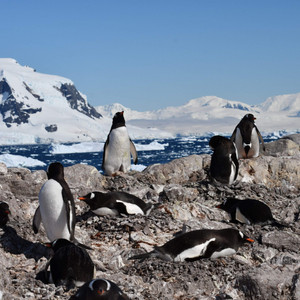
So a new study in the Journal of Animal Ecology found that they're breeding earlier than ever in the Antarctic spring.
Adelie and chinstrap penguins are breeding an average of 10 days earlier.
And Gentoo penguins almost two weeks earlier.
Over the decade, the researchers observed them.
And while two weeks may not seem like a lot of time, researchers say it's actually a radical shift in the penguins' breeding season.
Wait, so what's causing this shift?
So penguins time their breeding period to environmental conditions like temperature outside or whether there's ice on the ground or what food is available.
And with climate change, the Antarctic Peninsula is one of the fastest warming areas of the world.
And that could be a driver.
Interesting.
So how did they collect all of this data?
Like 10 years feels like a very long time to be in Antarctica.
Yeah.
So one of the study's authors, Tom Hart, says they set up 77 cameras across 37 penguin colonies and each camera took photos every hour for a decade.
Surveillance system.
Yes, it was very clever methodology.
We spoke to another penguin researcher who wasn't involved in the paper, Bill Fraser, and he said this camera method is a great way to get long-term data in Antarctica, because a lot of work in this region is restricted to human observations.
Huh.
Okay, so then what does all of this mean for the future of Antarctic penguins, you think?
Well, Tom says that's something they're trying to figure out for future work.
Some penguins might thrive.
For example, the Gentoo penguins are suited for warmer climates and eat a wider variety of fish.
So it seems that Gentoo's are doing better than the other species which could struggle with warmer temperatures.
OK, going from Antarctic penguins to the Winter Olympics, which are just a few weeks away.
Yes.
Yeah.
And I think like this would be a great time then to talk about ice science.
Tell us, Emily, what is new about ice?
Well, since Victorian times, there's been this idea that ice has a thin layer of water on top which makes it slippery.
And physicists have been arguing about it ever since.
Is there a thin film of water even at temps below zero degrees Celsius?
And like, how thick is this layer of water?
And there might be an answer now, published in the Journal of Chemical Physics this week.
Luis González-McDowell, a chemist at Complutense University of Madrid, looked at research all the way back to the 1930s to address this debate.
He also ran computer simulations to see how ice freezes or melts, really looking at what happens to that surface.
And what did he find?
Like, is that thin film of water there?
Drum roll.
There is a very, very thin layer of water on the ice, even though the ice itself is frozen.
And this is true down to negative 10 degrees Celsius.
That layer of water is about a nanometer thick.
And to put that in perspective, a sheet of paper is 100,000 times thicker than that layer of water.
Wow.
Here's Luis.
The surface of ice, which is solid, is always lubricated.
You have always...
Before you start sliding, already a lubrication layer.
And this is interesting because some past theories thought that maybe the pressure from like, let's say, an ice skate may be the thing creating that layer of water on the ice.
And he says it's always there, down to negative 10 degrees Celsius.
Okay.
So then, to apply this to the Winter Olympics, say what does this mean for winter sports like ice skating or hockey?
Yeah, well, ice skates, they put pressure on the ice.
And when that happens, the water layer actually gets thicker, because the friction of the skate blades causes more melting.
Interesting.
And Luis's computer models also took into account humidity and found that humidity levels can also affect the formation and thickness of that water layer.
Looking ahead to the Winter Olympics in Italy, there's already been some concern about the ice rinks and whether the ice is smooth enough to skate on.
And, according to Luis's work, if the humidity isn't quite right, that could also affect the slipperiness.
Okay.
Going from the pristineness of ice surfaces to dirty diapers.
What a pivot.
Yeah.
I am so glad to be child free.
What do we got here on this front?
Dirty diapers.
Talk to me.
This is inspired by the psychology of disgust.
So disgust is really important to our survival as humans, because it helps us avoid all kinds of substances that would otherwise make us like sick.
Remember, disgust was one of the five basic emotions in that movie Inside Out.
Yeah.
Caution, there is a dangerous smell, people.
I just saved our lives.
Yeah, you're welcome.
I love disgust.
She's an icon.
However, there are some kinds of disgusting things that people can get used to, like the contents of their kids' diapers.
No.
Scientists call this habituation.
When you're repeatedly exposed to something, you're less sensitive to it.
Especially if you're a parent, which I am, and scientists at the University of Bristol and Whitman College wanted to know how long do parents hold on to their tolerance for these gross things?
OK, I can't help but feel a parallel to owning a dog, because the amount of times I have gotten stuff on my hands like I just don't even care anymore, you know.
So I am curious.
Do it for love.
Yeah, exactly.
But if I were a human parent I mean a parent of a human like, even after my kids have grown up would I retain the superpower, this resistance to disgust?
Yeah.
So to study that very question, the research team recruited 99 parents and 50 non-parents.
And they showed them two photos at once on a computer screen.
On one side, a photo of something neutral, like a stack of towels or a clean sink.
And on the other side, photos of gross things like vomit on a sidewalk and, of course, dirty diapers.
They were all produced by my children, by the way.
So big shout out to my kids.
This is the study's lead author, Edwin Dahlmeier, who published these results in the Scandinavian Journal of Psychology.
By tracking the volunteers' attention as they looked at these photos, his team found out that the non-parents tend to avoid the disgusting photos, whereas the parents showed little to no avoidance.
They would look at those pictures of soiled diapers with little aversion, including parents who hadn't changed a dirty diaper in decades which is similar to me.
I am not bothered.
Oh, wow.
So you're like habituated for life once you have a child?
Maybe.
This superpower does seem to last a while, according to this work.
I mean, if I had to pick my superpower, this is probably not the one I would pick.
But big picture, why does this work matter?
What would you say?
Yeah, I mean, discuss habituation is actually a good thing in all kinds of jobs.
Think about nurses or surgeons or custodians.
Edwin would love to see his work be used in those professions.
Even if we can reassure people, hey, it feels a bit gross now, but you'll get used to it over time.
And hopefully that ultimately either helps or can lead to things that do help.
This is fascinating.
I wonder if it applies to people who are annoying.
You just get used to them over time and they stop bothering you.
I don't know.
But you, Elsa, are always welcome and not annoying us.
So thank you so much for coming on the show.
You're so welcome.
You can hear Elsa on Consider This, NPR's afternoon podcast about what the news means for you.
And for more science stories just like this one follow Shortwave on whatever app you are listening to.
I'm Emily Kwong.
And I'm Regina Barber.
Thank you for listening to Shortwave, the science podcast from NPR.
This is Tanya Mosley, co-host of Fresh Air.
You'll see your favorite actors, directors, and comedians on late-night TV shows or YouTube.
But what you get with Fresh Air is a deep dive.
Spend some quality time with people like Billie Eilish Questlove, Ariana Grande, Stephen Colbert and so many more.
We ask questions you won't hear asked anywhere else.
Listen to the Fresh Air podcast from NPR and WHYY.