Hey, it's Mary Childs.
This first week of October is historic.
It is the first time in over half a century that NPR and its member stations are operating without any federal support.
It may feel uncertain, but here's what is certain.
Public media endures.
Independent, resilient, people-powered.
Whatever the moment, you will still find us here telling stories that matter.
This is Planet Money from NPR.
We are making a board game.
Tabletop Games is actually the largest category on Kickstarter.
Get out of here.
Yeah, it is.
If you make games, there has never been more competition.
This is Orbeo.
This is Masterpiece.
This is Cargo.
We need help, a partner.
Welcome to the Exploding Kittens office.
Our basic question here is can we make a board game and where do we start?
I think what the next step here is we do some homework and you do some homework.
Your homework is give us three themes that are interesting to you.
I'm curious to see what you come back with.
So we talked roughly, what, two weeks ago, three weeks ago?
Yeah, somewhere in there.
That is the voice of Ilan Lee, game designer and co-founder of the Exploding Kittens game company.
Because we are making a board game, we are partnering with Exploding Kittens and we've got big dreams.
To make the kind of game that anyone would want to play.
To make a game that has big economic ideas baked into it.
And Exploding Kittens had given us an assignment.
We bring them some economic concepts and themes.
They see if any of that might have promise for a real game.
Okay.
We took the assignment very seriously.
We had a full staff meeting where we went deep.
We went nerdy.
And I believe you had told us to come back with about three ideas.
We've got 17.
Okay.
Oh, this is going to be a fun project.
Okay.
Now were all of these 17 ideas like obviously going to be monopoly killers.
You know, displace America's most popular games.
Well, who can say?
And so we began to pitch.
Think about this.
There are elves.
They live forever, but they have to plan for retirement.
What do they do?
What does that even mean?
All right.
Next idea.
Apprentice wizards running a bank.
So they have the power to create money with their apprentices, so it always backfires.
They mess it up.
Okay.
You don't have to respond to everyone.
You can let them settle in.
I'm letting that one settle.
Okay.
They weren't all home runs, but some of her ideas did seem to be getting a decent response.
Like when we pitched a game inspired by compound interest the idea that a small investment can snowball into something massive with enough time.
You ever play Risk?
Yes.
You just described the mechanic by which armies are built in Risk. which is great.
I mean, really, really nice shoulders to stand on there.
So I would call that half of an idea.
We also pitched a game called Moral Hazard, where you have to decide which failing banks to bail out.
But you may be hurting your future self by teaching those banks that you're going to clean up their mistakes.
What you just said, your future self.
Like there is an interesting game concept.
I've never seen before where you have two players you and your future self.
We pitched a game called Keeping Up with the Joneses, where you buy things like a boat to make everyone around you jealous.
Just to learn, oh no, having this boat card is costing me so much and making me miserable.
Here's why I hate this idea.
Let me start there.
I think what you have just described is a game with no replay value.
Once you understand the properties associated with each card, with each item, I don't think you're going to be able to find that same delight when you go through that game again.
We pitched Game Idea after Game Idea.
It's the same game and you don't know if you're playing within the capitalist system or the socialist system.
Oh, that's a fun twist.
After Game Idea.
I have a question, though, about the inflation game.
Like, what's the goal here?
Probably that, uh, I don't know.
We haven't thought that one through.
Yeah.
After Game Idea.
Procyclicality.
We don't have to call the game that.
Yeah, we're not going to call the game that.
And what became very clear was that we knew very little about what might work for a new game.
Do you think we brought something to the table here today that is useful?
Absolutely, yes.
I mean, look, there's two ways that games are born.
One is you come up with a gameplay mechanic you absolutely love.
And then you spend months and months and months trying to find the right theme that will sell properly.
And the other way is you start off with a really strong theme, something that you know there's already an audience for, and then you try to find the right game planning mechanic to match with it.
It feels like we've done neither here.
You've planted the seeds for a path for the latter.
Yes.
And in fact, one of the 17 economic idea seeds that we planted that day would eventually become the Planet Money game.
Hello and welcome to Planet Money.
I'm Kenny Malone.
And I'm Erica Barris.
Planet Money is making a game.
We have a partner.
We've got some econ ideas.
Now we need to figure out how to turn those ideas into a game.
Today on the show, episode two in our game series, we get to go behind the scenes to see what it takes to make a game, ideally one that is fun and also chock full of economics but doesn't feel like econ homework, which is perhaps a little harder than we appreciated.
By the end of this episode, you listeners will be able to play an early prototype of the Planet Money game.
In fact, we need you to play it and help us perfect it.
But first, the story of that game.
Support for this podcast and the following message come from Ameriprise Financial.
Chief Market Strategist, Anthony Saglimbeni, shares the importance of a goal-based investment strategy.
You have to know where you're going, right?
What's the goal?
What's the destination?
By identifying those goals, you can construct a well-diversified portfolio that hopefully helps meet those goals.
For more information and important disclosures, visit Ameriprise.com slash advice.
Ameriprise Financial cannot guarantee future financial results.
Securities offered by Ameriprise Financial Services, LLC, member FINRA, and SIPC.
We noticed that some of the most popular board games out there are about economics.
Think Monopoly, Settlers of Catan.
So we thought we should make a game.
And along the way, learn about the economics of making a game.
We want our Planet Money game to be nerdy, to teach people economics.
And we want the game to be popular, beloved the world over, selling hundreds of thousands of copies.
Millions even.
Millions.
Yeah.
Yeah.
And to sell all those games, the key is getting into stores like Walmart or Target.
This is partly why we've partnered with Exploding Kittens.
They know how to make games, the kinds of games that sometimes get picked up by big box stores.
But, you know, let us not get ahead of ourselves.
Step one here is what even is the game going to be?
Time for another meeting with exploding kittens.
So last time we talked to you you were the very lucky recipient of 17 incredible economic concepts that we gave to you.
Yeah.
That, again, is Exploding Kittens co-founder Alon Lee.
But there are a bunch of Exploding Kittens folks on this call.
It's been a few weeks.
And we hadn't talked at all since our prolific pitch meeting.
So we are curious just what happened immediately afterwards.
What was the conversation that happened right after that?
Oh, sure.
So even when you pitched them to us, we were taking notes and we wrote down like oh, maybe explore this, maybe explore that.
And so that... pretty quickly got us to like, all right, a lot of these are just not going to work.
Like they're just, this feels like school.
It's not going to be fun.
What do we do?
Yeah.
However, Ilan and one of Exploding Kittens' game designers, Ian Clayman, tell us that one of our ideas in particular had sparked something special.
So what was the idea that kind of fit?
Yeah.
So the one that we really got excited about was the Market for Lemons idea.
Market for Lemons.
Classic.
The Market for Lemons is an economics paper from the 1970s by Nobel Prize winning economist George Akerlof.
He's also famous because he's the husband of the former Fed head and secretary of the Treasury, Janet Yellen.
In a nutshell, the Market for Lemons paper is about the market for used cars and the problems created from what's known as asymmetric information.
In this case, there is unequal information between sellers and buyers of used cars.
Right.
A used car seller knows everything that is wrong with their used car, but the buyers do not.
And that is a problem.
But the reason it's a famous paper is because it shows how this ultimately becomes a problem for both the buyers and the sellers in the end.
What happens is you'll have some dishonest sellers who hide what's wrong with their used cars.
Eventually, buyers will assume all sellers are dishonest and all used cars are crappy cars.
And so the buyers will only offer crappy car prices, which then in turn means that the honest sellers, who actually do have good cars, won't bother trying to sell their cars at all.
And so we end up with this like spiral, where nothing's left in the market but lemons, just bad crappy, used cars.
The Market for Lemons is an example of how asymmetric information can destroy a market.
It can literally lead to market failure.
And it's not just a problem for used cars.
Asymmetric information can be an issue in the health insurance market or when a company is trying to hire new employees.
And Exploding Kittens liked the idea.
They liked the Market for Lemons.
Is it just because the branding is so good?
Like, it is one of the best names of an actual economics paper ever.
The name was compelling, but also...
The play pattern of two people trying to make a deal where one person has more information than the other, is a pretty well-established gameplay pattern.
Which could be good or could be, you know, rote at this point, I guess.
It could go either way.
Well, understood, but I would say like not overused.
Exploding Kittens had been playing around with some ideas inspired by Market for Lemons.
And co-founder Alon Lee was very excited because they had discovered what they thought could be the core part of what could become the Planet Money game.
In fact, Ilan says, they were recording the exact moment that this discovery happened.
No, it was really like just that is a very rare moment to catch on tape.
And I kept like staring over at the camera thinking, oh, God, please still be recording.
Please, please, please, please.
Yeah.
We really accidentally captured lightning in a bottle.
100 percent.
Yes.
Yeah.
Go go look at the tapes.
And so we present to you those tapes.
All right.
Go for it.
Okay, so we started off by talking about.
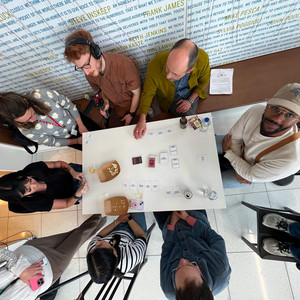
We see exploding kittens in the dining room of a house they'd rented for a retreat.
The dining table is covered in game designer accoutrement.
Yeah, blank playing cards and Sharpie markers.
Existing games that can be used for parts.
There are four people around this table, including Ilan, and they're playing around with some idea.
That's like I don't know what if there's one car seller and everyone else is a car seller buyer.
Except there's no car per se.
There's just four homemade cards that tell the seller whether they have a good car or a lemon.
I mean I did like the asymmetric information there of just like you and I were like oh, it's a good car.
And you guys were like, oh, it's a bad car.
But it's just not working, they seem to agree.
Interesting.
Not fun yet, but interesting.
They take a break to maybe let some new ideas percolate.
Now, what's important to know about these recordings is that Exploding Kittens is not testing a game at all.
Their cards don't have fancy art.
They're not playing full rounds.
What they are testing are different game mechanics, the most basic atomic level building block of a game.
It's the loop that players will do over and over.
And if the game mechanic is not sparking, there is no game.
The herd of exploding kittens reconvene and this, we are told, is where the magical Planet Money game moment is caught on tape.
We see co-founder Ilan Lee is now pacing around the room, sort of conducting the team.
Someone runs and grabs a deck of playing cards.
Yeah, red card's bad, black card's good, like whatever.
They're making this up as they go, and what they come up with is the following.
So okay, there's still a seller and that person is going to start by drawing two cards and secretly looking at them.
And they're going to see that those two cards are either both good or both bad, or one is good and one is bad.
Those are the only three options.
Then the seller proposes a deal to another player, the buyer.
Like, I want to keep this card and I want you to take this other card.
Now, the buyer does not get to see those cards.
They simply have to decide, do they accept this deal or do they reverse it?
Like, no, no, no, you take this card and I want your card.
And to be clear, the seller doesn't have to offer one card.
They could offer both cards or no cards.
It's a little convoluted to explain.
But it really is a surprisingly basic mechanic.
Like deal or no deal, is the seller bluffing or not?
Yeah, this isn't a fleshed out thing yet.
This is trying to see if there's enough social manipulation here to be interesting.
Yeah.
And here is the moment Exploding Kittens was so excited to show us.
It happens literally the first time they try this new game mechanic.
Okay, so the first seller is in.
He reaches for the playing cards, tries to remember the rules.
He draws two cards.
He looks at them, looks across the table at his buyer, looks back at his cards, looks at the buyer back to the cards.
He sort of tilts his head and looks puzzled, almost as if to say, oh wait, what is the strategy here?
Alon is watching him, and he is delighted.
Ian chooses to split up the two cards.
He puts one card in front of himself, one in front of his buyer.
Now it's the buyer's decision.
Should he reverse the deal?
No, he keeps it.
They both flip over their cards.
Yeah, some not radio-friendly words about how this all played out.
Because it turns out both cards were bad cards.
And Ilan is watching all of this fascinated, because it has revealed that this mechanic is maybe more strategically complex than he thought.
Ian had essentially chosen to eat one bad card in order to avoid the risk of ending up with two bad cards.
You split those.
Because you didn't want to take all the rest.
They run another round to test the mechanic again.
We're switching cards.
And again.
And again.
Keep it.
Like, there's no way three times in a row.
I mean, it is so basic.
So basic, but also so clear that it has brought the room to life.
Yeah, let's stop and have a little conversation.
Yeah.
All right.
So, something is happening here, which I like.
Yep.
But it's like a 6 out of 10 for me.
And so that Lon was explaining to us in our Zoom meeting is what a game design breakthrough looks like for Exploding Kittens.
It started to suddenly work, and work really well.
I noticed that you could sort of graph the intellectual curiosity like I guess there's something interesting here.
And then suddenly you're yelling more and saying the F word more to each other.
Is that?
I've never tried to plot that out on a graph, but I will bet there is a really nice correlation there you've just discovered.
They were so excited.
And we were excited that they were excited, too.
But how to put this, we did not appreciate the simple elegance of the game mechanic.
That's a nice way to put it.
No, we were like, that's all?
Like a bluffing game?
And in our defense, here's what we were thinking at the time.
We did know this was the earliest stage of development, but whatever, this was needed to be the seed for the Planet Money game.
Yeah, shouldn't it literally teach people the big economic ideas behind the market for lemons?
Like show players how asymmetric information can destroy a market.
And what Exploding Kittens had showed us was like fun looking, but it did just look like deal or no deal, lying or not lying.
Like that was the mechanic.
And so we gently tried to offer this feedback.
And then Ilan gently managed our existential crisis and reassured us that he has made a gazillion games.
We want a game that an economist will pick up and say, oh, this is the greatest game.
A high school class can play it.
And it's like almost like a substitute for reading the paper Market for Lemons.
But also like a 10-year-old can play it.
That is the version we want.
I love the challenge.
I think we are certainly not there yet.
I mean, is it going to be smart?
Can we make it smart enough so that we can say, here's the economics concept.
It's hidden there, but it's demonstrating this thing.
I do.
Yeah.
Well, here's the beauty of this.
We got a really good game.
It has a rough outline of this economic principle.
And now we need to figure out how you can walk away from the game with that delightful sense of nerdiness where you think like oh, you fooled me into learning something, but I didn't even realize it at the time.
And now that I do, that was really cool.
Like, if we can get there with this, we'll be in a good place.
And it's better to start with a really fun game and try to get there, rather than vice versa, which is a much harder task.
Basically, Elan and the Exploding Kittens crew are like, trust us.
We have an economic idea from you and we have the beginning of a good game mechanic.
And in this industry, a good game mechanic, it's rare.
It's like discovering a new way to power a game.
It is incredibly hard to come up with.
And we have that.
The rest will fall into place.
And thus began a months-long process of so much prototyping.
All right, friends, who wants to learn how to play the Planet Money board game, draft one?
Exploding Kittens would send a prototype, and in each draft they're sending over more than just a game mechanic.
They're sending handmade cards, usually just repurposed Exploding Kittens cards.
And they're sending instructions.
Your goal is to make deals with other players, to collect the good cards and avoid the bad cards.
The first player with five good cards wins.
And for each of these drafts, Elon seems to also be making like a million tweaks, running tests and apparently keeping audio journals this whole time.
Okay, we just ran another test of the Planet Money game, and it was good, but not great.
Okay, so the test last night was interesting.
The mechanic is still pretty solid.
Okay, just had a great test.
I need to make some changes.
Listening to Elon talk to I guess Elon in these recordings did perhaps begin to give us more of an appreciation for the art of what he's doing.
Yeah, clearly turning a game mechanic into something that is a game comes with all these questions.
Like, what is the optimal number of good cards versus bad cards?
The deck was completely unbalanced.
Would it be more fun if there were superpower cards that let you do special things?
Didn't really work.
Some were overpowered, some were underpowered.
Okay, maybe tweak the superpowers.
Make a whole new card.
I'm going to make six of those now that I think about it.
Wait, uh-oh.
Are there still enough bad cards in the deck to cause chaos, though?
Oh, shoot.
I think only one player can get knocked out of the game.
Oh, wait.
Yeah, it is never ending.
There was the version where everyone was getting bored in between turns, so Elan tried giving everyone 16 cards in their hand, so they did have something to look at.
So they're not bored.
That's great.
But there's just massive decision paralysis.
Then there was the version where the game took no time at all to finish.
Like average gameplay was like four minutes and ideally it would be closer to 20.
So meanwhile, whenever we would see one of these prototypes of the games, we were still a little worried, to be honest.
Superpower cards, 16 card hands, fine.
But like when?
Is this going to be a game where players live out the experience of being inside the market for lemons?
We would go back to exploding kittens with this, like throwing spaghetti at the wall approach.
Like, what if we introduced monopoly money?
What if people are constantly bidding or trading?
What if the rulebook is 15 pages long?
And Exploding Kittens was very patient with our flying spaghetti feedback.
Sometimes they would make tweaks and sometimes they would have very valuable lessons for us on why our suggestions may not fit into the hyper-competitive, low-margin world of game manufacturing.
So, for example, we asked them Would the game have more heft if it took a little longer to play, like more than 20 minutes?
I would say the sweet spot for us in general is really to try to hit a 20-minute game, maybe 15 to 20 minutes.
But if we can get maximum entertainment satisfaction, that beautiful sense of mastery, start to finish in 20 minutes, we know we have a hit on our hands.
Okay.
Why not go longer?
That's our executive producer, Alex Goldmark.
Why not go longer?
Why is that the special amount?
So you want players to be able to go longer.
You don't want the game to force them to go longer.
The story of Exploding Kittens is exactly this.
We optimize that game to be exactly 20 minutes almost every time you play.
Okay, another interesting business lesson came for us when we suggested that it was sort of hard during one of the prototypes to keep track of who was close to winning, who was close to losing.
So how fun would it be if there were colorful plastic coins to keep track of all the points, eh?
The Exploding Kittens team? like the idea.
But Kelly Volpalak, VP of Creative Operations, told us we are aiming for a planet money game made entirely of paper.
So it's not a no on coins, but it's way better if they're not plastic.
So paper is the cheapest.
We love an all paper game because that means if we charge $20, we can make more money.
Cardboard is paper.
Yes, yes.
Okay.
Cardstock, the box, we would even consider that paper.
Okay.
So okay, Exploding Kittens tells us they could add paper or cardstock or cardboard coins, if that's what everyone wanted to do.
But yes, mixing materials like having plastic coins would drive up manufacturing costs.
It might require multiple factories.
And to sell the game in a store like Target or Walmart, we want to keep the price to $20 to $25.
So we have to keep costs down and keep it to paper if we wanna make a profit.
Anything you get from a tree, you can consider that paper.
Okay.
So off go the exploding kittens to make even more changes.
And as we saw prototype after prototype, It did start to dawn on us how terrible our idea had been to try and push our game towards a full-on simulation of a market for lemons.
Because the beautiful lesson in that paper isn't just about the challenges when a seller has more information than a buyer.
It's about how that asymmetry can cause a market to grind to a halt.
So did we really want a game that ground to a halt in order to teach an economics lesson?
I mean honestly kind of.
But we were also beginning to see why that might not have a broadly popular appeal.
So, okay.
But even if the game wasn't going to recreate a Market for Lemons-style collapse, could the game mechanic at least get closer to nailing the feeling of real-world asymmetric information correctly?
Yeah, because remember the game mechanic.
You've got a seller who looks at their cards, offers a deal, and then a buyer who just decides, without any information, whether the deal is good or not.
That's just a game about bluffing, where one person has zero information and the other has all the information.
But when someone is buying a used car, they can see the car.
They get some information.
And that's fun.
It's a more complex, messy version of asymmetric information.
We need something that gets closer to that.
And then Exploding Kittens sent us a new version with this one key change.
All right, here we go.
Planet Money game, take 117.
This is a video of Elon explaining the new game version to his team.
All right, so let's go over what we just changed.
Okay, so hopefully the game in general will go much faster.
And what was this revolutionary change?
Well, Elon explains.
You're still going to have a seller.
They're still going to look at cards.
They're still going to offer a deal.
But this time... I'm going to show you this one.
Oh.
Wait, wait, wait.
What are you doing?
So you keep your cards, but I'm not taking mine?
Yes.
The seller now shows one of the cards in the deal.
Everyone gets to see it.
That's it.
That's the big change.
I know it doesn't sound like much, but suddenly, instead of the game just being about bluffing, the buyer now has some information, just like the economic dynamic that exists in the used car market.
And really, honestly, out of nowhere, it did feel more like an economics game.
We went back to Exploding Kittens one last time.
I think the top line note here is we had a lot of fun playing... the planet money board game.
Should we just say it?
It was great.
I mean, it was a lot of fun.
I love to hear this.
This is a milestone.
I think this is it.
I think we have a game.
I think we've got a game.
I love this.
I love this.
I mean, it was a prototype of a game with handwritten cards and rules that still needed tweaking, but it was clearly a rough draft of a Planet Money game and we liked it.
But the real test is to bring it to the tastemakers, who can get these games into the Targets and Walmarts of the world.
That is after the break.
So you can try it yourself.
Just go to linkedin.com slash NPR pod.
That's linkedin.com slash NPR pod.
Terms and conditions apply.
Only on LinkedIn ads.
This message comes from NPR sponsor, U.S.
Bank.
With U.S.
Bank Business Essentials, you get more than just a bank.
You get a dedicated partner that provides you a powerful combo of checking and card payment processing with quick access to the money you've earned, proving that there is nothing as powerful as the power of us.
Visit usbank.com today to learn more.
Member FDIC.
Copyright 2025 U.S.
Bank.
Once we had a version of the game that we were happy with, we wanted to bring it to one person in particular.
How many games have you played in your life at this point?
Oh my goodness.
Over under a thousand.
Oh, over.
Really?
Yes, definitely over.
This is Jamie Wolanski.
She's a game consultant.
Her job is to get games into big box stores.
She is, in fact, the one who first got Settlers of Catan into Target.
Exploding Kittens often hires her to pitch their games to the big box stores.
Ultimately, she is going to know whether this very rudimentary prototype of ours has a chance to achieve one of our wildest dreams getting the Planet Money game onto real shelves at real retail stores.
I mean, this was a huge moment for us.
Like, she was going to play a prototype of the game and render judgment.
So let's actually do the four of us playing.
So here's the scene.
We're in a hotel lobby with the Exploding Kittens crew and Jamie.
The head of game development, Thor Ritz, he runs through the instructions.
So I'm going to deal everyone five cards.
We're all crowded around a couple of high top tables.
Jamie is in fact sitting just to my left.
Oh, I have one too many.
I have six.
Beautiful artwork on these cards.
That voice is Carly McGinnis, president of Exploding Kittens.
She's being sarcastic here because they are literally just homemade cards.
There are red cards.
They're bad.
And green ones, they're good.
Avoid the red ones, collect enough green ones, and you win.
And of course, the way you collect cards is through our deal-making game mechanic.
The game begins.
Carly, you are going to make an offer to Jamie.
You're going to pick three cards.
You've got five in your hand.
So Carly, the seller, takes three cards from her hand.
She places one of them in front of Jamie, the buyer.
Carly.
The seller is essentially saying I want you Jamie, to take this one card and I want to keep these other two cards.
But don't forget, we now have that key information asymmetry tweak to our mechanic.
All that Carly has to do is reveal one of her cards.
Carly, the seller, chooses to reveal the one card she is offering Jamie, the buyer.
It is a green number two, a good card.
So now, Jamie, you know something about the deal that she just offered you.
It looks pretty good, right?
Sure does.
And now it is all up to Jamie to decide.
Take the deal or reverse it.
Does she take the sure thing, the green two, or does she reverse the deal in hopes that Carly was hiding something even better in the two cards that are still face down in front of Carly the seller?
You don't know anything about this pile?
Yeah.
But this pile, you know, at least has two pretty green.
Yeah, I'll take that pile.
I'll take the green pile.
Okay.
Now you have to show us.
What is it?
I knew it.
I knew it.
Yeah, Carly was hiding a much better card.
I never trust Carly.
Carly dogged you.
I knew it.
Jamie should have risked it and reversed the deal.
So I'm watching this first round.
Jamie seems into it.
So I turn to her and I ask her, do you love the Planet Money game yet?
Not yet.
Okay.
Does it help to know that it is inspired by a Nobel Prize winning paper about the asymmetry of information in the used car market by Janet Yellen's husband?
I don't know anything you just said.
We keep playing the game and Jamie starts dropping these hints that seem like a good sign.
I love a game that has... your strategy changes with every single turn.
Do you feel like that's happening?
Yeah.
At one point between rounds, Jamie tells us what, in general, she looks for in a game that will work on big box shelves.
The hallmark of great-selling games when you know it's a great game is when you can't stop thinking about it at night, when you're going to bed and you're like, God damn it, I really want to play that game again.
This game went on and got more heated.
People became more invested as they got closer to getting enough points to win.
And eventually, all four of us playing could have won.
And I'll be honest, I had been leading and I thought I was going to win.
We're all one chip away from winning.
Yes!
Oh my god, I won, you guys!
That's insane!
I am here to tell you that...
The underdog won.
Jamie won.
In the glow of her victory aftermath, we asked her what she thought.
Be real.
You're making a very excited face.
Okay, here's what I am excited about.
I am constantly on the lookout for a new game mechanic that no one else has ever done, and there is not a game out there that I can equate this to.
So to me...
Gamers are going to be excited about playing a new concept.
And it's also mass friendly enough that mass retailer and casual gamers will pick it up and have a blast playing it.
I mean, we did it.
We've got the Planet Money game.
Okay, well, hold on.
We've got one homemade copy of a game.
And yes, we have been calling it the Planet Money game.
The most critical thing at this point is naming it.
Really?
Yeah, the name, the title, because a good title or a bad title will just absolutely sink a really great game.
Okay, fine.
Title, TBD, workshop, amongst other things to figure out.
And then I would also say the artwork, the aesthetic of what can appeal to the masses, and picking the right theme is going to be critical to making it work.
All right.
Well, this is promising.
Really fun.
So just as long as we don't mess up the name and the pictures.
Theme and name.
The drawings, the naming, that's all stuff we're going to get to in some future episodes.
But our game still has kinks to work out, which is why we have...
A big, big, big announcement.
Sound the taboo buzzer.
Ring the operation bell.
The Planet Money game prototype is available for download starting right this instant.
Because listeners, our beloved intelligent audience, we do need you to help us conduct the largest prototype playtest.
I don't know, maybe ever.
Perhaps.
Now this is our troubleshooting phase, our debugging period.
We have about a month to do this.
So this is your assignment.
Put a game night on the calendar and download the printable prototype of our game.
And I'll see you next time.
At that link, you'll find instructions for how to play the game and how to send us feedback.
Plus, you'll be able to sign up for our big group play along slash.
Ask us anything happening on Saturday, November 1st.
Saturday, November 1st.
I'll be there.
Erica will be there.
Ilan Lee, co-founder of Exploding Kittens, will be there.
We would love to see you.
Also, we should say, Elon truly does not stop tinkering with these games.
And so the version that you will download and make at home is slightly different than the version we've been talking about.
But all of this will be explained at planetmoneygame.com.
This is just the beginning.
Please stay tuned for updates and let the wild world of asymmetric information be your guide.
This episode of Planet Money was produced by James Sneed with help from Emma Peasley.
It was edited by Jess Jang, fact-checked by Sierra Juarez, and engineered by Sina Lefredo.
Alex Goldmark is our executive producer.
I'm Kenny Malone.
I'm Erika Barris.
This is NPR.
Thanks for listening.