Hello, podcast listeners.
The one and only Carly Q here, coming at you with another episode.
This podcast may be a secret right now, but someday, I hope this thing goes viral.
Have it stand the test of time.
Who knows, maybe in 300 years, people will look back on this episode and go, this, ladies and gentlemen of the New York Public Art Gallery is a prominent example of early 21st century art and storytelling.
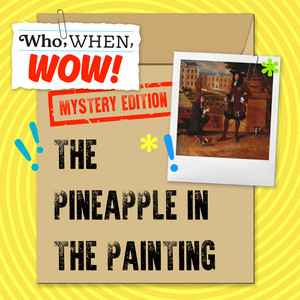
Kind of like the painting at the heart of today's mystery.
Ooh, how's that for a teaser?
I'm Carly Q and this is Who When Wow?
Mystery Edition. Our past is vast and wild.
Many things have brought us to this day.
As history has been compiled, some important details are slipped away.
In our spectacular shared existence, we consider it a business to recognize a few vlogs you may not know.
Who When Wow? Made important inventions.
Who When Wow? Asked all the right questions.
History will never be the same.
It was a hot summer morning, and for once, I was happy to get to the office early.
Air conditioning, yes.
Morning, Carl. Morning, Carl.
Hot one today? You can say that again.
Hot one today? Oh, I didn't literally mean it.
And that's when I noticed it.
You're digging the new artwork, Carly Q?
Lewis put them in yesterday?
Lewis had, unbeknownst to me, redecorated the entire lobby.
Goodness. Morning, Lewis.
Morning, Carl. Oh, you're here too, Carly Q.
You replace all the puppy and donut artwork in the lobby?
Yes, I did, Carly Q.
Our clients are never going to take us seriously.
We have stock photos of puppies and donuts all over our lobby.
Wait, he had clients?
So, I took it upon myself to class up the space a little bit.
With a bunch of boring old paintings.
Oh, please, these are hardly boring, Carly Q.
What we have here is a veritable retrospective of European artwork through the 16th and 17th centuries.
You lost me after. What we have here is...
I think that one's my favorite.
Carl pointed over to a large painting in the corner of the room.
It seemed just as boring as the others to me.
Two frilly old dudes posed outside some old -timey mansion.
But then... Wait a minute, is that...
I noticed something.
A pineapple? Don't be ridiculous, Carly.
Why on earth would anyone in a 17th -century portrait be holding a...
It was definitely a pineapple.
Oh my goodness, that does look like a pineapple, doesn't it?
Louis, why is this dude down on one knee holding a pineapple?
I... don't know. Did we just find a new mystery to solve?
And without a time -sealed file even?
We? Oh, like you have anything better to do during lunch break.
Fine. Meet you at the elevator?
Don't be late. How could I be late?
I worked down there.
I spent the rest of the morning filing away historical events.
Ooh, the chicken first crossed the road in 2032.
But I couldn't get that pineapple out of my head.
Uh, hello everyone!
It's lunch time! Ooh, yes!
Carly, koo -oo, I'm here.
Before I knew it, it was lunch time, and Louis and I were heading to the elevator to get us to the bottom of our pineapple -painting mystery.
Are you sure it was a pineapple?
Maybe it was just a very large tennis ball.
Huh? That makes even less sense.
What are you two arguing about now?
Oh hey, Odie. We're having a debate about fine art.
Fine art? That doesn't sound like you.
Odie, that's a little spicy, but whatever.
There's a whole new collection of paintings up in the lobby.
I noticed. Whatever happened to those photos of dogs with donuts?
Ask him. Storage? We needed to class up the place.
Not that you would know anything about the object.
But don't worry, it's not all bad.
We got a new mystery out of it.
You did? A mystery without a time sealed file?
I know, right? Hey, did you see the painting in the corner?
The one with the two old dudes.
That doesn't merrow without.
Okay, yeah, I hear that.
The one with the pineapple.
That was a pineapple?
It might be a large tennis ball.
We're not sure yet.
It is definitely a pineapple.
What is a pineapple doing in a 17th century painting?
That's what we've been trying to figure out.
I asked each dad to tell me who the two people in the painting are.
Analyzing. Analyzing.
Let me take a look at this.
Analyzing. Still analyzing.
Analyzing. Analyzing.
Analyzing. Works every time.
Oh, thanks for the tip.
If the two persons depicted in the painting title King Charles II is presented with a pineapple...
See, I told you it wasn't a tennis ball.
Are King Charles II of England...
And John Rose, the royal gardener of Dorny House, dated 1675.
We got a date. Now we just need to hop into the time -traveling elevator to get to the bottom of this mystery.
What did he say, Odie?
Okay, I'll allow it.
But only because I'm curious myself.
But remember, no interacting with the past.
And be back before lunchtime.
Very good you've been listening.
Now hold on tight! Say hello to the King!
Is anyone else thinking about pineapple pie?
Bye! And apparently, you're excited too because our San Francisco performance is filling up and our New York City performance is almost sold out.
So, we're adding even more wow with a second show for New York City.
Grownups, get your tickets today at Tinkercast .com slash events.
That's Tinkercast .com slash events.
That's it! We'll see you there.
Oh, never gets easier, doesn't it?
Nope, but there are certainly worse places to be dropped off.
Get a load of this place.
Oh, it is a fabulous garden.
Oi, what are you doing out here?
This is a restricted area.
Sorry. We were looking for...
Mr... John? Rose. Rose!
John Rose! Ah, you must be the new groundskeepers they sent for.
Ah, yes, that's us.
Two humble groundskeepers.
That is who we are.
Well, Mr. Rose is usually holed up in his greenhouse.
Hm, a green house? A greenhouse?
You know, like an indoor garden in a glass room?
Follow me and don't lag behind.
Right, right. So, what's this John Rose like?
Hard to say, he's a very secretive man.
Barely seen him these last few weeks.
Been tired up in his greenhouse working on something special.
Probably why he called you two in.
Right, right. Of course.
Anyway, this is the place.
Good luck with Mr. Rose.
He's an interesting character.
An interesting character?
What does that mean?
Let's find out. Come on.
Ugh, it's so humid in here.
I don't like this, Carly.
Why not? Oh, I don't know.
The creepy plants, the half -empty vials, the general haunting atmosphere, and the humidity does horrible things to my hair.
Oh please, Lewis, look at my hair.
It has doubled in size and I'm not complaining.
I love it. The humidity is not bad.
Whoa! Sorry, didn't mean to spook you.
May I offer my most sincere apologies, John Rose, at your service?
Royal gardener, John Rose.
The very same. Just the man we've been looking for.
Really? Yes, we've been sent to help.
Ah, you must be my new groundskeepers.
Perfect. But before you set off, I'd like your opinion on something.
If you take a seat here.
Hmm. Look at this. A silk sheet.
Very mysterious. This ought to be good.
Lady and gentlemen, under this silk sheet lies something that is hitherto never been seen before on this continent.
A delicacy that up until this very moment remained a vestige of the elite and the wealthy.
Uh, I understood about 20 % of that.
Without any further ado, let me introduce to you...
A pineapple? Uh, yes.
Wait. You've seen one of these before?
Duh. It's like my favorite pizza topping.
Really? Yes! It's delicious.
Wait. You have tasted this fruit?
Yeah. I had a slice of Hawaiian pizza for breakfast just this morning.
Ugh, you did? Do not judge me.
But I thought you two were groundskeepers.
Yes, definitely groundskeepers.
We're just well fed.
Then, how is it that you've had the opportunity to dine on such rare delicacies?
Well, uh, you see the thing about that is...
Oh, it is hot in here, isn't it?
We were royal tasters.
What? Yeah, for the king.
Tasted a whole bunch of weird foods.
You name it, we've tried it.
Well, in that case, you two will be aware that my spiky little friend here, you know, is the hottest thing in Europe at the moment.
You guys eat it hot?
Not literally hot. He means it's very popular.
Oh, right. Uh, I knew that.
Carry on. Well, since Columbus found them in the West Indies a while back, people just can't seem to get enough.
Uh -huh. Found them.
I'm doing air quotes.
I can see. The problem is that they only grow under very specific conditions.
Hot and humid. Which England is not.
Exactly. So, the king has been having these pineapples shipped over here from the other side of the world.
That is, until now.
What do you mean? Ladies and gentlemen, what you are looking at before you is the first pineapple to ever be grown on British soil.
Yes, Mr. Rose. Thank you.
Well done, Mr. Rose.
I plan on presenting it to the king right here at Dornay House when he comes to visit next week.
That must be what the painting was all about.
What painting? Nothing.
I'm hoping that this botanical advancement will help lower the price of the fruit so that everyone can enjoy it.
Not just kings, queens, and royal tasters.
The price? Why? How much does one of these bad boys possibly go for?
Oh, at the moment I think they're going for around seventy pounds.
That's almost ten thousand dollars in today's money.
Cash emoji. Pineapple emoji.
Who in their right mind would pay to - Oh, plenty of people.
Louis XIV, the Duke of Savoy, a Habsburg or two.
King Charles, of course.
That's quite a list.
It's actually become a sort of status symbol amongst the wealthy.
Which is why this home -grown pineapple is such a big deal.
And painting -worthy.
You keep going on about that.
Do you two really think I'll get my portrait painted for this?
I really do hope so.
I've always wanted a portrait.
Let's just say I have a very good feeling about it, Johnny boy.
Exynary on the revealing information about the future, eh?
Okay, playtime is over.
If you two really want to help me out, the rose bush over by the Royal Guest House hasn't been trimmed in weeks.
You can start there.
You got it, Mr. Rose.
Wait, your name is Rose, and you grow rose bushes?
That's so cool. Like, if my name was Carly mystery.
Such a good jokester.
Alright, bye, Mr. Rose.
Yeah, yeah, yeah. Head out the way we came.
Sounds like a plan.
Just keep an eye out for that guard.
Copy that. Come on!
The time elevator's over by those petunias.
Right behind you. Hey, you two!
What did I say about wandering all - Lewis, you had one job.
Run! Get back here!
Quick! Here! Go, go, go!
Close the door! We didn't even get to see the queue!
So, did you figure out the mystery of the pineapple in the painting?
You bet your sweet petute we did.
What? Yeah, sorry. That felt weird coming out of my mouth.
We did solve the mystery, though.
And? Turns out that it was a giant tennis ball!
Really? No. It was a pineapple, and not only that, we think it was the first pineapple ever grown in England.
That's probably true.
But, indigenous people in the Caribbean had been enjoying them for hundreds of years before the Europeans found out about them, right?
Yep, and the ones they imported from the Caribbean cost almost $10 ,000 a piece.
What? Yep. Well, now I can see why the king wanted his portrait painted with one.
So, I guess the new artwork in the lobby really did class up the place, huh?
I suppose it did. But I still want that photo of the dog with the donut back.
Me too. Ugh, fine. I'll see if I can get it out of storage.
Yes! A mystery solved and an injustice righted.
I am on a roll today.
You think that if it makes you happy, basement companion?
Have a good day. So, I found out how the pineapple got into the painting.
It's amazing to think that something as universally loved as Hawaiian pizza could have started from such noble roots.
Just goes to show, you never know how things are going to play out over time.
Who knows? Maybe in another 300 years, people will be trying to figure out the origins of the photo of the dog and the donut.
And if you're listening to this podcast 300 years in the future while you're flying around in your spaceship or whatever, well, tell your friends.
And thanks for listening.
Ooh, perfect! For Tinkercast, the executive producers are Guy Raz, Mindy Thomas, and Meredith Halpern -Ranzer.
The shows are written by Aaron Weissman, Susan Mwadi -Darrage, and Tom Van Kalkie.
The head writer for Tinkercast is Kenny Curtis, and Carly Shiraki is a producing consultant.
Big shoutouts to the rest of the Tinkercast team, including Jed Anderson, Jessica Bodie, Rebecca Caban, Natasha Crandall, Lizzie Freilich, Kristin Jang, Tui Mak, Erica Medina, Henry Moskal, Jodie Nussbaum, Ali Poxima, Linda Rothenberg, Steph Sosa, Tyler Thole, Joanna Weber, and Anna Zegursky.
The Who and Wow theme song was composed and performed by The Pop -Ups.
For more information on their three -time Grammy -nominated all -ages music, find them at ThePopUps .com.
Producers for GZM shows are David Kreismann, Ben Strauss, Chris Terry, Amy Cervini, and Claire McClanahan.
The production manager is Sharon Michaels.
Sound design and editing for Who and Wow Mystery Edition is done by Chris Terry and Oded Levaree.
Headphones emoji, microphone emoji, thumbs up emoji.
Original music was created by Jennifer Roecam.
Voice editing is by Yoni Rekim, and voice direction is handled by David Kreismann and Amy Cervini.
Uh, could you give me another one on that, please?
And voice direction is handled by David Kreismann and Amy Cervini.
Our main cast features Carly Shiraki as Carly Q, Brandon Salerno as Louis, Melissa Vander Schiff as Nibbles the Rat, Kenny Curtis as H -Dad, and Angel Desai as Oded.
Help support Who and Wow by becoming a member of the World Organization of Wowsers and discover wows all year long.
Sign up today at Tinkercast .com slash membership.
You can also subscribe to our YouTube channel at Tinkercast .com slash YouTube for full -length episodes of Who and Wow Mystery Edition.
And reach out to us at Hello at Tinkercast .com if you have a mystery you'd like but head to investigate.
H -Dad Powering Up. Who and Wow was made by Tinkercast and sent to you by Wondery.
Shhh, it's starting.