This year on ThruLine, NPR's history podcast.
For generations, an American quest has shaped the world.
Life, liberty, the pursuit of happiness.
Now, 250 years in, what is that pursuit really about?
Join us each Tuesday for an essential new series America in Pursuit from ThruLine on the NPR app or wherever you get podcasts.
You're listening to Shortwave.
Okay, everyone, show of hands, who's watching the Winter Olympics?
Okay, this is a podcast so I can't actually see you all, but I'm definitely gluing myself to the TV as much as possible these next few weeks.
Next, we travel to Italy, where Olympic competition is already underway in Milan.
For the first time in three decades, the Winter Olympics will feature an entirely new sport when they officially kick off this Friday.
Even though that's thousands of miles from the U.S., many on Team USA are very familiar.
And as I watch the curling, the figure skating, the snowboarding, the skiing, really every single one of these sports, I can't help but think it's all physics.
Ski jumping is my current favorite, but I'm really hopeful for ski mountaineering this year.
I think I may fall in love with that sport.
That's physicist Amy Pope.
She's a principal lecturer at Clemson University and for the past six years she's been teaching a class called The Physics of Sports.
She got the idea for the class in the middle of a Clemson football team meeting.
I'm sitting in the back of the room and I'm listening to everything that's going on and I'm understanding all the words but not the strategy, not why it's important.
And I realized that that's probably what most people feel whenever they listen to me explain physics.
So Amy thought, why not change up her approach?
Teach a class that starts with sports explained by physics.
I say, you already know a lot of physics.
You've practiced it.
You've thrown a ball before.
You already know the physics.
So now we're just going to figure out the why behind it.
So today on the show, we're learning the why behind the Winter Olympics, what fundamental physics principles are at work when a skier jumps or when a sled goes down a mountain, and how these world-class athletes are using physics to their advantage.
I'm Regina Barber, and you're listening to Shortwave, the science podcast from NPR.
No other organ brings together science and spirituality quite like the human brain.
Our thinking is very different from what we have imagined.
Studies about the brain are at heart.
Studies about ourselves.
So why, even after centuries of research, has the brain still remained such a stubborn and elusive mystery?
Listen to On Point for the special series Brainwaves wherever you get your podcasts.
On NPR's Wildcard podcast, Melinda French Gates on seeing her ex-husband Bill Gates' name in the latest Epstein files.
For me, it's personally hard whenever those details come up, right?
Because it brings back memories of some very, very painful times in my marriage.
Watch or listen to that Wildcard conversation on the NPR app or on YouTube at NPR Wildcard.
Amy, there's a lot of physics to go over.
And I think the easiest way to learn all of these physics concepts is if we tackle one with each sport.
So ski mountaineering, ski jumping, and bobsleigh.
So let's start with the brand new sport this year, ski mountaineering.
Ahead of its start on Thursday, the 19th.
What should our listeners know about the physics at play in this new sport?
So ski mountaineering, which they affectionately call SkiMo, is a sport where the athletes are going to go up a 70-meter tall incline.
Now, 70 meters is about 400 vertical stairs.
Oh, my gosh.
So they are going to ski up part of this.
Now, as you can imagine, if you think about skiing up a hill, that's not going to go really well for you.
It's hard.
Yeah.
So these athletes have skins that they put on their skis.
And so it's literally a fabric layer that's going on the bottom of their skis.
Now these are going to be really unique because as the athlete slides their ski up the incline, it's going to have a very low friction.
But as they try to slide it back down, it's going to have a high friction.
So these skins have like a different friction coefficient if it's like moving one way versus the other.
Correct.
It's kind of like petting your cat from front to back.
It's very low friction.
It feels good.
But you try and rake the fur in the opposite direction and you're going to have a much higher friction.
So it's actually going to grab.
And then at some point, they no longer can like ski up, right?
That skin on their ski isn't going to work anymore.
Right.
So the skin on their skis is going to be very efficient.
But once the angle gets too large, they have to take that off and they have to adjust their boots.
So they were in an uphill mode and they have to change it now to a ski mode.
And so now the boots become rigid and attached to the ski and our skiers are going to be able to ski down a course much like you would see during a downhill ski event.
So ski mountaineering is really exciting physics-wise because you are seeing athletes do something that is so out of the norm.
We're no longer just using gravity to pull the athletes down to the bottom of the hill.
But every other sport uses a chairlift to get you up to the top so gravity can pull you down.
But with this you're overcoming gravity and you are utilizing that friction to in a way unlike any other sport, to help you get to the top.
So with this new sport we're dealing with, you know, defying gravity as we go up and really using it on the way back down.
Let's talk about another sport that comes to mind that almost defies gravity a little bit, and it's the ski jump.
So that competition started last weekend and goes through Monday the 16th.
Why is the ski jump so amazing to you?
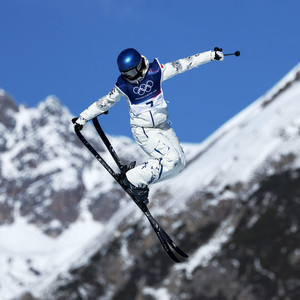
Well, the ski jump is amazing because it really makes us think about how these athletes can stay in the air for so long.
It's like they're flying.
It's like they're flying, and in a way they are.
So there are two different hills that they jump off of in the Olympics.
There's the large hill, which is like jumping off a 50-story building, and there's the normal hill, which is like jumping off only a 30-story tall building.
Oh no, just 30.
Yeah, that's it.
So, as these athletes are jumping off, if you were to think about throwing a bowling ball off of this ski jump, it would exert a beautiful parabolic trajectory and it would land far short of where our athletes are going to land.
So it would be much shorter.
So what these ski jumpers are doing is, you'll notice, whenever they take off, they assume a V position, right.
Now, with this V position, what they're trying to do is they're falling.
Yeah, and they're kind of like closed up like a taco.
Yeah, they're closed up like a taco or flat like a pancake.
And what they're trying to do is they're trying to minimize and maximize at the same time their interaction with the air resistance.
So you can imagine throwing your hand out the window of your car as you're going down the highway and you can feel that air pushing against your hand.
And so they have the drag, which is the air that's rushing face on at them.
And so if you put your hand parallel to the ground, you're going to find that you can kind of fly your hand there.
And so they're trying to use that air, those air particles, as they're falling, to help create a lift, which is a force that prevents them from falling in the downward direction.
It's going to slow that motion.
Yeah, it makes me think of, you know, planes.
When I used to teach Physics 101, I'd be like, OK, this is how plane wings work.
And you'd take this like sheet of paper and you'd blow air over the top of the sheet of paper and the paper goes up.
And this kind of amazes the students.
And it's because this moving air has less pressure.
And by moving air above the paper, you're generating lift underneath.
And these ski jumpers are doing the same thing.
They're utilizing lift.
Right, exactly.
So these ski jumpers are working very hard to maintain this optimal angle of attack, holding their body and their skis in exactly that same shape, so that they can minimize the drag but maximize the lift.
So in this last year, there have been a couple of ski jump scandals.
First, there was this extra material that had been stitched into Norway's men's team suits.
And then, more recently, there are these allegations that male jumpers are injecting their penises with hyaluronic acid.
And people were in this uproar because it could be giving these athletes an advantage.
Sticking to stitches in the suits, how would extra material let you go further in a ski jump?
Well, it's actually really interesting whenever we look at how this extra material is going to help these athletes.
So what we're going to find is that the lift is proportional to the surface area.
So by adding in a small amount of fabric, we're actually adding in an area that, And the larger that area, the larger the lift, the larger the lift, the greater time they're in the air and the further distance these athletes are going to fly.
It's kind of like these athletes are wearing a wingsuit.
Yeah, like a flying squirrel.
Yeah, exactly.
They're capturing that extra wind.
Now, the other thing that happens is that they had these extra stitches that put in.
So they actually put in an extra seam.
And that extra seam made the fabric stiffer at that point.
Now, that means that the material isn't going to flutter.
So there's going to be a consistent area that's going to be exposed to the air.
And these ski jumpsuits have to conform to the body really well.
But the area with the most leeway is that anterior crotch length, which has the greatest tolerance, which is why they chose to add the material in that area.
Everything else has to be so form-fitting to the body.
Well, I'm so glad we brought you on for this.
I've been hearing so much about it.
But for our last, like you know, physics lesson, let's actually review conservation of energy, one of my favorite things through the bobsleigh competition.
So that starts Sunday, the 15th.
Let's imagine going up a snowy hill.
You're gaining potential energy.
So that's what we physics professors also call like stored energy.
Then if you sled down that stored or potential energy converts to kinetic energy, which is this moving energy.
And when we're looking at the bobsleigh competition, it really does like tell you so much about conservation of energy.
Why is that?
Whenever you're looking at the bobsleigh competition, you are finding that you have a race that is decided by hundredths of a second.
Okay,
The entire race takes about a minute.
And so there are several parts to it because, as we have our runners, our athletes, getting into the bobsleigh, they have to run as fast as they possibly can.
And that is because they want to maximize their kinetic energy, or the energy of motion, at the top of the hill.
All of the bobsleighs start from the same height, so our athletes can have a small advantage by actually having a slightly larger initial speed.
So as these bobsleighs go down the track, they're getting faster and faster and faster.
So they're gaining that kinetic energy.
Yeah, I think a lot of people don't know this.
If you have the most speed at the very top, you'll go even further.
So they like recruit runners, right?
Like Olympic track runners.
Yes, Olympic sprinters.
Yes, they love to have those on the team because they can go fast enough.
Amy, this is so much knowledge and physics that you kind of gave us great analogies.
It makes me wonder is there a physics like sports question?
A student has asked you that you still haven't been able to answer.
Oh, there's so many questions that I can't possibly answer.
I often have students ask me questions that seem rather simple at the onset, about why one athlete might have an advantage over the other, or who's supposed to win this race.
And these are questions that I really can't answer, because there are different weather conditions that go in.
There are material conditions that go in.
There are just so many factors.
And we're not even talking yet about the skill of the athletes.
So there are just a lot of things that I can't tell my students definitively how things are going to work out.
That's the pain of physics sometimes.
Sometimes we just oversimplify it, right?
Absolutely.
Absolutely.
Amy, thank you so much for talking to us today about the physics of the Winter Olympics.
Well, thank you.
This was great.
If you liked this episode, give us a follow on the NPR app or wherever you get your podcasts.
And you can check out our episodes on how extreme g-forces affect Olympic bobsledders or our Summer Olympics episode on gymnastics.
This episode was produced by Hannah Chin.
It was edited by our showrunner, Rebecca Ramirez, and it was fact-checked by Tyler Jones.
Jimmy Keeley was the audio engineer.
I'm Regina Barber.
Thank you for listening to Shortwave from NPR.
We're just gossiping about physics.
Hey, that's what I do all day.
This is Tanya Mosley, co-host of Fresh Air.
You'll see your favorite actors, directors, and comedians on late-night TV shows or YouTube.
But what you get with Fresh Air is a deep dive.
Spend some quality time with people like Billie Eilish Questlove, Ariana Grande, Stephen Colbert and so many more.
We ask questions you won't hear asked anywhere else.
Listen to the Fresh Air podcast from NPR and WHYY.
Venezuela, Iran, Greenland.
World events move quickly.
Make sense of them with State of the World from NPR.
We bring you on-the-ground reporting from around the globe in just a few minutes every weekday.
Listen to State of the World on the NPR app or wherever you get your podcasts.