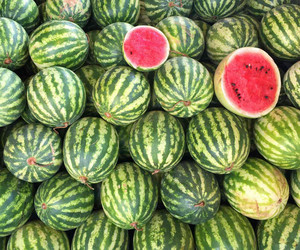
Summer in New England is my very favorite fruit season.
Right about now, I'm eating peaches and cherries and blueberries and, of course, lots and lots of watermelons.
Which made us think that it was time to revisit one of our favorite episodes, all about the watermelon.
Make sure to listen all the way through for how to choose the best, most delicious specimen from your local farm stand.
Enjoy! it's watermelon weather that summer kind of weather when people get together and sing I mean, I don't know about you, but I'm happy to get together and sing, especially if it's singing about watermelons.
Yeah, but I'm sorry, Cynthia. Are you 103?
Perry Como? What about some Harry Styles?
Watermelon sugar high, watermelon sugar high, watermelon sugar high. singing with a watermelon, frolicking on the beach with a watermelon.
It's all good. So hey, listeners, guess what this episode is about?
No, not Harry Styles. Or Perry Como. It's about the fruit that's bigger than both of them put together.
The watermelon. It's kind of a big deal.
A very big deal. Very big deal and growing.
So the FAO statistics yearbook, the Food and Agriculture Organization yearbook, says that The world produces something like 100 million tons.
Interestingly, of all the vegetable crops, watermelons are grown on the largest land area in the world.
They take up the most space of any crop in the world, of any vegetable crop.
And yeah, so they are a very important crop.
Important, delicious, and more fascinating than you might even imagine.
When I told my partner Tim that we were making a watermelon episode, he was basically like, what is there to say about the watermelon?
Tim, your mind is about to be blown. This is Gastropod, the podcast that looks at food through the lens of science and history, or should I say the podcast that specializes in extracting all the watermelon's most fascinating secrets.
I'm Nicola Twilley, watermelon lover. And I'm Cynthia Graber, also a watermelon lover.
And among the many mysteries that we will solve today, where did watermelons come from?
How did they get so sweet and so red? More importantly, how did the watermelon become the most dangerous fruit in America?
The most dangerous and the most racist fruit in America.
Plus, what everyone wonders while trying to figure out which watermelon to take home, how can you tell when they're ripe?
Support for this episode comes in part from Vitamix.
Quick kitchen history lesson. Electric blenders, first introduced in 1922, were invented to make milkshakes.
What followed was iconic Americana, the era of teenagers in checkered floor soda fountains and drugstores, jiving to jukeboxes, slurping shared milkshakes through two straws.
In the late 1930s, Vitamix began promoting their new blenders for use beyond making milkshakes.
Soon, electric blenders found their way into kitchens across the country, where they've been essential cooking tools ever since.
Vitamix reimagined the blender as a powerful, versatile tool ideal for making soups, nut butters, marinades, and, of course, delicious, nostalgic milkshakes.
Vitamix's trusted versatility blends together culture, There's just something about family road trips.
Windows down, music up, snacks everywhere, and stories that turn into inside jokes for years.
And now there's one more thing to love, pulling over for a chicken sandwich that makes the whole car happy.
Culver's new lineup, crispy, spicy, or grilled, is made with 100% whole white meat chicken breast.
Topped with cool, crunchy lettuce, ripe tomato, creamy mayo, and perfectly crisp fresh pickles, all in a toasted brioche bun.
Pair your favorite with a refreshing cold Sprite, and you've got a lunch stop worth remembering.
It's the kind of meal that keeps spirits high and seatbelts buckled up a little longer.
So wherever you're headed, make a stop that brings everyone together.
Find a restaurant near you or order online at Culver's.com.
To start our watermelon adventure, we called one of the world's great watermelon experts, Harry Paris.
He has worked on watermelon science for years as part of Israel's Agricultural Research Service.
Well, I think the first thing that comes are the first two syllables, water, right?
This is a fruit vegetable, which has a lot of water, and which actually, probably the first use by people of this particular natural product was was to quench thirst.
I've spent summers in Israel and it is basically watermelon paradise.
But that's not actually where Harry first fell in love with the watermelon.
It all started when his dad grew watermelons in the backyard in their home in Brooklyn in the 1960s.
Then Harry gave watermelon farming a try himself.
I was 15 years old and there was a new variety called Crimson Sweet that came out and I planted a few seeds in the garden.
And lo and behold, by the fall, we got one nice, big, sweet, high-quality watermelon fruit. that we grew in the backyard in Brooklyn.
And from then on, I was just hooked. Harry was well ahead of the locavore hipster curve in Brooklyn.
But the watermelon is neither from Brooklyn nor from Israel.
In fact, its origins are a little bit of a mystery.
One of the big headlines was back in the mid-19th century when the British explorer David Livingston went to the southern African deserts and lo and behold, It was the year in which there was more rain than average, and he found that large areas just covered with the wild watermelons.
These wild watermelons were hard, but as the name says, you have water, so you have to pound them and so on and so forth, but you could squeeze the water out of them.
David Livingston was searching for the source of the Nile, but apparently he was also, as a side hustle, looking for other sources, like the source of our sweet watermelons.
And people thought he'd found it, the wild ancestor.
But Livingston was wrong about the source of the Nile, and as it turns out, now we know he was wrong about those wild watermelons too.
Now, that scientists can examine the DNA of melons, they found that the Kalahari Desert wild melon that Livingston came upon is not the ancestor of our sweet watermelon.
But DNA is just one of the tools that scientists are using to try to figure out where and when the watermelon was domesticated.
You can't just use one approach. You have to use an archaeology approach.
You have to use plant science. You have to use linguistics.
You have to go into literature, some of it old, some of it ancient, and even more than that.
Of course, with the latest that we know with genetics and genomics can assist us.
So first of all, the plant science. Livingston was at least on the right continent because there are wild watermelons of various different species all over Africa.
So the wild relatives of watermelon, their fruits are smaller and rounder, not elongate.
They have often perfectly rounded, small fruits.
The outside looks like a watermelon, like, you know, a little green and white.
But inside they all have this extremely bitter and usually white color. white-ish pulp.
Suzanne Renner is a professor of biology at the University of Munich, and she's another one of the world's watermelon experts.
Suzanne says you could boil these super bitter watermelons for jam, or you could use them medicinally as kind of a purge to clean out your insides.
Basically, the wild watermelon wasn't a tasty thing to eat raw at all.
So where did the dessert watermelon come from?
There are two things that have to happen to these bitter wild melons to turn them into the watermelons we love today. two specific genetic mutations.
The first one is a mutation that switches off the production of bitter chemicals.
And so this mutation occurs in nature. It's bad for the plant because the plant, of course, has this bitterness to defend itself not to be eaten so that the fruits would not be eaten.
For the plant, it's bad to lose the bitterness, but for us, it's good.
And we can only imagine that native people Every once in a while, tried one of these melons, maybe for water, maybe, you know, hoping for something to chew on, and then found some that wasn't bitter.
Suzanne says scientists know what that mutation is and how to find it in a melon.
They know just where to look. And the second mutation is the one that turned it red inside rather than white.
The red color is also well understood. This is well studied, and it's a completely different set of genes.
So Suzanne and other scientists know exactly which two mutations they're looking for.
Those mutations aren't common in wild melons, so when did they happen?
When were watermelons domesticated? Harry says the place to look for those clues is archaeology.
In ancient Egyptian tombs, archaeologists have found paintings of whole watermelons on a platter.
They're oblong and striped like watermelons today, not round like the wild bitter ones.
But did those ancient Egyptian watermelons taste like the ones we eat?
Did they have the mutations for sweetness and maybe for the red color?
The painting can't really tell you that.
But fortunately, some other watermelon evidence has showed up in a 4,000-year-old Egyptian tomb complex.
Some of those seeds and leaves from the tomb ended up at the Kew Royal Botanic Gardens in England.
Suzanne wanted to find out if those remains held any clues about whether the watermelon had already been domesticated by them.
So she wrote to Mark Nesbitt, who coincidentally starred in our tonic episode and who runs the economic botany collection at Kew.
And she asked if she could borrow a watermelon leaf from the tomb.
It was in a glass box, encased in a box.
And he, Mark, opened it and he said it hadn't been opened since 1871 or whenever that thing was arrived there.
Suzanne and her colleagues analyzed the DNA in the leaf, and at first they were thrilled.
The watermelon leaf DNA did in fact have the mutations that would have made the fruit sweet and red.
But then when we used C14 dating for this material that we had received from Mark Nesbitt, it turned out it was much younger than we thought.
Yep, turns out the watermelon material in the tomb had been left there by a later visitor.
Carbon dating showed it was from the late 1800s.
Huge bummer. Okay, this is a real disappointment.
Luckily, other archaeological sites have also been found to contain a few watermelon seeds.
There's another tomb in Sudan and an even older one in Libya.
Ah, this is a super interesting site. It has an impossible name.
Wan Mujah is a super important site, apparently.
They found a black mummy there. So it was not an Egyptian person.
It was a North African person. OK, it is perfectly preserved.
It was embalmed in the most sophisticated way.
And this is where the oldest watermelon seed is found.
Not inside that mummy, but near that mummy.
Incredible. Incredible. Suzanne managed to get hold of these even older watermelon seeds and she sequenced them and the DNA showed.
I cannot tell you yet because the DNA is much more decayed.
You know, it's much older and now it's really, really old and it's really decayed.
Yeah, we have not nailed any mutations yet.
Suzanne and her colleagues are still analyzing this ancient DNA, but it hasn't given up its secrets yet.
She's still trying to figure out how long ago the watermelon turned sweet and red.
So then Harry turned to literature to try to find hints of sweet watermelons.
It turns out that one of the first mentions of the watermelon is in the Bible, the book of Numbers.
That book seems to be not quite as old as the ancient tomb Suzanne is studying.
So in the book of Numbers, when the ancient Israelites left Egypt, they dreamed about five specific foods they'd left behind.
Leeks, onions, garlic, snake melons, which are like cucumbers, and watermelons.
In my opinion, if they're associated with vegetables, it doesn't say that they were sweet.
They were probably used just as the others were.
You could eat them raw, you could eat them cooked, you could eat them pickled.
To find proof that these ancient watermelons really were sweet, Harry looked at a slightly later piece of Jewish writing, a rabbinic ruling from around the second century.
Watermelons are in a list with grapes, figs, and pomegranates.
You don't have to give a 10% tithe from your harvest if you eat these foods straight from the field.
And what do all these foods have in common?
They're sweet. There you go. That's exactly what they would be.
They would be watery or refreshing, and they would be sweet.
That's why anybody who was out there in the hot sun picking them, anyhow, that's why he would eat them.
That's why he would want them. You can't do the same thing with a stalk of wheat.
Finally, a watermelon that we would recognize.
But still, I hate to sound like Livingston, but where is the source?
No one can give an exact answer to that yet, but based on archaeology and seeds and tomb paintings and ancient writings and wild relatives, both Suzanne and Harry think that the watermelon was domesticated in northeastern Africa, in Sudan or Egypt or Libya, or maybe all of them at a number of different locations.
Harry imagines a story where someone, or maybe different people at different times, they come across one of these melons that has the mutation so it's not bitter, and he or she saves the seed, and over time people come across mutations that are a little more tender, and maybe even a little sweeter, and one day even pinkish or orange.
And they like those enough to save their seeds too.
It's a process that would have taken thousands of years.
By the time the process was complete, these delicious, sweet, refreshing fruits were a hit.
They took off from northern Africa and spread across the Mediterranean.
A few hundred years later, they reached India and after that, China.
And they stuck around nearly everywhere people could grow them.
One of the places they caught on was North America.
But once again, the watermelon is a mysterious fruit.
And no one knows for sure how it got here.
Some people speculate that European settlers brought watermelons with them, and some think it was Africans transported on slave ships who carried seeds from home.
Adrian Miller, the sole food scholar you may remember from our mac and cheese episode, he thinks the Spanish were first on the scene with the watermelon.
Because watermelons were growing all up and down the eastern seaboard because they had been embraced by Native Americans.
So much so that people later thought that watermelons were native watermelons. to the American South because they had proliferated so much.
So I think it was something that Spanish people brought over and then Native Americans discovered it and experimented with it, grew it themselves.
And then later when enslaved Africans arrived, it was something that they embraced as well.
Because it was a fruit from home. As we just described, there had already been sweet watermelons in Africa for thousands of years.
It was definitely part of the nourishment and especially was really important to the food culture of the antebellum South because in many cases, enslaved Africans and later enslaved African-Americans were allowed to garden and grow their own food.
And so watermelon became the symbol of independence and agency in ways that other fruits did not.
This is Shaina Klein. She's an art historian and author of a new book called Fruits of Empire.
I'll also tell you that the watermelon, as a member of the gourd family, had larger meanings relating to freedom as well, because the drinking gourd was a metaphor for the Big Dipper, the constellation that guided enslaved people north on the Underground Railroad.
And so the watermelon had all of this really rich, empowering symbolism before the Civil War.
Shaina says it wasn't just enslaved Africans and Native Americans who loved watermelons.
Everyone was eating them. The watermelon wasn't considered an exotic fruit.
It really made its way south, north, midwest and beyond and was very accessible and cheap. to most American consumers.
It was cheap, but not so cheap that the rich and famous didn't love it too.
Yeah. So Jefferson loved the watermelon.
He grew it at Monticello. Henry David Thoreau, he also had annual watermelon parties in Concord, Massachusetts.
And then of course, Mark Twain, famous American author, described watermelon as this beautiful fruit that angels eat.
So it was very well liked in early America, 19th century America and beyond.
Beautiful fruit that angels eat makes the watermelon sound quite delicate and ethereal, but most people didn't see the watermelon in quite that light.
It became sort of assimilated and Americanized as this rowdy party fruit that you would eat during watermelon parties, seed spitting contests, also during July 4th parties.
Watermelons were also used for imbibing alcohol.
So you could take a chunk out of the watermelon and then inject it with alcohol.
And this was a way of drinking watermelon wine, watermelon alcohol, which, of course, temperance supporters hated and despised.
Ah, yes, the watermelon keg, beloved of frat boys to this day.
But let's be honest, not exactly classy.
So some people in the 1800s, in the Victorian period, they tried to make watermelons a little more proper.
They tried to kind of clean them up. And so you can read etiquette manual after etiquette manual talking at length about how people should properly eat this messy watermelon.
They were told when to eat it, in what room temperature, in what clothing.
They were all trying to instruct Americans on how to eat this messy fruit with as much control as possible.
They even invented specific utensils to eat the messy watermelon.
So watermelon spoons, watermelon knives become invented in the Victorian silverware market.
Watermelons were not just unruly on the plate.
David Shields is a professor at the University of South Carolina, as well as the chair of the Carolina Gold Rice Foundation.
And he says it was basically watermelons gone wild out in the field.
One of the things which is interesting about watermelons was that it was very difficult to wrestle control over them in the early 1800s.
Watermelons will cross with one another with promiscuous abandon.
So you had all sorts of mongrel melons pop up.
Some were mushy, some were hollow-hearted, some were crisp.
And so through extraordinary effort, groups of breeders began isolating different melon types and crossbreeding melons in order to create stable market melons.
The first really reliable, really good melon in America was called the Lawson.
The seeds were brought from the West Indies by an American Revolutionary War officer called W.B.
Lawson. The Lawson watermelon wasn't particularly beautiful.
David said it was dumpy looking and it wasn't all that prolific.
But it was delicious, so much so that Mr. Lawson was pretty stingy about who he was willing to share the seeds with.
He only sent them to breeders who could maybe improve the variety and wouldn't let them grow promiscuously in the field.
You had to really deserve the Lawson seeds.
One of the breeders who was worthy of the Lawson seed was Nathaniel Napoleon Bradford of Sumter, South Carolina.
And by the late 1840s, he had managed to breed the first truly legendary watermelon, which he modestly called the Bradford.
There was a mineral element to the Bradford watermelon that was very appealing.
It has a distinctly sweet and inviting flavor.
And it has this one inch thick rind that which was used for pickling.
Watermelon rind pickles remain one of the great sort of home pickles of the South.
After the Civil War, enterprising southerners sold those super delicious Bradford watermelons up north.
The demand was so instantaneous and great that the watermelon crop of 1867 alone kick-started truck farming from the South in the post-Civil War era.
Truck farming, if you haven't heard the term, doesn't necessarily involve trucks.
It just means growing crops for a distant market.
The entire vegetable production for northern markets was triggered by the enormous success of these watermelons getting into the New York and Philadelphia markets.
These watermelons were such a hot commodity that growers had to protect them from thieves.
It was not unusual for people to be stationed with shotguns outside of watermelon patches.
But even then, you had the problem of Organized gangs of pillagers coming and just taking, overpowering the guards and taking the watermelons.
David says that thanks to the deliciousness of the Bradford and the temptation it posed to watermelon thieves, there were more people killed in watermelon patches than in any other agricultural setting in America, with the sole exception of cattle rust.
Now, growers didn't necessarily want to stand guard with shotguns to protect their huge watermelon farms, so they came up with another idea.
They had to resort to poisoning one of the melons and issuing a warning, you know, pick at your own risk one of these watermelons is poisoned.
The presumption was that, you know, the grower knew where it was, but sometimes they forgot.
Karma is such a bitch. You inject your watermelon with a cattle syringe full of arsenic.
You rub your hands together thinking that'll show them.
And then, oops, you forget which one you poisoned.
Yeah, when I ran across the newspaper articles that described this, I was dumbfounded.
They forgot where it was and they wound up eating it and poisoning their entire families.
To be fair, David said this wasn't a frequent occurrence.
The fact that it was newsworthy to him means that it was pretty rare.
Still, auto-intoxication by watermelon? Kind of ridiculous.
Just you wait, Cynthia. Next up, watermelon electrocution.
People would run wires out to watermelons.
The electrification of America... took place beginning in the 1880s.
So this was at the end of the 19th century when people ran wires off their house current to see if they could electrify the snatchers of a watermelon.
Electrocution and poisoning to protect their precious harvest, a fruit that spawned an entire industry.
These Bradford watermelons sound too good to be true.
Why haven't I tasted one yet? It's a sad story.
Coming up after the break. Support for this episode comes in part from NetSuite.
It's an interesting time for business. And by interesting, we mean incredibly stressful.
Not only do you have to balance all the usual variables, but with changing tariff and trade policies, there's even more you have to account for.
If your business can't adapt in real time, you're in for a world of hurt.
NetSuite says they can help. NetSuite by Oracle.
With real-time forecasting, you're peering into the future with actionable data.
And with AI embedded throughout, you can automate a lot of those everyday tasks, letting your team stay strategic.
NetSuite helps you know what's stuck, what it's costing you, and how to pivot fast.
If your revenues are at least in the seven figures, download the free e-book, Navigating Global Trade, Three Insights for Leaders, at netsuite.com slash gastropod.
That's netsuite.com slash gastropod. Support for this episode comes in part from Delete.me.
An important part of online safety is protecting your personal information.
But how do you actually do that? Well, you start with Delete.me.
Delete.me makes it easy, quick, and safe to remove your personal data online at a time when surveillance and data breaches are common enough to make everyone vulnerable.
When you sign up for Delete.me, their experts take care of removing you and your family's personal information from data broker websites.
Delete.me sends you regular, personalized privacy reports showing what information they found, where they found it, and what they removed.
And it isn't just a one-time service. Delete.me keeps working behind the scenes, monitoring and removing the personal information you don't want online.
Take control of your data and keep your private life private by signing up for Delete.me, now at a special discount for our listeners.
Today, get 20% off your Delete.me plan by texting GASTROPOD to 64000.
The only way to get 20% off is to text GASTROPOD to 64000.
That's GASTROPOD to 64000. Message and data rates may apply.
Support for this show comes from Pure Leaf Iced Tea. or it leaves you feeling even worse what you need is a quality break a tea break and you can do that with pure leaf iced tea real brewed tea made in a variety of bold and refreshing flavors with just the right amount of naturally occurring caffeine with a pure leaf iced tea in hand you'll be left feeling refreshed and revitalized with a new motivation to take on what's next The next time you need to hit the reset button, grab a Pure Leaf iced tea.
Time for a tea break, time for a Pure Leaf.
The Bradford has a very tender rind, and it can't be stacked more than two deep in a boxcar.
So if you're shipping your entire year's worth of watermelons north, you aren't going to make a profit if 40% of them are crushed when they arrive at the station.
So there was a great deal of despair. Almost right away, breeders realized they needed to toughen up the Bradford.
It was the perfect watermelon, except for that tender rind.
And there was a melon that sort of surfaced. in the early 1880s called the scaly bark watermelon that you could whack with a sledgehammer, wouldn't break the melon.
Breeders crossed the scaly bark watermelon with a Bradford and they came up with a baby.
The cold's gem, you could stack five deep in a boxcar and it wouldn't bruise the melon.
It didn't taste as good. But, you know, hey, it's Yankees who are eating them.
We got the good melon in our back patch.
That's the attitude in the post-Civil War era.
Then, of course, because growers have fields full of a single crop, they start getting diseases, and the breeders keep pushing for watermelons that are shippable and disease-resistant and generally sturdy as heck.
And unsurprisingly, flavor takes a backseat.
And, you know, you can flip forward to 2020 when you have these small, round, seedless refrigerator melons, which have no complexity whatsoever, real high sugar content because...
Hey, Americans like sugar, no nuance of flavor, no rind to speak of, so you can't make pickles out of their hides.
And you have the situation where a perfect industrial product has been created, and the Bradford gets lost in the shuffle.
The last crops are being grown in the 1920s.
One of David's main passions in life as head of the Carolina Gold Rice Foundation is finding lost southern foods.
And there was plenty of documentation about the Bradford from the 1800s, so David did some research and he wrote it up.
The greatest flavored watermelon the South ever knew, gone with the wind, and tears streaming out of my eyes on the page.
Turns out that someone read this, and Nat Bradford, who is the eighth generation descendant of the creator of the Bradford watermelon, wrote me an email at, I guess, 2 a.m. in the morning, saying, well, I've got Bradford watermelons I'm growing in Sumter.
These are my family's melons. And I'm wondering, you know, could this be the famous Bradford of the Civil War era?
Nat Bradford had wondered whether his melon might be the Bradford melon.
But when he asked a breeder at Clemson University, the breeder dismissed the idea.
So he had doubts, you know, instilled by some crop scientist.
And it's only, you know, when we really put together the historical record that it became absolutely certain that this was the melon.
For David, this was the moment he dreamed of.
He wasn't waiting any longer than he had to.
As soon as it was harvest season, he was out there in the field with Nap.
He handed me a slice. Actually, it was his father who was there who handed me a slice of melon.
And I tasted it, and it indeed was extraordinarily sumptuous.
More complicated than most watermelon taste.
It had a kind of body to it. And, you know, a lot of watermelon is sort of like sugar water when you eat it.
But this one was something different. It had a kind of whiny quality to it.
It tasted splendid, but it tasted completely different from my anticipations of what it tasted like.
Nat Bradford's original Bradford watermelons are now the hottest melons in town.
He sells some to distillers who make a watermelon brandy, which is sold out.
Yes, it was the first thing I checked. He also makes watermelon molasses, which is a traditional recipe from boiled down juice of Bradford watermelons.
It sounds delicious, but that too is sold out.
I'll be keeping my eye on their website.
And if you want to buy a fresh Bradford watermelon, yeah, good luck with that.
Three days ago, what is this? This is the 23rd of June here that I'm speaking.
A notice was posted by Nat Bradford for pre-orders for the melon.
And people come as far north as Massachusetts to pick up Bradford melon at his farm.
They're all pre-sold. He does make deliveries to certain restaurants in Charlotte, Columbia, Savannah, and Charleston.
But you have to be in the know in order to pick it up there.
Nat did release the seeds to a company in North Carolina called So True Seed, so you can try to grow some Bradfurs at home if you want.
Listeners, I bought the seed. But watermelons take up a lot of space, so I may need to also buy a country estate.
Stay tuned. But here's a strange thing about the Bradford story and actually about the whole watermelon story.
Remember all those gangs that were stealing watermelons?
David told us the gangs were mostly white Americans.
But whenever there was a drawing or painting or any sort of depiction of watermelon theft, the thieves were always portrayed as black.
And Jaina says that's because the watermelon isn't all sweetness and pickles.
There's kind of no more fruit attached so closely to racism than the watermelons.
What happened was, at the exact same moment that Northerners were getting their first taste of the wonders of the Bradford watermelon after the Civil War... At that time period, African Americans had a modicum of some rights because thanks to the abolition of slavery and the civil rights amendments that passed at the federal level, African Americans had some social rights. economic and political rights.
Of course, those rights weren't implemented everywhere or equally, but even just the idea that African-Americans might have these rights was terrifying to a lot of racist white people.
So you see this propaganda emerge where essentially there's a cultural war against African-Americans by racist whites to say, hey, look, these people are different.
They're inferior. They don't deserve these rights.
And here's one example. Look at how they deal with the food, the way they cook it, the way they eat it.
They're so childlike. They're bestial. You know, they did anything to take away from their humanity.
Adrian says watermelon became one of those toxic foods.
So watermelon and fried chicken are probably the most toxic.
But barbecue, catfish, all kinds of items were added to the list of foods used to ridicule African-Americans.
And so the goofiest part of all of this is that white people were eating and enjoying the same foods.
Shaina already told us that watermelons were considered rowdy.
Remember how much the temperance folks hated watermelons and the Victorians tried to tame them with special watermelon spoons because people were soaking them in alcohol, serving them at parties, using them as diuretics.
And so the watermelon accumulated all of these meanings and reputations for being this fruit that maybe had a bit of lack of control, a kind of flooding of digestion, excess and indulgence.
That's what makes the watermelon special. so terribly perfect for the most awful racial trope that emerges in the 19th century, a trope that shows African-American people eating watermelon, drooling over the fruit, having this lustful and insatiable appetite for watermelon, and even stealing the fruit from watermelon patches.
Shaina has looked at hundreds and hundreds and hundreds of watermelon images from the period.
Engravings in magazines, paintings, illustrated collectible cards, advertisements, even silverware.
The watermelon had been used as a shorthand for slovenly, rowdy behavior before.
Italians and Arabs had been called watermelon eaters as a way of saying they were lazy and childlike and irresponsible.
But that slur was never as pernicious and lasting as the stereotype in America.
I want to emphasize that there is no surface that the watermelon stereotype did not touch.
And many people talk about it as this racist Southern practice.
But in truth, the visual culture of the watermelon and its racism was a national exercise.
This just did not only happen in the South.
I mean, people outside of the South, newspaper editors, magazine editors, others were more than happy to recycle watermelons.
These images of African-Americans and to use food as a way to say you're different and you deserve to be marginalized in the society.
These racist images took a variety of forms.
We mentioned the images of Black men stealing watermelons.
Other common ones reduced African-Americans to base, almost inhuman caricatures.
One I'm thinking of in particular is by the white American artist Thomas Hovenden.
So Hovenden depicts this depiction of a Black boy who's holding a cut open watermelon and His lips are moist with watermelon juice.
And he's holding this cut open watermelon with a post-coital smile, which many critics remarked upon that there was this lustful, even sexual connotation to this painting.
That's fine art, quote unquote. But in popular imagery like the collectible trade cards, the racism is even more overt.
A few in particular show African-Americans not just lusting over the fruit or eating it, but literally morphing and transforming into the fruit.
We see African-American men whose heads have exploded into these watermelon rinds and watermelon meat.
This is a very meaningful message to send, that African-Americans are not even human on these trade cards, that they are so savage, so barbaric, that their minds, their physicality, literally becomes a watermelon.
As Shana studied all these images, she noticed something.
Almost none of the people depicted with watermelons were women.
And that got me really thinking, why am I seeing so many more Black men in the context of this stereotype and not Black women?
And I think that it's because Black men were much more of a threat in the late 19th century since they, and not Black women, were gaining privileges such as the right to vote, and the right to own land with the Homestead Acts.
There's a lot of anxiety also in the American North as Black men are moving over the Great Migration and people are feeling that they are taking over white jobs.
So you might be thinking, well, sure, these are nasty images from a different time, but really, how big of a deal were they?
But Shaina says you can't and you really should not underestimate their impact.
That's coming up after this word from our sponsors.
Support for this show comes from Pure Leaf Iced Tea.
You know that point in the afternoon when you just hit a wall?
You don't have time for self-care rituals or getting some fresh air, so maybe you grab a beverage to bring you back.
But somehow it doesn't do the trick, or it leaves you feeling even worse.
What you need is a quality break, a tea break.
And you can do that with Pure Leaf Iced Tea, real-brewed tea made in a variety of bold and refreshing flavors with a with just the right amount of naturally occurring caffeine.
With a Pure Leaf iced tea in hand, you'll be left feeling refreshed and revitalized with a new motivation to take on what's next.
The next time you need to hit the reset button, grab a Pure Leaf iced tea.
Time for a tea break, time for a Pure Leaf.
Support for the show comes from Google Pixel.
It's about time your smartphone gets smarter.
For your next upgrade, meet the Google Pixel 9 Pro.
You can experience its stunning new design, the advanced AI power of Gemini, and their best camera yet.
A camera built to capture everyone in beautiful resolution, including the person taking the photo.
When the extraordinary is possible, never settle for less.
You can learn more about the new Google Pixel 9 with Gemini Live on the Google Store.
Avoiding your unfinished home projects because you're not sure where to start?
Thumbtack knows homes, so you don't have to.
Don't know the difference between matte paint finish and satin?
Or what that clunking sound from your dryer is?
With Thumbtack, you don't have to be a home pro.
You just have to hire one. You can hire top-rated pros, see price estimates, and read reviews all on the app.
Download today. I mentioned that no surface was untouched by the watermelon stereotype. that it's so pervasive and that it ends up seeping into the visual consciousness of Americans.
And so that's what makes visual images so dangerous because they help to naturalize and normalize these awful stereotypes.
And to see these repeated over and over again in your trade card, in your dining room picture, in a print, in a publication, to seep into the visual consciousness in this way makes these images so dangerous by making these stereotypes seem normal and seem like nonfiction.
The goal of the watermelon trope was to constantly visualize black inferiority and to diminish the status of black people.
Nothing is more relentless in my mind than some of these images of the watermelon trope.
And so after decades of this campaign, what happens?
Even though certain rights were created in the 1870s, by the time you get to 1895, the Supreme Court decides Plessy v. Ferguson, which legally sanctions Jim Crow segregation.
So the culture war worked. Adrian Miller has spent his career exploring food's role in the African-American community, and he says the watermelon racist trope was horrible and pervasive, but it was just one of the many aspects of the racist campaigns at the time.
Because as much as those images proliferate, most of what I see, especially in periodicals of the time and newspapers especially, is just a constant assault on Black intelligence, the idea that Black people are dangerous.
So you see newspapers reporting all kinds of African-American crime.
You know, we have no sense if it's commensurate to the white crime rate.
And we see that even today. So I think it was just part of a culture campaign.
But the watermelon stuff was a powerful part of a powerful campaign, no doubt.
Shaina says one way to gauge a trope's impact is to look at the resistance.
So, for example, early African-American cookbook authors deliberately left any mention of watermelon out of their cookbooks.
And then in 1893, there was a super famous world fair held in Chicago.
It was called the Columbian Exposition. There were hundreds of acres of buildings and exhibits.
It was one of the most popular events of the year, maybe even the decade.
There wasn't an African-American exhibit at the exposition and black Americans were only allowed to visit on one day, so-called Colored People's Day.
And they fight to make it a no watermelon day.
This is a day when watermelons were supposed to be distributed for free at this event.
And they violently and rightly so, of course, protest this.
We still see the momentum of that today.
I know personally African-Americans who do not want to eat fried chicken and watermelon in the presence of whites and definitely do not want to be photographed eating those foods.
And just to show you the toxicity of this, even when African-Americans plan a Black History Month event tied around food, if watermelon is on the menu, Black students will protest against that event and get it canceled.
Adrian grew up regularly eating watermelon.
He ate it at family gatherings, Fourth of July, church events, Juneteenth celebrations.
He says as a kid, he was never self-conscious about eating watermelon because he mostly ate it in a community of African-Americans.
I really experienced it more when I was in professional settings after college and law school.
Because in those situations, we African-Americans were definitely the minority.
And I guess there was just heightened consciousness about that.
So I think the difference is being in a black space and consuming these foods, knowing that there won't be judgment and being in an interracial context where you never know what's in someone's heart.
And we saw that play out with President Obama.
I mean, there were several instances where. where he was eating certain foods, people posted it and made fun of him.
And then when they got the condemnation, they just said, oh, I didn't know that was racist.
And I was like, yeah, you did, because that's why you posted it.
There were cartoons of Obama featuring watermelon-flavored toothpaste.
There were images sent around of watermelon patches in front of the White House while he was in office.
The watermelon is still an incredibly potent racist symbol.
So I think the stigma and the toxicity of it still exists with us today.
And I in my work, I've been trying to do a lot to address the stigma and remove it because I believe the watermelon is delicious.
So I hate to see that this stereotype lives.
And I think in many ways we are still giving it life by not taking it head on and just talking about the history of it and trying to. reconcile with that and move on.
But given that toxic history, can the watermelon be redeemed?
Adrian thinks it can be, but he says it's going to take all the rest of us talking about this history and facing up to it.
The burden for that cannot be on African-Americans.
Because my own feeling is when someone of color or someone in a marginalized community points out these things and argues about these things.
I think for some people, they discount the argument or maybe dismiss it outright because it's so outside their own experience.
But when a white peer or somebody they respect speaks to those issues, I think it resonates more deeply.
So I think we have to, you know, figure out a way to sit down and talk about this.
Adrian still eats watermelon. He eats it deliberately and without shame.
And Shana eats watermelon, too, but consciously.
I still eat it regardless. But, you know, I can't. not think about the history when I eat it.
I'll never be able to eat a watermelon again without thinking of that myself, but we will still be eating it.
It's a complicated food, but it's also the taste of summer, and we love it.
Even the icebox watermelons at the supermarket, which David says are nothing compared to the Bradford, I'll still take them.
But if you want something a little better, even if it's not quite as good as the Bradford, David and Harry suggested looking out for some more farmer's market or homegrown varieties.
The Crimson Sweet is The Amish moon and stars, the Charleston gray and the black Spanish.
But how do you choose one? You can't look inside a watermelon.
You can't taste a watermelon. You aren't going to touch its flesh to see if it's soft like you might with a peach.
How do you know if it's ripe? Definitely in Africa, in Nigeria, we actually get to know how watermelons are ripe by tapping them.
If you tap an unripe watermelon, the tone seems to be flat.
But if you tap a ripe watermelon, there's a sharp tone.
Phoning in all the way from Nigeria to answer your question, Cynthia, it's our next guest, Stephen Onwubiko, who studies the acoustics of African musical instruments.
Stephen knew all about tapping watermelons to find the best one.
They're popular year-round in Nigeria. And he noticed that the sound of the watermelon reminded him of something else.
If you're listening to African music, you will definitely hear a tone, a slapping tone when you listen to African drumming.
It goes like this, pa, pa. As a music listener, as an African Nigerian music listener, when you hear the drumming of an Iba, you'll be able to identify the pitch of that Iba to the pitch of the watermelon.
Stephen wanted to test this idea, so he made some recordings of people slapping ripe watermelons and of people slapping the traditional Iba drums, and he teamed up with Tracy Nielsen from Brigham Young University.
Tracy is a physicist. Once I do the research and make the recording, she puts it into a spectrograph that is able to analyze the pitch pattern of the watermelon and correlate it with a Nigerian drum.
Tracy found similarities in the beginning frequencies and the duration of the two recordings.
And that means the ripe watermelon and the Igba drum sound kind of the same.
Stephen thinks that listening to traditional drumming can help familiarize people with the sound they should be listening for when they slap a melon.
But the watermelon varies in size, so there'll be tonal differences in each watermelon.
But even if you aren't steeped in the sound of traditional Nigerian drumming, you can definitely hear the difference between a ripe watermelon and an unripe one.
It's not watermelon season here yet, so we turned to the internet and it turns out that a lot of people have made videos of dapping watermelons.
This one is from the YouTube channel of Geddy Stewart.
This is the hollow knocking test. Okay, listen closely.
Which one of these two watermelons is ripe?
This is watermelon number one. And this is watermelon number two.
Okay, we'll play it again. Think carefully about this.
It's the difference between deliciousness or basically a giant watery cucumber.
Watermelon number one. Watermelon number two.
If you guessed the first one, you have a really sweet treat ahead of you.
But if you don't feel like swatting at fruit as you decide which one to buy, there are other methods.
One is to look for the pale spot where the watermelon rested on the ground.
If it's cream-colored, almost yellow, it means the watermelon had more time to ripen and should be sweeter.
If that spot is small and white, the fruit might not be quite as sweet.
People also say that riper watermelons are less shiny, their skin is duller and bumpier.
My method, honestly, is to hold the watermelons.
Heavier is definitely juicier, at least.
And I'm lucky that there's a farmer's market a short walk from where I live, so I just wait until the farmers tell me that the melons are ripe, and then I carry them home.
I carried a watermelon. That ending clip might not be as funny for you as it is for me if you haven't watched Dirty Dancing many, many times, actually.
So go see it. And then you too can walk around saying, I carried a watermelon?
Thanks this episode to Suzanne Renner, Harry Paris, Shaina Klein, David Shields, Adrian Miller, and Stephen on Wubico.
We have so many super great links and images and video from them up on our website. books and watermelon slapping and more all at gastropod.com if you are hungry for more watermelons and are wondering when and how the watermelon lost its seeds that'll be in our special supporters newsletter as well as the story of japanese cube-shaped watermelons gastropod.com support Thanks also to listener and scientist Lori Shapiro.
She studies cucurbits, and she suggested we do this episode.
She also pointed us to the biblical connection.
And a huge thanks to superstar summer fellow Sonia Swanson, who helped put this episode together.
Hope you enjoyed this Encore presentation.
We'll be back in a couple of weeks with a brand new episode.
Till then. And collaboration tools put feedback right where you need it.
See how you can turn your team into a content machine with Adobe Express, a quick and easy app to create on-brand content.
Learn more at adobe.com slash express slash business.
Support for this show comes from Pure Leaf Iced Tea.
When you find yourself in the afternoon slump, you need the right thing to make you bounce back.
You need Pure Leaf Iced Tea. It's real brewed tea made in a variety of bold flavors with just the right amount of naturally occurring caffeine.
You're left feeling refreshed and revitalized so you can be ready to take on what's next.
The next time you need to hit the reset button, grab a Pure Leaf Iced Tea.
Time for a tea break? Time for a Pure Leaf.