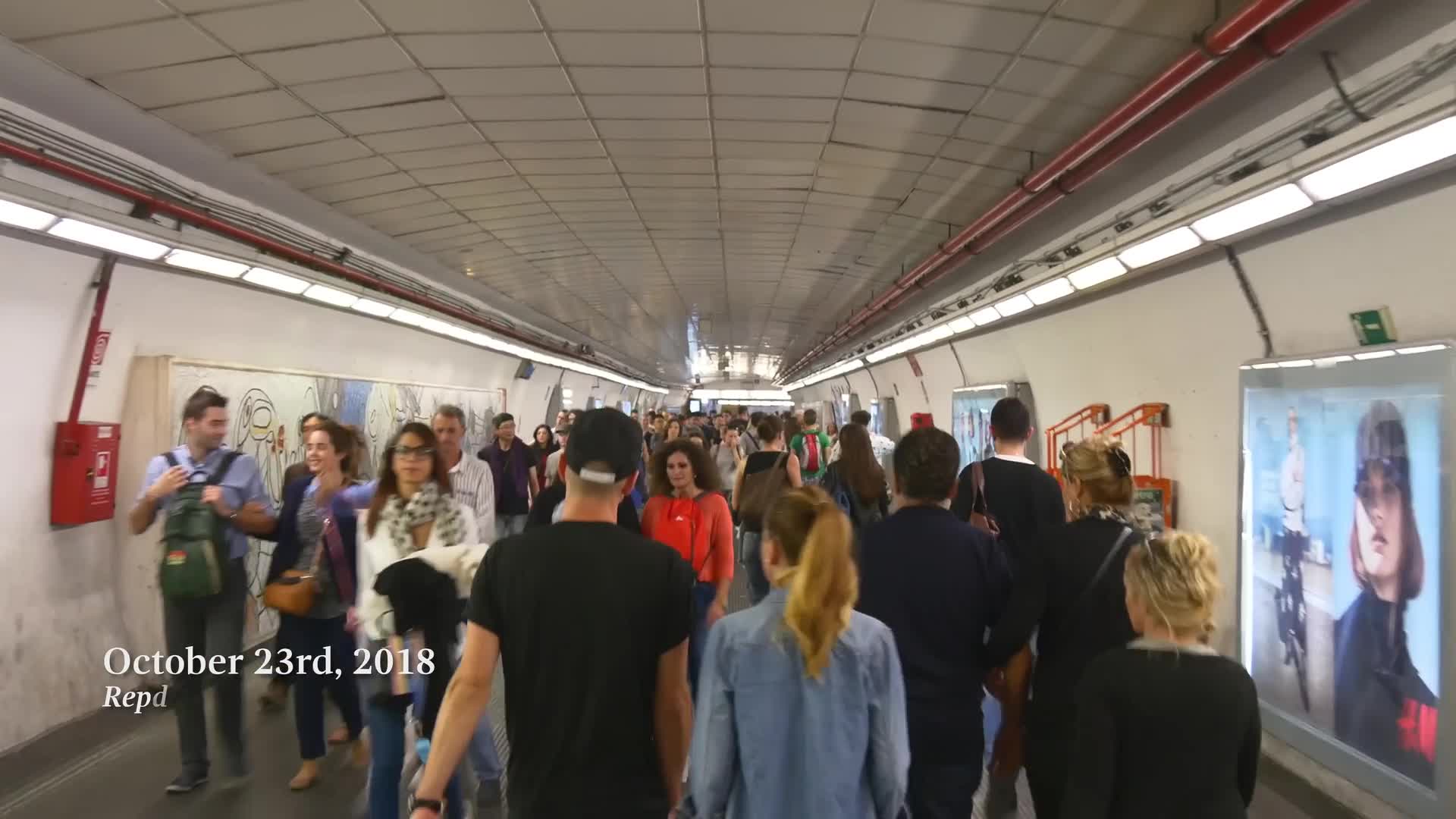
On October 23rd, 2018, thousands of football fans were making their way to the game in Rome.
Excitement for the game was high, and the fans began to chant and sing.
At 703pm, around 50 people were riding the long escalator down to the platform, but within 30 seconds the crowd had swelled to nearly double that.
Everything seemed fine, but inside the escalator was a problem.
The weight of the passengers was bearing down on the steps and the load on the main motor was increasing.
To try to slow the descent, the motor applied a counter torque, but as the force continued to increase, the stairs began to move faster.
By 7.04 p.m., the crowd had tripled.
The motor finally reached its limit, and under the massive strain, the drum began to slip.
With the motor losing control, the escalator triggered its second line of defense.
A safety relay tripped, immediately cutting power to the motor.
The main brake clamped down on the metal drum to stop the descent of the stairs.
But it failed.
The friction on the main drum wasn't enough to stop the motor from spinning, and the stairs continued to accelerate.
Sensing the motor had lost control of the steps, the escalator engaged the last line of defense.
In the event of an emergency, an auxiliary brake is designed to bypass the motor entirely and directly lock the driveshaft.
Under normal circumstances, the chance that all three safety measures fail at the same time is vanishingly small.
But these weren't normal circumstances.
At 7.05 p.m., the third and final safety system failed and the stairs began to plummet.
Fans were flung forward and started streaming down the escalator.
Some leapt over the central barrier in desperation, while others were swept into a crushing pileup.
At the bottom, the landing became a dangerous choke point.
Under the pressure, the steps twisted and buckled into jagged metal, leaving 24 people injured.
Something like this shouldn't have been possible.
And experts at the time knew that something had gone wrong and they started to suspect foul play.
In the aftermath, Rome's transit agency sealed off the accident site and closed the Republica station for several months.
The authorities ordered both a technical and a criminal investigation, and the mayor even publicly vowed to discover the cause of the accident.
So investigators began dismantling the wreck, tearing it down piece by piece to reconstruct what had happened.
The ride people experienced on that escalator was one of the most terrifying rides of their lives.
But maybe it's more similar to the origin of escalators than you might think.
Like, what was the first escalator even used for?
Do you want to have a guess?
It was an attraction in a theme park all the way back in 1896.
It had no steps, a 25 degree incline, and it was essentially just a slow conveyor belt made of metal and wooden parts.
It brought people up a full seven feet before they would have to walk down stairs on the other side.
And it was a huge success.
Over 75000 people enjoyed the attraction during its two week stay at the Old Iron Pier on Coney Island.
The ride was named the Continuous Elevator, and its inventor, Jesse Reno, had created it not just as an attraction but as a proof of concept, because he saw it as the future of transportation.
But as Reno watched people ride his invention, he began to notice a pattern.
Nobody walked.
Instead, they stood still, feet planted firmly sideways with people gripping the handrail tightly.
Two years later, the department store Harrods in England installed a similar device.
But the ride was so unsettling that Harrods had to put staff at the top to offer brandy to men and smelling salts to women, just to calm their nerves.
See for both devices.
The 25-degree conveyor belt was precarious to walk on and unnerving to stand on.
At around 12 degrees, walking on an incline becomes difficult, and 25 degrees is roughly the limit that our ankles can flex.
If only there was a way to replace the conveyor belt with a moving set of stairs.
Well then, the riders would always have a flat surface to stand on and a staircase they could climb if they wanted to.
One attempt at a solution had already been around for four decades, and it was called the revolving stairs.
It consisted of a chain that went around a loop, then fixed stair-shaped blocks were attached to it, creating a flat surface to stand on during the main incline.
But as soon as you'd reached the top, the steps tilted forward, making it treacherous to get off.
And a similar problem plagued you at the bottom.
Now you might think, if the top and bottom are causing problems, just extend each landing.
But that also doesn't work.
You just end up with a jagged mess for longer.
So how do modern escalators solve this problem?
I mean, have you ever stopped to think what happens to the stairs at the top of the escalator when they disappear?
Clearly we have steps going around in some sort of loop, but how do they actually behave on the return journey?
What if I give you two options?
Do they stay right side up, like the cabins in a Ferris wheel, or do they flip upside down and then flip back again at the other side?
I'm going to go this one all day.
Ferris wheel?
This one makes more sense.
Ferris wheel.
Yeah, this one.
I think they turn upside down.
And they're actually right side up.
But wow, you're both, yeah.
The solution to this problem came from another inventor named George Wheeler.
His idea forms the basis of every escalator in use today.
A modern version of it works something like this.
A typical subway escalator has an electric motor at the top with a power output of around 50 kilowatts, smaller than most electric cars.
This motor spins extremely fast at over 1000 RPM, but it's pretty weak.
So to drive the steps, the escalator needs to convert this into a slower output with more force.
To do this, it uses a reduction gearbox and a gear system, lowering the output to just a few RPM and increasing the torque by a factor of around 100.
The motor is connected with a large sprocket to a reinforced steel chain which pulls the stairs around a loop.
The so-called step chain is fitted with wheels to allow it to roll smoothly around curves.
But, unlike the design for the revolving stairs, Wheeler proposed attaching each step to this chain through a single axle, giving it the freedom to rotate.
Next, he added a second set of wheels to each step that followed a different track, allowing him to control the angle of each step at any point.
On the incline, the two tracks overlap, just like the revolving staircase.
But then at the top, the two tracks separate, and this is what allows us to keep the steps level throughout the entire ride.
The tracks then remain separated and curve around.
The steps flip upside down, tuck into the loop, and start their return journey.
At the start of the incline, the tracks rejoin, and the whole process repeats.
So the answer is you are both wrong.
Yeah.
Well, I never really thought about that.
Yeah, like, I would say it's like an upside down elevator, bro.
Guess what?
You're right.
But despite all modern escalators adopting Wheeler's design at the time, it caught so little attention that he was forced to shelve the idea.
It wasn't until eight years later that another inventor, Charles Seaburger, bought his patent and capitalized on the invention.
Seaburger partnered with the Otis Elevator Company and together they built a prototype.
A year later, in 1900, they showcased it at the Paris Exposition Universelle.
In total, 51 million people flocked to the exposition to see the marvels of modern technology.
But one of the most popular exhibitions was the world's first true commercial escalator.
The machine drew huge crowds.
French historian Philippe Julien described it as the jolliest attraction at the exhibition and wrote The escalator caused many an incident worthy of the vaudeville, separating families, sending old men sprawling, delighting the children and reducing their nannies to despair.
The escalator was even awarded one of the grand prizes of the fair.
Shortly after, escalators started being installed in different places across the world.
But these escalators weren't perfect.
They had smooth, flat stairs and when they reached the top, these stairs would disappear under a wooden board, leaving a dangerous gap between them.
Shoelaces, coats and especially the long skirts in fashion at the time, easily got caught in the machinery.
One incident even saw a three-year-old girl getting her foot pinched in the gap.
And while the girl luckily escaped with injured toes and a missing shoe, something in the design had to change.
To solve this, Seaburger and Otis installed a triangular shunt at the end of the escalator, forcing riders to go off to the left before they reached the dangerous gap.
This system worked, but it was awkward because it meant people had to put one foot onto solid ground while the other was still moving, which became especially tricky when some people stood still and others walked.
So to reduce the risk of people getting in each other's way, operators asked people to stand on the right and keep the left lane clear for faster walkers.
It's a convention we still often follow to this day.
But as it turns out, there's a much better solution than the shunt.
Modern escalator steps aren't smooth, they're grooved.
These grooves then interlock perfectly with a comb plate at the top of the escalator.
So now if a small item approaches the end, the comb plate lifts it up and out of harm's way.
This makes it much harder for things to get stuck.
And perhaps more importantly, it allows people to safely step off forwards.
But the comb plate doesn't entirely solve the problem.
We still have these gaps on the side of the escalator that can pinch and trap objects as the steps move.
So to address this, a new safety feature called the skirt brush was added to the escalator in 1982.
Escalators are full of subtle safety features like this, some old and some new, but almost all of them are designed around people.
All the way back in 1896, Jesse Reno predicted that riders on his attraction would need something to hold onto, so he introduced a moving handrail.
In a modern escalator the motor has a separate connection to turn a friction wheel that drives the handrail.
The only problem is that friction wears things down.
So over time, the wheel gets smaller.
And as its circumference decreases, each rotation moves the rubber loop a slightly shorter distance.
So the handrail begins to move more slowly.
The effect is small, but it builds up over time.
So to compensate for this, a new handrail is calibrated to move around 2% faster than the steps.
You can actually try this yourself.
Next time you're standing on an escalator, just place your hand next to you as you stand still, and you will watch as your hand slowly drifts forward.
This speed difference stops the handrail from lagging too far behind the steps over time.
Because I have definitely noticed that, that sometimes I'm on an escalator and then it's going faster than me.
My hand is going faster than my body.
But that means it's a new escalator.
Well, it's a new frictional wheel, that wheel that drives the handbrake.
We don't replace the entire escalator.
Oh wow, so so.
So that's like a party trick i can use to entertain my friends.
I mean, i don't know when i'd have a party on an escalator, but whatever, if i'm on an escalator with my friends and i can see it moving, i'd be like hey, that's because there's a new frictional wheel, i can that's like i can tell them that and impress them.
But it's not just the handrail.
The speed of the steps themselves is also something that needs to be carefully controlled.
Modern escalators use AC induction motors, which are extremely good at regulating their rotational speed.
And this has an unexpected benefit on downward escalators.
With enough people riding, their weight is enough that the motor no longer has to power the ride.
Instead, the weight of the passengers themselves drives the chain and causes the motor to spin.
As more people board, the force on the motor increases and it's pushed to turn faster.
But modern AC induction motors work by creating a rotating magnetic field.
When the motor tries to spin faster than the field, electric currents are induced inside it, which then create their own magnetic field.
This new field pushes back in the opposite direction to the spin, creating a braking force which resists the increase in speed.
But something interesting happens when the motor resists like this.
Rather than consuming energy.
The physics of the motor flips and it uses the excess mechanical energy to produce an electric current.
This is called regenerative braking, and it's the same trick that electric vehicles use to recharge their batteries.
In effect, the motor turns into a generator.
The result is that on a busy day, many modern downward escalators aren't just moving people, they're actually generating electricity.
Often this is channeled back to the building's internal grid and used to power other devices, including the upward escalators.
So even the escalator that was invented by George Wheeler and was installed in 1920, the Paris exhibition, etc.
I mean, all these escalators were regenerated.
What?
Yeah, when there were people standing on the escalator in down direction.
These escalators were feeding energy back into the grid.
No, it's like the down escalator is a generator?
This regenerative braking makes escalators extremely power efficient but, more importantly, it makes them inherently safe.
But there is a point where if you keep adding weight, then eventually the force becomes so strong that the motor can no longer resist it.
And if left unchecked, it would start accelerating uncontrollably.
The stairs would go plummeting down, which is exactly what happened in Rome.
After a nearly two year long investigation, the investigators published this 86 page report.
Inside, it lists the exact sequence of events that led to the disaster.
As fans crowded onto the escalator, their combined weight increased the load on the main motor.
The motor tried to resist this change, but as more and more people funneled on, the force got too high and eventually it hit a tipping point and the motor started accelerating uncontrollably.
Safety sensors in the machine noticed this sudden change and triggered two things in short succession.
At first, the power to the motor was cut, and immediately after that, the main brake engaged.
Two massive arms clamped down on the drum to lock it in place and avert a runaway.
This brake should have had enough stopping power to bring the fully loaded escalator to a halt, even under the massive strain.
But it didn't.
Tests after the incident showed that its braking force was far too low, around 37 of the manufacturer's specification.
The weakened brake struggled to slow the spinning motor and the escalator's downhill acceleration continued.
This is when the last line of defense kicked in.
When the escalator's speed rose by more than 20, the auxiliary brake triggered driving steel wedges into a disc on the driveshaft.
But when investigators opened up this brake, they were shocked.
The final mechanical backstop had been partially disabled.
Someone had physically tied plastic straps around one of the two brake wedges and rendered it useless.
With half the system unable to engage.
Its stopping power was cut by 50, just enough for the weight of all those passengers to overpower the brake and render the last line of defense useless.
Investigators knew that these failures should have been automatically recorded in the error logs, but when they went to check they found nothing.
The error codes had been turned off, meaning critical malfunctions could occur without leaving a trace.
The only way this could happen was if they had been disabled on purpose, meaning someone must have reprogrammed the system to stop recording fault codes.
Next, investigators turned to the maintenance records, but they found these similarly incomplete, and evidence of major work on the escalator was nowhere to be found at all.
With all the main safety systems compromised and critical alerts turned off, the escalator had been a ticking time bomb.
All findings from the technical investigation pointed not to a manufacturing defect but to a pattern of neglect and falsification by those in charge of keeping the machine safe.
This left the prosecution with one clear question.
Who was responsible?
The trail of evidence led back to June 2017, when maintenance responsibilities for Rome's escalators shifted to a new contractor, Metro Roma.
The transit authority ATAC severed its contract with Metro Roma in an attempt to wash its hands of the situation.
But as the criminal inquest continued, it became clear the problem went far deeper.
The investigators discovered that Metroroma had been working hand in hand with the transit authority ATAC, and together they presided over negligent maintenance and falsified records all across the network.
By September 2019, 11 suspects were named and the courts had suspended three ATAC managers, along with the chief of Metroroma.
The prosecution's findings were grave.
In many cases, safety devices had been deliberately sabotaged to avoid escalator shutdowns.
And those in charge had covered their tracks through a pattern of fraud and obstruction.
In the midst of the public outrage, prosecutors recorded a chilling wiretap of ATAC manager Renato D'Amico.
The translation?
If you run the numbers, out of 700 escalators, there'd be like three or four more dropping.
Come on.
The prosecutors note in their report that D'Amico appeared uninterested in the possibility there might have been people on those three or four escalators.
It was simply a matter of numbers and percentages to him.
It was a callous remark and it painted a clear picture of the incident.
This wasn't an engineering failure, it was a human one.
But that brings us to a more fundamental question.
I mean, how safe are escalators really?
The truth is, when they're properly maintained, the safety margins on escalators are enormous.
Each system is engineered to handle forces far beyond what they'll ever see in service.
So the breaking load of our step is like greater than 15 kilograms, so 1.5 tons.
So you can put an elephant on the step and it will break.
I've never seen a step break in my whole career.
Never seen a step chain break either.
When this is done right, the chances of a catastrophic failure are vanishingly small and, with around 15 million escalators worldwide, that really is how it should be.
In the US and Canada alone, over 100 billion escalator trips are happening every year, making the escalator one of the most widely used forms of transport on the planet.
On a scale that large.
It's sometimes easy to point the finger at our technology when things go wrong.
But the truth is, no matter how well designed our systems are, they all rely on people to maintain them.
And perhaps that's the lesson here.
As humans, we have a duty of care, not just to ourselves, but to everyone around us.
And sometimes that means taking responsibility for keeping each other safe.
In a way, that's how the escalators story began, with one person deciding to take responsibility for a problem that everyone else ignored.
Back when Jesse Reno was at university, every day he had to climb more than 300 steps to get to his frat house.
But while everyone else complained about this, Reno did something about it.
He had the math, the science and, most importantly, the problem solving skills to create the world's very first escalator, which he took to Coney Island.
So how do you go from a frustrating everyday problem to an innovation that changes the world?
Well, that's where today's sponsor Brilliant comes in.
Brilliant is a learning app built around interactive problem solving.
Whether it's electric circuits, probability or even AI, brilliance courses are designed to help you build intuition, the kind that helps you see the world in new ways.
Their unique approach lets you play with concepts and build your understanding from the ground up.
This is actually my favorite way to learn anything getting hands-on with ideas so that you actually understand them.
Plus, it's been proven to be up to six times more effective than watching lecture videos.
They're also releasing new and updated courses across math science coding, data technology, you name it.
So there is always something new to dive into.
The best part is you can start learning on Brilliant for free right now.
Just go to brilliant.org slash veritasium.
You can scan this QR code or click the link that I'll put down in the description.
Brilliant has also given our viewers 20 off an annual premium subscription which gives you unlimited daily access to everything they have to offer.
So I want to thank Brilliant for sponsoring this video, and I want to thank you for watching.