
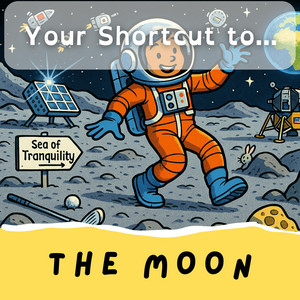
[A Cosmic Shortcut: Understanding Our Moon]-[The Moon... Your Shortcut]
📋 Summary
Exploring the Moon: Humanity’s Celestial Companion
For as long as humans have looked at the night sky, the moon has been a source of wonder, mythology, and scientific intrigue. In this episode of Squiz Kids, hosts Christy Kijerina and Bryce Corbett delve into the significance of our nearest celestial neighbor, exploring its cultural impact, its vital role in Earth's stability, and the burgeoning new space race to return to its surface.
The Moon in Human Imagination
Throughout history, the moon’s status as the "biggest, brightest thing in the night sky" has made it impossible to ignore. This visibility led various cultures to project stories onto its surface, from the "man in the moon" to the "rabbit in the moon." While some myths, such as the idea that a full moon triggers chaos, have persisted, there is "no scientific evidence that a full moon changes human behaviour at all." The perception of increased strangeness during full moons is likely rooted in the fact that, before street lights, a brighter night meant more human activity, which naturally led to more unusual occurrences.
The Moon’s Vital Role on Earth
Beyond being a muse for storytellers, the moon is essential for life on Earth. Its gravity acts as a "giant cosmic magnet," pulling the oceans to create tides. Without this, many marine ecosystems, such as rock pools and the survival of species like crabs and penguins, would be at risk. Furthermore, the moon acts as a stabilizer for our planet; without it, Earth would be "all wibbly wobbly like a dodgy spinning top," causing our seasons to go haywire. The moon also dictates biological cycles, with animals like moths, birds, and corals relying on its light and cycles for migration and spawning.
The Scientific Origins and Evidence
Formed approximately 4.5 billion years ago when a "Mars-sized object smashed into early Earth," the moon is essentially "recycled earth leftovers." Today, the moon is slowly drifting away from us by about "four centimetres every year." We can verify this and other lunar facts thanks to reflectors left by astronauts on the moon's surface, which allow scientists to "bounce lasers off them." These reflectors also serve as definitive proof that human moon landings were real, as one cannot bounce a laser off a movie set.
The New Space Race: The Artemis Program
After the Apollo missions concluded in 1972, humanity took a long hiatus from lunar exploration. Today, however, there is a renewed rush to return. The motivations are manifold: discovering "water ice in dark craters," studying the early solar system, and using the moon as a "lunar training camp" to prepare for future missions to Mars.
The United States is leading this effort with the Artemis program, which aims to land the first woman and the first person of color on the moon by 2027 or 2028. They are joined by global players like India, China, and Japan, as well as private companies like SpaceX. Despite this renewed interest, the moon remains an international commons. Under the 1967 Outer Space Treaty, countries are prohibited from claiming the moon as their own, and it must be used for peaceful purposes.
Challenges of Lunar Living
While the prospect of "moon towns" or "moon shops" is exciting, the reality is harsh. The lack of breathable air, extreme temperature fluctuations, and dangerous "moon dust"—which is described as being "sharp, like tiny glass shards"—mean that future lunar bases will likely need to be built underground or within protective habitats, with robots performing the bulk of the heavy lifting. While we aren't quite ready for "moon footy" just yet, the progress made by international space agencies suggests that our return to the lunar surface is closer than ever.

Deep Learning with ListenLeap


