
[A Nocturnal Symphony: Exploring the Imagery of Robert Louis Stevenson’s 'The Moon']-[the-moon-poem-16]
📋 Summary
The Celestial Timekeeper
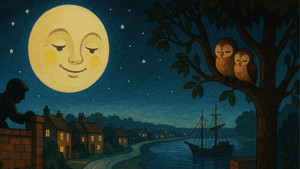
Robert Louis Stevenson’s poem, The Moon, begins with a striking simile that grounds the celestial body in the familiarity of domestic life: "The moon has a face like the clock in the hall." This comparison immediately suggests a sense of order and rhythmic presence. By personifying the moon as a silent observer, Stevenson implies that the night is not merely a void, but a structured space governed by this luminous "face." The moon acts as a witness, watching over the world with a steady, impartial gaze.
The Nighttime Collective
One of the most compelling aspects of the poem is how Stevenson catalogs the diverse inhabitants of the night. He notes that the moon "shines on thieves," implying a sense of secrecy and illicit activity, while simultaneously casting its light on "the garden wall," "streets and fields," and "harbour quays." This expansive reach demonstrates the moon's role as a unifying force that connects the human world of crime and infrastructure with the natural world.
The poem further highlights the animal kingdom's reaction to this light. Stevenson lists a variety of creatures—"birdies asleep in the forks of the trees," "the squalling cat," "the squeaking mouse," and "the howling dog by the door of the house." Even the nocturnal "bat that lies in bed at noon" is drawn into the narrative. By grouping these disparate entities together, the poet suggests that for the creatures of the night, the moon provides a shared stage. The phrase "all love to be out by the light of the moon" serves as a powerful testament to the allure of the nocturnal world, suggesting that the night possesses its own specific vitality that rivals the day.
The Duality of Day and Night
Stevenson creates a distinct boundary between the nocturnal realm and the daylight hours. He observes that "all of the things that belong to the day" must retreat when the moon takes its place. The imagery here is gentle and protective: these diurnal entities "cuddle to sleep, to be out of her way." The personification of the moon as "her" adds a maternal or guardian-like quality to the night.
He specifically mentions "flowers and children" as beings that "close their eyes," waiting patiently "till up in the morning the sun shall arise." This transition reinforces the cyclical nature of time. The poem concludes by emphasizing that the night is a distinct chapter of existence, one that requires its own set of rules and inhabitants. Stevenson’s verses effectively "conjure up the night time," turning simple observations into a visual tapestry that contrasts the bustling, illuminated night with the restorative, quiet slumber of the day.
Conclusion
In just a few short stanzas, Stevenson captures the essence of the transition between light and dark. Through his careful selection of vocabulary—ranging from the mechanical "clock" to the sensory "squalling" and "squeaking"—he creates a vivid portrait of a world that breathes in the dark. The poem remains a timeless exploration of the nocturnal landscape, reminding us that while the sun dictates our waking lives, the moon presides over a hidden, vibrant world of its own.
Deep Learning with ListenLeap


