From The New York Times, I'm Michael Barbaro.
This is The Daily.
Today, the story of how a small group of Senate Democrats broke from their colleagues, struck a deal with Republicans to end the government shutdown and touched off the latest civil war inside their party.
I spoke with my colleagues, congressional reporter Katie Edmondson and national political correspondent Shane Goldmacher.
It's Tuesday, November 11th.
Katie, welcome back.
Thank you, Michael.
I just want to explain that we're talking to you on Monday afternoon after a head-spinning few days of news that could keep changing after we talk to you.
And the reason the past few days have been head-spinning is that from the outside, it looked like Democrats were riding really high after last Tuesday's election, which seemed to ratify their strategy of keeping the federal government shut down as a way of forcing Republicans and President Trump to reckon with these sky-high healthcare costs.
In fact, it seemed to be working so well that, in the aftermath of that election, Trump declared that the shutdown was being blamed on Republicans and was helping Democrats.
He articulated that idea.
And then Democrats tossed this entire seemingly winning strategy Out of the window.
I didn't see that coming.
Well, I think it gave a lot of people a real sense of whiplash Michael because, as you said, I remember standing outside of Democrats closed door meeting on Wednesday and they came out sounding thrilled by what voters had just done in New Jersey, New York.
Virginia, which is to show overwhelmingly that they sided with the Democratic agenda here, which was focused on lowering costs specifically.
And so we heard from a lot of Democrats, particularly progressive Democrats, that look voters have just vindicated what our strategy is and they're telling us they want us to keep up the fight.
But I think what was always brewing under the surface Michael, was that There was this small clutch of centrist Democrats who have grown really uncomfortable with all of the pain points that have emerged of the shutdown, who are looking for some sort of off ramp.
Right.
A clutch of Democrats who did not believe that the shutdown was the height of Democratic success.
So tell us who these senators are and what they started to do.
Well, a lot of these senators hail from kind of purple or reddish states.
A lot of these are senators who really pride themselves on having some sort of bipartisan credentials to their name, pride themselves on working across the aisle.
And we're talking about the senators from New Hampshire, Senator June Shaheen and Maggie Hassan.
We're talking about the senators from Nevada, Catherine Cortez Masto and Jackie Rosen.
Angus King of Maine, he's actually an independent, but he caucuses with Democrats.
John Fetterman of Pennsylvania, of course, someone who frequently finds himself breaking with Democrats these days.
Mm-hmm.
We're talking about Senator Tim Kaine of Virginia.
And finally and importantly, there's Senator Dick Durbin of Illinois, who's actually the number two Democrat.
He is the party's whip, who will not be running for re-election at the end of his term.
Mm-hmm.
And I think one of the conclusions that they all ended up coming to together is that the chief demand that their party had been asking for, which is for Republicans to vote to extend the Affordable Care Act subsidies that are set to expire at the end of the year, was not going to happen.
It was not in the cards.
And what made them so sure of that, with Republicans starting to openly acknowledge that the shutdown was going well for Democrats—.
That meant them acknowledging that the health care issue was not going well for them.
And what furthermore, made these Senate Democrats comfortable with the idea of giving up on the central rationale for shutting down the government in the first place health care.
Well, I think most of them saw the writing on the wall, saw the refusal of President Trump to negotiate, saw the refusal of Speaker Mike Johnson over in the House to even commit to holding a vote on the issue.
And then, on the other side of the coin, they saw all of the pain that has been inflicted on American voters ever since the shutdown began.
And I think the conclusion that they came to was yes, extending these subsidies is extremely important.
It's a fight worth having.
However, we don't see an endgame here, and it is now coming at the expense of a lot of working people.
And so they begin these quiet discussions amongst themselves, but also with centrist Republicans in the Senate, to try to see is there some sort of deal we can broker here that can give us an acceptable off-ramp so that we can vote to reopen the government and end this shutdown?
And what kind of negotiation does this clutch of moderate Senate Democrats enter into with Republicans, knowing that health care is off the table?
Well, these negotiations essentially center on spending bills, right?
Funding bills to reopen the government.
But what they ultimately do really become centered around are these measures that Democrats are pushing for in order to rein in some of the actions taken by the Trump administration during the shutdown and also to protect some of the programs that the White House sought to weaponize during that funding lapse.
Some of the big provisions here include a measure saying all of the workers who were fired or laid off during the shutdown have to be returned to their jobs.
Michael, you'll remember that President Trump has hinted repeatedly during the shutdown that maybe he would not give back pay to federal workers who were furloughed during the shutdown.
So they include a provision that says the federal government will repay federal workers for the paychecks that they missed, and we're providing you with the money to do it right here in this bill.
Gotcha.
And this gets kind of wonky, but they move to protect this independent agency called the Government Accountability Office.
And this is a government agency that That essentially is a watchdog for how the White House handles the funds that Congress appropriates.
This is an agency that has blown the whistle on the White House seven times alone this year, saying that the White House has illegally handled money that Congress appropriated.
And this is an agency that actually has the power to sue the White House over impoundment or, when the White House resigns, refuses to release funds that Congress has appropriated.
And so House Republicans had pushed to essentially gut the budget of that agency and to also revoke its power to sue the White House.
And so in these negotiations, the senators say if you want our vote to reopen the government, you need to make sure that this agency is safe essentially, that it has the budget that it needs and it retains all of the powers that it currently has in order to sue the White House.
Fascinating.
And on health care.
Of course, the senators know that they cannot get a guarantee on a vote, but they do get this promise from Senator John Thune of South Dakota, the majority leader, that he will hold a vote later in December an up or down vote on whether or not Republicans will extend the ACA tax subsidies.
So, in short, these Democrats negotiate a deal that pretty much undoes a lot of the damage from the shutdown and preserves this government accountability office that matters to them as an institution that keeps the president in check.
And finally, and it seems somewhat significantly, they get what they see as an ironclad promise that Senate Republicans will vote on renewing Affordable Care Act subsidies, which perhaps they don't think Republicans will, but that would put Republicans on record as not doing it.
That's right.
What they want, Michael, is exactly that.
They want to put every single Senate Republican on the record on this issue.
And so all of the details of exactly what they had secured started trickling out on Sunday evening.
I was sitting up at the Capitol and lo and behold, the Senate Appropriations Committee starts putting out legislative text that actually contains the details of these policy wins the Democrats had secured.
And so I'm kind of carrying through these bills, right, trying to read exactly what's in them.
And it becomes very clear the more that you read that it seems like there's really a deal here.
I think we just have to explain this Katie, because most of us imagine that Congress is this very top-down place where decisions come from upon high.
But what you're describing is a handful of Senate Democrats a little bit going seemingly rogue And reaching a deal to try to end the shutdown with Republicans, and the leadership of the Senate Democrats is not really involved.
Well, I'm really glad that you brought this up, Michael.
I mean, that is completely right.
Typically, and especially in the past couple of years, Congress has been a very top-down institution.
What we saw here really was a return to sort of a style of legislating that was more progressive common, maybe six years ago, 10 years ago.
These were the so-called gangs that senators really prided themselves on being a part of.
It was the idea that me and my Democratic friends are going to sit down in a closed-door room with you and your five Republican friends and we're going to hammer this out amongst ourselves.
And that's really what we saw here.
And I think it's one of the reasons why again, their sudden declaration that they had a deal really did surprise a lot of people.
Got it.
And Michael.
The other surprising thing about the Senate is that, even though it is known for being such a slow-moving institution, it can really move quickly when its leaders want it to.
And so it was really not long after these centrist Democrats declared that they had the votes for a compromise to reopen the government that we saw that compromise be put to a vote on the Senate floor.
And I think this was the moment that The vast majority of us, myself included, got clued in on Sunday night, just in time for a news conference in which this small group of Democrats goes up to the microphone and tries to explain why they're doing what they're doing and why, in a sense, they have gone around the rest of their Democratic caucus.
Can you just talk to us about what they said?
Today, the Senate voted to start reopening the government.
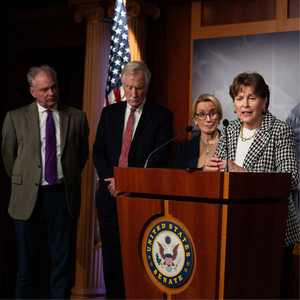
So, shortly after casting their votes, this clutch of Democrats holds a news conference right off the Senate floor.
We took a big step forward to protect the health care of tens of millions of Americans in exchange for funding through January 31st.
And they talk about how important they believe extending these health care subsidies is.
With the government reopened, we must move quickly to deliver on that promise and to keep health care premiums affordable.
But mostly they talk about the pain that people are experiencing in a shutdown.
We were seeing lines to our food banks in northern Nevada.
These were lines that I hadn't seen since the pandemic.
You have senators talking about SNAP recipients, right, who are going hungry.
We have TSA agents.
We have airport controllers.
You hear about the federal workers who have gone for weeks without a paycheck.
This agreement ensures that law enforcement, air traffic controllers and other federal workers get paid.
And one by one, it just becomes very clear that, for these senators, continuing on with this shutdown was simply not tenable.
This was the only deal on the table.
It was our best chance to reopen the government and immediately begin negotiations to extend the ACA tax credits that tens of millions of Americans rely on to keep costs down.
Thank you all.
Thank you all.
And yet, as we could tell from what was happening on the floor of the Senate on Sunday night, the vast majority of their Democratic colleagues disagree with them.
That's right.
At least that's how they voted.
There were exactly eight Democrats who voted for this deal to reopen the government.
And Michael, that was the magic number of Democrats needed in order for this deal to advance.
Which means that the entire rest of the Democratic caucus voted no.
Not only did they vote no, a lot of them were pretty vocal in saying how frustrated they were by this decision made by some of their colleagues.
Tonight, What this Senate is about to do is make a horrific situation even worse.
And you heard this frustration coming from a wide swath of the Democratic caucus, progressives like Senator Bernie Sanders.
If this vote succeeds, over 20 million Americans are going to see at least a doubling in their premiums in the Affordable Care Act.
But you also heard similar noises being made by people like Senator Alyssa Slotkin who I think of as being a pretty moderate Democrat from Michigan, who said that she simply couldn't lend her vote to this effort because there was no real health care deal on the table, and that's what she wanted for the American people.
The Democratic leader.
Mr. President, America is in the midst of a Republican-made health care crisis.
And even Senator Chuck Schumer of New York, who is the leader of the Senate Democratic Caucus.
I must vote no.
...says that he is going to oppose this deal that was brokered by some of his own members.
And he says This health care crisis is so severe, so urgent, so devastating for families back home that I cannot in good faith support this.
...that fails to address the health care crisis.
Now Michael, it was really only minutes after these centrist Democrats made their declaration that they were ready to vote to reopen the government that Democrats on Capitol Hill were already hearing from their voters all across the country.
Actually, as I was standing outside of that closed-door meeting, I looked over at a senior Democratic aide who was scrolling on his phone and his face was.
He just had a funny look on his face.
He was almost a little ashen.
And I said, well, what's going on?
And he said, oh, I'm just looking at the reactions to this on social media.
And what he was seeing is what I think we've all seen.
What, if anything, did Democrats get out of a 40-plus days of a shutdown?
Nothing.
They didn't get anything.
This was the same deal that Senator John Thune... On social media, on cable news.
It is unconscionable, unconscionable.
This emotionally charged explosion within the Democratic Party...
Like, why are we acting as if Democrats just lost the election?
Democrats had overwhelming victories.
I don't understand how a Democratic senator goes, wow, we won really big.
Let me cave now.
I don't understand what these people in Washington think they're doing representing the people who they claim to represent.
That, I think, has resurrected a lot of the sort of fierce debates that are happening internally within the party when it comes to how should Democrats position themselves in this moment.
How...
Can Democrats best fight back against the Trump administration?
Katie, thank you very much.
Thank you, Michael.
We'll be right back.
Thank you for being here.
Thanks for having me on.
The last time you were in the studio... Less than one week ago.
Less than one week ago, election night and you came on to observe what an extraordinary moment of triumph it was for Democrats.
And now, less than a week later, the Democrats are screaming at each other and resounding victory at the polls has yielded to claims, as Katie just said, of capitulation betrayal, caving.
What a difference a week makes.
The term that has come up as I've talked to Democratic strategists has been that this feels like a self-own for the Democratic Party, that the Democratic Party had been riding high after a rough week for Donald Trump.
And here, starting this next week, they decided this was the moment to give up a fight that the party's base had been craving and one that they seemingly had been winning, at least politically.
I want you to answer to the best of your ability—
This very simple question.
Taken in its totality.
If we assume this shutdown is going to soon be over, was this a good experience for the Democrats or a bad one?
Let's start with the good.
The good is that the Democratic Party has clearly elevated two issues that it feels are the winning issues for the party.
The first is health care.
And the second is affordability told through health care.
And...
Those have been the dominant topic of conversation for weeks, which is pretty hard to pull off when you're the minority party with no power in Washington.
And it took a shutdown for them to do that and for them to elevate those issues in hopes that, long past the shutdown, voters will think oh, that's the party that's actually fighting for me on those issues.
Right.
So that's one side of the ledger, the good side.
That's the good side.
But the risk of that fight was inflating people's expectations that they were actually going to win something on those issues right.
They had to say, we're fighting for this because we want X, Y, Z outcomes.
And they didn't get those outcomes.
They've got the promise of a vote, which is not guaranteed to pass.
Right.
Someone called it a pinky promise.
A pinky promise.
There you go.
And so the bad is that the timing of this shutdown ending is coming just as the Democratic Party was actually starting to feel some rare momentum in the Trump era.
That's exactly when the Democrats chose to cave, seemingly when things were going great.
And so this decision to cave at this moment is unleashing the anger and energy that has been burbling beneath the surface for months, which is, the Democrats are angry at their own party.
And they have been all year.
They have been basically since Kamala Harris lost.
And the shutdown was this sort of notable little reprieve where Democrats kind of stopped hating Democrats for a little while.
I mean there was a Quinnipiac poll over the summer that showed that Democratic approval rating of Democrats in Congress was at 39.
That's a really bad stat.
And that same pollster took a poll in October and it had jumped 20 percentage points to 58%.
Not great, right?
People aren't suddenly in love.
It's a big increase.
I'll be really interested to see what those numbers look like now that that bubble of hope had been inflated and deflated.
Well, talk about the consequences of having created this hope bubble, this idea that the shutdown was going to lead to meaningful changes in the country's healthcare system which we don't think they are and, in a broader sense, would show that Democrats were willing to really take on the president, which they were until they weren't.
I mean—
This was always the risk of entering the shutdown, right?
Chuck Schumer was very clear about why they should have this shutdown, what they were fighting for.
But there wasn't an endgame to get out of it with a win on policy.
And so you were always going to have this ugly ending, as people have described it to me, that the fear of how it was going to end was going to be bad, even if, in all these unlikely ways, they were actually doing okay in public polling about the issue.
And so...
Who actually voted to end the shutdown, I think, is really revealing.
And the people who voted to actually end the shutdown are the people furthest removed from facing any real backlash, because none of those eight Democratic senators Democratic-aligned senators are on the ballot next year.
They're all either retiring or on the ballot in 2028 or 2030.
The Senate has these staggered terms, and this is something you can do in Washington.
Try to keep your most vulnerable people out of having to cast the toughest votes.
Interesting.
You're saying that the Democrats to the degree that this is any kind of organized strategy which I guess we're not entirely sure put the safest Democratic senators furthest from election out to do the quote-unquote dirty work here of reopening the government without fulfilling the promise of improving healthcare.
Yes.
So I think the yes votes here are really revealing.
But there's one no vote that I found interesting. especially interesting.
John Ossoff.
He is the most vulnerable senator up for election next year.
So he will face the voters.
And he's running in Georgia and really focused on his general election, right?
No one's running against him in the primary right now.
And what the no vote here says is that he doesn't want to risk backlash from inside his own party in this campaign.
Whether that's from a potential primary challenger who could get recruited from one of these angry groups, or whether it's the small donors who are fueling his campaign, deciding you know what.
Maybe we're not so into John Ossoff.
He doesn't want to risk backlash.
That's fascinating because, as you're suggesting, John Ossoff could reasonably be most focused on a Republican opponent in a general election, saying you should have voted to reopen the government.
That's what matters in this race.
And instead what you're saying is he's more worried about upsetting Democrats in a potential primary, and that's what animated his vote on the shutdown.
And in the end he votes to keep the government shut down because he wants to look like he's on the side of the Democratic base.
That's what we think happened here.
Yeah, I have not talked to Senator Ossoff here, but what you can see is that there are two choices here.
Choice one is vote to reopen the government and say I'm going to buck my party and I'm going to reopen the government even if people on my left attack me for it, right.
That's a selling point in a lot of places, right?
And so here's a Democrat saying you know, that's not the right calculus here, to the extent he's making a politically motivated choice.
The right calculus is to make sure that your own party likes you and supports you and sees you as a fighter, because you want that energy behind you in a coming midterm election.
I noticed as well that several of the Democrats hoping to be the next presidential nominee woke up this morning, on Monday, and decided that this was a terrible decision.
I think a lot of them decided last night.
They didn't even wait.
They started issuing these statements on Sunday.
You saw it from Gavin Newsom, who said, just as it was done, that America deserves better.
You saw it from Chris Murphy, who's in the Senate.
You can see how tired I am.
I've been here all weekend.
I've been working throughout the past few weeks to try to prevent this moment.
He said, we could have won this fight.
We gave up too early.
There's no way to defend this.
And you are right to be angry about it.
I'm angry about it.
You saw it from Ro Khanna.
Can we recover?
Yes.
I think that the first step to recovering is to have generational change and new leadership.
A congressman from California who said Schumer, it's time for him to go.
He is not meeting the moment.
He's out of touch with where the party's base is.
If you were thinking or planning to run for president as a Democrat in 2028, you've basically denounced this deal.
Well Shane, since Ro Khanna brought Chuck Schumer up, let's talk about his past place in all of this.
There's a fair bit of anger being directed at him today as we're speaking, yet he's the one who brought the democrats into the shutdown.
He helped create the strategy.
He is the architect of now what has been the longest shutdown in history, and the architect of fighting on these particular issues.
Right saying these are something that we can fight for now and win on later.
Elevate this for voters, make them think about affordability, make them think about health care at.
He created the message.
He's kept them on the message and he kept his conference together for 40 days.
So why are people mad at him?
Because he's the leader, right?
The frustration is Chuck Schumer, if he was really the leader, would keep his party in line until he decided that the fact that he didn't vote with them sure that means he's not supporting ending the shutdown right now, but he's not actually leading and keeping them in line sufficiently to have the fight that they want to have.
Got it.
So I just want to observe where we are.
And it's a really interesting place.
Democrats who want to be president are railing against this deal that was achieved by fellow Democrats.
That's how much they want a fight right now against President Trump.
Senators like John Ossoff in a very purple place.
They're fighting this deal to end the shutdown the way that it's probably going to be ending.
That's how much he wants it. a fight against President Trump right now.
The majority of Senate Democrats are voting against this deal struck by their own fellow Democrats.
That's how much the whole party wants to be fighting President Trump right now as a kind of a brand message.
And that brings me back to what our colleague Carl Hulse said to me the night that the shutdown began, 40-something days ago.
He argued that the Trump era has fundamentally changed the Democratic Party.
In a sense, it's radicalized it.
And the party wants to say as loudly as possible we are not the Democratic Party of those eight moderates who did this deal.
That's not who we are.
We exist to fight President Trump.
And if that means we have to fight ourselves in a kind of civil war, if that means we're going to take out our anger at our own Senate Minority Leader, Chuck Schumer, so be it.
We will be the party of fighting Trump period.
One of the defining forces for Democrats in Trump's second term is that voters are angry at their own party.
And I think that's part of what gets us into the shutdown.
It's part of why they're going to be disappointed by the results of the shutdown.
And we're going to see what that looks like next year.
That anger, that energy, that has worked for parties before to take back power.
And so I think Democrats are trying to tread carefully here.
They want to keep the voters angry, but they would like to direct the anger at the other party.
At the moment, it's being directed internally.
And that's getting back to that self-owned moment, right?
Which is last week, you saw angry voters turn out and vote out Republicans all across the country.
And the concern is, what if we've turned that anger back at us now?
And, as quickly as possible, they're going to try to harness that energy, that anger, that frustration, and say We fought the good fight here.
You wanted us to fight.
We did the fight.
And even if we didn't get everything we wanted, we showed you that we can and would, and that the details of how this ended are going to be forgotten far sooner than the fact that they had the fight in the first place.
In other words, the message now is, don't worry about the way this ended.
Just be glad it even happened.
Just remember the fight we had.
Well, Shane...
Thank you very much.
Thank you.
On Monday night, the Senate approved a package of spending bills backed by the eight Senate Democrats and every Senate Republican that would end the government shutdown.
Those bills now head to the Republican-controlled House, which is expected to adopt them later this week.
If that happens, the government will reopen by the end of the week.
We'll be right back.
Here's what else you need to know today.
At the Supreme Court on Monday.
The justices denied a request that they consider overturning the court's landmark 2015 decision to legalize same-sex marriage.
The decision was closely watched by gay Americans and their allies, who feared that the court's conservative majority might reverse the gay marriage ruling in the same way that they eliminated the nationwide right to an abortion.
But the high court agreed that it would hear a case challenging mail-in.
Ballot rolls across the country.
The case revolves around Mississippi's five-day grace period, which allows election officials to count ballots that have been mailed on Election Day but arrive a few days later.
Dozens of states have similar grace periods as Mississippi's, so if the court finds that Mississippi's rules are illegal, it could create chaos leading up to the 2026 elections.
Today's episode was produced by Claire Tennesketter and Anna Foley.
It was edited by Rachel Quester and Patricia Willans, contains music by Rowan Emisto, Dan Powell and Marion Lozano, and was engineered by Alyssa Moxley.
That's it for The Daily.
I'm Michael Bobar.
See you tomorrow.