This message comes from Fred Hutch Cancer Center, whose discovery of bone marrow transplants has saved over a million lives worldwide.
Learn how this and other breakthroughs impact the world at fredhutch .org slash look beyond.
Just a quick warning, this episode includes a kid cursing.
This is Planet Money from NPR.
A few months ago, I came across this livestream video clip that had started going viral online that I think captures something essential about the absurdity of the current financial moment we're living through.
Here's the backstory.
On the night of November 19, 2024, this baby -faced kid—he looks around 13 years old—used a new online platform to launch a brand -new cryptocurrency into the world.
We're not using his name because he did all this anonymously.
The cryptocurrency he created is what's known as a meme coin, which is a kind of joke currency, Something that doesn't hold any inherent value besides what other people on the internet are willing to pay for it.
The kid named his coin Gen Z Quant.
He spent a few hundred dollars to buy up about 5 % of the total supply of his new coin.
And then he also started live streaming on the platform.
Somebody else recorded the live stream, which is why in the video you can hear the kid and a couple other voices.
Are we bonded yet or what's good?
In the video, you can both see the kid's face and a chart showing the coin's price.
Within seconds, the list of people buying the coin starts to stream in, and the little green price line on the chart starts shooting upward, like a rocket ship trying to reach escape velocity on its way to the moon.
At first, the kid seems surprised.
But then, he gets this kind of devious grin on his face.
His cheeks start to get a little flushed.
He moves his cursor over to a sell button on the website.
And with one click, he caches out the entirety of his holdings in Gen Z quant.
Some 51 million tokens for a cool $20 ,000 or so.
There's a murmur of surprise from other people watching the live stream.
In the chat, a little burst of fire emojis starts popping off.
And the price of Gen Z quant then immediately collapses.
The green line on the price chart turns red and takes a nosedive.
And for a moment, the kid, again, seems shocked at what he's been able to do.
Holy fuck! Holy fuck!
And then the kid makes it clear.
He is not, in fact, so confused.
He seems to know exactly what's happening.
He extends both of his middle fingers to the camera and utters a line that's become kind of infamous in the crypto world.
Thanks for the 20 bandos.
Thanks for the 20 bandos.
Thanks, in other words, for the $20 ,000 or so that this group of total strangers on the internet had just transferred right into his account.
The kid then stands up, starts tugging at his hair, and just takes a moment to revel in what he's pulled off.
Yo, yo, yo, yo, yo, what the fuck?
And I think maybe the most absurd part of all this is that the kid then goes on to pull this exact same move two more times with two other meme coins he created that very same evening.
netting over $50 ,000 in total.
No, no, no, no, no, no, no.
Nah, bro. And when you take a step back and just think about what's happening here, it's kind of wild, right?
We're living at a time where a 13 -year -old can create his own cryptocurrency, successfully hawk it to a bunch of strangers on the internet over live stream video, and then rip them off for tens of thousands of dollars.
Not once, not twice, but three times in one night.
All from the comfort of his own home.
and all before bedtime.
If someone pulled this move on a market like the New York Stock Exchange, they might have had government regulators knocking on the door.
But meme coins are kind of a wild west.
And the thing is, what this one kid did is just a tiny glimpse into this much bigger economic story.
Just one example of a transformation rippling across the internet.
There are thousands of these meme coins being launched every single day now, involving everyone from literal children, to social media sensations like Hoktua or Mudang the Pygmy Hippo, to the President of the United States.
It's the kind of thing that makes you wonder, how in the world did we get here?
Hello and welcome to Planet Money.
I'm Alexei Horowitz -Gazi, and I'm joined by freelance reporter Nick Nevis.
Hello, Alexei. Hello.
Yes. Over the past few months, you and I have been on a deep dive into the world of meme coins.
We've been spelunking in the crypto mines.
We've been getting lost in them.
Because over the past decade, meme coins have gone from a one -off joke to a speculative frenzy worth tens of billions of dollars.
Today on the show, the story of the meme coin casino.
How a few technological leaps and cultural shifts helped turn a seedy internet backwater into a giant cryptocurrency gold rush.
This message comes from Charles Schwab.
When it comes to managing your wealth, Schwab gives you more choices, like full -service wealth management and advice when you need it.
You can also invest on your own and trade on Think or Swim.
Visit schwab .com to learn more.
This message comes from BetterHelp.
Think about the people who inspire you the most.
They don't have all the answers, but they probably do know how to ask for support when they need it.
therapy can be a great way to find that support better help has experienced therapists who can help with challenges ranging from clinical issues to everyday stressors build your support system at betterhelp .com slash npr today to get 10 off your first month this message comes from mint mobile mint mobile
took what's wrong with wireless and made it right they offer premium wireless plans for less and all plans include high -speed data unlimited talk and text and nationwide coverage.
See for yourself at mintmobile .com slash switch.
Okay, so in order to tell the story of how we got to this moment, where we are constantly awash in new meme coins, we have to begin at the beginning.
And in the beginning, of course, there was Bitcoin.
Bitcoin was launched in 2009, and it was pitched as a sort of utopian alternative to government -backed currencies.
It was a way for people to pay each other without having to rely on the existing financial system.
But in the years after its launch, there was also this whole wave of often sketchy new Bitcoin copycats.
And this is where you start to see this pattern develop that's characterized the world of cryptocurrency ever since.
A cycle of grand utopian promises, followed by a period of frenzied speculation and outright fraud.
And this was the seedy state of crypto that inspired what is widely considered to be the first meme coin.
Dogecoin. The story starts back in 2013 with a guy named Jackson Palmer.
Palmer was an Australian product manager at a tech company, and he believed that there was something fundamentally useful about what crypto promised to do.
But when he looked around at some of these speculative new cryptocurrencies, he saw that people seemed to be using crypto as a kind of cash grab.
Basically, some people were running what are known as pump and dump schemes.
Here's how it would work.
Some programmers would create a new coin.
They'd hype it up as the next Bitcoin and maybe do some sketchy stuff to fake demand and get people to buy in, all to pump up the price.
And when enough money had flowed in, they would sell off all their coins.
They would dump their holdings.
The price would collapse, leaving everyone who'd bought in holding the bag.
As Palmer looked around, he thought crypto was turning into kind of a joke.
So why not turn it into an actual joke?
He described how he came up with the idea in an interview with our daily podcast, The Indicator, back in 2018.
I'd come home for the day, and an Australian kind of tradition cracked open a beer, and I was just sitting around.
And the way it kind of came together was that I had one browser tab open with this article about Doge, and right next to it I had CoinMarketCap, which is a very popular website for checking the valuations of cryptocurrency.
So my tab names kind of almost spelt it out for me, in a way.
And I just thought, Dogecoin, that's hilarious.
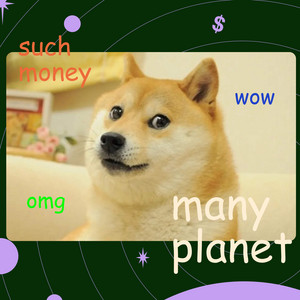
Doge, you may remember, was this super popular internet meme built around the image of a dog, a quizzical -looking Shiba Inu.
And it was paired with these kind of grammatically challenged captions, like, such wow, and much amaze.
Palmer and a friend coded up a new coin, and in doing so, they married the world of memes with the world of crypto.
For Palmer, Dogecoin was an attempt at convincing the crypto -curious to make more rational investment decisions.
But instead, the good people of the internet decided to pull a giant, irreverent yes -and to Palmer's joke coin.
They started buying more and more of them.
Palmer was surprised, and at first he went along for the ride.
He and a community of fellow crypto -jokesters donated their increasingly valuable dogecoins to charity.
And for a while, things were going well.
But... Whenever you have something that's going really successful, You have a successful community like that.
And there's a monetary element to it.
It's like blood in the water, right?
Like sharks can like smell it from miles away.
And pretty quickly, fraudsters started to use Dogecoin in the kind of pump and dumps it was meant to critique, which was exactly the opposite of what Palmer had intended.
Yeah. Tell me about it.
Right. The irony is definitely not lost on me.
You know, I feel guilty enough for creating Dogecoin, which I'm sure that people have I know that people have lost money on it in the past, and that pains me.
In the years that followed its creation, Dogecoin ended up spawning dozens of copycat cryptocurrencies, or copy doges I guess in this case.
But the number of these new meme coins was still limited by the technical expertise someone needed to make one.
You needed to be able to essentially copy and tweak Bitcoin's underlying code.
And to understand how that barrier to entry started to change, we called up Zeke Fox.
X. Zeke is an investigative journalist at Bloomberg and author of the book Number Go Up, Inside Crypto's Wild Rise and Staggering Fall.
What do you do when you're not digging into the smarmy back corners of the crypto world?
I've got three little kids, so I like to hang out with them.
And I hope they never get into meme coins.
Yes, keep them quarantined.
Zeke says that first revolution that helped spawn our meme coin -filled moment was a cultural one, the one where Dogecoin helped marry the world of memes to the world of crypto.
But the second revolution was a technological leap.
It came a few years later with the invention of a brand new blockchain called Ethereum.
So a blockchain is basically a ledger that everyone can see, and it keeps track of how many tokens someone has of a given cryptocurrency.
It used to be that in order to make a new cryptocurrency, you had to code up a new blockchain.
So Bitcoin had its own blockchain, Dogecoin had a different one, But Ethereum made it so that you could keep track of multiple cryptocurrencies on the same blockchain.
You could just create a new coin right on top of Ethereum's underlying infrastructure.
And this new Ethereum blockchain helped set off a massive surge in new cryptocurrencies, starting around 2017 or so.
They were called initial coin offerings, or ICOs.
And these coins were often framed as useful new technologies, cryptocurrencies that would have some sort of real -world utility.
This was the time when people were still really pitching blockchain as like the solution to all the world's problems.
So in general, these ICOs were like, it's the blockchain for dentists, or this is going to be the blockchain that helps track agriculture.
It's Bitcoin for farmers.
Yeah. But people are basically trading them just on hype.
And studies afterwards found that something like three -quarters of all the ICO's initial coin offerings were scams or fraud.
You can see that same quintessential pattern playing out again here, an era of utopian promises turning into a whirlwind of fraudful deceit.
Yet, Zeke says, this round of crypto speculation was also limited in its impact, because the majority of investors just did not understand the basics of transacting on the blockchain, like how to set up your own crypto wallet or trade coins.
But then came the third revolution that helps explain how we got to our current meme coin moment.
And this one had both a cultural element and a technological one.
The cultural part happened around the time of the COVID -19 lockdowns, when a bunch of bored day traders stuck at home started banding together to buy meme stocks.
Companies like AMC and GameStop.
This was the marriage of meme culture and the entire stock market.
The technological part was the rise of mainstream crypto exchanges like FTX and Coinbase.
These platforms made it easier for retail investors to buy and sell cryptocurrencies, and that helped swell the market to new heights.
During that huge crypto bubble of like 2021 -2022, there certainly was some memecoin trading, but it was not the focus of cryptocurrency traders.
The rise of the memecoin was still to come.
Most cryptobros were still focused on mainstream cryptocurrencies like Bitcoin and Ether.
And the most radical speculators were obsessing over things like non -fungible tokens or NFTs, like those weirdly expensive bored ape cartoons people were buying.
Apes together strong.
Planet of the speculative ape investments.
Exactly. But as we have learned in the cyclical history of crypto, number that go up must eventually come down.
Which is exactly what happened in November of 2022.
That's when it was revealed that the founder of crypto exchange FTX, Sam Bankman -Fried, had been secretly using billions of dollars of customer funds to make massive risky bets.
In winter 2022, FTX collapses and that's like the nadir of the crypto market.
Crypto winter, some might call it.
Yeah. So how do we go from crypto's dark night of the soul to an era teeming with more meme coins than we can keep track of?
And who are the winners and losers of this brazen new world?
That's coming up after the break.
set your own deadlines and learn on your own schedule.
That means you don't have to put your life on hold to earn your degree.
Instead, enjoy learning your way and pursue your educational and career goals without missing a beat.
A different future is closer than you think with Capella University.
Learn more at capella .edu.
Support for NPR and the following message come from Bowlin Branch.
Change your sleep with the softness of Bowling Branch's 100 % organic cotton sheets.
Feel the difference with 15 % off your first set of sheets at bowlandbranch .com with code NPR.
Exclusions apply. See site for details.
Support for this podcast and the following message come from Indeed.
You just realized your business needed to hire someone yesterday.
Indeed's Sponsored Jobs helps you stand out.
According to Indeed data, sponsored jobs posted directly on Indeed have 45 % more applications than non -sponsored jobs.
Speed up your hiring right now with Indeed and get a $75 sponsored job credit to get your jobs more visibility at Indeed .com slash NPR.
Terms and conditions apply.
Hiring. Indeed is all you need.
This message comes from Insperity.
providing HR services and technology from payroll, benefits, and HR compliance to talent development.
Learn more at Insperity .com slash HR matters.
Okay, so at this point, we've seen the same pattern play out over and over in the world of crypto.
There's a rush of utopian promises, followed by a speculative rush of shady investments, followed by a sobering collapse as all this sketchy stuff is revealed.
Dogecoin, you'll remember, was first invented as a cheeky response to the wave of sketchy Bitcoin copycats.
And you can think of the current memecoin moment as a sort of like doubling down on the joke.
When crypto exchange FTX collapsed, bringing down the whole crypto market along with it, it was like the ultimate Emperor's New Clothes moment.
Even Sam Bakeman -Fried, the person who seemed to be the face of crypto going legit, turned out to a committed fraud to the tune of billions of dollars.
In light of that, some crypto traders stopped believing in any promise of the technology's underlying value.
They started to see it as pure irreverent speculation.
And early last year, that sort of nihilistic feeling fused with yet another technological leap forward.
Zeke Fox says, this time in the form of a new website.
The latest meme coin craze was really enabled by this new trading platform called Pump .Fun that made creating a meme coin a point -and -click experience.
And more than 5 million coins have been created in like the year that it's existed.
Pump .Fun is a bit shadowy, but as far as we can tell, it was created in January of 2024 by three entrepreneurs in their early 20s in London.
We'd reached out to Pump .Fun, but they didn't get back to us.
And the idea behind the platform was basically to demolish the barrier to entry for people making new meme coins.
To create a place where people could launch and then promote their own coins as a sort of social media experience.
Let's go to Pump .Fun.
Will you give us a little safari?
Yes, definitely. Zeke took us on a little tour of the Pump .Fun website.
It looks a bit like a throwback to the Flash websites of the 90s.
All bright neon text and JPEGs of memes.
I know. It seems like something that only a child could enjoy.
Maybe a man -child. I think there's a lot of kids on there.
Some who've made a lot of money.
Pump .fun has made it so incredibly easy to make new meme coins that the homepage is just constantly updating with images of coins that have just been born, coin after coin after coin.
I'm looking at their most recent coins, and, you know, there's What If We All Hold, 27 Seconds Ago, Doge Knight, 46 Seconds Ago, Leader of Hats, One Hour Ago.
What's the kind of meme coin leaderboard today?
Some of these ones just sort of become classics and they keep trading.
Dogecoin is still top dog, I'm sorry.
Top doge. That was completely inevitable.
I shiba inu which is like a dogecoin ripoff is very high up there pepe dogwith hat has proven to have some staying power but I think fart coin is the hottest meme coin right now fart coin's going to the moon yeah I mean fart coin to me it's like how is this even funny and so I was asking my favorite
meme coin trader source about this I was like do you think it's funny.
And he said, sometimes the fact that they're not funny is what's funny.
It's like horseshoe meme theory.
Yeah. Pump .fun is a place where the newest juvenile inside jokes of the internet can be transformed almost instantaneously into tradable financial instruments.
And so you can see the stream of new coins on the site as the cutting edge of what wannabe meme coin millionaires think might go viral.
Irreverent internet culture meets the market.
Could anything possibly be more Planet Money than that?
Should we make a coin and find out?
Let's go right to the edge of making a coin and then hover on the edge.
What do you think? Should it be a cute animal?
Yeah, I mean, our mascot is the squirrel from the T -shirt project.
Oh, where can I get this squirrel?
I brought a picture of my cat, but we can use a squirrel.
Yeah, just type into Google, type in Planet Money Squirrel.
It's got a martini?
It's a squirrel with a martini glass.
Wow. This seems like it has a lot of meme coin potential.
Definitely. So what should we call it?
Well, there's either animal spirits or there's PM squirrel coin.
PM squirrel coin. Okay.
So the ticker will be PMSC.
Naturally. For the description, this is the Planet Money Squirrel.
Does that sound good?
Oh God. We're playing with fire.
We could launch a coin that just gets out of our hands.
Just so you know, you can never take it back.
We did not, in fact, launch the Planet Money Squirrel coin.
Not today, Satan. But it was a shockingly easy prospect.
By filling out a few description details and uploading a copy and pasted image from the internet, you too can be the proud -slash -parrified parent of a new meme coin.
But raising that coin to a monstrously profitable adulthood is not so easy.
Because you can think of Pump .Fun as this hyper -literal attention economy.
If a coin creator can't generate enough excitement around their meme coin, they won't be able to ensnare enough buyers to get it to take off.
It's very easy to create the coin, but what's hard is attracting attention for it.
Now, there are three basic ways people garner attention in this world, and it comes down to how much clout the person might have.
For the first group, for the people who are cloutless in crypto land, And Pump .Fun offered a solution.