WBUR podcasts, Boston.
This Circle Round episode was recorded live with members of the Boston Symphony Orchestra plus a star-studded cast of actors at Symphony Hall on February 7 2026.
You can learn more about our live events and all things Circle Round, including our picture books, merch newsletter and Circle Round Club at wburorg slash circleround.
The writer Maya Angelou once said, when someone shows you who they are, believe them.
What she meant was every action we take, every word we utter, they can be seen as reflections of our true character.
In today's tale, we'll meet an animal whose true character is revealed from the get-go, even though she tries hiding it behind a mask.
I'm Rebecca Shear and welcome to Circle Round Live at Symphony Hall in Boston, Massachusetts.
Today our story is called The Masked Bandit.
It comes from the Sioux, one of North America's oldest and largest indigenous tribes.
Joining me on stage is a star-studded cast of actors Michael Bobbitt, Michael Cerveris, Hallie Crossley and Faith Saley.
Providing musical accompaniment, under the direction of our own Eric Shimalonis, is a world-class ensemble from the Boston Symphony Orchestra Kathy Basrak on viola, Rachel Childers on horn, Chris El Chico on clarinet, Clint Foreman on flute, Ben Levy on double bass and Suzanne Nelson on bassoon.
So circle around, everyone, for The Masked Bandit.
¦ ¦
Long, long ago, before people roamed the earth, there lived a raccoon.
How you doing?
I'm raccoon.
Raccoon's stout, stocky body was covered with dense gray fur.
Her legs were short but strong, and the flexible toes on her paws helped her climb up and down trees, with her bushy ringed tail bobbing behind her.
But of all raccoon's features, The most distinctive was the patch of dark fur around her eyes.
Oh, I love that patch of dark fur.
It's so cool.
It looks kind of like a bandit's mask, you know?
I sure do.
And that's a rather apt comparison actually since, just like a bandit, you're always stealing things.
Stealing things?
Little old me?
Yes, little old you.
Come on, raccoon.
You're notorious for swiping stuff from the other animals.
Am I?
Yes.
Especially food, given that you'll eat just about anything.
Be it fruits, nuts, fish, frogs, bugs, icky, smelly, dead things.
I like to think of myself as an opportunistic omnivore.
Well, thanks to your opportunistic omnivorism, the other animals don't trust you.
Isn't that right, other animals?
Oh, yeah.
No, it's totally right.
We don't trust her at all.
What?
Get out of town!
I'm not that bad, am I?
Not that bad?
Listen, raccoon, I'm a skunk, so I'll eat just about anything, too.
But I don't...
And as an opossum, I've engaged in my own share of opportunistic omnivorism.
But even if I'm not picky about what goes down my gullet, I don't take food from other animals.
Nor do I. Squirrels like me do occasionally snatch an acorn from our brothers and sisters.
And once people start roaming the earth, they better keep an eye on those bird feeders.
Excellent points all around.
So, what do you have to say for yourself, Raccoon?
Um, I guess I have to say, what's a bird feeder?
Now, Raccoon wasn't just an opportunistic omnivore.
She was an insatiable one, too.
The nocturnal critter was always craving food, whether she was out and about under the moon or fast asleep under the sun.
One evening, just before sunset, Raccoon was snoozing away when her grumbling stomach startled her awake.
Whoa!
Was that my stomach?
Gosh, it sounded like rolling thunder.
Or an out-of-tune bassoon.
Oh, I am so hungry.
I could eat a, well, pretty much anything.
Ooh, now that the sun's going down, I'll go out and grab some chow.
Raccoon headed toward the river and as she did, the water birds began to panic, fearing that the sneaky scavenger would swoop in and scoop up their eggs.
One by one, the birds raised a call of alarm.
First, swan.
Then crane.
Then sandpiper. until every bird was honking, squawking, and tweeting away.
Sheesh, guess I won't be eating an omelet tonight.
I'd better move on.
Raccoon was scooting through a tangled patch of grass when she stumbled upon Skunk.
Skunk was nocturnal just like she was, but even though it was nighttime, he was still sleeping in his bed of leaves.
Beside him was a stack of pungent, overripe apples.
If I can't have myself an omelet, I'll have myself some fruit.
I'll swoop in and swipe some of Skunk's apples.
Say two or three or 30.
But the moment Raccoon thrust out her fingers.
What do you think you're doing?
Skunk leaped to his feet.
I heard you sneak up on me, Raccoon.
Don't you dare steal my apples. your apples, little old me?
Oh, please.
We've heard this song and dance before.
You're a food-snatching bandit and everybody knows it.
So go grab your own grub or I'll spray-ay-ay you.
Skunk smiled and began lifting his tail.
Yikes!
I'd better get out of here.
And she did.
Raccoon raced away, running and running until she reached an oak tree.
Snoozing inside a nest of twigs was Squirrel.
Beside her was a gleaming pile of acorns.
Since Squirrel is diurnal, not nocturnal, she'll be asleep all night.
So if I can't have myself an omelet and I can't have myself some fruit, I can at least have a handful of nuts.
If not two handfuls, or twelve!
But the moment Raccoon stuck out her paw... Hold it right there.
Squirrel snapped open her eyes.
I thought I heard someone creeping up on me.
Don't you dare make off with my acorns, Raccoon.
Make off with your acorns?
Little old me.
Oh, spare me.
We all know what a bandit you are.
So go get your own food or I'll call all my brothers and sisters and we'll chase you far, far away.
Squirrel let out a whistle.
Within seconds, dozens of squirrels came scurrying over.
Yikes!
I'd better get out of here!
And she did.
Raccoon raced away, running and running until she reached a hollowed-out log.
Snuggled up inside was a possum.
A possum was also nocturnal, but he hadn't yet woken up for the night.
Heaped by his feet was a writhing, wriggling mass of slugs.
Ooh, well, looky here.
I guess, if I can't have myself an omelet and I can't have myself some fruit and I can't have myself some nuts, I'll have myself some slugs.
Or the entire juicy heap.
But the moment she reached for the soft-bodied mollusks... Not so fast.
...a possum jolted awake.
First off, narrator, nice use of the word mollusks.
Thank you.
And second, raccoon, don't even think of swiping my slugs.
Swiping your slugs?
Little old me.
Oh, come off it, raccoon.
You're not fooling anybody.
So go find your own eats, or I'll faint.
I'm sorry.
Your what?
I'll faint.
And that's scary and threatening because why?
Ever heard the expression playing possum when you pretend to sleep or be dead?
Uh, yeah.
Well, as a real possum, I can faint.
I can flock to the ground and enter a comatose-like state called tonic immobility, in which I go limp.
And?
And the moment I go limp, I also release the stinkiest, stenchiest odor you ever did smell, accompanied by an ooze of icky green fluid.
So...
You ready?
Opossum's eyes glazed over.
His tongue lolled from his mouth.
Yikes!
I'd better get out of here!
And she did.
Yet again, Raccoon raced away.
She didn't stop running until her nose caught a whiff of an unfamiliar and utterly delicious scent.
Something around here smells amazing.
It's so sweet and rich.
It's kind of flowery and also kind of fruity.
I must find out where it's coming from.
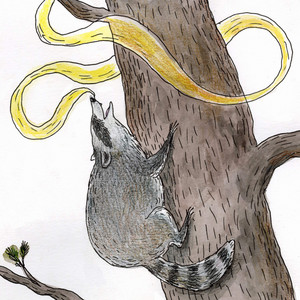
Raccoon sniffed and sniffed until she tracked the scent to a cypress tree.
Trickling down the tree's trunk was something gooey and golden.
Little did Raccoon know, but that gooey gold was about to gum up her plans.
What do you think will happen next?
And what is that golden goo?
We'll find out after a quick break.
Reviews are in and super fans like you are loving the circle round club.
An exciting opportunity to support public radio and get cool stuff, including ad-free episodes and a personalized birthday message from me.
What i like about the circle round club is that rebecca shears sends extra messages and it supports the show, and there are no ads Grown-ups.
Support public radio and sign up today at WBURorg.
Slash CircleRoundClub.
I'm Rebecca Shear and welcome back to CircleRound Live at Symphony Hall in Boston, Massachusetts.
Today our story is called The Masked Bandit.
Oh.
Before the break, Raccoon failed in her attempts to steal food from the other animals.
But then she caught a whiff of something so delicious, so scrumptious.
She had to find out what it was.
She tracked the appetizing aroma to a cypress tree whose trunk was dripping with something gooey and golden.
She gave the stuff a lick.
Oh, wow!
I've never tasted anything this heavenly.
I must have more.
Grasping the trunk with her nimble fingers, Raccoon began to climb.
She climbed higher and higher, seeking the source of the golden goo.
She finally traced it to a hole in the trunk and thrust both of her paws inside.
When she pulled them out again, they were covered with sticky honey.
But they were also covered with bees.
Bees. angry bees who began stinging her all over.
Thing is, in those early days of the world, Raccoon had never tasted or seen honey, nor had she ever seen a bee.
What is happening to me?
And where is that buzzing coming from?
She slapped at her body with her honey-covered paws, hoping to drive her mysterious pesterers away.
Instead, she just slathered herself with honey from head to toe, and the stings kept coming back.
Yikes!
I'd better get out of here!
Raccoon took a leap and dove down from the tree.
A pile of dead, crunchy leaves cushioned her fall.
The dead, crunchy leaves clung to her dense, sticky fur.
So by the time she pulled herself to her feet, she wasn't just covered in honey.
She was covered in leaves.
The crunchy dead foliage plastered her entire body, including her fuzzy face and masked eyes.
Dazed and distressed, Raccoon stumbled this way and that.
Until she was finally spotted.
What in tarnation!
By Opossum.
But he had no idea who or what he was seeing.
What is that thing?
Is it a monster?
It must be a monster!
Raccoon couldn't see through the leaves, but she knew a possum's voice when she heard it.
Oh, possum?
Oh, please, can you help me?
But a possum didn't answer.
He had already run off and cowered beneath a bush.
So Raccoon staggered on, moaning and groaning.
No!
No!
Her cries woke up Squirrel, who had been curled up in her nest.
When she laid eyes on the mysterious creature barreling her way, she let out a squeak.
There's a monster down there!
A monster!
Raccoon craned her neck toward Squirrel's voice.
Squirrel?
Oh, please!
Can you help me?
But Squirrel didn't answer.
She had already scrambled away through the treetops.
So Raccoon bumbled on.
She soon passed a berry bush where Skunk was feasting on fruit.
When he caught sight of the creature straggling toward him, his eyes went wide.
Oh my gosh!
Oh my gosh!
Oh my gosh!
It's a monster!
A monster!
Raccoon swiveled her head in Skunk's direction.
Skunk!
Oh, please, can you help me?
But Skunk didn't answer.
He had already hot-footed away and huddled beneath a boulder.
Raccoon stumbled onward, careening this way and that, until...
Oh, oh, that rippling, flowing sound I hear.
It must be the river.
Raccoon didn't waste a beat.
She lurched to the shore and dove into the current, letting the cool water soothe her stinging body.
Ah, much better.
Well, after that unfortunate, ill-fated evening, Raccoon vowed to change her tune.
She wholeheartedly promised to stop stealing.
I will stop stealing!
And pilfering.
I will stop pilfering!
And swindling.
I will stop swindling!
And do you think she stuck by her word?
Do you?
Oh, come on!
Of course I did!
Actually, you didn't.
By the time your bee stings faded, so did the memory of your promise.
And you went back to your old ways.
Well, you know the old saying, you can't teach an old raccoon new tricks.
And that's why, to this day, if someone sees raccoon coming be it an unassuming animal hanging out in the woods or an unassuming human taking out their garbage, they had better be on alert.
Because if they're not careful, the furry masked bandit is bound to strike again and again, and again.
Now it's your turn.
Raccoon's new encounter with the bees was rather surprising.
So think about a time you encountered something new.
Maybe it was a new place, a new person, or a new experience.
Think about what that new encounter was like.
What did you learn?
Find a grown-up and tell them all about it.
Then ask them what they learned from a new encounter of their own.
This week's story, The Masked Bandit, was adapted by me, Rebecca Shear.
It was edited by Dean Russell.
Circle Round's composer is Eric Shimalonis, who conducted our world-class ensemble from the Boston Symphony Orchestra.
Kathy Basrak on viola, Rachel Childers on horn, Chris El Chico on clarinet, Clint Foreman on flute, Ben Levy on double bass and Suzanne Nelson on bassoon.
Our cast at Symphony Hall included Michael Bobbitt, Michael Cerveris, Callie Crossley and Faith Saley.
Special thanks to everyone at the BSO, including Chad Smith, Tony Fogg, Mark Rulison, Kazmir Duranet, James Campbell, Dana Falloon, Jason Lenhard, Stephen Ponchak.
Circle Round's artist is Sabina Han.
Sabina has created a black and white coloring page for all of our Circle Round stories and you can print them out and color them in.
Grownups, visit our website, wbur.org, and click on Coloring Pages.
While you're at WBURorg slash Circle Round, you can explore our Circle Round picture books, our merch and swag and you can sign up for your monthly Circle Round newsletter, The Lion's Roar.
Again, it's all at WBUR.org slash Circle Round.
Looking for more ways to Circle Round with us?
Join the Circle Round Club and support your favorite public media podcast, while getting all sorts of cool perks, including ad-free episodes, bonus bedtime stories, Audio features about Eric's musical instruments, plus the chance to add on goodies like our Circle Round t-shirt, lion stuffy and a personalized birthday message from me.
Grownups, visit WBUR.org slash Circle Round and click on Circle Round Club.
Love the stories you hear on Circle Round.
Grownups, please leave us a five-star rating or review on your favorite podcast app.
And please tell your friends about the show.
With your help, we can make the Circle Round circle grow even bigger.
Circle Round is a production of WBUR, Boston's NPR.
I'm Rebecca Shear.
Thanks for circling round with us.
Now that you've made it to the end of this Circle Round episode, we want to know what's your favorite Circle Round story.
Thousands of fans just like you have been telling us about the Circle Round stories they like best.
Take a listen.
Maybe one of their favorites is one of yours, too.
My name is Eliana, and I live in Qatar.
And my favorite Circle Round story is the horse in a different taller.
My name is Dominic and I live in Boston, Massachusetts.
And my favorite Superlounge story is Anansi the Spider and the Sky Goddess.
And I like the part where Anansi gets piped on and where Sky Goddess can barely talk.
My name is Nina, and my favorite Circle Round story is The Horse of a Different Color.
I like how it has a rainbow-colored horse.
My name is Sohana and I live in Austin, Texas.
My favorite Circle Round Stories is the Blizzard Wizard and the Coconut a Day.
My favorite part of the Blizzard Wizard is when the girl gets the three arrows and the bow from the sun.
My favorite part in the Coconut a Day is when the lady gets the bottle of magic water from the little red man.
My name is Thea.
I live in Beacon, New York, and my favorite Circle Round story is The Sea in the Sky.
And I like the part when the kite plays the trick on the sea in the sky.
My name is Caleb, and I live in South Florida.
My favorite Circle Round story is The Laughing Bird.
I like the part when the laughing bird laughs.
My name is Hazel.
And my name is Ray.
And we're from Anacortes, Washington.
And my favorite story is the nine sticks, because I like the part when Beer Ball explains to the emperor how his plan worked.
And my favorite story is the all with stick, because I like the part when Faye gets her all with stick.
We love you, Rebecca Spear.
Did someone mention a story you've missed?
Not to worry.
Grownups.
You can find all of our Circle Round stories, plus links to the Circle Round Club, picture books, coloring pages and oh so much more on our website wburorg slash circleround.