In the U.S., national security news can feel far away from daily life.
Distant wars, murky conflicts, diplomacy behind closed doors.
On our new show Sources and Methods.
NPR reporters on the ground bring you stories of real people, helping you understand why distant events matter here at home.
Listen to Sources and Methods on the NPR app or wherever you get your podcasts.
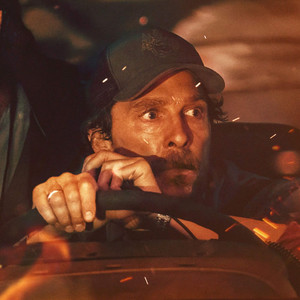
The new movie The Lost Bus, is a harrowing drama, a climate warning and a disaster film, all based on a true story from the enormous campfire in California in 2018.
Matthew McConaughey and America Ferreira play a bus driver and a teacher who have to transport more than 20 kids to safety when evacuation orders roll in.
I'm Stephen Thompson.
And I'm Linda Holmes.
And today we're talking about The Lost Bus on Pop Culture Happy Hour from NPR.
Listen to Ye Gods, part of the NPR network, wherever you get your podcasts.
I'm Jesse Thorne.
Ghostface Killa told me about when he was a kid.
He found the number of his hero, Dougie Fresh.
He dialed it.
He didn't really think it through.
And he's like, hey, who this?
And it just goes quiet like that.
Ghostface Killa.
That's on Bullseye from MaximumFun.org and NPR.
Joining us today is Ronald Young Jr.
He's the host of the film and television review podcast, Leaving the Theater.
Hello, Ronald.
Hi, Linda.
The Lost Bus stars Matthew McConaughey as Kevin McKay, a school bus driver in Paradise, California.
He's been looking to pick up extra work, but he's still nervous when he learns that there are more than 20 kids who need help at an elementary school in an area that's being evacuated as the dangerous fire approaches.
Their parents cannot come and pick them up, so they have to be taken to a safe meeting place.
Kevin loads them onto his bus along with a teacher named Mary, played by America Ferreira.
Kids, this is our bus driver, Kevin.
Can you say hi to Kevin?
Can I get you in two straight lines, shortest in the front, tallest in the back?
What follows is a terrifying and unpredictable trip through streets blocked by cars, total confusion about what areas are on fire, and efforts to get in touch with family and authorities as networks fail.
The film is directed by Paul Greengrass, who has made several fact based films about different catastrophes like United 93, Captain Phillips and 22 July.
Maybe a little surprisingly, his other claim to fame is having made several of the Jason Bourne movies.
The Lost Bus is streaming now on Apple TV.
Stephen, I'm going to start with you.
I saw this in Toronto.
You just saw it more recently.
What did you think?
I think it's a very, very effectively made disaster movie.
It is several different kinds of movies at once.
It's a disaster movie.
It's a family drama.
As you kind of noted up front, it's a climate warning.
There are a number of Kind of elements to this story.
Where it works, I think, very effectively is purely as a disaster movie.
Once you start getting into the based on a true story of it all and kind of balancing the story that it's telling against the facts on the ground of a disaster that took place only seven years ago, I got a little queasier about it.
You know, this is a very big, very sad story.
And to see it fictionalized and kind of given this gloss of you know he has an estranged son and she's trying to get to her kid.
And some of that stuff felt a little rote to me.
So much of the story is just like moving extraordinarily extremely propulsively from scene to scene in a way that makes these like two hours and ten minutes absolutely fly by, and that element of it i really, really appreciated, as well as kind of the technical gifts that go into this film.
Cgi fire has long had a major uncanny valley problem that i think they're starting to push past.
I think the sound design is extremely impressive and on balance i enjoyed it, just with a few reservations, Okay.
Thank you very much.
That makes sense to me.
Ronald, what did you think about The Lost Bus?
I agreed with everything Stephen said, but I think that I was left a little bit more meh than Stephen was, because most of those elements I remember as soon as the film came on.
Well one I didn't watch this in a theater.
I watched this on my computer.
And right off the bat.
As soon as I see Matthew McConaughey, I'm like.
This seems like a miscast to me.
Not because he can't be a bus driver, but until he starts doing the kind of overwrought family stuff with his family, I did not understand why he was cast for this role specifically.
Like, for instance, if I looked at Ashley Atkinson who's playing his boss, I thought that was perfect.
The way she was playing the role, the way she was interacting with him.
All of that just felt very much that character.
It's a bit of a sticky time.
Yeah, I just don't have anything for you, Kevin.
Well, I said, maybe.
Yeah, and people that have been here longer, the guys that have seniority, they get their stick of the overtime shifts.
Mind your business, old man.
If anything comes up, I'll let you know.
Do you copy?
Whereas Matthew McConaughey just felt like Matthew McConaughey, having family problems, who also happens to drive a bus.
There was just something about that that just threw me off straight from the beginning.
And then when we get to the big scenes of the fire and kind of more, you know the massive everything's on fire, like you said CGI, all of that.
I thought it looked good, but I knew it would have looked better on a big screen.
And I think that was probably one of the deficits of, you know, watching it like that.
But all of it together, even when we get to the end, there's not much character development of the kids.
So I don't end up caring about the kids that much.
And then they keep telling me that Matthew McConaughey and America Ferreira are going to get their kids.
And I don't care about their kids either.
And I want to be clear.
I care about kids as a whole.
I just didn't care about these kids or their kids in a very specific way that I feel like the movie was supposed to make me.
So at the end, I kind of just felt left very mid on this movie.
Yeah.
So when I saw this in Toronto, two things I think were important to the fact that I really liked it when I saw it there.
One is that my expectations were very moderate.
I think, going into this, before it had premiered at Toronto, the trailer was out and it was like Matthew McConaughey, tough bus driver.
And it was like, what?
And even though it's fact-based and obviously it's a very important story, it kind of had this feeling like It really felt like it could go powerfully either way.
So I think I knew a lot less about it than people know about it going in now that it got a relatively good reception there.
The other thing is I saw it in a gigantic theater with a ton of people.
And I do think that a film like this that operates on scale benefits from that.
I use the word spectacle, but like, not in the like razzle, dazzle way, but like spectacle in just the idea of scale.
I think benefits a bit from being on a big screen like that.
And part of me does think that maybe this is not a movie that the ideal home for it is home viewing.
At the same time.
I will say also Stephen mentioned the sound design is a known fact that you know.
This is not a story about a bunch of people dying on a bus, particularly children.
They do make it through this fire.
He did eventually deliver these kids on the bus.
And at the moment when you realize that they're going to survive.
And When I watched it at home, I was able to appreciate the way that they use sound design and particularly silence.
Yes.
Whereas in the theater, you got a gigantic explosion of audience applause.
Yeah.
And it was a very different feel.
So in that sense, I appreciated it, seeing it in this way.
I will disagree, I think, with Ronald about McConaughey who, I think – is actually pretty good in this.
What i like most about that character is that he doesn't want to do it.
It is true of both mary the teacher character and kevin the bus driver.
Right, they don't want to do this.
They don't go in and say, you know gosh, darn it, i'm the right one, let me go.
They both have their own families they want to get back to, and i think that's used effectively and in a way that I thought worked very well.
So I really think it's good.
Oh, and thank you, by the way Ronald, for mentioning Ashley Atkinson, who I think is terrific in this.
She's a character actress I've seen a million times, often being funny.
This is straight-up dramatic.
And I think she's absolutely great in it.
I agree.
I think she's terrific.
I wish America Ferreira had a little bit more to do.
I wish that character were a little better...
I think that character feels like a little bit of a nothing.
I agree.
I love Ashley Atkinson in this film.
I do want to put in a word for if you're going to watch this movie at home, if you're not going to see it on a big screen, I recommend seeing it the way I saw it, which was on a laptop with a really good pair of headphones.
Because that gives you a feeling of claustrophobia that I think actually works with the way this film is paced.
It is a stressful viewing experience, but it is a very enveloping one.
And sometimes, you know, I do find, especially when I'm watching movies on my computer, when I'm kind of at home, I am a very easily distracted person.
I'm somebody who really keeps a finger on that pause button.
And watching it that way, I was really propelled through the film and not really tempted to pause, in part because the movie is just kind of echoing in my head.
And I think that's a very, very different experience versus seeing it in a theater, where it's on a gigantic screen.
I do think it can be an effective home viewing experience.
Yeah.
I mean, I think probably I would have benefited from watching this on a bigger TV with surround sound.
But again, for me, I think the juxtaposition of family drama versus actual disaster is is something that whenever you do a disaster movie, I would almost prefer that it wasn't built on a real disaster, if that makes sense.
It's I mean, it is pointing to the future, obviously, but it's crafted in a way that makes it so that the drama is integrated with the story itself.
And there's a coming together that I actually care about because you built it up that way.
Whereas in this one, we know that the fire was real.
I don't know if his son got sick that morning.
Or even as soon as he's talking to his boss about the extra hours and all that.
For me, I remember just thinking, just get in the fire.
Like, what are we doing?
Like, get on the bus.
Let's get these kids to where they're supposed to be going.
And I don't know if we needed to build it that much.
That's kind of where it started to split for me.
But I want to be clear.
When they're in the fire, when everything bad is happening, and it's a disaster movie.
It is a good disaster movie.
It's just the rest of it kind of just kneecapped it for me.
Yeah.
Yeah.
I would defend, I think, doing it about a real disaster in this case, because it's obviously meant to be a gripping story.
And we've talked about that.
But I do think they want this movie to help people understand something about what these real fires feel like.
Yeah, I definitely recognize that.
What I appreciated about that is that when you're in the fire, the heat and the flames and the smoke and the fact that the entire thing feels like it's taking place at night because it's so dark from smoke, which I think they use very effectively.
I agree.
But what I really took away from this and what has really stuck with me is how effectively I think they portray a fire like this as a logistical challenge and as chaos.
The scariest thing about this fire for a lot of people is that it's incredibly hard to know what's going on, because your access to information starts to be cut off.
The dispatcher played by Ashley Atkinson and Kevin are sort of both sending off messages to each other at times when they do not know if the other person can hear them or not, because the communication is failing.
The people who are trying to manage the fire are trying to get information back and forth about what's going on in different places.
And I think the film is really effective in capturing just the confusion and the chaos and the difficulty in responding.
I think if you grew up mostly in cities, when you think about firefighting you think about like a bunch of guys standing there with hoses, right?
And that is not what this kind of firefighting is, not only because a lot of it is planes, but a lot of it is trying to, you know, take down trees, and there is so much involved.
It's an incredibly complex thing.
And then Obviously, when you have a town that is evacuating, you have the problems with roads being blocked and everybody trying to leave at the same time.
You have issues with in this case, because it's a kind of a mountain community.
You have roads that wrap around the edges of mountains.
And they're very difficult places to take a vehicle like a school bus or a fire truck.
So I found all of that stuff really impressive.
And I will say I walked out of this movie thinking, I think.
This is going to be potentially really triggering for people who have had experiences with fire.
And when I left this film, I got onto an elevator with a group of people and there's a woman on there and we were all just kind of shaking our heads like oh my God, that was a harrowing experience.
She said, I just recently lived through a fire.
And she immediately started to tear up on the elevator.
So I do just want to be very open about the fact that I think if you have experience living through not even just in a fire like this but near one, living through the effects of it, I do just want to put that out there that I think it's potentially pretty dangerous. upsetting i did question that a little bit and knowing that it is a net positive to bring attention to the fires in california especially after the year that we just had there was a part of me and i don't know if this is just from the political state that we're in or the way i'm thinking now that was watching this and thinking i hope that no one thinks that this was an opportunism like let's make a movie about a fire because people are still thinking about it right now but knowing how movies are made i imagine it was already in the can and they were already working and they were going in that direction Well, I think also with Greengrass, this has been kind of his jam.
He's been very interested in going very deep on real life tragedies and catastrophes and trying to kind of dig into what happened in recent tragedies.
I mean he made united 93 not terribly long after september 11th, when that was still very, very raw in people's minds.
Yeah yeah, i think it's a good film and i will mention the book which is called paradise.
One town's struggle to survive an american wildfire, by lizzie johnson, is not just about this bus.
That is essentially one of a whole bunch of stories that are woven together In the book.
The book does have other stories that kind of flesh out the situation, including stuff about funding and policy decisions and things like that that have made these fires either more or less likely or more or less difficult to respond to when they happen.
Yeah.
Yeah.
Well, I think this one is well worth your time.
You can see what you think and tell us what you think about The Lost Bus.
Find us on Facebook at Facebook.com slash PCHH and on Letterboxd at Letterboxd.com slash NPR Pop Culture.
We'll have a link in our episode description.
That brings us to the end of our show.
Ronald Young Jr., Stephen Thompson, thank you so much for being here.
Thank you.
Thanks for having me.
Thank you so much for having me by our showrunner, jessica reedy.
Hello, come in, provides our theme music.
Thank you for listening to pop culture.
Happy hour from npr.
I'm linda holmes and we'll see you all next time.