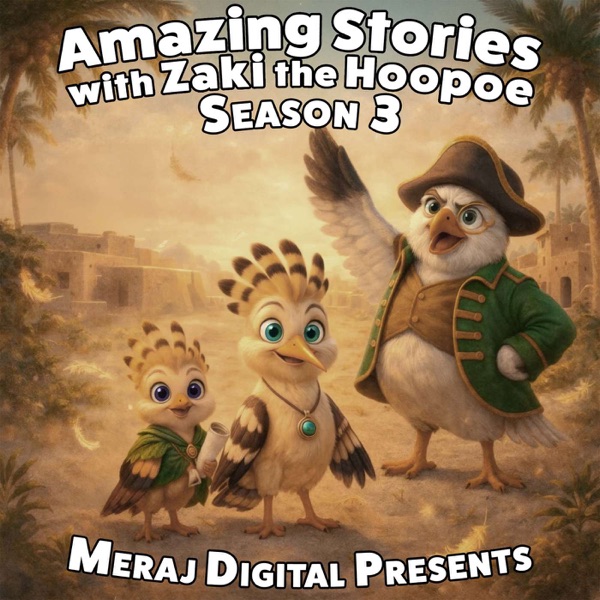
Blasted barnacles by the slippery scales of samudra.
He took it right out of me.
Claws took what, captain sohail?
What says the hoopoe?
Only the finest smoked haddock roll this side of the arabian gulf, Snatched by a pelican.
A pelican, I say.
Wait, are you telling me a pelican robbed you?
It wasn't a robbery.
It was tactical fish-snapping.
He flapped in like a floating pirate ship and wham, right off me perch.
Whoa!
Did you chase him?
Did you squawk him down?
Did you...
Oh!
Do the triple wing flap spin swoop!
I strategically chose not to engage.
You let him get away?
Nay, young feathers, I let diplomacy prevail.
You hid under the crate of dates.
It was a tactical retreat, I tell you.
Besides, not every battle must be fought.
Sometimes the brave bird is the one who doesn't get pecked in the beak.
Or maybe...
The brave bird is the one who stands up when someone's being unfair.
Even if they have giant pouches and scary eyebrows?
He returns, the beat-pandit o' the pay.
Oh dear, are we retreating... again?
Or are we going full seagull-nado this time?
Nay, if he swoops again, I shall stand my ground.
I shall flare my wings, puff my chest and declare you may take my fish, but you'll never take my pickled olives.
I ate the pickled olives.
Last week, mirage digital presents the amazing Season 2, Episode 17 The Lion of Allah.
Salaam, my fine-feathered friends.
It's me, Zaki the Hoopoe, your humble, wing-flapping narrator, ready to take you on another incredible journey.
And don't worry.
I've made sure Captain Sohail is far away from any snack-snatching pelicans today.
I heard that, lad.
And I've drawn a line in the sand.
Literally.
A big wobbly one.
No bird crosses it without a duel.
We'll check back on that later.
But first, today's story is one of bravery, real bravery, the kind that doesn't come from flapping your feathers or puffing your chest, but from standing up for what's right, even when everyone else is too scared to speak.
Have you ever seen someone being treated unfairly?
Maybe someone getting picked on or left out?
And you wanted to say something, but you were afraid?
I think that happens more than we talk about.
That's what makes today's story so powerful.
It's about someone who saw injustice and couldn't stay silent, not even for a moment.
A man who stood tall, even when the whole city stood against him.
Aye, not all heroes wear capes.
Some wear camel hide vests and carry a lion's heart.
That hero's name was Humza.
Maka was changing.
Not the mountains or the markets, no.
The city looked the same, but it felt different.
Ever since the Prophet Muhammad began calling people to Islam, the Quraysh, his own tribe, had turned against him.
But wasn't he known as Al-Amin, the trustworthy?
He still was, but people fear what they don't understand.
And instead of listening, the Quraysh grew angry, furious even.
Muslims were now being hurt just for believing.
Ammar ibn Yasir, a young man filled with faith, watched his parents, Yasir and Sumayya, beaten in the scorching sun.
Bilal, a former slave who whispered, one God, one God, was dragged across the burning sand.
And then it got worse.
One day, right near the Kaaba in front of everyone, Abu Jal hit the prophet.
He mocked him, humiliated him, And no one dared to stop him.
He hit him?
In front of the city.
And the city stayed silent.
Cowards!
If I'd been there, I'd have dive-bombed that scoundrel right in the turban.
All because they said, there is no God but Allah.
That's not fair!
Why didn't anyone stop them?
Some wanted to.
But fear, fear can make even the strongest wings fold.
The Quraysh were powerful and most people were too afraid to speak.
But not everyone stayed silent.
One man, one lion-hearted man was returning from a hunt.
Bow on his back, dust on his cloak, and fire in his heart.
Aye, the man who wrestled lions and raced camels, a hunter, a warrior, a protector.
And the Prophet's uncle.
It's Hamza, isn't it?
Hamza ibn Abdul Muttalib.
The Lion of Allah hadn't yet heard what happened, but when he did, the entire city would tremble.
Hamza was returning from the hunt.
His bow slung across his shoulder, his sandals dusted with desert wind.
He had spent the day in the wild, where he felt most alive.
"'By the hammocks of Hejaz!
Look at that stride!
That's not walking, lad!
That's conquering the road!'
Captain Sohail, are you blushing?
What nonsense.
I just admire a man with proper feather.
Ahem.
Footwork.
Strong wings.
Solid stance.
Tactical eyebrows.
You have a crush, Captain.
Nay.
I respect his battle posture and his ability to glare at danger until it runs home crying to its mother.
All right, all right.
But you're not wrong.
Hemza wasn't just brave.
He was brilliant.
A warrior, a protector.
And more than that, he was the Prophet's uncle.
But as he stepped into Makkah's streets, he noticed something off.
The people were whispering, not the usual Hamza's back with fresh meat whispers.
These were different.
What were they saying?
That Abu Jal had hit the Prophet, that he had cursed him, humiliated him in public, and no one had stopped him.
That scurvy-footed coward.
He wouldn't last a moment in a real duel.
Hamza felt it like an arrow to the heart.
You see, he loved his nephew, not just his family, but as someone he deeply respected.
The Prophet had always been honest, kind, full of mercy.
Hamza had watched him grow, seen his character, his strength.
And though Hamza hadn't accepted Islam yet, he knew deep down that what Muhammad was teaching wasn't falsehood.
It was something real, something worth defending.
So, his jaw clenched, his eyes narrowed and without a word to anyone, Hamza turned and marched straight toward the Kaaba.
By the salt of the seven seas, this is it.
This is a man who doesn't wait for justice.
He brings it with him.
He's really going to face Abu Jal.
Face him and something more.
I mean, did you see the way his cloak billowed in the wind just now?
Like a thundercloud with muscles.
Sohail.
What?
I'm just saying, if I ever get into trouble, I want that man showing up.
Cloak, bow, righteous fury.
Maybe a small fog machine.
The Quraysh were gathered near the Kaaba, Smug in their power, laughing about what Abu Jahl had done.
Their voices were loud.
Too loud.
And then, silence.
A shadow crossed the courtyard.
Hamza had arrived.
Is this it?
Is he going to stop him?
Now remember, Hamza was the bravest person in Makkah.
Everyone knew how strong and bold he was.
Bold, you say?
In fact, he was so strong and bold that people were actually a little afraid of him.
Not because he was mean, because he was the bravest person who wasn't afraid of anything.
So imagine the people when they saw Hamza walking towards the Kaaba.
Hamza didn't shout.
He didn't need to.
Hamza walked straight up to Abu Jal, straight through the crowd like a lion through reeds.
Eyes locked, shoulders set, fire in his stride.
Then he raised his bow and all of a sudden struck Abu Jal across the face.
Abu Jal fell to the ground in shock.
He couldn't believe that Hamza just hit him across the face.
No one even dared speak back to him and Hamza just smacked him across the face.
Now, that's a lion if I've ever seen one.
Hamza looked into Abu Jal's eyes and said You lay a hand on Muhammad, then know this I Hamza, son of Abdul Muttalib, follow his religion now and I stand with him.
Next, Hamza stepped closer, his voice like thunder in a storm, and said, Muhammad is my nephew.
From this day on, whoever harms him will face me.
And just like that, everything changed.
By the golden gills of the Gulf, I...
I think I need a moment.
He just said it?
Like that?
In front of everyone?
Just like that.
No hesitation.
No fear.
Hamza declared he was Muslim right there, before anyone could stop him.
I'm fine.
I'm fine.
Totally fine.
Just something in me eye.
Maybe sand?
Or destiny?
What is this strange warmth in my heart?
Is this what admiration feels like?
I need to lie down in a bucket of ice. and sardines.
Oh, Captain Sohail.
It's okay, Uncle Sohail.
Everyone needs a hero.
I think Hamza would totally like you.
You think he'd let me join his patrol?
Or shine his sword?
Or fluff his saddle blanket?
I'm willing to start with minor camel chores.
One step at a time, Captain.
After that day, no one dared harm the prophet in public.
Not while Hamza stood by his side.
So he didn't just protect his nephew.
He protected everyone.
That's what love does.
And courage.
And faith.
Hamza wasn't just a lion in battle.
He was a shield for the truth.
And a fine feathered role model, if I do say so myself.
You may, Captain.
You may.
Uncle Zucky?
Was Hamza scared?
Maybe.
But being brave doesn't mean you don't feel scared, Nunu.
It means you do the right thing anyway.
So, it wasn't just about being strong?
Exactly.
It was about being true.
He didn't just protect the prophet because he could fight.
He did it because he loved him and he knew the truth when he heard it.
And he said it.
Even when no one else would.
Aye, that's the sort of courage that knocks the wind out of the cowards and makes the bullies choke on their own bad breath.
Not how I would have put it, but yes.
I think I'd be scared too if I saw someone being hurt.
Even if I knew it was wrong.
That's honest, Nora.
And that's why we tell these stories.
So we can remember what courage really looks like.
Sometimes it's quiet.
Sometimes it roars.
But it always stands for the truth.
And sometimes it looks like a dusty hunter with a lion heart and a bow on his back.
Or a little bird in a big school who says, Hey!
That's not fair!
That's the start of every great roar.
What a story, huh?
Hamza.
Uncle.
Warrior.
Believer.
When he stood up, it was like a mountain moved and the muslims finally had someone to stand with them and, as the prophet's uncle, he gave hope and support and safety, just like my uncles do, oh dear, the ice sweats are coming back and, speaking of safety, Our next story will take us far from Makkah, across the sea.
Some of the Muslims had to leave to find safety.
We will meet someone new.
He was Prophet Muhammad's cousin.
That's the story with the king.
That's right.
But did the Muslims get accepted or turned away?
And who gave the speech that changed everything?
Was it me?
Did I give the speech?
You weren't there, Captain.
Always the same technicality.
Join us next time as we sail across waves, across borders, and into the court of a king.
A king who listened to the truth with his heart.
Because when you carry faith, Allah always makes a way.
Ay, lad, faith, courage, and maybe a fast ship with snacks below deck.
I mean Hamza just declares his faith, slaps a tyrant and walks off like a thundercloud with purpose.
I don't need to go to Abyssinia.
I need to be shipped there in a crate, soaked in humility and Hamza's leftover courage.
Somebody stamp me fragile and send me to Abyssinia for repairs.
This story was produced by Mirage Digital.
Voices provided by Wayne Holland as Zucky and Curtis Fletcher as Captain Sohail.
Episode written, directed and edited by Syed Kashf and Atef Hussein.
For more content by Mirage Digital, please visit our site at www.mirage.digital.
Content copyright and production copyright 2025 by Mirage Digital.