I'm Rachel Martin. You probably know how interview podcasts with famous people usually go.
There's a host, a guest, and a light Q&A, but on Wild Card we have ripped up the typical script.
It's a new podcast from NPR where I invite actors, artists, and comedians to play a game using a special
deck of cards to talk about some of life's biggest questions. Listen to Wild Card, wherever you get your podcasts, only from NPR.
This is Planet Money from NPR.
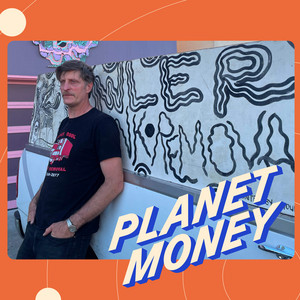
John Rauston is in a nook under the stairs. He is on his hands and knees brushing rat poop off of old boxes, and he's digging through what looks to me like total junk.
Car parts, scrap wood, not cloth.
John's clearing out all the junk out of a house in San Francisco. The same family has filled it with it's stuff for a hundred years.
The house just sold and everything inside needs to go.
In this nook there's chairs, a car axle.
Yeah, look, 10s for up.
There's stacks upon stacks of cardboard boxes. Some are wet, some are moly.
Can food, turkey, sweet potato, or cat food. This is similar.
Photo albums from the 1940s, a box full of tangled extension cords.
Ain't nothing here worth a squirt of piss.
Really?
John says really. So far this is all junk.
But John does to keep digging because he's been clearing out houses and offices for about two decades.
And he has found all kinds of stuff. The gold ring on his finger that says dad, he's not a dad.
Every single appliance in his house enough toilet paper to last a lifetime.
Once he found $20,000 in cash.
And John, he's kind of an expert. He knows what moves, what sells, what we value.
Like he opens up a box and starts pulling out black and gray t-shirts.
So you're always hopeful you're going to find like a Nirvana t-shirt or a Rolling Stones t-shirt.
They are not. But John says there's another thing to check. Maybe their vintage.
He shows us the him at the bottom of one shirt.
The construction involves a double stitch. Vintage construction involves a single stitch.
So that's double stitch. So that's not vintage.
This man knows a lot about the economy. The consumer economy, the commodities markets, what's going on with labor and housing.
He has been called Wastro Damas, a trash savant. And we are going to spend the day with him.
He's ready to hit the road. Hello and welcome to Planet Money. I'm Erica Barris.
And I'm James Sneed. Some people look at a pile of a hundred discarded items and see junk.
But John sees the components of a hundred new items. He sees value. For him, a pile of a hundred discarded items is a pile of a hundred different economic indicators.
And if you can understand the junk market like John, you can understand dozens of trends in our economy.
Today on the show, we are riding shotgun with a junk man through the streets of San Francisco as he collects trash and turns it into money.
He explains the markets and shows us the ecosystem of how our reusable trash gets dealt with.
And how our junk sometimes gets a second chance at life.
On this week's episode of Wild Card, Poet Laureate Ada Lemom tells us how to give yourself a little grace.
The nice thing about being in my mid-dualaid forties, yeah, I forgive myself all the time.
Join me Rachel Martin for NPR's new podcast Wild Card, the game where cards control the conversation.
Bridgerton is back and the Netflix series is as gossipy and over the top as ever.
I love the dialogue as ridiculous as it is sometimes.
I'm so ridiculous.
We're talking about the romance, the clothes, and the nudity, and obviously the queen's hair.
Listen to the pop culture happy hour podcast from NPR.
John starts every day here at a huge building.
It's pink, it's part deep bunk storefront, warehouse, garage, and offices.
There are old city signs, hundreds of yardsticks, shelves full of sex toys.
John calls it his museum of junk. Stuff is piled up so high that we have to squeeze through this maze of boxes.
Whoa, look at all this stuff. Oh my goodness.
A little embarrassing.
It's not embarrassing, this is amazing.
What's it?
What is all this?
This is the stuff that we're like, oh, we can't throw that out.
Back when he was in high school, he took one of those career tests that told him he was best suited to be a garbage man.
And John took great offense because he was an aspiring poet.
So a life of trash? No way.
He went to college for poetry, work construction.
After his shifts, he'd hauled debris down to the dump.
And the garbage there, beckoned.
The San Francisco dump has an artist in residency there for an artist to go for three months and pick through the garbage.
Really?
Cool.
And I was like, wow, you could go play in the garbage.
John got one of those residencies made sculptures out of trash, wrote a zine called city sphincter.
John became obsessed with the garbage.
The reward part of my brain was like so lit up from digging through the trash and finding cool things.
Turns out that career test got it right.
And I was like, I just discovered like a life hack.
The secret to life is the garbage. And then I would be driving around like going in dumpsters and finding cool stuff.
I was just totally hooked on junk.
Late nights cruising, looking for junk.
Soft music playing in the back.
San Francisco story.
Very white, sexy music playing.
And that is how John ended up starting a business.
Cleaning out houses and offices. He's got a staff of seven employees who help him.
And it's been a good business because when people and companies move out of spaces, they just don't want to deal with their stuff.
So they pay him to deal with it.
They pay him for that service.
His job is to dispose of other people's junk.
He gets paid by the truckload.
For the house earlier with the old cat food and not vintage shirts, he's probably going to get about $4,000.
But then when he's got truckloads of office chairs or vintage t-shirts, there's a decision to make.
John could just dump it. Or he could sell it.
Yeah, some of it he sells for raw materials.
Like he can bring things made of aluminum or copper down to the scrap yard and see what he can get.
And some of it is valuable as is.
Hopefully you're smart enough to pick out the valuable things quickly and have a market for it.
That's just a little bit of pepper on top.
That's when you make the gravy.
I'll show you. We'll go see.
Alright, let's go see.
John's got his pickup check out front.
It's loaded with junk he got from cleaning up places the last couple weeks.
He's got tires, a random bag of clothes, and what looks like a ton of metal.
And his goal today is to make $50 an hour by selling everything in this truck.
Our first stop, tires.
John's got nine tires.
We drive to an auto repair shop to see how much these are worth.
Hola, happy.
I have tires on the rims.
Giovanni's operator runs the shop and John starts selling them on the tires.
These are good tires. You're going to want to pay me for these.
But Giovanni's like, I'm going to test these out first.
He starts bouncing them, kicking them, because he explains the more they bounce, the junkier they are.
That one's so good.
Tire one and two are two bouncy.
Tire three still has some life in it.
In the end, seven are trash and two can still be sold.
Giovanni says he'll buy those two for about $40.
The other seven will have to be recycled.
They will most likely get turned into what is called crumb rubber.
That squishy stuff on kids playgrounds.
John and Giovanni, they have to go for a little bit.
And then?
Comes out with his calculator.
Does some math.
Okay, yes, give me a hundred bucks.
So this is costing you money?
John tells us when he finds tires on the job, it's also his job to get rid of them.
Which is why whatever he can't sell, he has to pay to dispose of.
Giovanni charges $30 to dispose of each tire.
In total, that would have cost John about $200.
But he got a discount because he's dropping off a bunch.
And because he knows Giovanni.
Thank you, Giovanni.
That went well.
One hour in and we are at negative $100.
Our next stop is one of John's favorite places on earth.
As soon as we get near it, the air takes on the strong metallic smell.
So here we are at Sir Costa Iron and Metals.
This is the Ferris side.
Ferris is the iron-based stuff like steel.
Basically, anything a magnet can stick to.
This is the only tool you need to be a scrap guy.
Is that a magnet?
A magnet.
That's it. That's all you need.
Obviously a scrap guy, John always carries the magnet with him.
So before we can enter, John drives his truck onto a huge scale.
It weighs almost 7,000 pounds.
Now we go down.
We drive around the corner.
Hold on, stop, stop, stop.
This claw is just picking up every, like, toasters, computer parts.
This huge claw is just dropping stuff onto a gigantic hill of metal.
John is standing in the bed of his truck and he just starts tossing stuff out.
The claw grabs the stuff and feeds it into a shipping container.
Small bits of steel and iron are flying through the air.
To loop the claw.
Don't breathe right now.
This is the stuff that's going to get sent to steel manufacturers in Mexico or Turkey.
And some stays in the US.
Steel is in theory infinitely recyclable.
It can be melted down over and over again and made into a new lamp or toaster.
Which makes the stuff John is tossing pretty valuable.
We drive back onto the scale to get way to see how much ferrous metal John just dumped.
And the scale says John tossed 1,400 pounds.
The scrapyard is paying a little less than 4 cents per pound, which makes the total.
Here we go.
Moment of truth.
$55.
That's not bad.
That's not bad.
Awesome.
That's pretty good.
Three quarters of a ton.
Yeah.
We lost money earlier in the day.
It's a roller coaster around here.
It's a wild ride.
Thank you.
At this point, John's made a negative $45.
Actually, negative $45.20.
Because when he grabs his bills, he leaves two dimes on the counter.
A tip.
That was like the majority of the stuff in the truck, though.
The majority of the volume, the minority of the money.
Yeah, the real money maker is the non-fair stuff.
The things that don't stick to a magnet.
We jump back into the truck and drive around the corner to bring all the non-fairist materials to another big scale.
And we start dumping based on categories.
First up, John's getting rid of a bunch of lead fish and weights.
Because, you know, lead is toxic.
Really, I shouldn't be touching it with my bare hands.
You really should not be touching that with your bare hands.
He rubs his hands all over them.
Ah!
Killing me.
The lead gets weighed and processed.
And that lead could go into making car batteries.
A lot of that manufacturing is done in the US.
Next up, two big outdoor light casings.
John's not sure what material they're made of.
He brings it to a worker to test.
The guy rubs a coin against the metal.
And it leaves a scratch.
The trick is, if you want to know, aluminum is very soft.
You can scratch it.
Oh!
Yeah, it's basically feeling back.
This means it's aluminum.
And that's great for John, because it's worth more than he thought it'd be.
And finally, John has a cardboard box full of tangled wires.
This is the most valuable.
That's worth more than regular.
I'm not saying that, that makes it so valuable.
I guess it's just more copper.
When it comes to scrapyard metals, copper is often the most valuable.
It is the prized commodity here.
It's in everything techy, like phones and electric vehicles.
John says the pure or cleaner the copper is, the more valuable.
Like an actual bare copper wire is worth more than a string of Christmas tree lights
and copper in it.
If you want to strip all the plastic coating off your wires, then you'll get a better price for it.
The copper, John, has today, is not all that clean.
He doesn't have time to strip the wires, but he's still able to sell them.
They have a clean price and a dirty price.
This is very dirty.
This has got so much plastic in it that give you a very small, low price for the wire.
They estimate his wires are 30 to 35% copper.
Altogether, he makes $100 and 15 cents for the copper, the brass, the aluminum and the lead.
The current telly is $54.95.
And at least now, he's not losing money.
We get back into the truck and drive to our last scrap stop of the day.
A recycling center at the San Francisco Port.
Cardboard.
I have cardboard.
John says even though cardboard may all look the same, it is not.
Cardboard has different grades.
It's got the edge crush test.
Tells you how strong it is.
Oh, look at that.
John points to something we'd never really notice before.
There's a stamp that says edge crush test on the box with a number in the center.
That number tells you how much weight a stacked box can handle before it just flattens.
I feel like I've never actually closely looked at any of my cardboard boxes.
This has an edge crush at 32 and that one's 44.
32 is a common rating for single wall boxes.
Around 44 is common for double wall boxes.
What John has today is called old corrugated cardboard or OCC.
This kind of cardboard can be recycled about six or seven times before it becomes unicyclable.
And it is a very valuable commodity.
Yeah, the price for old corrugated cardboard can fluctuate.
It had drastically dropped before the pandemic.
Then skyrocketed when people started buying tons of stuff.
It's at a high right now because there's more demand for recycled paper products.
I'm realizing if prices are holding steady, cardboard's 95 tonne and Ferris 10 scrap is 80 tonne.
So cardboard's more valuable per pound.
We're at a recycling center that's...
...chinaurous. It's the size of a few football fields.
It's essentially a warehouse that recycles all the classics.
Glass, paper, plastic.
Oh man, this is cool.
Junk City.
This is the stuff I've been dreaming of.
There are bales of plastic three times taller than us.
There's bales of thinner plastic like the kind raspberries come in.
There are bales of thicker plastics.
Yeah, that's laundry detergent.
And in a meta moment, a recycling bin being recycled in that building.
We head to the cardboard station.
There's a conveyor belt that swoops the cardboard boxes around.
They get bound up in cardboard bells.
Some will wind up on a container ship going to Indonesia or Malaysia.
By now, we know the drill.
John Toss is his cardboard and we head to get weighed and paid.
They're buying cardboard at a pretty high price.
$95 a tonne.
Wait, this is it? This is the payout?
95 cents.
That's 95 cents?
Oh, wow. Thank you.
That's it? That was just 20 pounds.
Including the 95 cents, John's made $55.90.
But he also got paid $100 just for picking up the cardboard.
So his total is actually $155.90.
As we leave, we see other trucks loaded up with cardboard heading into the warehouse.
I call them cardboard cowboys because it's a liturative.
But I don't know what you would call it.
They're just, uh...
Yeah, hustlers there.
These cyclers.
People who study commodities markets would call them peddlers.
They pedal or used wares for money.
And as long as there have been markets, there have been peddlers.
For all the things John has offloaded so far today,
there has been a clear market for where they go.
But what do you do when you have something like a vintage can of tobacco
that you don't want to scrap?
Modern day peddlers have another option.
Going online.
After the break, John goes to eBay.
Jasmine Morris here from the Storycore podcast.
Our latest season is called My Way.
Stories of people who found a rhythm all their own
and marched to it throughout their lives.
Consequences and other people's opinions be damned.
You won't believe the courage and audacity in these stories.
Hear them on the Storycore podcast from NPR.
With NPR Plus, there's more to hear.
Like extended interviews with some of the experts we talk to
at Planet Money and the Indicator.
It's a mistake for economists to only think about
economic efficiency when considering policies
because you'll actually wind up with a worse outcome.
And with NPR Plus, you help keep NPR going.
Learn more at plus.npr.org.
In any great story, there's a moment that sparks your curiosity.
It tells you there is more to uncover.
How did this happen?
How did we get here?
That's where Embedded comes in.
We are NPR's home for documentary journalism,
immersive and intimate stories.
I was stone-called speechless.
Nothing will ever, ever, ever, ever be the same here.
Find Embedded Wherever You Get Your Podcasts.
Humans are kind of overrated.
Over on Shortwave, a science podcast were only kind of kidding.
We're bringing you the wondrous world of animal science
to your daily life.
From queer animal love stories to songbird memories,
we're showing you how critter knowledge informs human science.
Listen now to Shortwave, a podcast from NPR.
It is a beautiful day in San Francisco
and we're rolling around town in a hollard truck with John Rolston.
He is a dormant poet who makes a living and makes sense of the world through its junk.
People in the US, we toss out nearly 300 million tons of trash every year.
John, he can't stop thinking about all those people
who might still find value in that trash.
So if you're looking at things and you are constantly assessing them
and you are seeing their value, is it a blessing or is it a curse?
Oh, it's an overwhelming burden.
Why is that?
Because I'm the last hope for this stuff.
And if I can't figure it out, it's going in the ground.
John feels the metaphorical weight of all this trash
and that informs what he keeps and doesn't keep.
Back at his warehouse, most of the stuff John collects and stores,
it's here because unlike the stuff we've been dropping off,
he believes that it still has value as is.
He shows us this 80-year-old tin can of rolling tobacco.
Got the paper tax stamp.
Oh, cool.
What?
And that came with the tax stamps that's still sealed inside.
It still smells like tobacco.
Yeah, and it's got like good color.
It's not rusty.
Wow.
Yeah, some of the stuff John collects from clean outs,
you can sell it flea markets or on eBay.
We should say eBay is a funder of impure.
John says there are some obvious contenders for eBay,
like gold watches or an autographed jersey.
But there are some things that are less obvious.
The stuff that's valuable that sells on eBay is not glamorous.
It's like weird components that you don't really know what it is,
but you look it up and you're like, oh, that's $600.
So that's why you do a lot more work of research
in order to get valuable things out of the garbage.
There are all kinds of strange things that John has sold on eBay.
Expired 35-millimeter film,
Prints in Madonna cassette singles,
even a Chanel shoe box without the shoes, just the empty box.
Right now, he has 3500 things listed on eBay.
When John's putting something on eBay,
it's got to meet some specific criteria.
First, it's not worth posting unless he can sell it for at least $30.
Second, what does the competition look like?
To show us, he grabs a ceramic bourbon decanter.
So you go to Google Lens and take a picture of it.
And look at that.
There's one example for $40 on eBay right now.
Rare vintage 1981 fat English hunter, 12 inches ceramic bourbon decanter.
And here it is for $22.
But John goes a step further.
We're going to scroll down to sold
because that's what it's actually worth is what people have paid,
not what people are asking.
No exact matches.
That means all those people are asking someone to buy it,
nobody's actually bought it.
So to me, that's not worth putting on eBay.
Another metric John uses?
The sell-through rate.
Which tells you how many sell that are listed.
So you want around 100% sell-through rate.
It's got like a 20% sell-through rate.
That means there's 80% of them are still up for sale
and nobody's buying them.
So they're not moving.
They're not a hot seller.
So it's not worth my time for these slow runners
to sit on my storage shelf.
How quickly something sells and how long it'll sit in his space
are as important as how much it might sell for.
And John tells us one more thing to consider.
Just because something retails at a high price
doesn't mean it'll necessarily sell for him.
In this way, John is kind of like a matchmaker.
He has objects and he has to find buyers for them.
And eBay makes this easier in some ways.
But there are also objects that there just aren't markets for.
If nobody wants it, what do you do?
I mean, lately we're throwing away Victorian furniture.
It's a solid wood, exquisite craftsmanship.
But you can't donate it anywhere
and you can't get anybody to buy it.
And you can't hold on to it.
So you throw it away.
And that just feels stooping as people don't want it.
It's been about 10 hours since we first set out on our adventure.
John's arms are streaked with dirt and maybe some lead dust.
He starts pulling out receipts.
How are you feeling, John?
Sunsetting.
My body is stiffening.
It must be time to count the money.
John's goal for today was to make $50 an hour.
After 10 hours, that should be around $500 in total.
We start calculating.
That's $3.
That's $0.95.
That's $39.
He adds up what he got for the tires, medals, cardboard,
and a few other things.
Meanwhile, on eBay, not a bad day for eBay.
We had a few sales, but they were big ticket items.
He sold five items of vintage lacrosse stick,
a Harry Potter backpack.
And we sold the vintage silver plated three wicks,
a gar lighter, without the base.
Rare.
In total, between eBay and all the scrapping,
he made $903 in $28,
which means his rate for the day was more than $90 an hour.
And remember, for John, this money is the gravy.
Yeah, the pepper.
Right, right.
His real income comes from providing clearing out services.
And in the end, he met his goal.
And an entire truckload of stuff got a second,
or third, or fourth life that it wouldn't have had otherwise.
So, I'm constantly doubting myself and questioning myself.
But I'm also waking up every morning, like, pretty stoked to go see
what's in the garbage.
So, that's the success, right?
Music
Coming up on Planet Money, we are living through a golden age
of online fraud and scams.
But what are you supposed to do when your money's gone?
What happens after the scam?
It was so hard to try to face the fact that,
oh, you've been scammed in a really costly way.
Like, it's devastating.
You're like, oh my god.
Can't even admit this.
We follow one cybercrime victim to learn how it works
and how it feels to try to get your money back.
That's next time on Planet Money.
This episode was, I guess, produced by me, James Need,
with help from Emma Peasley, and edited by Jess Jane.
Engineering by Jess Newell was fact-checked by Sierra Watters,
and Alex Goldmark is our executive producer.
Thank you to Brett Biggers and Joe Picard for helping me understand
the reuse commodity markets and to Adam Minter,
whose book, Junkyard Planet, was a delight to read.
I'm Erica Barris.
And I'm James Need.
This is NPR.
Thanks for listening.
The Embedded Podcast brings you eye-opening reporting.
There's something that hasn't been disclosed yet.
Immersive journalism.
I could smell the smoke.
I could smell the dust.
Personal stories.
I was scared. Like, I can't protect you.
We are NPR's home for documentary storytelling.
Find Embedded Wherever You Get Your Podcasts.
Wait, wait, don't tell me isn't just jokes about the week's news.
It's also life hacks.
For example, here's actor Karen Allen revealing how she got her starring role
in Raiders of the Lost Ark.
He said, how well can you spit?
And I just found it coming out of my mouth.
I said, oh, I can hawk them with the best.
I'm Peter Segal.
If you want to increase your self-confidence,
then listen to the Wait-Wait-Don't-Tell-Me Podcast from NPR.
On the inheriting podcast,
Carol Park was 12 years old, working at her family's gas station.
When a big moment in US history changed her life.
Korean businesses in South Central have been torched.
Dozens looted.
The 1992 LA uprising.
Why would this happen?
I didn't get to answer that until I was an adult.
Listen to inheriting from LA Studios and the NPR Network,
wherever you get your podcasts.