Hey, this is Erica Barris.
Before we get to the show, I wanted to tell you how excited I am to see you, our listeners, in person on our book tour in Pittsburgh.
I may have a new story I want to workshop with you all, and I'm going to be talking with Carnegie Mellon's Kevin Zolman, the author of The Game Theorist's Guide to Parenting.
The Planet Money Book Tour is going to a dozen cities.
Every stop will be totally unique with different hosts and guests.
And if you get a ticket, you can get a tour-exclusive tote bag with your purchase, while supplies last.
Find the show nearest to you at the link in the show notes or go to planetmoneybook.com.
And thank you.
This is Planet Money from NPR.
When I think of an inventor, I think of somebody like this guy.
My name is Leonardo Chedidione.
An Italian inventor named Leonardo?
Like, come on.
He's very passionate, very smart, and very precise.
You speak five languages?
Is that true?
So this means that you have consulted Wikipedia about me, and that is something that I really hate.
Leonardo does actually speak five languages, including Japanese.
He just doesn't want some random person on Wikipedia speaking for him.
When I will be dead.
I mean, people can talk as authoritatively or not, about myself, but as long as I'm alive, I am the only one that describes myself.
Yeah, he wants to be the one to write his own story which, for our purposes, is not just a story about Leonardo and his invention.
It's a story about how we even think about the nature of invention.
It begins back in the 1980s when Leonardo was working at what is now Telecom Italia.
And he had a big idea.
My dream was I want a world where everybody can talk with everybody else.
The vision Leonardo had is pretty much the one we live with today.
It's a world where it's easy to share media and, in particular, video.
I want a television that goes everywhere.
Leonardo had this idea back in the days of analog television.
Video was stored on tape.
Think cassettes, VHS.
It was fragile and clunky and difficult to store. but also to transmit, like to TVs.
So broadcasters were looking to digital video, but that was in its early stages.
The problem with the new digital video files was that they were also really big, like both virtually and physically.
Like take, for example, an hour of television.
On digital, it would take up a lot of space.
Probably something like 100 hard disks.
100 disks just for one hour of television.
Yes.
These large files were, again, hard to transmit.
So if digital video was going to take off across the world, Leonardo realized that broadcasters everywhere would need a smaller, maybe even tiny, file to make transmitting it easier and less expensive.
So?
I invented the thing called MPEG.
MPEG.
M-P-E-G.
What is an MPEG?
What is?
Oh, it's many things.
MPEG is the name of a file format.
And then MPEG is the name of, I'm sending you an MPEG.
Yeah, that is the way most people would know MPEG.
MPEG is a kind of file format for video files, kind of like a JPEG for pictures or an MP3 for audio.
MPEG took huge video files and compressed them, made them way smaller to make it easier and cheaper to store video, to download it and to play it across different old school electronics.
But Leonardo didn't invent the actual technology.
He was more like the mastermind, pulling together a bunch of different technological innovations from a bunch of different companies to make a new thing.
That's how it got that weird name, MPEG.
It stands for Moving Pictures Experts Group.
And the reason we called up Leonardo isn't to understand this technology he brought into the world.
Rather, it's because of what it took for MPEG to succeed.
Because MPEG raised a huge, important question about when inventors can and cannot work together under the eyes of the law.
See, MPEG was sort of like a new language for digital video.
And in order for his MPEG to succeed as that new language, all the electronics that stored, sent and received the video, they all had to speak that same language.
Which meant the companies making and running those electronics needed to agree.
OK, we're all going to use it.
We're all going to speak the language of MPEG.
What were some of the things that you realized at the outset would cause problems for you?
No, simply that people would not care.
That is the worst, the worst thing that can happen.
So I had the vision, but you know, you have to have that vision accepted.
That was the next big hurdle, because there were all these competing digital formats and people were divided about which language to speak.
So for MPEG to succeed, Leonardo and Telecom Italia needed a bunch of companies to all get together and make a collective choice to say we're all going to make sure that this digital format will work on our machines.
So our machines can all work together, like a signing of contract of sorts.
And in fact, a bunch of companies liked MPEG and did want to do that.
But there was just one little problem.
Was this agreement between these companies to use this new language collaboration?
Or was it collusion?
Hello and welcome to Planet Money.
I'm Sam Yellow Horse Kessler.
And I'm Erica Barris.
When Leonardo and a bunch of companies and inventors all wanted to collaborate to make the MPEG the new efficient language of digital video, there was just one big problem.
American antitrust law barred companies from making collective decisions to stamp out their competition.
So to convince the government that this collaboration was not only legal, but that it would be a boon to people everywhere, they had to look to another invention, one from more than a century earlier the Singer sewing machine.
Today on the show how the Singer sewing machine laid the groundwork for inventors to collaborate without colluding.
And how it created the technological world we live in today.
It's the story of the rise and fall and second coming of the patent pool.
OK, so our Italian inventor Leonardo, and a bunch of huge companies wanted to make the MPEG a universal language for sharing video.
But all those companies needed to figure out a way to collaborate without colluding.
And that was a complicated endeavor.
How do you make a big, complex technological agreement simple and legal?
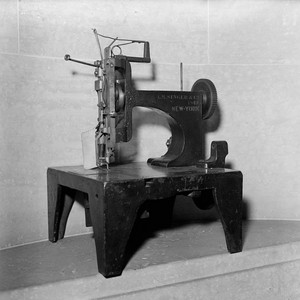
The answer was hidden in the story of another invention from more than a century earlier, the Singer sewing machine, invented by Isaac Merritt Singer.
Your clothes, the ones you may or may not be wearing right now.
I don't want to judge how you listen to podcasts.
There is a decent chance that they were made using a Singer sewing machine.
And the man behind the Singer sewing machine was another one of those colorful, somewhat particular inventors.
He was described by some people as an irascible scoundrel.
He had a violent temper.
Michael Mattioli is a law professor at Indiana University and he's written a ton about patents, including singers.
He was also married to at least five women under different names.
At the same time?
At the same time, yes.
Okay, we looked it up, and it wasn't five at the same time.
Maybe three.
Plus, there were a bunch of mistresses.
He also had 20 children that he acknowledged.
Michael told us Singer was an actor, but he was better at inventing things.
He invented a drill to bore through rocks.
He also invented a tool for engraving text into wood.
Back in 1850, Singer was in Boston, where he happened upon this sort of rudimentary sewing machine.
It was nothing like the one we know today.
It had a hand crank and a curved needle, and it kind of moved up and down like a stapler.
And the story goes that he saw this machine and said, I could do better.
Right off the bat, he saw a few major improvements he could make.
He came up with the idea that you could have a straight needle that would be suspended from an arm overhead.
Singer started toiling away, working day and night.
Someone would hold the lamp for him, actually, while he would try to make the machine work.
In Accounts of His Life, Singer says that late one night he and that lamp holder guy were doing their inventor thing, racking their brains, trying to get the machine to sew tighter stitches.
They kept testing it, but something just wasn't right.
So, feeling dejected, they headed back for the night.
But on their way around 1 am this guy turns to Singer and he says hey, did you notice those funny little loops of thread on the seam?
And Singer says, by God, he actually said that.
The lamp holder guy wrote it down because he didn't like that Singer curses so much.
He said, by God, we need to add tension to the thread.
So they ran back to the machine shop, adjusted the tension and tried the machine and they got at least five perfect stitches.
The thread snapped, but that was enough to see that the secret was all in the tension of the string.
Singer made some adjustments so the thread didn't snap.
And there it was, his invention, the Singer sewing machine.
He got his patent in 1851.
And for Singer, this patent was government-issued proof that he was the inventor and owner of this technology, his machine,
It meant only he could profit off of it.
And that's what patents do.
They are basically like little government-granted monopolies that incentivize innovation.
And Singer's patent was a huge success.
Within a couple years, the Singer Corporation was making hundreds of sewing machines.
His machine won a prize at the 1855 World's Fair.
And Singer became wealthy.
But with that wealth came enemies.
A sewing machine war was brewing.
Because what you have to keep in mind is this was the Industrial Revolution, a time in history when lots of people were inventing lots of things.
And some were standing on each other's shoulders and others were stepping on each other's toes.
So a singer was making his name in the sewing machine world.
Someone else was sitting on the sidelines, seething.
Another inventor who'd already made another sewing machine similar to that janky one.
Singer based his machine on
Elias Howe Jr. fired the first legal shots in the war.
Elias Howe had also patented part of his sewing machine.
And in fact, Singer had used a part of Howe's invention in his machine.
But he never made any money off of it.
He did not get wealthy.
So when Howe saw Singer's growing fortune, he saw an opportunity.
And he sued Singer.
That was sort of the battle.
And it led to the war.
The two of them took out ads in newspapers, each saying they were the proper inventor of the sewing machine.
Howe wrote, you that want sewing machines, be cautious how you purchase them.
Singer retorted, machines made according to Howe's patent are of no practical use.
Singer fought back.
He made threats.
He threatened to kick Howe down a flight of stairs.
He didn't.
At least we don't think he did.
Eventually Singer agreed to pay Howe 15000 old-timey dollars, plus royalties, on every sewing machine sold.
So a compromise.
But the fight brought all this attention to the new sewing machine.
All these other inventors with less successful sewing machine patents turned up out of the woodwork and sued.
Grover and Baker and Wheeler and Wilson.
Singer sued Grover and Baker.
Grover and Baker sued Wheeler and Wilson.
Wheeler and Wilson sued Singer.
This was the sewing machine war.
They all said that some component of the sewing machine was invented by them.
Singer had to make a closet to store all of his legal files.
This could not go on.
All of these competing patents claiming ownership over some part of the sewing machine.
It wasn't only bad for Singer, but it seemed bad for industry, for inventors of all kinds.
Like why would anyone invent anything if they would then be sued by everyone who ever had a similar idea?
Yeah, Singer had done something that hadn't been done before.
He made a functioning sewing machine, one that improved on everyone else's designs.
In other words, he innovated.
And all these lawsuits and petty inventors, they were bad for innovation.
They were creating what is known as a patent thicket.
Like a thicket of patented ideas that you got to machete your way through before you can even go about making something new.
To solve this patent thicket problem, a new idea was needed.
And this time it didn't come from an inventor.
It came from a lawyer.
His name was Orlando B. Potter.
And he thought what if all these competitors could stop fighting each other and put their patents together into one big pool, take all their best ideas for different parts of the machine and make it so any of the companies could use them?
So he pointed out all of these rivals were harming themselves.
He was the first to suggest that they could all benefit just by cooperating.
And by God, Grover and Baker, Wheeler and Wilson, and Singer, and Howe, they all agreed.
In 1856, they all signed an agreement and created one big collective patent pool.
So now, every time one of the companies made a sewing machine, they would pay 15, and that would be divided among the members of the pool.
Millions of machines would end up being sold.
It opened up an entire world of manufacturing.
And it all started with this agreement.
They called it the sewing machine combination, and this was the first patent pool in America.
And it became a groundbreaking idea.
The key was patent pools didn't just combine similar inventions.
Only complementary inventions could go into the pool.
As in, the inventions work together to form a larger invention, but they don't overlap.
So like a patent for grinding coffee and a patent for making a coffee filter.
It's like peanut butter and jelly.
Exactly.
Yeah.
And this patent pool idea became a model because, in an ever more technologically advanced world, it allowed people to build on each other's inventions, to stand on each other's shoulders without stepping on each other's toes.
And importantly, to make sure everyone got credit for their ideas.
And for consumers.
The hope was patent pools would bring better, more affordable inventions to the market.
And patent pools hit it big.
They started cropping up in all these major inventions of the 19th and 20th centuries.
There were so many.
So I'm looking through my list here.
1856, sewing machines.
1877, steelmaking.
1890, farm tools.
1899, footwear.
1900, this little contraption that would take the seed out of a raisin.
Very important.
Maybe just as important today.
1903, automobiles.
1908, motion pictures.
1917, aircraft.
1919, Radio Corporation of America.
RCA was... Sorry, couldn't help it.
Couldn't help it.
Sorry.
Keep going.
1921, oil refining.
1930s through 38.
We've got heavy industry like high-tension cables, hydraulic oil pumps, Phillips screws.
Really?
Which are used in all kinds of products around our houses.
The government even pushed for patent pools in certain situations, like when they needed a lot of airplanes for the First World War.
They asked the Wright brothers to form a pool.
But from the very beginning, there were also concerns about the very idea of patent pools.
That companies that were supposed to compete with each other were instead getting together to cooperate.
And that they might even be colluding.
There is a lot of skepticism and outrage about the possibility that we're looking at a cartel.
Yeah, pooling your ideas together, setting prices, trying to dominate a market.
These are all things that a cartel does.
It's a little like kneecapping your competitors.
And all these concerns came to a head in the 1940s with this one super complicated machine that made glass jars like mason jars.
The key invention was called a gob feeder, G-O-B.
And they had control of over 94% of U.S. glass containers.
Can I tell you?
I am looking at an image of the gob feeder right now and it looks like there's more than a thousand components.
The gob feeder was like this big machine with a bunch of moving parts and it takes a hot rod of molten glass that's the gob and it spits it out into a mold for jars and bottles and such.
And this gob feeder was part of a big glassware patent pool that included four different companies.
And over time, the pool allowed these glassmakers to dominate an overwhelming majority of the market.
They controlled the gobs.
They were basically like the gob father.
Yes, the gob father.
Yeah, essentially they were operating like a cartel.
Like if you were part of the pool, you had to promise in a contract that you wouldn't make glassware that competed with anyone else in the pool.
They had divided up the market.
So the U.S. government sued the glass manufacturers.
They said the pool had overreached.
The primary purpose of this pool was to restrict output, to fix prices and also to make sure that competitors weren't going to enter the industry.
The government said, you guys cannot own this industry.
And the case went all the way up to the Supreme Court.
And in 1945, the court said, yep, this behavior violates the Sherman Antitrust Act.
You cannot kneecap your competition.
Justice Hugo Black wrote that it's the most completely successful economic tyranny over any field of industry ever.
The court said, in essence, the glass companies just had to play fair, set reasonable prices, and you can't cut off your clients who don't do what you want.
You know, put that crowbar away.
And this case laid the foundation for a new rule that in order to collaborate with other companies, share your inventions and pool your patents, you have to be quote fair, reasonable and non-discriminatory.
The acronym?
F.R.A.N.D.
You gotta be friendly.
Why can't we be friends?
This glassware case and the friendliness of it all, laid out a roadmap for patent pools, with yield signs along the way.
But the world of industry saw them more like stop signs.
And by the 1970s, the mood had changed from what you can do to what you can't do.
A new antitrust sentiment had taken hold in the country.
The Department of Justice wanted to break up anything that even resembled a monopoly.
The Justice Department actually laid out a list of don'ts.
The nine no-no's.
The nine no-no's?
Was this written for other adults?
This was written for adults.
Wow.
The nine no-no's were a list of things that were big no-no's, like tying.
Tying is essentially telling your customers if you buy a car from me, you also have to buy my tires.
The thing is, when inventors saw this list of nine no-no's, combined with Fran'd, All this guidance seemed to deeply discourage anyone looking to collaborate with other companies.
People basically stopped forming patent pools.
In the 1970s, Michael's research found that not a single notable patent pool was formed.
Patent pools were essentially dead.
And they would basically stay dead until the 1990s, when our Italian inventor Leonardo, showed up on the scene with MPEG.
After the break, the valiant MPEG takes on the nine nomos.
And clears the way for inventors to collaborate again.
So we've told you the story of the rise of patent pools.
How Isaac Singer brought all his would-be competitors into a collaborative pool to avoid endless lawsuits for stealing their ideas.
To work as a team instead of rivals.
And we've told you the story of the fall of patent pools, how some pools grew too powerful and how a Supreme Court case and rising antitrust sentiment brought patent pools pretty much to a grinding halt.
And now for the rebirth of the patent pool.
The 80s was once again this crucial moment in technological history.
It wasn't the Industrial Revolution, but something new was on the rise that would spawn millions of tiny new inventions, each dependent on the next.
That thing that was on the rise?
Computers, tech.
These inventions would necessitate more collaboration than ever.
A lot of it.
Tons of it.
Gobs of it.
Take, for example Leonardo, our Italian inventor, and his dream of connecting the world through MPEG, this new language for digital video.
We want to make people happy and to make industry happy.
And it is this magic formula.
It was this magic formula, but only if everyone uses it.
Because there were all these other formats for video.
And if one company is using one language and another is using another, then none of the machines can talk to each other.
It'd be like if you bought a lamp, but you couldn't get a light bulb to fit in it.
Yeah, these things needed to be interoperable, to be able to talk to each other.
It was in the interest of consumers and manufacturers to pick one standard like a standard file format for these tiny, adorable compressed video files.
Standards are like an agreement across an entire industry for technical specs and norms.
There are actually international organizations that exist just to set standards and maintain them.
So that's what Leonardo was hoping MPEG could become, a big international standard.
So Leonardo, partnered with a handful of other companies and this major international standards organization.
And they hired a bunch of lawyers to help them turn MPEG into a standard.
One of those lawyers was a guy from Queens named Ken Rubenstein.
I was one of the fathers, let's say.
Would you say you're one of the founding fathers?
I think I'm one of the founding fathers.
Yes.
It was Ken's job to help figure out how to create this international collaboration without running afoul of American antitrust laws.
So the first hurdle was to figure out what shape this would even take.
They were sitting in conference rooms asking themselves, how do we make MPEG the new standard?
How do we collectively and legally choose what language all of our technology is going to speak?
The tool they landed on was the patent pool.
They actually thought back to another time a group of competitors wanted to pool their inventions.
They thought of the sewing machine and all the patent pools that came after it.
But with patent pools came those pesky concerns.
Like, who's going to stop you?
Well, the US government, for example, could intervene and sue us, because a patent pool is inherently a joint activity, a cooperating activity of companies that normally are supposed to be competing.
Yeah, they thought the Department of Justice's antitrust division would have too many issues with a patent pool that from the jump they would flag it for being too much like a cartel.
So they would need to address the issues of the past.
Frans and the nine no-nos.
That was the second hurdle.
How do you go about making sure, in this massive negotiation between heavy hitters like Sony and Mitsubishi, that every company was treated fairly?
You know friendly.
Frand means fair, reasonable, and non-discriminatory.
So they would need to be fair and reasonable about who gets to be part of the pool.
Because a lot of companies wanted in.
They could be paid every time somebody bought a product that was part of it.
And they had to be non-discriminatory.
Ken and the other lawyers knew you can't just exclude people willy-nilly.
Ken's job was to make sure that every patent included was essential to the pool.
And he was supposed to be impartial, to make these choices based on merit and fairness.
So I evolved into the umpire who got called the balls and strikes on essential, not essential, for patents.
You know, anyone could submit a patent for the pool and Ken had to sort through all of them.
I seem to recall tons and tons and tons of paper.
They sorted through abstracts of patents and they had criteria.
And the criteria boiled down to, is this patent necessary for the larger standard?
Is it complementary and not a substitute?
So you know, if we go back to our PBJ example, you don't have 18 different kinds of peanut butter when you only need one.
You have one patent for peanut butter and one for jelly.
These are the criteria that Ken is looking for, the patents that are essential to the standard.
And once they found those essential patents, there was one final tiny step, one little hurdle, just convincing the Department of Justice that this wasn't all collusion.
This was their final battle in their fight for the fate of MPEG.
For DVDs and HD television and eventually video calls and TikToks.
And one of their key moves.
They didn't want to wait around and get sued by the Department of Justice like those infamous patent pools of the past.
So they acted first by directly asking for permission.
So they talked to the Justice Department, learned from their conversations what the department's concerns were and then, using what they learned, they crafted a weapon of sorts, a weapon to finally win the fight for MPEG.
They used the best, the sharpest, the mostest tool they had.
A letter.
They wrote a letter to the Department of Justice.
And that letter basically promised that the MPEG patent pool would not edge out competitors and would not make anyone sign coercive contracts.
It would all be above board, you know, family.
And this was crucial.
It made the case that all of these companies could and should collaborate, not just for the company's sake, but for the sake of consumers everywhere.
And it helped that this coincided with a loosening of antitrust laws, an argument that was gaining momentum that if it was good for consumers, let it be.
And we got the letter approved, I think it was in 1997.
Yeah, in 1997, the DOJ granted permission for the patent pool.
And that patent pool allowed MPEG to become a standard for storing and sharing video files.
But the real power of the letter was that it became a template.
Now all these other companies were able to write their own letters to model their own patent pools off of MPEG's methods.
They were able to successfully argue that companies could and should collaborate, not just for the company's sake, but for the sake of consumers everywhere.
Now you started to see patent pools crop up everywhere again.
1997, Bluetooth.
1998, DVDs.
Michael Medioli again, law professor and patent pool enthusiast.
1999, there's another pool for DVDs.
2001, 3G mobile phones.
Today, we still use various standards that patent pools allow for, like Bluetooth and 5G.
Some people even still use CDs and DVDs.
Yes, I do.
Whatever.
Erica might be one of those people.
I'm proud of it.
How many things would you say today you have touched that have involved a patent pool in some way?
Oh my gosh.
Well, just in the course of setting up this call, I touched at least five things that involved a patent pool.
My smartphone, the tablet that I'm using, the desktop.
So yeah, we're surrounded by patents that are parts of pools.
And those pools, the saga of Singer and the sewing machine, kind of paint a different story of the world we live in than the one we're often told.
This idea that a singular inventor, one great person, has an idea and they have to fight to have it realized.
Like Edison versus Tesla, Jobs versus Gates.
I think America has always loved the story of the individual.
And I think that The notion of individuals who have overcome obstacles and done great things, it is naturally compelling to us.
So the Singer story and the stories of other patent pools.
They're stories about the power of cooperation over the ambition of an individual.
To me that's really.
It's kind of hopeful actually to think that sometimes it's possible to for competitors to realize that the best thing for all of them is to cooperate.
When patent pools are working.
They're sort of this line in the sand that separates collaboration and collusion.
A way for self-interested inventors like Singer to serve their own needs as well as the needs of other inventors and consumers, so that we can all have glassware and airplanes and streaming video.
And sewing machines.
Thanks to everyone who supports this show by spreading the word.
More and more people are finding podcasts through algorithms, but word of mouth is still the best way we reach new listeners.
If you can think of someone in your life, a colleague, a friend, a lover of sewing machines, who might enjoy this episode, send them a link and tell them why.
This episode was produced by Luis Gallo with help from Willow Rubin.
It was edited by Marianne McCune.
It was fact-checked by Sierra Juarez and engineered by Sina Lafredo.
Alex Goldmark is our executive producer.
Special thanks to Sophie Tannhauser, whose book called Worn is where we first heard about the story of the sewing machine and its impact on the world of antitrust.
And thanks also to Ruth Brandon, author of the book Singer and the Sewing Machine.
Special thanks as well to Lori Fitzgerald and Garrett Beeney.
I'm Samuel Ahorse-Kessler.
And I'm Erika Barris.
This is NPR.
Thanks for listening.