Hey, it's Lauren Dragon from Wirecutter, the product recommendation service from The New York Times.
And I test headphones.
We basically make our own fake sweat and spray it over and over on these headphones to see what happens to them over time.
We're going to put on some noise cancelling headphones and see how well they actually block out the sound.
I have 3 ,136 entries in my database.
Kids, workouts, what version of Bluetooth… At Wirecutter we do the work so you don't have to.
For independent product reviews and recommendations for the real world, come visit us at NYTimes .com slash Wirecutter.
Hi, everyone, it's Lulu.
Before we get into today's episode, I want to let you know about something exciting we have coming up here at The Interview.
It's our first ever live show.
It'll be at the Tribeca Festival in New York City on Thursday, June 12th.
I'll be talking with actor Sandra Oh, you might know her from Grey's Anatomy or Killing Eve.
I'm really looking forward to it.
Tickets are on sale now at Tribeca Festival dot com slash the interview.
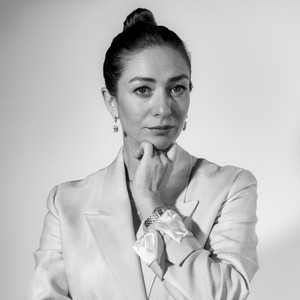
Hope you can come. From the New York Times, this is The Interview, I'm Lulu Garcia Navarro, and this week I'm interviewing Whitney Wolf -Heard, the founder and CEO of the dating app Bumble.
Now, when I started dating, the apps weren't an option.
I met my husband the good old fashioned way through his ex -girlfriend, but I wanted to talk to Wolf -Heard because her story really maps onto our culture's fraught relationship with technology and female business leaders.
In 2012, Wolfhard was just out of college when she co -founded Tinder, the dating app that was squarely aimed at her generation of millennials.
Tinder gamified finding love, introducing that addictive swipe feature.
But Wolfhard went on to have a messy breakup with Tinder.
In 2014, she left the company and sued them, alleging that she'd experienced sexual harassment and discrimination from one of her co -founders, with whom she'd also had a relationship.
The company denied responsibility and they settled the case.
Soon after though, at only age 25, she started Bumble, which billed itself as this safe space for women to find love, where they made the first move.
Wolf Her then became a darling of the so -called girl boss era, when women were making real strides as leaders in tech. Cut to today, our love affair with dating apps is dying.
Post -pandemic and with Gen Z very much wanting IRL connection, Bumble's shares have taken a tumble, and female tech leaders like Wolf Herd are even more rare than when she began.
So after stepping down as Bumble's CEO just last year, Wolf Herd is back at the company as of March, with a plan to turn its fortunes around.
It involves Silicon Valley's latest transformative technology, AI, a broader vision for the app beyond dating, and some perspective on what tech can and can't do for us.
Here's my interview with Bumble founder and CEO, Whitney Wolf -Heard. Whitney, thank you so much for joining us today.
Thanks for having me.
You just stepped back into your role as CEO of Bumble in March after being away for more than a year, I think.
You've been in tech though since your early 20s and I'm wondering what it was like in that time away.
Because you haven't had a break.
It was amazing. The time off was incredible.
It was the first time I was faced with who am I without one of these huge consumer brands attached to me.
And that's a very strange place to be.
If you think about it, I was 22 years old when we were starting Tinder, and then I became the Tinder girl, and then I became the Tinder lawsuit girl, and then I became the bumble girl, and this became an extension of my identity.
I am the type of founder, CEO who is in every detail.
I'm emailing members who are having bad experiences personally.
And so to relinquish that level of involvement took maturity I didn't know I possessed.
It took a level of release of control that I didn't know I was capable of.
And so it was very, very destabilizing at first when I stepped away because I was like, who am I without all of this?
And when I left Bumble, it was tough because it didn't play out the way I'd maybe hoped in terms of the narrative and for somebody who has been building a consumer brand and has been in the public eye to some degree, narratives can hurt.
They explained to me what the narrative was that you were unhappy with?
Stock was down. at the time.
who knows? 80 % so the world was seeing that as a failure.
So here was 10 years of what was a lot of progress.
I mean it's a billion dollar revenue business.
It's a big company.
It's a brand that is global at this point so in my mind I was stepping away from something that I had seen as so much bigger than where it was when we started objectively, and to have it reduced down to, oh, she failed, she must have been kicked out.
I mean, there was so much fodder around why I was leaving, and it hurt my feelings.
What was the real reason you left?
I was exhausted. I was completely exhausted.
I wanted to see my children.
I wanted to get still in my own mind, and I just needed a break.
I wanted to see my mom, I wanted to see my husband, And I wanted to be with friends.
I just needed to take a breather.
I guess that leads me to the question of why you came back because you are coming back at a high stakes moment for the company.
As you mentioned, Bumble's stock price has been on a low, steady decline.
It's about $4. You've announced a rebrand, which we're gonna get to, but big picture, what drew you back to the company?
I had no intentions of coming back.
I mean, here I am, I'm just in the groove of being this kind of removed founder.
I was meditating every day.
I was really working on these inward practices, but very still involved, all the board calls.
But I'm not running the show.
And I had a phone call with my prior CEO, who I still think the world of.
This is Lyddiani Jones, who had come over from Slack to take over Bumble.
Yes. And she's an amazing woman.
We're on very, very good terms. I think the world wants people when it's, particularly when it's a woman to a woman, they want there to be some rift. There's no rift. She and I got on a call.
And she let me know that it wasn't working for her anymore.
And I think she had burned herself out.
And I felt so deeply for her because I felt like I was looking in a mirror.
I felt like I was looking at myself a year prior.
Um, I could tell that she was exhausted and that she herself had made some of the same mistakes I had made, which was working that extra hour, putting in that extra trip.
Um, so you can imagine what was going through my mind.
Am I going back? Who's going to run this company?
And ultimately, I felt like even if it's not what I necessarily would have signed up for willingly, I felt like it was happening for me.
I did feel like, oh, this is happening for a reason.
Bumble needs me back.
It's an extension of me to some degree.
And watching it fall from its peak has been very hard. And I did feel, this is this is a bit of a crazy story, I had this strange epiphany a week before she quit where I was like, oh my god, my life's work was to help people get closer to love.
And I literally, because I'm, you know, I love Oprah, and I love everything she talks about, I had been doing her exercise of don't tell the universe what you want, tell the universe to use you what it needs from you.
and so I'd been like, just use me for love, just use me for love and light.
And she left a few days later.
And so I was like, I've gotta go back in.
And I kind of just raised my hand to the board and said, listen, I'd like to put my hat back in the ring.
The board could have chosen not to put me back in.
The board did their diligence, they convened, and they called me and said, we'd like to have you back if you'll do it.
We're gonna talk a lot more about your plans for the company, but I do want to start by going back because your trajectory has been so fascinating when you started Bumble, and you mentioned this in 2014, you recently left Tinder, and the big difference between Bumble and other dating apps was women had to send the first message, right?
That was like the big innovation of Bumble.
And media at the time called it, Feminist Tinder.
Is that how you saw it back then?
So, I didn't think about the word, feminist or feminism back then.
You have to remember, I did not come out of a liberal arts college, somewhere in the northeast where it was super progressive.
I was at SMU in Ballast Texas for college.
I then ended up in a would not say extremely feminist tech environment and I was 22 and then 23 and then 24 years old in the time that was before Me Too before Time's Up before this was you know I call it the pre pink target era do you know I'm talking about where this was before Target started selling all the girl power t -shirts it feminism had not gone mainstream.
I didn't wake up and see some marketing opportunity to go build a feminist this or a feminist that.
None of it was an angle.
It was genuinely a real lived experience where I felt that as a young woman who had dated, I did not feel like an equal.
I felt like women had to wait for men to choose them.
You couldn't text a guy first in college you were considered crazy, desperate.
So this was just my natural environment.
It's not like I was sitting around saying, oh, how do I come up with a new angle at Tinder as some revenge plot?
That's not what happened.
What happened was I just built a solution to the problems myself and my friends had.
And then of course media and everybody else said, oh, it's feminist, and it's this, and it's Girl Power.
And I kind of was like, well, yeah, I mean look at the definition.
I guess you could technically call it feminist if you wanted to, because it's about trying to level the playing field.
I mean, it's interesting because there's always been this narrative around you, right?
This was the Girlboss era when you started.
You were one of its best -known figures.
A woman in her 20s leading this successful company.
And I'm curious, how the term Girlboss sat with you at the time, and if you look back on it any differently now.
It's so funny. I don't know how to properly answer this because for me, I do remember vividly being at Tinder and having Sofia's book, Girl Boss.
I'm sure about Sofia Amoroso, who wrote the book Girl Boss.
And I do remember feeling inspired.
Like, oh, wow, look what she's done.
I had never seen any representation of a woman building something before, I just had never seen it.
And now of course you had the greats at the time, which were Sheryl Sandberg, but again she was a C .O .O.
It wasn't, you know, a woman that had founded the business.
I love Sheryl, I think she's amazing.
And so at the time I just thought the girl boss narrative was fine.
And then somewhere along the line, somewhere along the years, 2016, 2017, 2018, this girlboss arc just turned dark.
I don't really know what happened.
See again, I was in such a tunnel building this company.
However, I watched a lot of my peers fall, a lot.
My era, which sounds like we're talking about something 600 years ago, a few years back.
You're in your early 30s to be clear.
So this was like, 2016 through, call it, 19.
That era was all about the young woman who was building something, and then it was about just taking her down.
And it paralyzed me.
I'll never forget Bloomberg came, I was pregnant with my first child, Bloomberg came to follow along as we passed a law for cyber flashing to create, you know, protections online for women because we were seeing that so many women were being subjected to unsolicited lewd behavior and images and we were doing our best to try to create some accountability.
And this was in Texas which eventually that law passed.
The law passed and so we brought the reporter with us to the Capitol and to testify and in my mind we were just following along.
The article came out and the headline was, Some version of, Bumble is not feminist, it's just feminist marketing.
And it sent me into a very dark place because I felt like I could do nothing right.
here I was doing my best to run a company and pass a law to try my best to make this safer for women online.
And even doing that, well, a lot of the...
Not to be disrespectful, but a lot of the male tech CEOs are not trying to pass laws to make the internet safer, right?
So I just felt like, oh, this is what happens to you when you're a woman CEO. You can't survive.
You will be scrutinized.
You will be taken down.
And I think that was the beginning of the end of me feeling confident in what I was doing.
I think that the culture now looks at Sheryl Sandberg, the lean in era, and that moment with a lot more skepticism.
And there is this idea of what is performative and what is actually the structural challenges that women face to get ahead.
are people taking advantage of Zeitgeist or are they actually trying to change fundamental underlying things that make it difficult?
I think this is where I struggled during those years.
I think what became a challenge for me was I felt like anything I did would just auto get labeled back to this woman CEO. She must be a faker, she must be this, she must be that.
And it just felt like you couldn't catch a breath during that chapter.
Which the reason why I bring any of this up is I think it led to the depletion that I faced three years after being a public company CEO with all those challenges where it's like I can't do this anymore.
I have to get out of here.
And by the way, the other thing we do need to touch on Bloomberg probably was not entirely wrong.
Bumble's not perfect.
Nor was it perfect then, it's not.
Women have been treated very badly on Bumble.
I actually think that there are times where we have over -shot the benefit to women in a marketing moment or whatever that is, then what we've actually been able to do.
I think my point back to the Bloomberg moment was that it felt like that was just another gotcha attempt in this culture of which CEO that's a young woman can we go get next?
Does that make any sense?
I don't feel like it was done because they authentically wanted to cover the company and they wanted to find the fair flaws and the fair benefits.
I did feel as if it was like, oh, this is a target that hasn't fallen yet.
Let's go get her. I am curious when you say there were fair flaws, like what would do you mean by that?
Well, a woman sending a message on an app is not going to save the world.
It's not, let's just be honest. It was a small step to try and recalibrate thousands of years of power dynamics in relationships.
Um, but yeah, I mean, maybe we've oversold ourselves along the way in certain ways, and I'm okay to say that.
We are a part of the problem, this bigger cultural landscape of online love.
We're not perfect. I am curious, beyond the broader cultural moment, how you felt you were received as a young woman within the tech industry, especially after your lawsuit against Tinder for sexual harassment and discrimination.
and this is before Me Too, this is before a lot of things.
How did that impact you professionally?
Nobody wanted to associate with me.
Nobody wanted to work with me.
There was only one person that was willing to give me any opportunity, and that was my former business partner.
I kind of had to be scrappy and take whoever was willing to see past it.
The tech, you know what it was?
A lot of people outside of the tech world didn't know about this, I didn't care.
I mean it's like the world goes on.
When it comes to that tech space, oh, you just don't talk to Whitney Wolf.
Why would you ever talk to her?
As you mentioned, you did find an investor and a mentor in Andrej Andreyev, who was the head of Bedu.
And he was a co -creator of Bumble.
And then you faced another workplace scandal after Bumble launched involving him in 2019.
Forbes published an investigation into him and the culture there, and he was accused of creating a toxic and sexist work environment at their London headquarters.
Now, he denied the allegations, but ended up selling his majority stake not long after the article was published.
I don't want to get into the particulars, which have been I think pretty well chewed over.
I think I bring it up because it is striking to me that you had to deal with a high -profile case of alleged male bad behavior in your professional life, at the same time you were building a company whose brand was about empowering women.
I mean, what do you make of that now?
I mean, horrible. Like, absolutely the worst case scenario.
I obviously felt sick for anybody that felt the way they felt.
And I did not know about any of these allegations, which to a lot of people, they're like, oh, Whitney is a liar, of course she knew all these things and she's covering up for this guy and...
The frank truth is, I was in Austin, running Bumble from Austin, very much as a stand -alone business.
It's not like I was sitting in the office all day and intersecting with those people.
And so, it was gutting to me when Forbes called me and told me this.
I was speechless. I was shocked.
And you know, it was really important to Andre that I be honest about my personal interaction with him which the frank truth is, I had never seen anything to that degree.
However, I would never question a woman or another person in their experience.
And I said that. And remember the, so this is an important note for listeners, I believe those allegations were stemming from several years prior.
They were not active.
They were talking about workplace culture from kind of the earlier Badoo era, if I remember correctly.
There was a range of allegations from different times the article came out in 2019.
Right. Right. But I think the bulk of the article was covering things that had been kind of earlier days.
So what I'm getting at, I'm not trying to recuse myself from anything, that's not what I'm doing.
I'm trying to say, if you look at the early 2010s, I mean, we've all seen the movies, the WeWorks, and the Ubers, and there starts to be this consistent picture of, you know, when you close your eyes and think about a tech company in 2012, you see beer pong and you see, you know, all the men together.
I don't think you close your eyes and think back on, like, a progressive office space.
What do you take away from this?
I don't know. You could call it whatever you want.
Maybe I just found myself in two of the only situations or was this painting a bigger theme of what was pervasive in tech culture at the time.
The other thing about that period is that it also seems like a moment of tech optimism.
All these apps were coming out.
They were backed by incomprehensible amounts of money.
They promised to solve so many of the world's problems. Did you believe that back then?
Did you sort of feel like this was an incredible opportunity to really tackle things in a new way?
Yeah I did. I did. To be able to get on an app, see who's around you and instantly connect with them and then all of a sudden end up on a date with someone that you would have never in 100 years met had it not been for this interface.
place, that felt really transformational, but so did being able to order a black car on Uber.
We were just at this moment.
And gosh, if any Gen Z people are listening to us right now, they're making these people, what, did they live in the dark ages?
Listen, I remember the time before cell phones completely.
So you know. Yeah, I mean, but you know where I'm going with this.
That was a huge leap in terms of efficiency and ease.
And so I couldn't believe we were at the center of this as well.
And then, and I don't say this in a, in a self -promotional way, at all, it's really hard to do it twice.
It's really hard to do it twice.
And so many people over the years been like god she's just lucky, she wore a lot of yellow, she's blonde, you know they they assumed it was all these things that made it happen.
But I'm not entirely sure people realize just how hard it is to get critical mass on an twice.
I mean there are thousands and thousands of dating apps that hit the app store and none of them work.
None of them scale.
I mean what there's two or three or four that have ever scaled to our degree of scale.
The next era of Bumble you had a lot of growth during the pandemic when everyone was stuck on their apps.
It was a huge moment.
You go public in 2021, ring the bell, baby on hip and the very next year user growth starts to slow down what do you think was happening then my opinion is that I ran this company for the first several years as a quality over quantity approach there were opportunities throughout my career at Bumble we're huge scaled operations offered us a telephone provider came to us early on in Bumble.
They said, we love your brand.
We actually want to put your app pre -programmed on all of our phones and when people buy our phones, your app will be on the home screen and you're gonna get millions of free downloads.
And I said, thank you so much, but no, thank you.
And nobody could understand what in the world I was doing.
And I said, it's the wrong way to grow.
This is not a social network.
This is a double -sided marketplace.
One person gets on and they have to see someone that is relevant to them, that they want to see.
And if you flood the system just endlessly, with, you know, you're not going to go walk down the street of New York City and want to meet every single person you pass.
That is the truth. So why would you assume that someone would want to do that on an app?
This is not a content platform where you can just scroll and scroll and scroll and scale drives results.
What happened was in the pandemic and throughout other chapters, growth was king.
It was hailed as the end all be all.
So this is like users, how many people are joining the app, engagement, etc. The more the merrier.
The more people here, the more money, the better.
Let me put this simply.
The world started focusing.
When I say the world, I mean even our team started focusing on outputs.
What are outputs? Outputs are revenue growth, payers, sheer volume of registration.
A good business does not focus on outputs.
A good business focuses on the core inputs that matter most. So for us, what are the core inputs that are the most critical?
Are our members actually getting what they came here for?
And that question stopped being asked for too long.
We were chasing growth.
And so when you chase growth, you get it, but then you lose it.
So I'm interested in this because you're talking about the expectations on the street and investors as one of the reasons why this was a difficult period after this enormous growth during the pandemic, but one of the things that I was thinking about was that you were the age of the average user when you started Tinder and Bumble, this was millennials, right?
The apps were new, we've talked about this, but Gen Z grew up with the apps and the data says they're very much over them.
79 % report dating app fatigue, we've seen that dating apps are highly generational.
Okaycupid, it's very different than Bumble.
Um, that seems challenging to constantly be chasing a new user base, because this idea of, as you say, your members and the ideas helping them find love, success obviously means that they no longer need the app.
For me, I have a very different framework here.
Okay. I think the reason Gen Z has abandoned the apps is because they're getting on the apps and they're not seeing who they want to see and they're feeling two things, which I take full accountability for at Bumble.
They're feeling rejected and they're feeling judged.
If you look at the way these products were designed - With the swipe function.
Yes, but it's not even just swipe.
It's paradox of choice.
It's the volume, it's the scale.
Our brains were not engineered to behave like this.
I mean, not that we were engineered, maybe, who knows, But you get where I'm going with this, we were not born to have this, and this is why social media is changing the brains of children as well.
This is not natural to humans.
And so - So go through 100 people and just what left and right.
Yes, so again, I'm being very vulnerable and very accountable here by telling you these things.
And I'm bringing you into the sausage making of how we're doing things differently.
Gen Z doesn't like dating apps, in my opinion.
Because they get on the app, they essentially have to judge people and reject people in order to get to a match. You're saying no, you're looking at someone and determining if they're a yes or a no. So you are judging someone that means you're being judged on the back end, none of those things feel good.
I think that Gen Z is fatigued and burnt out on feeling bad.
And I think they do prioritize mental health more so than maybe the first round of Bumble members.
And so the way the app is functioning for them right now, it's not going to work.
Not only that, but they have to swipe through, you set it yourself.
Let's just use 100 as an example.
100 people. What is the average?
So that is a private number.
Okay. I would love to tell you, but unfortunately that's not something as a public company we don't disclose it.
I'm using 100 as a random hypothetical number.
if they have to swipe through 100 people to get maybe one or two matches that they're looking for, do you think that that's a productive experience?
No. That's why I have to reimagine it.
I want to linger on this idea of what actually makes a successful company for Bumble, because if it's not user engagement and keeping people on the app, and it's not having a big user base, then how do you monetize this?
I mean, because it sounds great in theory.
But you're also a business that has to actually give a return on investment.
Of course. So I'm certainly not saying that we don't care about retention, and we don't care about engagement.
My point is, you look at a social network, TikTok, for example, people are spending like 10 hours a day on TikTok.
If you were spending 10 hours a day on Bumble, we would be doing our job the wrong way because Because the goal is to get you to a match, to get you to conversation, to get you on a date.
So what I'm getting at is retention does very much matter for us.
Are people coming? Are they swiping?
Are they getting into good, healthy conversations?
The more quality member base we have, and when I say quality I don't mean elite standards, I don't mean beauty, I don't mean, you know, there's some of these apps out there that have been like, if you don't have a job and you don't make this much money a year, you can't be here.
All I'm saying is show up.
Fill out your profile.
Have the maximum amount of photos.
Put your ID verification in so we know that you are actually who you say you are and come and engage in a quality way.
So if you can imagine a hypothetical world where 100 % of our member base was that, you want to talk about growth.
It goes up into the right if that is achieved.
I mean, you're quite bullish on AI.
I've heard you talk about it.
How are you imagining AI functioning in this next iteration of the app?
Okay, so for example, let's just talk about AI through the lens of safety for a second.
Let's say we could train AI on thousands of what we perceive as great profiles, and the AI can get so sophisticated understanding, wow, this person has a thoughtful bio.
This person does have photos that are not blurry.
They're not all group photos.
They're not wearing sunglasses.
We can see who they are clearly and we understand that they took time.
The AI can now select the best people and start showing the best people the best people and start getting you to a match quicker, more efficiently, more thoughtfully.
So the goal for Bumble over the next few years is to become the world's smartest matchmaker so that you can get on there and you can be match made with wonderful people.
And this is beyond love.
know we have a friend product with a very broad member base and it's really beautiful.
Most of our success stories we're hearing now are actually of all the friend dates going on.
I don't know if you've ever met anyone that uses the friend finding product.
I've been on it and yeah it's yeah I mean it's interesting.
A lot of people are finding roommates, navigating life stages with that.
So for me, I don't say, oh like, what is the future of a dating app necessarily?
what is the future of connecting people through technology to really meet people that they can love, whether that's a friend they love, whether that's a romantic partner they love, and then ultimately, down the road, if we can help people like themselves more, they'll get into better relationships, so that's, of course, a long -term vision.
When you say, like themselves more, where do you see Bumble helping with that?
Well, I think we're a relationship business, we're about love, and I find it very hard to believe that people can have healthy love with others if they cannot find a way to have a healthy relationship with themselves.
And so many people are walking around right now.
I was one of these people not too long ago.
I didn't know what my attachment style was.
I didn't know what type of communicator I was.
I didn't know how I handled conflict.
I didn't know why I did the things I did.
it was just this black box of guess that's just who I am.
And so can you imagine the power of helping members connect through quizzes and better understanding of how they do deal with conflict, how they do communicate when something, can they handle what happens when they're rejected?
How do they react to that and why?
So this will be an additional part of what Bumble would offer where you can have a sort of self exploratory journey that can help you understand yourself better.
That's right. Because it leads to better relationships.
So, I'm a bit of an AI skeptic.
I've heard a lot of people say that it can be my own personal concierge and act as my personal assistant.
Lord, may that day come.
Yeah, right? But when we're discussing the human heart and we're discussing people's desire for actual connection, I do wonder how having an AI super intelligence mediating that is actually what people are wanting to spend their time on.
So I don't think you and I are actually thinking about this too differently.
We are rolling out human dating coaches in the product because I have the same belief.
I don't want an AI to be my therapist personally.
I want to talk to a real person who has EQ and heart and understands.
However, where I do think AI is unbelievably beneficial and I've seen it with my own eyes, I've seen the demos, I've seen the work streams. It can condense and summarize information like I've never seen before.
That is objectively factual.
So, if you were to build towards a future where you do have the human matchmaker and you do have the human dating coach at your fingertips through our product, that's great, But if you can find a way to use AI to read your profile and to extrapolate different learnings from you, like loves weekends in the countryside, loves to be outdoors, huge hiker, very into nature.
Where AI is brilliant at these things is it can learn patterns in the other person.
What it can do is it can then scan thousands of profiles, if not more, and it can say, hey, you know what, I think you should meet this person because they also have similar values.
And that's where the sorting and the machine learning can be really powerful.
What about serendipity?
What about opposites attract?
What about finding people that you would never think you had anything in common with, but it works?
I mean. And so this is the, you're now touching on the other side of the coin of the argument of dating apps.
Half of the people I've spoken to throughout my career that met on Bumble, they said I would have never thought I would like this person in real life but there was something about their photo and I just swiped right.
I don't know why, I just did.
So serendipity will take on a life of its own.
However, what I will say is that I think opposites attract but opposite values don't attract.
I'm a firm believer of this.
You can be completely opposite.
You can like sweets and they can hate sweets.
You can wake up early and they can go to bed late.
It doesn't matter. These are lifestyle choices.
These are quirks. These are personalities.
I personally – and maybe you can argue this.
I personally have never met a couple that that stayed the course when their values didn't align.
And you can argue with me on that.
But I personally have never seen it work.
Can AI read values though?
If we ask you to input them.
So what are the inputs for values?
What are you thinking of asking?
Beautiful quizzes that we would work with very, very experienced therapists and relationship experts that we're currently working on as we speak.
And if you go and speak to a couples therapist, They will tell you the 10 books that they have used with thousands of couples throughout their career.
They will tell you the most important questions that they've asked the couples they've worked with over the years that have had the most impact.
Why would we wait for a couple to have to end up in therapy?
Why wouldn't we go and take all of those learnings of what truly drives compatibility and love and health of relationships and help you get to know yourself first so that we can help you better find what you're looking for.
And so this is really just leveraging technology to make love more human.
Whitney Wolford, thank you so much, and we're going to talk again.
Thank you. I really appreciate your time.
Thank you so much. After the break, I call Whitney back and we talk about how broader political and cultural shifts are playing out in Silicon Valley.
I mean I had someone who identifies as very left, actually last week, say, I'm so happy to be in a environment, I can't believe I'm saying this, where my whole week is not taken up with just cultural issues, and we can focus on work.
Hey, I'm Robert Vinlow and I'm from the New York Times Games, and I'm here talking to people about Wurtle and the Wurtle Archive.
Do you all play Wurtle?
I play it every day.
All right, I have something exciting to show you.
It's the Wurtle Archive.
Whaaaaaat? Okay, that's awesome.
So now you can play every Wurtle that has ever existed.
There's like a thousand puzzles?
Whaaaaat? Wurtle Archive.
Oh, cool. Now you can do yesterday's Wurtle, if you missed it.
New York Times game subscribers can now access the entire Wurtle Archive.
Find out more at nytimes .com slash games.
Subscribe by May 11th to get a special offer.
... Hi. Good to see you again.
How you doing? I'm good.
I know I'm interrupting vacation time, so, um— Oh, no, no worries.
I just sent my little boys out the door on an adventure, so we are good.
You're not going to be interrupted by too little, whatever costumes they're wearing today.
So thanks so much for taking the time again.
In our last conversation, you mentioned that many female leaders in tech who were your contemporaries have left or been pushed out and that is true.
And I am wondering why do you think things seem to have moved backwards?
Oh, goodness. I mean, listen, I think it's been hard for women.
It has been. I've talked to so many of them and they face a lot of challenges and I will...
Venture capital firms are giving less money to female entrepreneurs than a decade ago.
I mean... It's really hard, Lulu.
It's moved back! It's really hard. I'll tell you another thing that I have observed.
I've seen this with so many young women I've spoken to.
So I'll have a young woman founder who comes to me And they don't just have an excellent deck or an excellent pitch. They have real numbers.
Like they have sales.
They have something to show for themselves and they just can't get anyone to take a meeting with them.
And then a young male founder will come to me and they'll be like, oh, I just secured $13 million on this valuation.
I'm like, really? Let me see the product.
Let me see what you've done.
They're like, oh no, it's an idea.
Like, how did you get $13 million?
So, I am shocked by just how little we've moved forward and the fact that here we are, and this is still so top of mind, it's really unfortunate.
Yeah, there is, I think, a moment that we're experiencing right now, and it's not just in Silicon Valley.
There is a tech brofication of everything.
You're seeing it in politics, you're seeing it in media.
What do you think about the fact that men in tech have become so powerful right now outside of the companies that they've run?
Yeah, that's interesting.
No, I do see a big shift in the last couple of years.
I feel it too. I think it's how we're measuring power, right?
Perhaps we're assigning influence to people that maybe aren't thinking about the integrity or the safety of the things that they've set out to do.
But it's a different moment.
Um, I also think people got fatigued candidly from what I've seen and what I've heard. I've asked around, I've spoken to people on the far left, the far right, in between everything.
And I do think people felt stifled by the level of things people were being asked to advocate for or champion.
And they're like, can't we just get our work done?
I mean, I had someone who identifies as very left, actually last week, say, I'm so happy to be in an environment, I can't believe I'm saying this, where my whole week is not taken up with just cultural issues and we can focus on work.
So, you know, I think we're just back to connection and we're back to relationships.
I'm staying out of all the fodder and all the ickiness of the world and I just wanna focus on love.
I genuinely just wanna, I want to drive a love company.
We just have to help people find love and that might sound cheesy and ridiculous, but that's kind of where I'm at Yeah it does feel like we've moved past the era when it was both fashionable and maybe even good business for tech companies to be Political, you know, I'm thinking of black lives matter or me too there was just this moment in the culture where you really had to engage with these movements and That is no longer the case Do you think it's a good shift?
Well, listen, I don't think you can drive good business if you don't care about people, right?
I'm not one of these people that's like saying, no DEI and none of that because I think inclusivity and equity is at the root of relationships.
So how can I ask my team to foster a community of millions and millions of people that need to find equitable relationships, if we ourselves don't care about it?
I never spoke about equity and inclusivity after the cultural moments, I was saying it before because I just felt like it was the right thing to do.
I mean, go back and read our manifestos from 2014 before all of these things.
We just wanted to build a kinder, safer, more respectful place.
So candidly, I'm kind of immune to this because I personally don't blow like the wind on these topics.
I've stayed true to who we are from day one.
To turn back to tech more broadly and its impact, I interviewed an expert in dopamine research, Anna Lempke, and we talked about digital drugs and how apps are designed to take us out of the real world and monetize our attention.
I also talked to Robert Putnam, the author of Bowling Alone, who continues to make the that getting involved in real -life social activities is the key to combating our loneliness, our isolation.
And I was wondering, why is Bumble better than a bike club or a board game night or a church group?
Why should people go there instead of trying to meet the old -fashioned way?
They shouldn't. I actually completely agree with what you just said.
I do not want you to stare at your phone all day.
I fail my job if I trap you on the phone.
I do a great job, in my mind, if I help get you to board game night, if I help get you to bowling as a group, if I help get you to Bible study as a group, if I help get you to pickleball, whatever your interest is, this is precisely why I started Bumble for Friends.
I was seeing a huge huge gap between people getting into romantic relationships and then feeling so lonely, like they literally had to go bowling alone because their spouse was at a work dinner or whatever and they had no one.
Why would I actually make the argument that bumble might be the quicker safer way to do that?
Well, A, I don't know if I'm missing something but I have no idea how to find a board game night.
I have no idea how to find that unless my next -door neighbor happens to be hosting one, I have no clue how to find that.
That's the power of what Bumble can be.
And that's why you will see in the coming months and quarters, that we are actually going to be integrating events, groups and happenings in the area so that we can get you into the run club, we can get you into the board game night, we can get you into the book club, we want you offline.
And so if we can use technology to say here's a safe, trusted member base, that's the dream outcome.
So, it sounds like a sort of melding of next door and bumble.
Our goal has never been come online and just stare at the app all day like an Instagram or a TikTok.
It's always been, hey, connect with this person who's right around you right now so you can go to a coffee shop.
I agree. We should get people in the real world.
We need real -life connection and candidly, Lulu, I don't know if I've seen a more critical moment for it in my career.
Granted, it's not all that long, but the 12 or so years.
AI, isolation post -COVID, technical addiction.
Which sounds weird because I run a tech company, but the products that just keep you in it, right?
The content overload, it never ends.
And you might be saying, wow, she's a hypocrite.
I can't believe she's saying this.
She's been running these tech platforms that are based on, you know, getting people to swipe on each other.
But that's why I'm back, Lulu.
I want to do it differently.
I want to take this to the next level and get people in real life together.
As you're talking, it reminds me, you've been in the tech industry really since the start of the App era.
Your story, as we've mentioned, tracks all of its twists and turns.
You believed in the possibility of technology, and you've acknowledged now the technology's limitations.
And we are, as you've mentioned, again, in this new era of AI, it's this transformative change that is coming for us all.
Is any part of you worried that your industry will make some of the same mistakes that you made before?
You know, I think it's on us now to ask ourselves this every step of the way.
Are we doing things that are actually pushing us in the right direction?
Are we bringing people closer to love?
Are we bringing people closer to healthy relationships?
And so for us, we will just consistently pressure test ourselves.
I can't speak on the broader tech industry because I think things are moving so fast. They're moving so, so fast. But, you know, I really do commend a lot of my friends in the AI space because they are thinking about this.
And I don't know if everyone in the industry is thinking that way, but I have seen caution that I've got to be honest, Lulu, I never saw this type of caution before.
So I have optimism in the level of caution and the level of thoughtfulness that I am seeing in conversations right now.
Ten years ago, I never heard an expert get up on stage and caution people about where things could go.
It was just off to the races.
So I think we're all watching and learning from the past candidly.
But you know, we'll see I can only control myself and what we do at Bumble.
And I'm going to do everything I can to create a better, healthier, kinder, more loving world, not a worse one.
That's Whitney Wolfhurd. This conversation was produced by Wyatt Orme.
It was edited by Annabel Bacon, mixing by Sofia Landman, original music by Dan Powell, and Marian Lozano. Photography by Devin Yelkin.
Our senior booker is Priya Matthew.
And Seth Kelly is our senior producer.
Our executive producer is Alison Benedict.
Special thanks to Casey Newton, Rory Walsh, Renan Bireli, Jeffrey Miranda, Nick Pittman, Madi Masiello, Jake Silverstein, Paula Schuman, and Sam Dulnick.
If you like what you're hearing, follow or subscribe to the interview wherever you get your podcasts.
To read or listen to any of our conversations, you can always go to NYTimes .com slash the interview.
And you can email us anytime at TheInterviewatNYTimes .com.
Next week David talks with writer and historian Rutger Bregman about his new book moral ambition stop wasting your talent and start making a difference.
Look it's a free country, so if people really desperately want to work for McKinsey and their main goal in life is to go skiing as often as possible and to have that nice little cottage on the beach, sure fine people have the right to be a little bit boring.
But this book is about how to build a legacy that actually mattered, to do something that is worth remembering.
Lulu Garcia -Navarro I'm Lulu Garcia -Navarro and this is the interview from The New York Times.