This episode is supported by HubSpot.
Growing a business can feel impossible, but HubSpot's Customer Platform can help.
It's powered by Breeze, their suite of AI tools, so you can generate more leads, close more deals, and scale your service fast. With Breeze agents handling the busy work, customers are cutting sales cycles in half and saving hours on work each week.
Best of all? You can see results in days, not months.
Visit HubSpot .com slash AI to learn more.
From the New York Times, this is The Interview.
I'm David Marchese.
Pretty much whenever I watch a buzzy new stand -up comedy special, at some point, I end up having to scramble for the remote control to hit the mute button, because one of my kids has wandered into the room.
The material's just too blue for their precious little ears.
When I was watching Nate Barghezzi's latest special, though, my ten -year -old walked in, I grabbed the remote, and then I realized I didn't have to do anything, because the next joke he told with my daughter in the room was about drinking chocolate milk.
If stand -ups today often catch fire by being seen as transgressive and dangerous, saying the things others won't say about subjects others won't talk about in language others won't use, then Bargezzi has captured the zeitgeist in a friendlier way.
He's low -key and clean, and his comedy traffics in highly relatable stories about the foibles of family life, his confusion with modern living, and his own lack of smarts.
It's an approach that apparently works.
His was the highest -grossing comedy tour of 2024.
He's also found a new audience through a couple of recent and widely -praised turns hosting Saturday Night Live.
And now, he's branching out to a new area with his upcoming book, the self -deprecatingly titled Big Dumb Eyes, Stories from a Simpler Mind.
That kind of aweshaks attitude is a trademark of his, but as I learned, it's actually masking some surprisingly bold ambition.
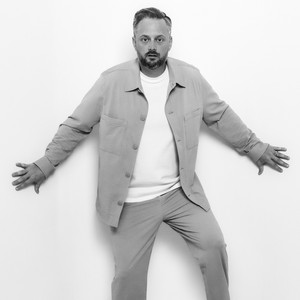
Here's my interview with Nate Bargetzi.
It's interesting reading articles about you over the last couple of years, since your career has really taken off and you hit a new level, and the writers of those articles always try and explain why you've gotten so big.
But what's your hunch about why you have gotten to the place you've gotten to over the last couple years?
Like, why you? Oh, I always wonder why you.
You know, I mean, I think as you're talking about relatable things and you're talking about, I think authenticity, not that I'm going out for authenticity, but you're in a world now where entertainment is, I think there is no authenticity.
You know, it's like you have The Wickeds and you have these Avenger movies and you have all this stuff that's great, but there's not like a regular person like on a screen anymore, and where there movies used to kind of be like that where you would see Planes, Trains and Automobiles and Home Alone and you would have someone be like, all right, that's a guy, that's a regular guy in this movie that you enjoy watching.
You know, it's like easier to watch and it's just easier to take in, and you just want to be entertained, and you don't always want to be thought provoked.
And that's something that I've always tried to stay clear of, because I realized, you know, I need to, I'm trying to sell you something.
I'm selling you entertainment.
So I need you to be able to come and trust that you're going to get the entertainment that I am showing you that I'm selling you.
You said I'm selling something, which is an interesting thing to hear, because obviously that's true.
And obviously that's true for just about everyone in the entertainment business.
But usually, in my experience, people aren't so explicit in saying that.
Why do you think there is hesitation on the part of some entertainers to say like, hey, I'm selling something?
I don't know, because I think there's got this weird, I mean, it's just, I think, kind of in life in general, it's got this self -importance.
You know, I have a platform, so I need to say something on this platform.
and I'm kinda anti -platform, I don't need to use this platform to tell you what to do.
You know, if I go want to give you my opinion and like tell you what I think and all this, I also think that's a lot about me, is what I think, and when I go on stage I try to remind myself this night's not about me, it has nothing to do with me.
If it becomes about me it's too much, I can't handle it.
But if I can make it for other people, now I'm just kinda an employee and I'm working, And so I'm just making stuff for people and so it's not about myself importance or any of that stuff It just doesn't matter.
You don't need me to do that Help me understand the distinction.
You're making when you say, you know, I don't want it to be all about me Because your material it is largely about you Well, it's about me and the fact that I'm yes.
I'm talking about myself and I'm making fun of myself But the materials written for you I mean I just got a message today about a lady that's like she doesn't like flying and I get like messages like this all the time And so she's like, I listen to you and you've helped me fly because it's like this I don't know.
It's like takes her mind off of it or whatever.
It's the way you watch this show that's comforting So anytime I think I want to go do something else.
It's like I think about the her and go well That's not fair to her.
I'm not doing it to make myself Look good or look better do this kind of stuff.
I'm doing it to make you laugh I always say you can laugh with me or at me.
So it doesn't matter.
You relate to it, or you think I'm an idiot.
Either way, I'm here to entertain you.
When you were starting out, did you feel any sort of peer pressure from other comedians to perform differently or tell different kinds of jokes?
Because you work clean.
Your stuff isn't really political in nature at all.
There's a lot of family jokes, which I could imagine if you're 28 year old guy working comedy clubs in New York City, there's maybe not a ton of your peers are doing that kind of material?
Yeah I think it was you know I would do a lot of shows starting out it'd be midnight it'd be a show called uncensored comedy and you know and I mean these are some of my friends are like very dirty.
Yeah most comics I'm around were the complete opposite of everything that I did.
I had to learn how to do what I was doing in those rooms but I didn't want you to notice that I was clean.
So I think that is something that helped me into the fact that, if I can go up and make you laugh and make this crowd laugh.
I'm 28 years old in New York City, doing a show, it's one in the morning.
These people are drunk and I'm doing it.
How can I do this material that's not doing sexual jokes or whatever everybody else was kind of doing?
And so you learn how to try to hide it.
I think if you walked up and said I'm clean, it's gonna be like, well, this guy's not cool and this guy's not this and that and I think it I look back at now I think it you know it was like I was reliable for late night sets because I was clean Fallon liked me and so it was like an easy one to go do and rely on because you know I'm not gonna say I'm not I'm not having to like change my act for television your family is the source of a lot of your material yes you know and your wife in particular and I didn't wonder does she have to vet the jokes you tell about her, like if you're coming up with a joke
based on something she's done that annoys you, say, or that you found strange, do you then go to her and say, like, Hey, I'm working on this joke.
Are you okay with that?
Yeah, I'll tell her.
Yes. I mean, there's a couple times I'll go try it first to make sure I even want to.
Because if it's not going to work, then maybe there is no reason for me to bring it up to her.
So then if it works, you're even in more of a bind.
But if it works, then I go and I can figure out how to say it.
And I always try to make in front of myself too in it.
When I first started, I would do jokes about my wife and I could tell that the audience, if they don't know you and if you don't show love, then they're not gonna go with you.
So if you show that aspect of it, then you can get away with quite a bit.
With my daughter, I'm very sensitive to try to, I haven't talked about her a ton outside when she was a baby because I didn't want her to, I want her to be her own person.
I want her a bit of a trust that she can come to me as her father, which is the most important thing and say stuff to me and not think anything she says I'm gonna go tell the whole world so it's Splitting that balance to be like I'm you want to be very protective of that for my wife for my family For any of them to know that you know, I'm not just using all of them to gather material Your dad was a comedian and a clown.
Yeah when you were growing up Do you and he have any competitive feelings about comedy?
He did, so he was a clown at the beginning, and then he did magic.
He's a magician and I mean he'll tell me like jokes and stuff and say, well you didn't say this and say that so I can talk to him about comedy and all this.
But yeah, he comes out on the road with me and he's done a hundred and some shows with me in arenas, and it's, I would say, competitive.
I mean, it's like different.
I mean when he came up, they had three kids and he had a day job and he did all this stuff.
He could've moved to Vegas when we were younger and he chose not to.
And so we grew up in Nashville and I think grew up with a very normal, I mean as normal as you can with your dad being a magician, but he's very proud and he cries when he brings me on stage.
I ask just because, I don't think it's uncommon for when fathers and sons go into the same or related lines of work for that Sometimes be emotionally complicated.
Yeah, yeah. I'm sure there is some committed to us.
I mean, there's some when you go traveling.
I love traveling with my dad, and then there's times where you're like...
I always joke to be like, it's every little boy's dream to travel with your dad when you're 45 years old, so...
You know, got a tour bus with a CPAP machine.
They go really living it up.
You know, your dad grew up you know, in pretty different circumstances than you grew up in.
It sort of had a hard childhood.
And then your daughter is then growing up in different circumstances than you grew up in.
She's just a lot, I assume, a lot more affluent.
Do you think about how your daughter understands like how or why her life and her childhood are so different than yours or her grandfather's?
I don't know if she gets the extent of that.
I think we've done a pretty good job.
We moved back to Nashville.
We live in a cul -de -sac.
We're not around a big crazy neighborhood where it's, you know, just everybody's famous or wealthy or whatever.
But yeah, I mean she has stuff.
The amount of stuff I wasn't allowed to have versus what she has is...it's not even remotely close.
You know, I wanted Jordan shoes but we got some from Dollar General and they just kind look like Jordan's shoes I would get all this stuff the Super Bowl team that lost I'd be wearing all that stuff.
A lot of Buffalo Bills gear.
Yeah, according to my family the Bills won four in a row.
You have been doing this a long time but it's probably in the last six or seven years where you sort of changed actually how you look.
Yes. You got a different haircut, you grew the beard and mustache, started dressing a little cooler, probably, I think maybe you lost some weight.
Did the impetus to do that come from you or did a manager or agent say like, hey, if you want to get to the next level, we might want to think about making some changes?
Yeah, kid's show business showed up and goes, hey, fatso, if you wanna make it, you better get your life together.
No, I mean, it's both, it's a mix of, no one told me to do anything.
I mean, as a comic, weirdly enough, you're you and you're talking about yourself.
So you are going to be you.
But I wanted to do it too and I'm going through it right now.
I mean, you know, I do not have great eating habits and when I grew up, we just ate because you had to eat.
Food was never celebrated.
Food was just something you had to do.
And so I eat a lot of fast food and a lot of chain food and I get on the road and I do realize it can get in the way though, that I realized.
I stopped drinking in like 2018 because I knew if I wanted to get where I wanted to get as a comic This was gonna be in the way And so I've realized that with food too, if I want to do this thing I want to do stand -up, this high level, probably just make some movies, all this kind of stuff.
Even for myself I realized all right well, I have to go put in the effort for me to be able to handle all this kind of touring and in the mentality it takes to stay focused.
Which is interesting to hear you say that because you don't think of the you know the image that pops into the mind when one thinks of a comedian is not like a super fit guy.
I always say I'm looking forward to the day you can't see my nipples through my shirt.
So that's it. That's all we're working towards.
One day we're going to It's a good idea to get there.
I know you're working on a new hour of material.
Can you share a joke or section of it that you're feeling good about?
The thing about nothing to do, that's the one that I'm working on.
You know, that there's nothing to do.
So the joke I do is bowling's still around.
Because that's how, if you and your wife and your family is like, let's go do something.
You go out to eat and go see a movie and you get to bowling a lot quicker than you probably should be.
you know it's 2025 so and we have AI we should I feel like bowling is a caveman sport that should have faded out but that's how little there is to do that it's still hanging around you know we're talking ahead of the publication of your book big dumb eyes and you know you joke in the book about not being much of a reader you know the way you've put it it you know books they you just have too many words.
And to help readers, you know, you threw in some blank pages in your own book.
Yes, for people to keep their head above water.
But now that you've written a book, are you feeling any differently about books?
I did think, I thought of it last night as I was watching something, like on TV.
I'm like, yeah, I was like, I think this is when you should be reading, like before bed.
You know, I was like, I think that's when people do it.
That's why there's reading lights and all that kind of stuff.
So I was thinking about getting built a fun book you know like what's an easy one.
So it's like let's start with something super fun and then just get into a habit.
Do you have a sense of what that book would be?
I looked up like the most popular books.
It was like Christina Agatha.
Is that her name? she's like an author?
Agatha Christie. Agatha Christie.
So I was off backwards.
I think I'm dyslexic so that should count as I said it correctly in my head.
Wait, that wasn't just a bit, Christina Agathe?
No, I thought that's what it was.
I'm sorry. I write the line, you don't know what's a bit.
What's not a bit. You know, that's, I'm very protected.
No one really tell what's going on.
And then I can, you know, depending on who I'm talking to, I can decide if it was dumb or not.
And, you know, even just the title, Big Dumb Eyes, or You Already Made Some Self -Deprecating Illusions to Your Own Level of Intelligence, which, you know, I know, I know that's sort of the persona.
But stand -up, almost by definition, at least from my perspective, really requires intelligence.
Comedians can act stupid or tell stupid jokes, but comedy involves crafting the material.
It involves observational insights and editing the material.
You need to have some facility with words.
Are there aspects of comedic intelligence that do transfer over to day to day life?
It's being awareness.
Being aware of just your surroundings and what's going on.
Because you're looking for material, you're looking for things that happens to make a joke about or tell a story about, so you're always very alert.
It's exhausting because it just doesn't feel like it turns off, you know, you analyze every interaction you have. I like seeing when I see two people talk and I realize that neither one of them really know what they're saying to each other.
And they're kind of on a different page.
That's very fun to watch. Is there an example recently that comes to mind of just something out in the world that you observed and thought oh, maybe if there's material in here for me?
I mean, one of it was my dad and my buddy, Nick Novicki.
Nick, his eyesight's bad.
He's just kinda won't be paying attention.
And then my dad's older and they won't.
So I watched them one time have a conversation in the hot tub.
And so Nick asked him how, he's like, how's everything going?
And my aunt was not doing well at the time, so my dad's like, well, you know, my wife sister's not doing that well.
Then Nick goes, well, that's, you know, it's good to hear.
Cause he doesn't hear him.
So they won't just acknowledge that neither one of them know what's going on.
So they're just having conversations.
And then Nick got out, dried off, and threw his towel away in a trash can cause he thought it was a towel bin.
So, something like that.
You can tell no one's really invested in what each other's saying.
That's like what I like to watch You're just on the subject of larger ambitions Something that I've seen you say in other interviews was um, I think you you mentioned I don't know if you were being totally serious, but wanting to build something to replace the old opry land amusement park with a naitland, yes, what's missing in in the amusement park space that you think you could help fill well like I mean just talk about the state of Tennessee and Nashville alone.
Nashville is a great city that's booming and there's a lot to do.
There's not a lot to do with your family there.
So when you have kids and stuff you can go to Broadway you can go drink and the bachelor parties and all this and a Titans game and there is great stuff to do but it's not less you do with your family.
What I like about when people come to my shows is that it's children to grandparents are at these shows.
They're able to go do something as family.
I think a lot of entertainment now is not made for the whole family.
Even television or movies can be separating in the fact that I'm watching Narcos and my wife watches Housewives and there's not a show that we're necessarily watching together and so I do think there's a void in that so I'm just gonna, you know, I look at stuff to go do with my daughter.
I loved when we lived in California we would go to Disneyland all the time and like, you know, you look at Disney, essentially I would like to be able to build something in that aspect where people can - it's a big one but...
You're not lacking an ambition.
No, no, I don't care.
I mean, it's... yeah, I mean, the ambitions, like, I don't know, I've done all this, I'm nobody, dude.
Like, and it's like, I just wanna make stuff that people have somewhere to go to with their whole family and, you know, it's It's easy to watch and it's fun.
Maybe this is related, but in the acknowledgements of the book, right at the end of the acknowledgements, you're writing to your fans, you write that, it might not always seem like it, but I do have a plan, and I hope you keep rolling with me, what's the plan?
The plan is, I mean, I'm kinda doin' it.
It's like the plan is to be, if you found me and you like what I'm doing in this, is I don't wanna betray that trust. So the plan is just to trust me.
You know, I don't plan on touring forever and doing standup forever I mean, I want to make movies I think you get a lot of times that people can think like if you get too big or you're gonna change I mean look in the south.
I can tell you right now I can be like oh you're Hollywood now or you're this or you're that or you're gonna The audience is very much in my mind with everything that I will make and I will make stuff Hopefully for them and with them in mind, I know I'm not doing it again.
I try not to do it for me It's not to get my point across.
My point does not matter.
It's for you. And so I wanted to be able to keep coming and see that I'm trying to do something I think that's a little against the grain right now, and weirdly enough, something being broad is, you know, like when I started comedy, some comics would be like, well I'm not for everybody.
And I was like, well why would you not want to be for everybody?
I want to be for everybody.
Hee -hee! Hee -hee! After the break, Nate and I talk again, and he tells me about his desire to serve a sorely neglected comedy audience.
I have a lot of grandmothers come to my shows.
And they love me. I do really good with grandmothers.
And I always loved them, because I don't think there's much being made that they could go to.
Certainly not stand -up comedy.
No. No, no. Hi, you're a regular listener of The Daily.
You like knowing what's going on in the world.
Well, you could know way more if you subscribe to The New York Times.
I'm Michael Simon Johnson.
I'm one of the producers that makes The Daily.
What we can cover on the show is really just a sliver of the incredible reporting that's being published every Day in the New York times, unexpected insightful articles you might never otherwise come across.
For me, that's this piece about how states legally classify butterflies.
It has to do with whether they're considered wildlife.
It's hard to explain, but it's fascinating, and you should just read it.
The Times obviously delivers the vital essential news of the day, much of which we cover on the daily, but there is so much beyond that to explore.
And yes, you support all of this journalism when and you become a subscriber to The New York Times, but you also get to experience it.
You get your curiosity fed.
You get to know cool stuff, and you get to be informed about what's going on in the world.
You can subscribe at nytimes .com slash subscribe.
Hi, Nate, how are you?
David, how are you?
I'm good, I'm good, thanks for taking the time to talk with me again.
Oh, yeah. You know, I saw a thing Marc Maron wrote earlier this year on his website where he was writing about the importance of for him, of doing political comedy.
And the way he put it was that, like, challenging people in real time with provocative material is where the real feels happen.
And I'm just curious to know your response to something like that.
Is it just that a guy like him and a guy like you are almost working in two separate fields?
Yeah, it's just different types of comedy.
I went on the road for Marc Maron, opened for Marc Maron.
A lot that I do on stage is stuff I learned from him.
Maren is very much himself on stage.
And so I always try to mimic that to be how close can I be to me offstage to on stage.
I think there's a place for that, for Maren doing it.
And you need that. You can have that.
You can also have this.
I always joke that I'm a comic's parents comic.
I stand behind my standup.
I work on it very, very hard. But yeah, you do feel sometimes a little like, because I'm clean, like yeah, you can get looked at Like, wow, of course, he sells all these tickets.
It's easy. Or it's like he's not doing anything challenging.
I mean, I don't know, I kinda disagree with that, because it's hard to, you know, mainstream is not something that's easy to attain, even with movies, you know what I mean?
Sandler did. That's not easy.
That's why there's not 40 Sandlers.
I remember you on The Tonight Show, 2016, and you did a couple jokes about how you like Donald Trump but then the joke was basically like because you're so stupid that you that you believe often like insane promises that he made yeah but then in the same routine you had these jokes about well you wouldn't vote for him in that instance then the joke wound up being because you were essentially too stupid to figure out how to go vote But would you do material even on that level now?
I would now if I felt it.
So that was the reason I wrote that joke was because everybody was saying they didn't like Trump.
Every comedian. So all the jokes were saying I didn't like Trump.
So then I thought, how can I make a joke that say I do like him and be able to do it on tonight's show where I write a line where no one's going to get mad?
I don't want the people voting for Trump to get mad.
I don't want the people that are not voting Trump to get mad.
I wanted to say the opposite what everybody else was saying.
So if I have an idea and I can do that, I will do that.
I do like that challenge.
Are there other topics like that that come to mind where you feel an instinct to go against the herd in that way?
Yeah I did it with the peanut allergies.
I had a joke on uh about airplanes like you know when they say you can have peanuts like who are these adults addicted to these peanuts this bad?
These kids are going to and so that was one that you know there's a lot of people that would make fun of the peanut allergy aspect and so it's just going the opposite way and just defending the kids that have the peanut allergies and I like writing that line and just when you make it self -centered it's much easier to ride the line all right help me understand this aspect of you because I was thinking about it I can't quite wrap my head around it so you're this seemingly humble, low key guy who is happy living on a cul -de -sac and doesn't want to go Hollywood, but then you also alluded to ambitions
to build Nateland into, and this is your comparison, like a Disney level production, which is not a normal -sized goal even for a famous comedian.
So is there like another more aggressive side to you when it comes to business?
Help me reconcile the two seemingly disparate sides of Nate Bargezzi?
You know, it is. I'm very driven.
And, you know, I don't when you didn't go to college, barely made out of high school.
Like it's like, you know, I don't understand most business stuff.
So you kind of just, maybe it's naive.
I'm like, well, why can't we do it that way?
You know, when everybody's like you can't.
I'm like, well, why not?
I'm not buying the whole yokel stick, buddy.
Yeah. Yeah. I'm good.
But I'm the thinker, the talker, like the visionary, I guess.
And then you're good at putting people around you that do know all that kind of stuff.
Because that I don't.
I didn't write a real job, so I don't know any of that stuff.
What's the last idea you had where you then said to someone you work with, can we make that happen?
So on the arena tour.
When I first started going, our screens, because you're in an arena, I wanted of the screens to be bigger.
I was like, they should be bigger because I want the experience for the audience to be as great as it can be.
And I was told they can't be bigger.
I was like, well that doesn't make sense.
And I'm fine with being told no but I just want to know it went through the whole system.
I want to be told exactly like the building's not big enough or whatever, and for this next tour, we do have bigger screens.
Because I get a lot of people, when I say I want to do theme park and I've had it with friends where I say I want to do this and they're like why why would you you basically get told you can't do anything because it doesn't make sense for I guess how I've lived to think that I want to go do all this other stuff.
What would be in the Nate Land theme park?
Just rides... you know ideally I would want it to be like a Universal Studios kind of thing where we can be shooting movies on one part and then you have the theme park on the other and kind of just build that.
I just want to build a world where people can be discovered.
I think that's a big driving point for me is like when I came up I think a lot of people would not get out of the way for the next younger people like in comedy clubs when you're coming up and you can't get spots at that club because the guys that have been there for 15 years are not moving or going somewhere else and so I want to like have places for new artists to be able to, I don't know, come do something.
I don't want to be another one of those naysayers, but at Universal Studios, slash, theme park, I think you'd need like a billion dollars to do that.
Yeah, well, look, we got some stuff we've got to get through, you know.
I was going to ask you how much money you have, if you could give it to me.
We were asking for everyone doing a Venmo.
You need a lot of stuff, I do agree.
The one thing I've learned, though, is in a business, Money's not the problem.
People have a lot of money.
There's a lot of money, and money gets used in a lot of different ways and stuff like that, so hopefully we can get there.
This is not something that's gonna be tomorrow, but I feel driven to do it, so we're gonna give it a go.
I wanna go back to the book.
In it, you mentioned that you were raised Baptist, your parents are Baptist, and you write very movingly about how your dad at one point found a deeper level of faith.
You call it his moment of testimony.
Have you had a moment of testimony?
Yeah, I feel sometimes I'm having it now.
I think that's where the drive and all this stuff is coming from to make sure that you can bring your child to my stand up show, that I want you to come as a family and you go do stuff.
and I think about those moments of, you know, I have with my daughter, all these little dumb moments of you going to the movies with your family because it's fun to get, watch your kid try to talk you into buying candy and popcorn and all these little silly kind of moments that you think back on.
So, I think I'm going through it now.
I think it's constantly having to work on it, constantly just reminding myself to be out of it and make sure that this life is not about me.
So, yeah, I mean, it's just a constant going on.
So, I think I follow what you're saying.
The idea is that there's almost a deeper motivation or a spiritual impetus for trying to create these moments for families where families can be together, and that, in some ways, your attempt at doing service for God?
Is that right? Uh, yeah.
It's a service to you know, it's a big belief to be I am second, second to God, second to your family, second to you know I believe the audience, second to everybody.
You kind of live to serve.
So it's very much a calling in that aspect that I feel.
But again, it's like it's trying to ride that balance and I don't want anybody that's not this or that or whatever lay whatever everybody is.
that doesn't matter.
I just want to make something that all of them can be in the room together.
And I feel it's driven on a bigger purpose for me, but you know, it's like everybody has their own things.
I sense a little hesitation on your part in wanting to say there's a spiritual motivation behind it, but I think you get, You are nervous about it, about being labeled.
You don't want it to be this kind of thing.
Cause stuff gets faith based or stuff gets like that.
Like people write stuff off or they take it, especially now, in very different ways.
Yeah, but, you know, it's like the moments when you're with your kids and your wife or your partner and you're all doing something and just having a joyful time.
I'm not a particularly religious person, but those are holy moments.
I mean, that's where, really, what it comes from is just, I remember our daughter's first movie was Moana.
And so, going to sit and watch it, we sat in the very back and, you know, it's like I can't, the whole experience of that day is like, that's something that I remember.
That's a dumb day in the grand scheme of things.
You're not doing, no one's in school, no one's taking a test, it's not this crazy important days, but those are the ones that you tend to go back to and remember.
And so, yeah, creating those moments.
I always see older, I have a lot of grandmothers come to my shows, and they love me.
I do really good with grandmothers.
And I always love that, Because I don't think there is much being made that they could go to.
Certainly not stand -up comedy.
No. No, no. That's the goal.
I'm trying to be only grandmothers.
Shows are at 8 .30 a .m. That's the late show.
You know earlier you had mentioned, um, that you don't plan on touring forever or doing stand -up forever.
Yeah. Do you actually know currently when you'll stop?
I do. I could see...
The next specials will be on Netflix.
You know, I could see maybe one more special after that and I don't want to overstay my welcome I also want to get out of the way if I preach it and I was frustrated by it I need to live by that and so I do think there's a point I need to get out of the way I need to step aside and let the next wave of comedians come up and I don't want to be just hovering in The spotlight and you know, I got this tour and then maybe one more tour and then just from there I got movies I want to do, and then do that, and then start running Naitland.
Wow, that's, I have to say that's, I feel like that's big news that Nate Bargette knows he's going to stop in a couple years.
Yeah, yeah. We were doing this interview in 10 years, and I'm like, you know what?
I got back into it, all right?
I'm only doing standup.
I don't have a theme park.
I have a carnival. I have a carnival that travels.
That's all I can make it.
I can do a theme park.
Still something. There's still some rides.
Nate's book, Big Dumb Eyes, will be published on May 6.
This conversation was produced by Seth Kelly.
It was edited by Annabel Bacon, mixing by Sonia Herrera.
Original music by Dan Powell, Diane Wong, and Marion Lozano. photography by Devin Yalkin.
Our senior booker is Priya Mathew, and Wyatt Orme is our producer.
Our executive producer is Alison Benedict.
Special thanks to Max Carpenter, Roy Walsh, Renan Borelli, Jeffrey Miranda, Madi Masiello, Jake Silverstein, Paula Shuman, and Sam Dulnick.
If you like what you're hearing, follow or subscribe to The Interview wherever you get your podcasts.
To read or listen to any of our conversations, you can always go to nytimes .com slash theinterview.
And you can email us any time at theinterviewatnytimes .com.
Next week, guest host Gilbert Cruz, editor of The New York Times Book Review, Interview's author Isabel Allende.
I think that my way of getting over things, of understanding, of exploring my own soul, my past, and also, most important of remembering, is writing.
I'm David Marchese, and this is The Interview from The New York Times.