Not every science class is textbook, especially not for Kate Biberdorf.
Known as Kate the Chemist.
She earned her degree at the University of Michigan and now turns science into a spectacle for kids everywhere.
She fills stadiums with nitrogen, launches ping pong balls on talk shows and helps more kids see a place for themselves in STEM.
For making science more visible, and more for everyone, look to Michigan.
See more solutions at umich.edu.
From the New York Times, this is The Interview.
I'm Lulu Garcia Navarro.
Most academics do not become global celebrities.
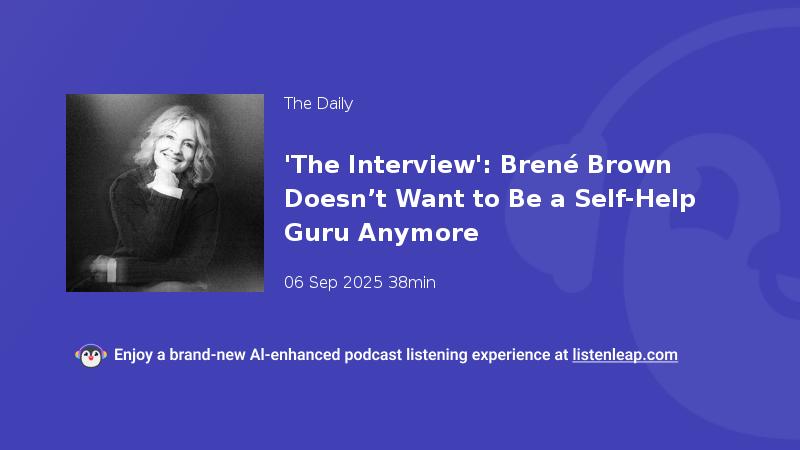
But in 2010, Brene Brown, a longtime professor of social work at the University of Houston, gave a TEDx talk about her research on shame, empathy and courage, called The Power of Vulnerability.
In it, she made the case for why people should get comfortable with being uncomfortable.
And it turned her life upside down.
Fifteen years later, that TED Talk is still one of the most viewed ever, and Brown has become a kind of guru for millions of people all over the world who devotedly follow her writings, podcasts and TV specials.
That's not always a role she's comfortable in, as she and I discussed.
In recent years, Brown has turned her focus to corporate settings.
She runs a consulting practice where she works with CEOs, and she's written a new book about leadership called Strong Ground.
It's about what makes a good leader, but it's also about this moment of intense technological and cultural upheaval we're in and how the ideas she spent her career preaching about might be able to help us weather it.
Here's my conversation with Brene Brown.
Brene, you are known for your work sort of mapping, explaining human emotions.
Yeah.
And especially around shame, vulnerability.
You're also, at this moment though, a leadership consultant who brings those ideas to various workplaces, from the NFL to the military, to the Fortune 500.
Yes.
And one of the things that I wanted to talk to you about today is the enormous amount of change that we're seeing politically at work.
In every way imaginable.
We are in just these extraordinary times that are very unsettling for me and, I think, pretty much everybody.
Ooh, I don't trust a subtle person right now.
Tell me what that means.
Look, if you're, I mean, like, if you're not unsettled, you're not paying attention.
That would be the first correlation as a researcher.
Like, we work toward feeling grounded.
But we're in a tempest right now.
Like.
This is a maelstrom of craziness and unpredictability and volatility and instability, and it's disorienting.
And so I don't think that feeling unsettled or feeling disoriented means that there's something wrong with you.
I think it means in very technical skills that you probably have some level of critical thinking skills, anticipatory thinking skills, emotional awareness.
I think it's a good sign to feel unsettled right now.
The question is, how do you get tethered?
I mean, you've written a new book.
It's called Strong Ground, and that's basically the idea behind it, which is we need to center ourselves at a moment of great change.
Can you tell me why that became something that you wanted to engage with, corporate leadership?
Because it's not necessarily obvious how Women in Shame in your early work relates to leadership in Fortune 500 companies.
Yeah.
When you study the intersection of emotion, behavior and thinking, you can apply it pretty much anywhere.
And so after the TED Talk on vulnerability, this is weird.
After the TED Talk on vulnerability went viral.
This is in 2010.
Right.
And the first phone calls I started to get after it went viral were from leaders saying we think there's a lot of application in what you're talking about in our work.
Can you come talk to us?
So I started a leadership study and that was all I needed.
I was like, wow.
When you ask leaders who are doing really important work corporate nonprofit, military sports what's getting in the way?
And the answer across every single industry is courage.
We won't have hard conversations.
We don't hold people accountable.
We shame and blame them.
I was like, oh, I can do this.
I know how to do this.
So for me, this whole crazy path makes a ton of sense.
In the end, at work, we're just people.
And if I was going to find an intervention point In which I think I can make the biggest difference in every area that I care about.
This is it.
Explain that to me.
Why leaders are important.
Why talking to leaders is an important thing to do in a company and why you've focused your work on that.
We spend more than half of our life at work.
I've never met a content person who is working under a shitty leader.
And I always say, who's going to be your boss?
Who's the leader?
Because that's going to determine if you get promoted, if you're happy, more than even the job title, the salary, what you're doing.
Are you working for someone that you like and respect and will help you?
Because if you're not, it doesn't matter how good the job is on paper.
It's not going to make you happy and it's not going to get you to where you want to go.
Is that kind of what you mean?
I could almost cry to hear you say that.
Do you know how rare it is to hear from someone you look up to what you just said?
No one says it.
You and me, party of two.
And that's exactly what I'm talking about.
That is exactly what I'm talking about.
And let me tell you, I define a leader as anyone who holds themselves responsible for finding the potential in people and processes and has the courage to develop that potential.
I have been in C-suites of Fortune 100 companies and not seen a leader among them.
And I have been on factory floors and been surrounded by leaders.
So to me, leadership is about skills building.
It's about self-awareness, understanding who you are, because who you are is how you lead.
And then it's skill set.
Just because you have experience and subject matter expertise doesn't just because more likely you knew the right person doesn't mean you have the skills to lead.
So I want to get to the heart of the matter, which is that this moment is different.
You know, like a lot of people in every industry, I personally am feeling overwhelmed by the pace of change.
Same.
One of the things that I noticed in your new book.
About halfway through, you quote Amy Webb, a CEO and NYU professor who studies the future, basically saying And she described this moment as a super cycle of unprecedented change.
What does that look like inside companies, right?
Because this massive disruption, all this new technology that companies have available to them.
I mean, I imagine it's first of all, how they're supposed to use it.
Right.
And then how to train people on it.
What does that look like inside a workplace today?
At this moment where it just feels like everything is up in the air.
It looks like a complete shit show.
What it looks like is scarcity.
Right.
We're not doing enough.
We don't know enough.
We don't have enough people trained.
We're not investing enough.
This is what everyone's doing, and we're behind.
So it looks like fear and scarcity driving huge investments in AI that are not even aligned with business strategy.
So in this moment of sort of profound change, what is a good leader then?
So a good leader to me right now is a leader who understands urgency but is working from productive urgency, who is not like my grandma would say you know that's a terrible saying, but chicken with your head, cut off urgency.
And we're seeing a lot of that.
But productive, strategic urgency.
You know, action over impact is so dangerous.
And right now we're seeing a ton of action over impact as companies try to integrate this technology.
And Right now this month, we are starting to see some devastating numbers around return on investment in terms of what companies are investing in AI, because they're coming in operationally and making decisions and not strategically.
They're not understanding AI how to bring people along, how to use it in smart ways where it will work, where it will not work.
Linda Hall, Harvard Business School, professor, researcher, studies digital transformation.
Love this work.
She's just brilliant.
She will tell you the hardest thing about digital transformation never the technology, always the people.
Then you add to that you're talking about this super cycle absolute geopolitical instability around the world.
You know leaders wake up and, depending on the tariff fever dream of the night before by this administration, everything has changed.
So geopolitics, then you have what we talked about first, technology super cycles.
Next, you have radically shifting marketplaces because consumers are changing.
We're changing.
You know, we don't.
You know.
I'm talking to people who are economists that are mentioning mayonnaise jars again for the first time.
Do you put your money in the market?
Do you not put your money in the market?
So there's complete instability economically.
There's markets instability, technology, geopolitical instability.
And I'm not going to downplay the complexity of intergenerational workplaces.
I mean, some of these forces are largely out of the control of leaders of companies.
Yeah, I mean, I would say the majority of them are out of the control.
But what is in your control?
Have you ever watched like five or six-year-olds play soccer?
Sadly, yes.
Yeah.
I know for sure that you have by your answer.
The ball leaves the field and my daughter's sitting crisscross applesauce making daisy chains.
One of the things that's really interesting is when you watch little kids play soccer.
A kick will come into a kid at chest level and they won't settle the ball, look down the pitch and decide where it needs to go next.
They'll just raise their foot up over their head and try to kick that ball back about that high.
A good leader takes the incoming churn and instability, settles the ball, takes a breath, creates some space and time where none exists, looks down the pitch.
So how does that connect with your older ideas around compassion empathy, vulnerability?
I mean, are those things still necessary in those moments?
Because I get why it makes us better humans, but why does it make us better leaders?
Because when you raise your foot up shoulder height and kick a ball, you have no control where it goes.
It's not strategic.
It's reactionary.
It's not a response.
So the answer to your question is I have my team working really hard toward a project.
And I just found out from my boss it's been deprioritized.
I pull them together.
And what does compassion in that moment look like?
And what does vulnerability and humanity look like in that moment?
And I say I want to start by saying how grateful I am for the work you've been doing and that it was important work and work we were asked to do and asked to do.
And I counted on you for that and you delivered.
I found out this morning that this initiative, due to whatever a supply chain issue, a change in strategic priority has shifted and we're being asked to change direction.
And I don't want to just throw everything at you.
I want to take a minute and I want to acknowledge this the amount of cognitive and emotional energy it takes to walk away from good work and start new work.
And I want to check in with you about it.
I'm listening to you and I'm nodding and I'm going, yeah, that sounds really good.
But I also see that that kind of leadership seems to have fallen out of the zeitgeist.
The companies that are some of the most valuable in this era are tech companies who aren't exactly known for their people-centered leadership anymore.
And that sort of shift away from appearing empathetic is to trying to understand the other side of people's experience.
That doesn't seem to be as popular anymore in the era of the Elon Musk style of leadership, where you can go in, you can fire a bunch of people and you can still have a productive company.
Some would argue even more productive.
One.
Two.
What's in the zeitgeist and not in the zeitgeist is of very little interest to me personally.
Democracy is not in the zeitgeist right now either.
I'm still a firm believer in it.
Number two...
We collect data on everything we do.
We see a very compelling persuasive, strong correlation between courageous and daring leadership and performance, as measured by the way companies measure performance, whether that's quarterly stock price, whether that's retention, whether that's engagement.
I have zero doubt that, just because the world at large believes that you have to be a total dick to get performance out of a team, There is actually very little evidence of that over a long period of time.
Zero.
They're not sustainable for a really easy reason.
I think a simple reason.
Fear has a very short shelf life.
And in order to maintain fear as a leadership tool or power over rather than power with and power to.
Mary Parker Follett's work social worker, early management scholar you know she talks about power, power over power, with power to power within.
In order to lead from power over using fear humiliation, you have to demonstrate a capacity for cruelty at very regular intervals because of the short shelf life that fear has in people.
So you can't keep me afraid forever, but if periodically you can demonstrate cruelty and a capacity for it, that will rekindle my fear.
I think people are becoming less and less tolerant of of living that way.
And I think we have a new generation of people who won't work that way.
Well, that's interesting because you know there is a responsiveness, I think, to culture and the zeitgeist.
They adopted them in response to another cultural moment, right, in 2020.
And now because things have changed, they've apparently decided that it doesn't help them anymore.
And I guess I wonder if the embrace of a lot of these management and leadership humanity trainings are only performative.
That they are there simply to respond to forces outside of their control, but they're not really about doing the work that you say is necessary.
Heck yes.
Yes, absolutely some are and some are not.
If we want to talk about DEI programs specifically... It's an example, though.
I think one that people have noted.
It's an example, but it's an important example.
Did some companies adopt DEI and exploit it, use it as a part of their brand and then, the minute they were told to get rid of it, they got rid of it?
And without thinking twice about it, I think that's for sure.
Did I see DEI programs function in meaningful way?
You know, DEI programs are not.
They were developed and when done well, they were just meritocracy programs.
That's what a good DEI program is.
It's just a meritocracy program.
It's just a program to make sure that the invisible program of favoritism and bias was being checked.
This is not administration.
That's a fan of meritocracy.
And you have an administration saying you'll get rid of this or you'll lose every contract that touches the government, any federal or state dollars.
And you know that that means that you'll need to lay off 35,000 people.
I don't know that people are choosing to get rid of their DEI programs.
I would be comfortable enough to say that any leader that props up or folds something that's good for their people and helps make their people feel more connected and seen and also drives performance which is a leader's job, whether they're in an NGO or a nonprofit or a for-profit or a government military sport doesn't matter is a pretty terrible leader.
After the break, I asked Brene about the online self-help ecosystem.
Shit, I almost escaped this whole thing without having to go here.
Not every science class is textbook.
Sometimes it's a teacher running around setting things on fire.
A moment that makes a kid say, let me try.
That's what happened to Kate Biberdorf when a high school chemistry teacher lit the fuse.
She brought that spark to the University of Michigan, where she earned her Bachelor of Science in Chemistry and discovered new ways to share what she loved.
Today she's better known as Kate the Chemist, a science entertainer, author and professor bringing chemistry to life for audiences everywhere.
From classrooms to talk shows, she makes science impossible to ignore or forget, helping countless kids see a place for themselves in STEM.
For making science more visible and more for everyone, look to Michigan.
See more solutions at umichedu at new york times cooking.
We believe that you shouldn't have to run to the grocery store every time you want to make something delicious.
I'm melissa clark and my recipe for the most adaptable one bowl cornmeal pound cake is a comforting loaf cake that you can have fresh out of the oven in under an hour, using ingredients you probably already have on hand, and sliced, toasted and buttered.
It's practically a bread, so it gives you a pass to eat cake for breakfast.
You can find so many easy, flexible pantry recipes like this one at nytcookingcom.
NYT Cooking has you covered with recipes, advice, and inspiration for any occasion.
So I'm listening to you talk and it is this very difficult moment.
You keep on bringing something up though, that I do think is really interesting, which are the generational differences that we're seeing in the workplace, and how different generations view work and what work is supposed to do and what work isn't supposed to do.
Can you just expand on that a little, what you've seen and what you're thinking around that is?
I do think there is complexity, organizational complexity in intergenerational work.
I think we're different.
I think that we were raised differently.
We have different ideas about what success is and everything.
I think there's something to learn from each generation.
I think each generation has real strengths in a workplace and possibly some deficits.
I do get nervous talking about swaths of people like generations, but I also think there's some truth to it.
So I'll try to balance that.
I'm a Gen X person who's raised two Gen Z folks.
I think we did...
Some good things.
I think we did some not great things raising that gender.
I mean, it's like when people start really dogging on Gen Z.
It makes me laugh, because it's usually the exact people who raise them.
So I think I always like... It's a good point.
You know, self-indictment.
But I think that we wanted to make sure...
That our kids didn't have all of our experiences, the traumatic hard ones.
And somewhere along the way, we confuse trauma with adversity.
And adversity is really good for kids and trauma is not good for us.
And so I do think there's a little bit of that.
So let's be clear about that.
I think what I've noticed about this generation is that they're not doing anything without the why.
This is like the generation my generation that was grown up, grew up with like because I said so getting really frustrated with a generation that said I don't know, why are we doing it that way?
What is that?
Why is that going to be helpful?
And, you know, people my age are looking for a little yes chef action, like got it, on it.
No, these kids are not interested.
They want to know the why.
I like it because when you give them the why through your gritted teeth, they're like.
So let me play back what you're saying, Lulu.
You want me to get this data for you by three o'clock this afternoon, because you're going to use it in a meeting with these people.
Is that right?
And you're like, yes, damn it.
And they're like, I think you're asking for the wrong data.
Yeah.
Dude, you need bruh, you need a whole different set of data if that's what you're trying to do at five o'clock.
And then that's helpful.
And so, with the right skills, what would be really good task conflict that leads to innovation and ideation and smart things.
With the right skills, it's amazing.
The problem is without the right skills, task conflict becomes emotional conflict.
And then people don't like each other.
They blame each other.
They're having meetings outside the meetings.
You know, all the stuff that just tears teams and organizations apart.
It's the lack of skill to straddle tension and stay in it and be productive with it.
That's the problem, not the generations.
How we talk to each other.
What are we doing when we're having these discussions?
And as a fellow communicator, I think about this a lot, because ultimately, communication is about building trust, bringing people along.
Why do you think we suck at it?
From the New York Times journalist.
You know why we suck at it?
Good communication is a skill that's based in clarity, discipline, and accountability.
I'm thinking about those three words.
Clarity, discipline, and accountability.
Yes.
Walk me through them.
Okay.
So...
First of all, good communication is vulnerable.
It's hard.
You have to have a tolerance for discomfort if you want to communicate well and honestly.
And that's at every level in an organization, in a family, it doesn't matter.
A brave life is basically 15 fricking hard conversations a day.
So it's vulnerable and scary.
And so that's part of it.
Then we talk about clarity clarity of what we want to say, economy of words, using the right words to describe what we want to do and what we want, what we mean, what we need.
Discipline.
Checking an email three times.
Picking up a phone instead of sending a text because tone is lost on text and it doesn't work.
Accountability.
You say, wow, Brene, that was a really shitty thing to say.
And I said, yeah, that was my intention.
I'm pissed.
Or, God, that was not my intention.
I apologize.
I could see how it landed that way.
That's accountability.
You know, and then I think behaviorally, you know, the behavior, no one's taught how to do that.
We don't teach people how to communicate well.
I mean, we operate from an axiom, clear is kind, unclear unkind.
So I think communication has never been more important than it is right now.
Yeah.
We have only a little bit of time left and I wanted to ask you a little bit about the changes that you've seen in the industry within which you work.
Because, as I was thinking about your career, you know you came up in 2010 and you have sort of ridden this enormous boom in people looking for guidance and help in the way that they should live their lives and interact with other people.
And I don't know how you feel about the label of self-help being applied to your work, but you were definitely sort of one of the earliest practitioners of a very online strain of personal improvement content that's still very, very popular.
Though most people practicing it don't have your credentials.
How do you look at the evolution of that world in the last 15 years?
Shit, I almost escaped this whole thing without having to go here.
Almost.
You really are.
You get the A-plus in communication, Lulu.
Okay.
I think that there are a lot of well-meaning well-intentioned, well-trained people in that space.
And I think they make up about 30% of that space.
I think there are 30 of the people who want to be in that space or trying to be in that kind of self-improvement wellness space, who are underqualified thoughtful, sometimes helpful, often benign.
And I think there are 40% sheer grifters.
And everything they say is, it's predatory advice giving.
I think, depending on who you'd ask, who you ask, people could put me in different categories there, depending on what they think about what I'm saying.
I've always been, tried to be very, very careful when I was in that space.
There was a moment when I made a very, very specific tactical get the hell out of Dodge decision to not be anywhere near that space.
When was that?
And that was when my sisters and I were caregiving for my mom with dementia.
And when I found myself bombarded by posts that would say things like caregiving for a parent with dementia, starting to wonder about your own memory.
A tablespoon of castor oil will change your life.
Find yourself devastated by your own parents' cognitive decline.
Our four brain teasers will ensure this never happens to you.
And my first reaction to that was, fuck you.
No, no, no.
That was my second reaction.
My first reaction is, I'll take it.
I'll buy it.
What are you selling?
Let me do it.
That was my first reaction.
And I realized that I would see clips of myself come up on Instagram and where the clip had been cut such that it was kind of provocative and advice-giving and conveyed a certainty that the first half of my answer was like look, I'm not sure, or I don't study that area or we can't draw causal lines here.
And I was like, I can't be a part of this.
I cannot be a part of this.
And I absolutely do not Want to participate in overwhelming people who I don't know with what they believe is advice that they should take.
I just don't think it's I don't think it's that's not who I am.
So explain to me, practically speaking, what that shift then means.
I mean, what do you do differently that you might have not done before as you were coming into this?
I'm interested in talking about how organizations function.
I'm interested in talking about more macro topics.
I think I'm just figuring it out.
I was walking – I was with Adam Grant somewhere, and he's a good friend.
And we were talking about our careers, and they're very much the same.
Would you think a little bit?
Or would you say, like, we do the same kind of work in companies?
Yeah.
And he said I don't understand, like why – you're careful about walking down the street or going into this thing.
And I said, I think my experience is different than yours.
And we walked like four blocks through this like conference area.
And in that time, six people came up to me.
Three of them were crying, you know, and he's like this is not my experience in my life.
And he said and when you get attacked for something you say, it doesn't look and feel like the attacks.
And I said, what are you saying?
And he's like, we got a big fat gender issue here.
And I said, you think so?
And he goes, yeah.
He's like, this is...
And so I think that's still really at play.
He goes to the UK and it's like thought leader.
You know, researcher Adam Grant arrives to talk to people at Canary Wharf.
I think the headline when I got to the UK said the queen of self-help arrives in London.
It's just, I don't see myself the way the world sees me.
You know, I think it was during the pandemic that Texas Monthly.
I write about this in the book.
Texas Monthly, you know, I mean, the New York Times is the same way.
They can interview you.
You have no control over what the headline is or anything else like that.
And you're always like, oh, shit, what's going to happen?
And of course, the cover, it was a cover story on me.
And there was a couple things about it that were like, just for me, really hard.
And I love Texas Monthly.
But it said how Brene Brown became America's therapist.
And I'm like, what?
I don't think I've ever been, I've been always clear.
I'm not a mental health practitioner.
I respect that work, admire that work.
I have a therapist.
I'm not a therapist.
And I don't want to be your therapist or anybody's therapist.
And so I think I've just drawn a very hard line around where I think I can make a contribution to And where I can't.
And yeah, that's it.
That's Brene Brown.
Strong Ground will be out September 23rd.
To watch this interview and many others, you can subscribe to our YouTube channel at youtubecom slash at symbol, the interview podcast.
This conversation was produced by Wyatt Orme.
It was edited by Alison Benedict.
Mixing by Sonia Herrero.
Original music by Rowan Nemisto, Dan Powell and Marian Lozano.
Our senior booker is Priya Matthew, and Seth Kelly is our senior producer.
Annabel Bacon is our senior editor.
Video of this interview was produced by Paola Newdorf and Felice Leon.
Cinematography by Zebediah Smith.
It was edited by Amy Marino.
Brooke Minters is the executive producer of podcast video.
Special thanks to Afim Shapiro, Rory Walsh, Renan Barelli, Jeffrey Miranda, Nick Pittman, Matty Mastiello, Jake Silberstein, Paula Schumann and Sam Dolnik.
Next week, David talks with Cameron Crowe ahead of his new memoir, which is about his early days as a teenage music journalist.
I'm Lulu Garcia Navarro, and this is The Interview from The New York Times.
Not every science class is textbook, especially not for Kate Biberdorf.
Known as Kate the Chemist.
She earned her degree at the University of Michigan and now turns science into a spectacle for kids everywhere.
She fills stadiums with nitrogen, launches ping pong balls on talk shows and helps more kids see a place for themselves in STEM.
For making science more visible, and more for everyone, look to Michigan.
See more solutions at umich.edu.