Understanding the human body is a team effort.
That's where the Yakult group comes in.
Researchers at Yakult have been delving into the secrets of probiotics for 90 years.
Yakult also partners with Nature Portfolio to advance gut microbiome science through the Global Grants for Gut Health, an investigator-led research program.
To learn more about Yakult, visit yakult.co.jp.
That's Y-A-K-U-L-T dot C-O dot J-P.
When it comes to a guide for your gut, Count on Yakult.
Hey, Science Quickly listeners, Rachel here.
I just wanted to give you a heads up that I'll be taking a short break from hosting the pod to go on parental leave.
But don't worry, I'm leaving you in excellent hands.
Award-winning journalist Kendra Pierre-Lewis is stepping in to host Science Quickly while I'm gone.
You might recognize her from the late Gimlet Media podcast How to Save a Planet or from her work at Bloomberg, The New York Times, Popular Science and lots of other outlets.
She's taking the helm starting in November and I'll be coming back into your feed sometime in the spring of 2026.
So see you next year.
And as always, thanks for listening.
So the snowflakes were a different story altogether.
So there's the classic one.
You know, I lived in Ottawa Ontario, for six years, three years of continuous snowflake production, because really the winter lasts for half the year.
I worked out a methodology to get snowflakes into the vacuum chamber of the electron microscope using liquid nitrogen.
I had this kind of cryopod which was used to take DNA samples around Canada.
So you can capture the flakes and keep them at minus 200 or something degrees.
Something incredibly cold.
And then you have a shot at getting it into the vacuum chamber.
Ice in general doesn't like a vacuum and it doesn't like being hit by electron beams.
You know, it sublimates and it melts.
But you have about three minutes to capture a snowflake.
And so we worked out a methodology to get high quality SEM images of snowflakes.
That's a close view of the center of this thing.
You can see why no two snowflakes are alike when you look with a microscope like this.
Because they're so complex, you know.
This one has a... bisected tine.
And when I first saw it, I thought, oh, it's too bad it's not perfect.
I can't really use this one.
And then a minute later, I said, wait a second.
This is how it looks.
Use this.
And actually, I think it's beautiful.
It is beautiful.
For Scientific American Science Quickly, I'm Kendra Peer-Lewis in for Rachel Feltman.
Radiolarians are single-celled organisms that live in water and are invisible to the naked eye.
But under microscope, these creatures take on an almost glassine-like quality.
Their beauty, along with that of other tiny creatures, and some extreme close-up images of lunar rocks, are the subject of Michael Benson's recently released book A Journey in Electron Space.
In it he uses a specific type of microscope, a scanning electron microscope, often used by scientists for research, to create beautiful art that he hopes will help instill a sense of wonder and awe in the world.
And just a note to all you listeners Michael and I were together to look through his stunning new book and we made a video version of this podcast so that you can look too.
Head over to our YouTube to see snowflakes, radiolarians and moon rocks in all of their visual glory.
We have Michael Benson here with us today.
Thank you so much for coming.
Thank you very much for inviting me.
I'm really looking forward to talking about my project.
Your earlier books you know Planetfall and cosmographs really focused on sort of the beauty and the enormity of space.
And this is a little bit the opposite.
Like you've spent seven years in a tiny room in Canada looking at tiny things.
Why did you decide to switch it up?
A lot of people don't even remember the name Buckminster Fuller.
He was a prominent futurist. very famous in the mid-20th century.
And he was being interviewed apparently, by a young journalist, a little bit nervous, talking to the great man towards the end of his life.
And the journalist said you spent a career prognosticating about colonies in space and our position in space.
Does it ever bother you that you haven't actually been to space?
And Fuller looked at him and said, my God, man, where do you think we are?
And my point is that actually this is not that different from the other work I've been doing.
It's just that it's at a different scale.
It's all about space and time.
Looking at how we try to understand our position in space and time using images.
But I also write.
And with the electron microscope work it was finally having a chance to look at phenomena here on this planet.
I wanted to look at natural design at sub-millimeter scales.
So smaller than a grain of salt.
So huge, basically.
So huge, basically.
Well, okay.
I'm kidding.
Well, no, it's huge if you're talking about atomic physics or something.
We're talking about large structures.
That's true.
And we are talking about atomic physics, because the electron microscope uses the electron and not the photon to look at subjects.
Yes.
I was going to ask you about that.
What makes a scanning electron microscope so different from conventional lens-based microscope?
It's quite different.
It takes up most of a room.
It uses electrons instead of photons to look at the subjects, which allows for a far more detailed nuanced, accurate look at extremely high magnifications of subjects.
From a very young age I was aware of electron microscopy images, invariably presented as belonging to scientific research.
But I'm an artist and a writer and I'm not a scientist, although I am very science adjacent.
I use scientific technologies to explore phenomenal reality for my purposes, which is more associated with the arts.
It is not science.
In what way is it art?
Because I think, when people think about taking an image of something or preparing a slide, what are the choices you're making that make it different from say what people think of when they think of science?
So scientific imaging is about research and empirical data acquisition.
I am positioning my work as belonging to the history of the image, the history of photography, although in this case it's mycography, but it looks like photography and it's printed like photography.
And in fact I approach it like photography.
Although it's using a million dollar piece of scientific research equipment that never leaves a single room.
You can't take it around and take photos with it.
You have to bring the subjects to it.
There is a real learning curve learning how to use that kind of instrument.
And I have been fortunate in having the confidence of the Canadian Museum of Nature in Gatineau, Quebec.
I had a training period and then they let me loose on the instrument.
It's a very complex set of procedures just to get a sample ready for the SEM SEM scanning electron microscope.
And that's all exactly the same as what any scientist would do.
Exactly the same.
Art has a freer hand than science.
Art does not have to justify itself and prove things.
Art is about sublimity.
It can be.
And about evoking wonder and about triggering aesthetic and emotional responses.
And art is also – to quote something Brian Eno said recently –
I don't think he invented this, but it's an interesting point that art is in some ways how adults play.
And furthermore, play is not wasting time.
Play in children is about figuring out their place in the universe in a way to simplify.
And in my case, this work is in part an extension of that impulse.
You know how to continue producing in myself this sense of wonder about what our place in the universe, about the universe.
You know the phenomenal reality.
And I'm also fascinated by frontiers.
One of the sets of images that open up the book are of these lunar moon rocks.
And it's interesting looking at them because they do, they look like mountainscapes to me.
What are we looking at?
So it's lunar impact glass and it was a piece of ejecta, as they call it.
You know from a macro meteorite impact millions of years ago that the Apollo 16 astronauts just kind of casually noticed lying on the lunar surface when they were doing something else and raked up.
They had these rakes, sample rakes, and just threw in their sample bag and brought back to Earth.
Every single lunar image in the book, there aren't that many.
Mm-hmm.
This is another lunar mountain range.
They all came from the same piece of impact glass which I just found marvelously ravaged and geological and landscape-like.
This is all fracturing from the impact, and I guess from the impact of the glass when it hit the surface.
And then there were millions of years of exposure to space that resulted in various forms of weathering.
Let's say
Here you have micrometeorite impacts.
So they have.
You can see, you know, characteristic lines radiating out, just like in macro lunar craters that we can see through a telescope.
Yeah, that's really cool.
Yeah.
I very consciously wanted to make landscapes, lunar landscapes on Earth.
They look like Utah or Arizona slick rock country, you know.
They look very geological, and they are geological.
It looks like something you could climb.
Yeah, it does.
Can I ask a very silly question?
Absolutely.
Did you lick it?
No.
Lick it?
Why?
I don't know.
There's like a whole trend or thing where people feel compelled to lick rocks.
Oh, my God.
These are Apollo samples.
No chance.
In fact I wasn't allowed to coat them because most samples you put in the electron microscope are coated with a molecule-thin layer of platinum so that they don't charge.
And that's complicated to explain.
But you have an electron beam hitting the subject, you know.
And if it's not grounded with that coating, it can charge and so on.
And so I had issues with, of course, I couldn't do that.
These are priceless samples.
So I had to figure out ways of imaging them without their charging.
And nobody who listens to this podcast is going to sit through an explanation of how I did that.
But I did manage to do that.
But, no, I did not lick them.
Good question, though.
Yeah.
Many of the images, like the image of the weevil in a flowering plant.
I really like that one become almost a world unto themselves because they're taken so closely.
They're obviously so beautiful, but is there also like a scientific benefit to taking pictures like these?
Whether or not there's a scientific benefit is... beyond me.
But as I said earlier, I am fascinated by frontiers, wherever they may be.
I define a frontier as where what we know or think we know meets what we know we don't know.
And there's this sort of hazy zone in the sciences where all of this research is taking place.
And I am fascinated by that, but I'm not a scientist.
I go there as an artist looking for my kind of discovery.
You know, with those images of insects in plants.
You know I did have the benefit of being able to speak to and actually get loans from entomologists at the Museum of Nature.
So I was asking things like, well, what does that thing do?
And then I would typically get an answer.
Well, we believe it's for this.
And I realize I'm at the frontier.
You know, we believe it may be for this.
So that's an interesting place.
So this is a flowering plant from the Adriatic.
And when I collected it, I mean, this is incredibly small.
It's about the entire plant.
Let's check.
The entire plant is 8 millimeters wide.
So that's under a centimeter wide.
And when I collected this thing with tweezers and put it in ethanol, I noticed that there was this weevil in it.
Mm-hmm.
And then they both went in the ethanol.
And so what you're seeing is this kind of I mean very, very close to how it would look in actual nature, you know.
If someone actually paid attention to look.
Yeah.
I mean, because it's so small, it just feels like the thing that most of us would overlook.
Oh, yeah, of course.
I mean, and also, who really looks at all those really tiny flowers?
You just kind of trundle along, you know.
But one of the reasons why I really had a lot of fun with this project is it changed my way of looking at, my way of being in nature.
You know, I mean I was, of course it was a little bit predatory when I was collecting samples but um, there's another one that's similar to this.
That is even more ambitious.
In a way, in fact, I think it's the single most complex um mosaic I did in the whole book.
All of these are mosaic images.
By the way, they're comprised of hundreds of individual scans.
This is the one.
Yeah, so that is um, that's from a, that's an Ontario plant, and a Fox glove a fit in it.
Uh, right there.
Yeah.
Um and that one took about three weeks of continuous work to assemble, because the the individual um SEM frame was something like this, you know, and then there's also a depth of field question.
So I mean not to get all nuts and bolts here but, um know, sometimes i had to do focus, stack and get multiple scans of one part of the subject in order to stack them in photoshop and make sure everything was in focus, and then, you know, build a complex mosaic.
So um, you know, and this is, this has some elements of, you know, that famous painting with the tiger in the jungle.
There's a little bit of that going on.
Art isn't prescriptive, but like, what do you hope that people get from seeing these images?
I don't know.
I mean, you know, for example those, the weevil surrounded by flowering plants was consciously modeled after 16th and 17th century Dutch still life painting where you can see all these flowers and insects all in a perfect arrangement and just kind of, you know, life in miniature.
Mm-hmm.
It's about triggering an aesthetic response.
It's about showing worlds that you can't see with the naked eye.
But we have these tools now to see them.
That also is all bound to this question of the frontier, of course.
Radiolarians.
They're these microscopic, basically, organisms that live in the ocean.
But they're so beautiful.
They're almost like glassine in structure.
They are.
But we would never be able to know about them without you know advancements in imaging functionally.
Well, it's interesting.
Radiolarians are specifically a central focus of the 19th century German marine biologist Ernst Haeckel.
He's best known to the layperson as the author of a book that in English the title is –
Art Forms in Nature, which is really the first arts-science crossover illustrated book bestseller ever.
And it's still in print.
It's incredible.
So he brought, let's say, the message about radiolarians to the public in the late 19th century, discovered many of them.
His work impacted... design and architecture and art.
He was using an optical microscope.
The electron microscope had not been invented yet.
He would have been envious, I think.
I could look at radiolarians with a level of particularity that he could only dream of.
But he did produce extraordinary work about radiolarians and many other organisms diatoms dinoflagellates, all kinds of things.
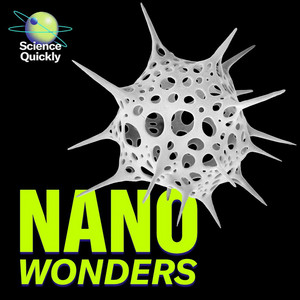
So this is a radiolarian from the equatorial Pacific.
It's 300 microns wide, which means zero.
0.3 millimeters.
It's extremely small.
But look at the complexity there.
And you know, when it was fully intact and not partly damaged, it had a whole shell of this kind of lattice work going on there.
I write in the book about what all of these things are we think are doing, or at least to an extent you know what the those radiating spines are all about.
It's partly about flotation in the water column.
The beauty of it is breathtaking to me.
Here's a Closer view.
Yeah.
I mean, there's nothing like radiolarians anywhere else in nature that I've seen in biological nature.
They're quite specific.
And I think if we pop over here.
So these are diatoms.
And diatoms are another class of single-celled organism.
And they tend to be much more sleek, as you can see here.
And interestingly about diatoms, diatoms produce oxygen. in the Earth's atmosphere.
But they're tiny little things, you know.
It's just that there are billions of them.
You have diatom blooms.
You see these long tendrils.
You can see it from space, you know, of kind of greenish blooms in the water.
And all of the shells are actually glass.
I mean, they're silica.
Just like with radiolarians, by the way.
The radiolarians are also, they distill silica from seawater and produce their shells from that.
Under an optical microscope.
They look like glass in an SEM.
You see the surface texture of the glass, you know.
But the reason they do that I mean the reason they have to be clear is that they're like petri dishes.
They have symbiotic Photosynthesis going on algae living inside producing energy for them.
Yeah, that's a marina marine diatom Like a pillbox, isn't it?
Mm-hmm Yeah.
I mean, this just blows me away.
I mean, there's an element of Islamic architecture somehow in here.
This is a close view.
I mean, this could be something in Istanbul, you know.
Flip it the other way and it could be the top of a building, you know, connected to a mosque or something.
Yeah.
And so, you know, again, you know, what you have here, this is almost literally a Petri dish.
Look at it.
It's the same shape.
Yeah, little bit more beautiful.
Yeah, it's almost like got lacing in there.
Yep yep, and then we're gonna bounce forward again.
Yep, so that's a dinoflagellate, and they are so strange, they are so beautiful to me.
Um, you have, usually you have this sort of equatorial groove where one of the flagella um, coils around um, and then you've got the this uh, you know, polar opening here where another flagella extends.
They spin for stability like a spacecraft might.
And then they're propelled at the other end by another flagella, which shoots them forward.
And they're just amazing things.
We don't know what this is all about.
What are these guys up to?
I think that there's a tendency to think that well, we're multicellular creatures, so a single cell must be a very simple thing.
You know, because we're complex and we were made of many cells.
Well, it's not so simple.
I mean the single celled organisms that have managed to survive and compete with each other and prosper in the sea, have just as much evolutionary history as we do.
You know, four point something billion years.
Right.
Or three point something.
Yeah.
I really should know that.
We don't know that.
Nobody knows that for sure.
In any case.
It's been a while.
It's been a long time.
It's been a long time.
Yeah.
So they're very complex and their survival strategies, their structural complexity is a result of the necessity to prosper, to go forth and prosper.
They had the same marching orders as Adam and Eve, I think.
Go forth and prosper.
That's life's –
And so, you know, they're very complex.
And also, I guess nobody who actually knows anything about cells would say well, single cell is a simple thing.
It's a mysterious, complex, magical, amazing thing.
Anyway, even in a multicellular organism like us.
But the ones that are free-floating and competing with each other are particularly amazing.
It feels like in this moment it's really easy to be very cynical about everything that there's a lot of weight and heft going on in the world.
But hearing you talk about this book and this project, it seems like it reinforced your sense of wonder and joy.
Yes, yes.
And I know that people have many emotions in looking at art, but it does feel like that If people take away anything from your work, it should be kind of a sense of just how beautiful and weird and strange this world is.
Yes.
Thank you.
That's a great question, and you're right.
There's also a spiritual element here.
I'm not a believer in any kind of organized religion, but I'm awestruck by where we are.
And so there is an element of – I mean okay, it sounds like a real – cliche here, but communing or trying to understand.
You know what is this?
What is this project called life?
You know, and you're right.
You know, we are living in times where, with a lot of help from algorithms and social media and certain toxic politicians and so forth, we are focusing on negative things largely, And on ourselves.
The human race, like any life form probably, is focused on its own self largely.
But my work has been to in a sense turn my back on at least the visual work on the human race and look at nature, look at non-human phenomena.
Now, I don't do that as a writer.
I'm fascinated by the history of technology and science and I have an opening essay in the book where I trace the history of the microscope.
So, you know, I'm part of the human race, obviously.
I'm not an alien, but I do— Or at least that's what you want us to believe.
Well, maybe we're all aliens.
That's another question.
But in any case, it is about drawing the human gaze—
Ideally away from our political squabbles, our social media, our I don't know, you know all of these things that are pretty banal actually when you look at it, or I would say so.
And look at, look out, look at where we are, look at the larger environment that actually produced us.
And look at creatures and organisms and phenomena that have developed alongside us for the same length of time as we have, you know.
Yeah.
That feels like a good place to end this conversation.
Thank you so much for your time.
Thank you for joining us today.
Thank you very much for allowing me to expound on my work.
I appreciate it very much.
Science Quickly is produced by me, Kendra Peer-Lewis, along with Vonda Mwangi and Jeff DelVisio, who also edited this episode.
Shaina Poses and Aaron Shaddock fact-check our show.
Our theme music was composed by Dominic Smith.
Subscribe to Scientific American for more up-to-date and in-depth science news.
And don't forget to tune in next week when we take a deep dive into all things Wild Turkey.
For Scientific American, this is Kendra Pierre-Lewis.
The holidays mean more travel, more shopping, more time online and more personal info in more places that could expose you more to identity theft.
But LifeLock monitors millions of data points per second.
If your identity is stolen, our US-based restoration specialists will fix it.
Guaranteed or your money back.
Don't face drained accounts, fraudulent loans, or financial losses alone.
Get more holiday fun and less holiday worry with LifeLock.
Save up to 40% your first year.
Visit LifeLock.com slash podcast.
Terms apply.