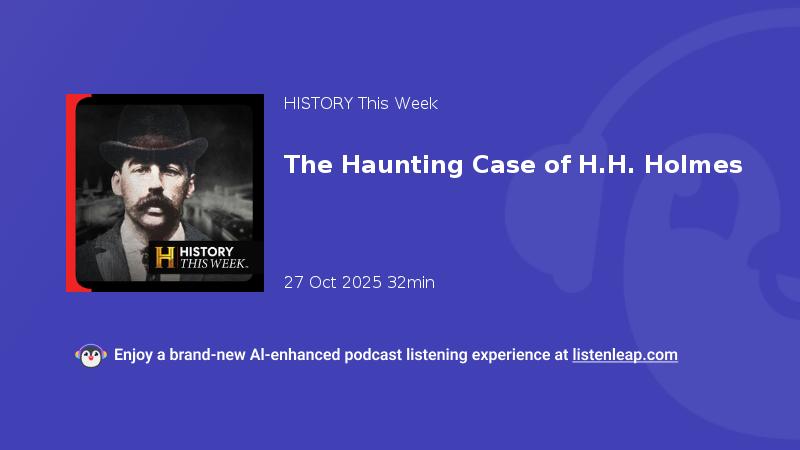
The History Channel original podcast.
History This Week, October 28, 1895.
I'm Sally Helm.
A Philadelphia courtroom.
Murder trial day one.
60 potential jurors are waiting to be vetted.
First up is a streetcar conductor named Enoch Turner.
He stands, swears to tell the truth, gives his profession, his address.
And after the preliminaries, the lawyer's first question is this.
Do you, Enoch Turner, already have an opinion about the guilt or innocence of this prisoner?
The prisoner in question is sitting right there before the jurors.
Herman Mudgett, alias H.H.
Holmes.
He has a mustache and a pointed goatee.
He's pale, fidgeting.
He stands accused of killing one of his business associates, a man named Benjamin Peitzel.
But in the press, he's been accused of much, much more.
It's said that Holmes might have murdered hundreds of people in Chicago, that he built and occupied a horrifying castle of death in the city, with rooms that people are calling the death shaft, the black closet and the room of the three corpses.
It's been reported that bones were found in his basement, that his castle contains a mysterious soundproof room.
Many times a murderer, said one headline in San Francisco.
Another in Nashville.
He sups on crime.
So it's no wonder that some of the prospective jurors assembled in this courtroom may already have some thoughts about the case.
Enoch Turner answers the question honestly.
Does he have an opinion about the guilt or innocence of H.H.
Holmes?
I have, Turner says, through reading the papers.
He doesn't say what his opinion is, but it's probably not favorable.
And he's likely not the only juror who came into the room already suspecting that Holmes is a killer.
The thing is, they're not wrong.
Holmes is in fact guilty of killing his business associate, Benjamin Peitzel.
He's also killed before and since.
He's committed crimes ranging from pretty run-of-the-mill insurance fraud to horse swindling to murder.
But also, a lot of the news coverage about his murder castle and his crimes is pretty much made up.
Today, some have called him America's first serial killer.
But how did H.H.
Holmes earn this reputation?
And why is it so hard to learn the truth about this legendary fiend?
This episode is brought to you by White Claw Surge.
Great podcast pick, friend.
No surprises there.
After all, you're all about finding the tastiest flavors out there, just like White Claw Surge.
And with big, bold flavors to enjoy, like blood orange blackberry, cranberry and more, it's time to go all in on taste.
Unleash the flavor.
Unleash White Claw Surge.
Please drink responsibly.
Hard seltzer with flavors.
8% alcohol by volume.
White Claw Seltzer Works.
Chicago, Illinois.
Hey everyone, I'm Josh Radner and I am so excited to tell you about How We Made Your Mother a rewatch podcast, looking back at how I met your mother.
And I'm here with Craig Thomas, who co-created the show along with Carter Bays.
Hi, Craig.
Hey, Josh.
Somehow it has been 20 years since the show premiered.
I'm going to check the math on that.
10 years since it went off the air.
And we thought that made this a perfect time to look back, see what the hell we did and why the show still seems to resonate with fans around the world today.
Follow and listen to How We Made Your Mother wherever you get your podcasts.
At New Balance, we believe if you run, you're a runner.
However you choose to do it.
Because when you're not worried about doing things the right way, You're free to discover your way.
And that's what running is all about.
Run your way at newbalance.com slash running.
The supposed horror castle of H.H.
Holmes the building that one newspaper called a veritable murder factory.
It was located in Chicago.
But it's not there today.
The site of it today is mostly a blank space next to a post office.
There's about four feet of overlap with where the post office is now.
That's Adam Seltzer, who recently wrote a book about homes.
And I have been down in the basement of the post office a couple of times.
And it is kind of creepy down there, but there's nothing original left.
Seltzer has been to a lot of sites in Chicago where H.H.
Holmes also tread.
Because he's worked for many years as a tour guide in the city.
He loves Chicago, says he's discovering new things there all the time.
Today I went for a walk and saw a pig on a leash.
Didn't see that every day.
And found out the statue they call Babraham Lincoln is fairly near my house.
Why, Babraham?
It's young Lincoln with his shirt unbuttoned.
And got to admit, the dude looks hot.
Years ago, the company Seltzer works for wanted him to develop a new tour centered on city legend HH.
Holmes.
So he started researching.
I felt like I needed to find more stories just to have more places to go on the tour.
And it came to realize just how much ink was spilled about this H.H.
Holmes guy over the years and how much of it is just collecting dust on microfilm reels.
Seltzer ended up getting deep into the source materials newspapers, court transcripts, police records and writing a book.
Now, when he goes to the corner of South Wallace and 63rd Streets, where the castle once stood, he sees what's in front of him.
A railroad track, an Aldi.
And a little vacant lot.
But he can also imagine what Holmes would have seen when he stood on that same street corner in the late 1800s.
Guys selling things from carts on the street.
The building that he put up had a restaurant and a candy shop and a tinsmith.
You would have seen carriages going down the street.
Now and then you might have seen somebody testing one of those newfangled horseless automobiles going down the road.
Holmes first shows up on this street corner in 1886 looking for a job.
Holmes is a young man with a mustache, just like every other young white man at the time.
Nothing in the world is as popular today as mustaches were then.
He graduated a few years before from medical school in Michigan.
And as the story goes, he got a job in old Dr Holton's pharmacy where his poor, hapless wife was trying to run the place while old Mr Holton was dying upstairs of cancer.
It's always implied that they disappeared and were never seen again.
And Holmes told everybody they had gone off to California.
Some who later wrote about Holmes suggest he duped this elderly couple out of their pharmacy before he made them disappear.
AKA murdered them, probably.
But when Seltzer goes looking for the Holtons in the archives, It turned out it wasn't an old man and his wife at all.
It was a young doctor and her husband.
And they both lived well into the 20th century, so he's off the hook for those ones.
This is just one example in Holmes' story where urban legend might have taken over from the truth.
But if we trace things back and kind of peel back the onion, we eventually do find some of the real story.
By the time H.H.
Holmes first walks into the Holton's pharmacy, he's already a somewhat mysterious figure.
But according to Seltzer, he didn't have a stereotypical serial killer origin story.
We don't have any stories about him torturing animals when he was a kid, or about his father being a drunk.
A lot of these are just patterns that we've seen in other modern serial killers that people have kind of assumed ought to be applied to Holmes.
H.H.
Holmes was actually born Herman W. Mudgett in Gilmanton, New Hampshire in 1861.
Not a lot is known about his childhood, But Seltzer did read consistently that the young Holmes suffered from a common condition called strabismus, when a person's eyes don't always point in the same direction.
Over and over.
When you look at interviews with people who knew him, they say again and again things like I knew.
I couldn't trust that guy because he never looked me right in the eye.
And so even back as a kid, people probably would have instinctively distrusted him.
He had to learn to be very persuasive even as a kid. even if that meant lying.
Oh, the man lied constantly.
He lied when he didn't have to.
He lied when it only made things harder for him.
He lied to the census man.
He lied almost constantly.
I'm not qualified to diagnose whether it was pathological, but it sure seems to have been.
One detail from Holmes' childhood that does fit with the common story of serial killers is that the young Herman Mudgett was fascinated by anatomy and learning about the human body.
What exactly got Holmes interested in medicine, we can't exactly know.
We know that his uncle had served as a surgeon for the Union Army during the Civil War.
That might have had something to do with it.
There's also this story about an early moment of bullying.
Apparently, some kids shoved him into a doctor's office where there was a skeleton on display, just to scare him.
Whether that's true or not is very difficult to tell, but we do know that he studied with the doctor in town who, even years before Holmes was born, was widely known for his collection of morbid anatomical specimens.
So a skeleton would have been the least of what that guy had.
Herman Mudgett did eventually find his way to medical school, where stories of his morbid fascination keep cropping up.
There were stories that went around after he was captured talking about him taking dead bodies home with him to dissect from the medical school.
Or while he was teaching school.
Briefly, when he ran out of money to go to school himself, he supposedly brought a human foot into the class to show the class, though that was denied at the time.
And there were some indications that Mudgett had a violent side.
My favorite story from those days is one day he beat the heck out of his roommate because the roommate had borrowed his mustache wax without permission.
Oh my God.
You know, you don't tug on Superman's cape and you don't borrow H.H.
Holmes' mustache wax.
In medical school, Mudgett wasn't an exceptional student.
The professors say that they graduated him mainly out of pity.
By May of 1886, Mudgett had set his sights on becoming a pharmacist.
And he finds his way to Chicago.
This is the moment when he decides to give up the name Herman Mudgett and become H.H.
Holmes.
Why that name?
We have no idea.
It probably just sounded like a nondescript sort of name to him.
It was occasionally said that it was taken from Sherlock Holmes, but the first Sherlock Holmes story wasn't published for months after this.
Maybe Holmes was just trying to leave his past in the past.
He'd been married.
His wife and child were back in New Hampshire, but he had no intention of having anything to do with them.
He arrives in Chicago and begins his new life.
According to Seltzer, he takes over the pharmacy from a Dr. Elizabeth Sarah Holton.
It all seems to have been done on the up and up.
One of the first things he does then is buy barber equipment.
You know, pharmacists would generally have a barber shop attached to those days.
And this purchase, Seltzer says, proves to be a pivotal point in Holmes' life.
But he bought all the stuff for it on credit and then didn't pay it off.
Which I think is what he discovered was his real true love, was buying stuff on credit and then not paying for it.
Buying stuff on credit and then not paying for it kind of becomes Holmes' thing.
It just seemed like to me that he almost got addicted to scamming people.
Once he got away with a couple of things, he just wanted to keep on doing it.
Eventually, he sees an opportunity right across the street.
A vacant lot opposite the pharmacy.
The property is where he built his new building, which initially was a two story building with retail, including a new pharmacy, on the first floor and then residential apartments on the second floor.
And this is what people would come to call the murder castle.
Yeah, this is what people would eventually call the castle.
And then in the 20th century, we called it the murder castle.
Holmes, it seems, used the construction project to make money.
A lot of people later suggest that he designed the building specifically to carry out murders, but Seltzer says he didn't find any evidence to confirm this.
He thinks this was likely just another one of Holmes' scams buying goods and services on credit and never paying.
He swindled the Edna Iron and Steel Company.
He swindled the construction company.
He swindled the architects.
Within a couple of years, the two-story building is complete, and Holmes takes on some tenants.
In 1889, the Connors move in.
Ned, his wife Julia, and their daughter Pearl.
Holmes gives the couple work in the jewelry store on the first floor.
He has by this time found a second wife, Myrta.
He's also still married to his first wife, who lives back in New Hampshire.
But none of that stops him from starting an affair with Julia Connor.
And it seems that everybody in the building knows about it, except for Holmes' wife Myrta, who is also living on the second floor.
The affair carries on for two years.
Then Ned Connor, Julia's husband, also finds out.
Soon after, Holmes commits what seems to be his first murder.
On Christmas of 1891, Julia Connor and her daughter Pearl turn up missing.
It's tough to know exactly what happened, but Holmes was fairly consistent in saying that Julia had died during an abortion.
Most likely he had gotten her pregnant and decided the easiest thing would be to get her out of the way.
It's possible that Holmes had truly tried performing an abortion and that, given the danger of the operation and his relative inexperience, Julia died accidentally.
But Seltzer says it's basically impossible that Pearl's death was an accident.
He never said what happened to Pearl.
Most likely she would have been poisoned.
And it's likely they died in the place where they lived, Holmes' castle.
No one seems to catch on at the time that Holmes has anything to do with these disappearances, certainly not law enforcement.
And five months later, Emmeline Sagrand moves into his buildings.
They, too, embark on an affair.
I think that she knew Holmes had a wife who had now moved up to the north suburbs, but she thought that the wife was dying and pretty soon she'd be Mrs Holmes.
They live in a nice big house on Honoré Street.
Hmm.
But that's not how it works out.
But that's not how it worked out.
A year after Julia and Pearl disappear, so does Emmeline Segrand.
Holmes also later claimed that she died during an abortion, but he almost certainly killed her.
Once he'd done it once or twice, he just got kind of used to it, I suppose.
But there's also the next couple of people that he killed.
It's hard to guess what his motivation would have even been.
Minnie Williams had come to Chicago from Texas.
She tried to become an actress, but ran out of money.
So she becomes a secretary for H.H.
Holmes.
They rented an apartment together up on the north side, along with Minnie's baby sister Nanny, who had come up to join them.
They hadn't really seen each other much as kids, but they moved into the north side and both of them just disappeared completely.
July of 1893.
This time, Holmes didn't use a story about an abortion.
It got a lot more elaborate.
Holmes had a long rambling story that Minnie had killed Nanny and he had helped her dispose of the body and that Minnie was still off in the world someplace.
He sticks to that story throughout his life, even later, suggesting that Minnie Williams was involved in crimes that he himself had been accused of.
Around the same time the Williams sisters disappear, something big is happening in Chicago.
Decades later, it's still a major part of the legend of H.H.
Holmes.
The city is hosting the World's Columbian Exposition, aka the Chicago World's Fair.
It was a chance for Chicago to prove itself as a major world city over the course of this huge six-month-long event.
Regular Chicagoans had been looking forward to the fair for years.
Everybody in Chicago thought they were going to get rich off of this World's Fair.
Everybody had some kind of scheme to make money off of it.
H.H.
Holmes, swindler extraordinaire, obviously saw an opportunity.
He decided to add a third story to his building and claimed that he was going to turn the whole thing into a hotel for the upcoming fair.
Holmes never finished this hotel or had it open for business, and I don't think he ever really planned to.
The whole idea was just to swindle people.
He got a $3,000 investment from a doctor who lived on the second floor.
He was able to go to flooring companies, hardware companies, mattress companies, anybody who might furnish stuff for a new hotel, and get all kinds of stuff on credit, because they were just being way too free with their credit.
They were all eager to get rich off of the fair too.
Holmes borrowed all this money.
And then a few months after the start of the fair...
The third floor, where the hotel was supposed to be housed, mysteriously burns down.
And Holmes files a big insurance claim.
The insurance companies were not fooled for one second.
Holmes has to skip town.
He goes to Denver with his new lover, Georgiana Yolk.
There he picks up some cash that was owed to Minnie Williams as a result of her brother's death in a mining accident.
And he marries Yolk, even though he's still technically married to two other women.
Then Holmes and Yolk head to Texas to steal something else from the deceased Minnie Williams some land she'd owned.
On that property, Holmes tries to pull the same trick again.
He builds another castle.
There's only a couple of drawings of it that survive, but it looks like just a double-sized version of the castle back in Chicago.
He swindles a bunch of money with this project, too.
And he tries some other tricks.
He had gotten involved in some horse swindles while he was there.
What's a horse swindle?
Um, buying horses on credit and not paying for them.
A classic H.H.
Holmes move.
Pretty soon, he has to skip town again.
But before he leaves, he comes up with a new plan.
Holmes has a sometimes business associate named Benjamin Peitzel.
And he goes to Peitzel and says, hey, let's get you a life insurance policy.
And once it matured, they were going to fake his death.
Ooh, okay.
A little sinister for Benjamin Peitzel, gotta say.
Fake his own death?
Is that what happens?
Well, that was the plan.
They'd fake the death and split the money.
Holmes and Peitzel go up to Philadelphia and set up a fake business for Peitzel.
He was supposed to be buying and selling patents and doing some inventing himself on the side.
The idea was that they'd bring a random dead body into the office one day and make it look like Peitzel had died in a laboratory accident.
Peitzel seems to have been all in on this scam.
He even has real clients, like this one guy who had invented a new kind of saw.
One day, that man shows up at Peitzel's office.
He bangs on the door.
Nobody answers.
So he forces his way in and starts poking around.
Holmes probably thought it was going to take a lot longer for anybody to find the dead body.
Didn't reckon with just how eager somebody might be to get their patent out there in the world.
This saw inventor finds the body of Benjamin Peitzel.
He'd been killed with chloroform by his friend H.H.
Holmes.
Peitzel's widow is able to get the insurance money, but Of course he swindles the widow out of most of it and says we have to settle some debts with this.
And then starts traveling around the country with three of Peitzel's children.
Yeah, why is he traveling with the children?
Is that not weird since he just murdered their father?
It was definitely weird, but he was telling them that any minute now we're going to see your father.
He was telling their mother that their father is still alive.
This is a big scam that we've pulled.
It's all going to be OK.
And the next city we're going to see him in.
We'll all reunite and then we'll all go off to Europe together.
It's not long before the authorities in Philadelphia realize that something is fishy with the insurance claim.
They're on to Holmes' scam.
And they learn that there's a warrant out in Texas for his arrest for that horse swindling.
It's all adding up.
This guy is a scammer.
They track him to Boston and arrest him as a horse thief.
Holmes was panicking when they arrested him.
And then they got him to the station and he recognized the insurance company inspector and said oh, I get it.
This is really about the insurance scam up in Philadelphia.
Well, I am, in fact, a big insurance scammer.
I admit it.
We faked his death.
Please send me to Philadelphia to stand trial for that, not to Texas as a horse thief.
Why?
He was scared to death of being in a Texas jail.
Swindling an insurance company in Philadelphia is not going to get you as harsh of a punishment as stealing a horse in Texas in those days.
Holmes winds up in jail in Philadelphia.
And he starts talking to anyone who will listen.
Telling all these stories about how oh, I've done this a million times, faking people's death for the insurance money.
I'm a big insurance scam guy.
Not a murderer.
Big insurance scam guy.
Meanwhile, the Peitzel children are missing.
He tells everybody, oh, I reunited them with their father.
They're off and hiding someplace.
But really, the Peitzel children are dead.
Pretty soon.
Holmes is put on trial for the insurance scam.
But this time he's changed his story a little bit.
Now he's saying that was in fact Benjamin Peisel's body, but it was a suicide and he made it look like an accident, so the family would get the money.
So after the trial the district attorney took him inside and said okay, so you admit that that's Peitzel's body.
That leaves the question of where are the children really?
And he said, oh, they're off with my old friend, Minnie Williams.
She has taken them off to London someplace.
Minnie Williams, of course, has been dead for two years.
A Philadelphia detective is on the case, a man named Frank Geyer.
He tracks Holmes' path through the country and soon makes a discovery.
He finds that there's a place that Holmes rented in Toronto where the current renters won't go into the basement because it smells so bad.
So they go down to the cellar and start digging and find the two girls, Alice and Nellie, buried in a shallow grave.
A little later, Detective Geyer finds their brother, Howard Peitzel, who had been killed in Indianapolis a few weeks before his sisters.
Now... law enforcement is starting to understand what they're dealing with.
And they go digging through the life of this guy, H.H.
Holmes.
Before long, attention turns to the building he'd owned in Chicago, the castle.
That, remember, had been at the center of a different insurance scam.
And there were stories that it was full of hidden rooms where Holmes had been hiding stolen furniture.
The police think maybe we should look around there.
The police started digging up the basement, looking under every piece of tile in the building, and they let the reporters from every paper just come along with them.
The potential crime scene turns into a media circus.
It's almost unthinkable today.
They let reporters go digging through things with their bare hands.
Let them handle all of the evidence, let them interview everybody they could get their hands on.
It was not exactly what you would call a professional investigation.
The chief of police in Chicago at the time, John J Badnock.
He had no experience as a cop, nothing in criminal law or any kind of law or forensics or anything like that.
Just a few months before his appointment as chief of police, he had been a flour and feed dealer.
But Badenoch was part of the political machine in Chicago, and so he gets a new job.
Not surprisingly, he struggles to carry out an effective investigation.
The police do find some bones in the basement of Holmes' building, but they struggle to make sense of them.
Forensics wasn't quite there yet.
If this had happened a few years later, they could have taken some of the bones that they found in the basement of that building and figured out for sure whether they were human bones or soup bones.
But in 1895, they weren't quite there yet.
The information is confusing and incomplete.
And Holmes has not yet stood trial for murder.
But this is smack dab in the middle of the yellow journalism era.
A lot of newspapers are quick to publish anything that will sell.
So reporters go looking for juicy stories.
Oh, we found a rope.
Maybe he was hanging people.
Or here's a bench.
Could that have been a dissection table?
There's some knives in the kitchen.
And even now, if you walk around the basement, it's like a mop ringer.
You could kill somebody with that.
The New York World publishes an article that soon becomes famous.
If you've ever looked up Holmes online, you've probably seen the diagram they put with all the names of rooms, like a room of the three corpses, the secret hanging chamber, the death shaft, the black closet, the maze.
And it's a really entertaining article.
It's based on them kind of piecing things together from the Chicago papers and also filling in a lot of blanks with their own imagination.
The article describes the building as a hotel, Even though, according to Seltzer's research, it never actually functioned that way.
They had this line in there that the number of people who went to Chicago for the fair and didn't come back was a long one and in the greater number foul play was suspected.
They started speculating how many of these people might have gone to H.H.
Holmes' hotel.
This is where the myth of H.H.
Holmes really starts to take off.
That paragraph has been verbatim in just about every Holmes thing written since then.
And so the idea is kind of like maybe every single person who disappeared during the World's Fair or who came to some mysterious end, maybe Holmes was behind all of them.
Right.
I can just kind of imagine Chief Badenoch thinking, I've done it.
I've solved every murder of the last five years.
The article is sensational.
It calls the building a murder factory.
Other newspapers pick up the story, and the public is rapt.
They want to see Holmes punished.
And soon enough, they will.
Hello, it's Ray Winstone.
I'm here to tell you about my podcast on BBC Radio 4, History's Toughest Heroes.
I've got stories about the pioneers, the rebels, the outcasts who define tough.
And that was the first time that anybody ever ran a car up that fast with no tires on.
It almost feels like your eyeballs are going to come out of your head.
Tough enough for you?
Subscribe to History's Toughest Heroes wherever you get your podcast.
H.H.
Holmes is put on trial again in Philadelphia, this time for the murder of Benjamin Peitzel.
And the first day in court is a circus.
Early on in the proceedings, Holmes' two lawyers withdraw.
They say they haven't had enough time to prepare for such a difficult case.
Holmes is left to represent himself.
By all accounts, he did a reasonably good job of it.
But pretty soon, he's outmatched.
His attorneys come back after just a day away.
But the prosecution presents damning testimony against Holmes, including from Carrie Peitzel, who had lost her husband and three children.
She breaks down on the stand.
Holmes doesn't appear to react with any sorrow.
In fact, the Philadelphia Inquirer writes that he smiles.
A few days into the trial on Halloween, Holmes' wife, his third wife Georgiana, is called to testify.
She introduces herself as Georgiana Yolk, a slight to Holmes because she doesn't use the last name she'd shared with him.
Reports say that the prisoner begins to weep and shake in his seat.
The defense calls no witnesses. presents no case.
They're hoping that the prosecution's case won't be strong enough for a conviction.
Most people who were watching the trial, who were experts in such things, said that was probably the strongest hand they could have played.
But it wasn't strong enough.
Holmes was convicted very quickly.
Sentenced to death by hanging.
In the months before his execution, the press is still trying to capitalize on the story.
Every paper was trying to get him to write a confession.
He turned the New York world down and, kind of to get revenge, they put up a thing themselves saying Holmes is about to write a confession where he will confess to having killed 20 people.
And really, he was negotiating with the New York Journal and the Philadelphia Inquirer.
But after that he couldn't very well confess to fewer than 20 people, so he ended up confessing to 27.
But of those, at least half a dozen were still alive.
Several others were fiction.
There's really just nine that we know of.
The confession doesn't add to too much.
It was strictly written for the money.
This questionable confession also adds fuel to the idea that Holmes killed dozens of people.
Seltzer says his count is nine, still a horrifying number.
And on May 7th, 1896, Holmes is executed.
The weird thing about it is he was buried in a giant block of cement by his own request.
He had been getting offers like people who wanted to put his skeleton on display at a carnival.
He didn't like the idea of that.
That is the end of the life of H.H.
Holmes.
But his story has a long afterlife.
It's revisited in the Chicago Tribune in the 1930s, in the 1940s in a book called Gem of the Prairie and in the early 2000s in the book Devil in the White City.
Adam Seltzer had heard the more extreme parts of Holmes' story passed around for years.
Things that were first reported in those newspapers that loved to print scary-looking maps of the murder castle.
And he said it was incredible to him how, even after so much time in the archive, so little of Holmes' story could be definitively pinned down.
It is something that makes you think about how many other stories we might be getting completely wrong.
How many other stories could we go back and find?
If you look at the contemporary accounts and all the stuff in the legal archives, you might find some totally different story.
You know, there's this great game of telephone that takes place over the course of several decades and we just remember the wildest parts of the stories.
Thanks for listening to History This Week.
For more moments throughout history that are also worth watching.
Check your local TV listings to find out what's on the History Channel today.
If you want to get in touch, please shoot us an email at our email address historythisweekathistorycom, or you can leave us a voicemail 212-351-0410.
Special thanks today to our guest, Adam Seltzer, author of H.H.
Holmes, The True Story of the White City Devil.
And Harold Schechter, professor emeritus of literature at Queens College and author of Depraved, The Shocking True Story of America's First Serial Killer.
This episode was produced by Ben Dickstein.
History This Week is also produced by Julie Magruder, Julia Press, and me, Sally Helm.
Our editor and sound designer is Bill Moss.
Our researcher is Emma Fredericks.
Our executive producers are Mikami Lin, Jesse Katz, and Ted Butler.
Don't forget to subscribe, rate, and review History This Week wherever you get your podcasts.
And we will see you next week.