Hey folks, this is Max Young-Rice from the StoryCorps podcast.
Just want to remind you that you can tell us your personal stories by calling our voicemail at 702-706-TALK.
Is there someone important in your life you wish you could record a conversation with?
Leave us a voicemail telling us about them at 702-706-TALK.
Thanksgiving is almost here and people across the country are getting ready, anticipating their favorite dishes and family traditions.
But here at StoryCorps, we have our own kind of Thanksgiving tradition.
Hello, I am 16 years old.
I'm speaking with my grandmother.
Okay, so I will be interviewing my dad.
I'm interviewing my tutu, which means grandma in Hawaiian.
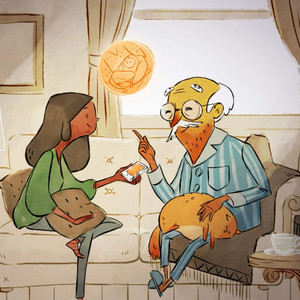
It's called the Great Thanksgiving Listen, where every year we put out a call for young people to interview an elder in their lives, maybe a grandparent, a parent or an important mentor or friend.
I'm interviewing my grandma in Glenview, Illinois.
Hi, I am Sophie's grandmother.
I'm speaking with my grandpa.
Good to see you, Jeff.
Good to see you too.
The idea is to give young people a chance to honor someone, to learn from them and preserve their story for future generations.
I'm really glad that you took the time out of your day to give me all this information, and it has been quite a pleasure interviewing you.
Thank you so much for allowing me to express myself.
Awesome.
This year, we're celebrating 10 years since we first started The Great Listen.
And it all began with the release of an app that allowed anyone to record with us using their phone.
Three, two, and there we go.
Okay, this is my grandmother.
Say hello.
Hello.
And one person who started using that app immediately in her classroom and every year since was a high school history teacher named Stacey Flannery.
The students at Glenbrook South have recorded literally thousands.
From my class, I have listened to every single interview from start to finish.
And I love listening to these stories.
Hello, Ms.
Flannery.
I am here with my grandma, Mary Jane.
Hello, Ms.
Flannery.
Oh, wow, this is stressful.
Okay, it's fine.
We'll be fine.
She's a good teacher.
Don't worry.
She's nice.
Okay, we're recording.
Can you state your name, please?
John Delonte.
I am your father.
Yeah, Darth Vader.
Ms.
Flannery, I am so sorry.
I know you were listening to this.
I'm Jasmine Morris, and it's the StoryCorps podcast from NPR, where we bring you inside our archive the largest collection of human voices ever gathered.
And in this episode we'll be listening, with Mrs Flannery, to stories recorded over the last decade through the StoryCorps app from the students at Glenbrook South outside Chicago.
Mrs. Flannery's annual assignment started with a brainstorm.
She and her fellow US history teachers at school were looking for ways to make the subject matter they were teaching more personal for their students.
So they tried something.
Have their students hear from someone they know, who lived through an historical event, by recording an interview with a family member.
It is a semester-long assignment and I have earphones in my ears for about a month and I'm literally listening to these constantly on my way to school and my way home when I walk my dog, and it never gets boring.
What made you want to leave Romania and come to America?
How old were you when you enlisted?
I was 20 when I enlisted and 21 when I went into the Marine Corps.
Wow.
Okay, I just want you to talk about your dad a little bit.
What kind of man was he?
What do you remember about him from when he was alive?
I remember lots.
You got drafted?
I couldn't hear.
And so they didn't let you in?
So they sent me home.
OMG, this is good.
No, it was horrible.
No, this is like so interesting that you lived all this, that you were like there.
This is good for the interview.
But that is horrible.
I know that you were very young during the Cuban Missile Crisis.
Do you have any stories about that?
On the news.
They would draw pictures rings around the state of Florida and North Carolina and New York City showing how far some of these missiles could reach.
It was a scary, scary time.
No question about it.
Is there any specific stories your parents told you that were depressing, sad during the Great Depression, that really showed the impact that it had on their family?
One recording that stands out is a student who came up to me when I introduced the project and said that her favorite uncle came back from Vietnam and told his family don't ever ask me about this experience.
I don't want to talk about it ever again.
So I said to her, it's been a long time and maybe he would be open to talking to you about it.
Was there a moment you remember being really scared?
Yeah, some fights that scared the hell out of you.
I could hear in the recording, he had picked up a coffee on the way to the interview.
And you can hear him crunching the Styrofoam cup as he's talking because it is so difficult for him.
When you came back, did you feel like people were supportive?
I got rid of all my military stuff and came back in civilian clothes.
So I didn't have any military stuff whatsoever when I came home.
You didn't want to keep it?
Nope.
That was over.
That's past.
I'm done with that.
So just forget about it and let it go.
Yeah.
How has the war impacted your life since you came back?
I'd probably appreciate life more, you know.
My belief and my hope is that in that interview, there was connection and healing for her uncle.
He's doing it for his niece because he loves her.
And she's listening to him because she loves him.
And I know that this student felt very proud and also honored that he did this with her.
Hello, my name is Leandra Arredondo.
16 years old in the TV room of my grandfather's house.
Good afternoon.
My name is Ramiro Prudencio.
I'm 86 years old.
I wish everyone could see the smile on my face when I just heard Leandro say his name and his grandfather say his name, because I know what will follow.
My childhood years were very happy, except for an accident.
I lost my right eye. through a window glass that broke and injured me.
I remember very vividly that day, and I think it has guided very much of my life.
When I was 10 years old, I came to the United States to receive an artificial eye, but that was not a handicap for me.
Did you go into medical school with kind of a chip on your shoulder, knowing that you were, we could say, disabled?
My accident, I want to repeat for emphasis, was never a handicap for me.
It was an incentive.
I had to be better than the next, better than everybody else.
What I love so much about that interview is the way he helped Leandro see that some of the most difficult things could potentially be the best things that ever happened to us.
And for a 16-year-old to hear that from their grandfather's story, that is going to come back to them in a personal moment of challenge.
Another student's interview that really stands out is an uncle who was living on a houseboat in New York when 9-11 happened and died.
Talk to his nephew about the story of being in this really defining moment.
Well, I remember that morning vividly because I heard an explosion.
You know, I was only a couple blocks away.
I remember looking out the window and I saw the fireball from the first plane.
Then I remember distinctly the buildings coming down and then this huge cloud of dust sort of enveloped the whole area.
Next thing I knew, I couldn't see.
It was like you were in a thick fog.
I saw a Lots and lots of people.
They just looked like ghosts.
Then I didn't know what to do.
And at the time I was living on a boat and I had some friends who were also on boats and we started shuttling people across the river.
He just unanchored his boat and got to work.
So give me the time period and I will have examples for you of people who have played important roles in just about any moment in life and 21st century history.
When I start this assignment, they're high school students, so it's not like they're jumping up for joy on the first day, but the end is incredible.
And if you could be present when the students are hearing each other's stories, the curiosity, the interest, the active listening.
I don't have to instruct them And there is no other assignment we give that we hear about from students after graduation.
This one stands out, and the value and importance for our students is undeniable.
After a short break, more from Mrs Flannery and her students and why for her this project is much more than just another assignment.
I hope everyone listening records an interview with a loved one, because there is one person I wish I could have interviewed but he passed away when I was in college unexpectedly and I never got the opportunity to record any of his stories.
We'll be right back.
Support for this podcast and the following message come from Dignity Memorial.
When planning for life's most important moments, sometimes the hardest part is simply knowing where to start.
Dignity Memorial is here to help.
When you pre-plan a celebration of life with them.
Every detail will be handled with simplicity and professionalism, giving you the peace of mind that you've done all you can today to remove any burden from your loved ones tomorrow.
When Stacey Flannery introduces this assignment to a new group of students each year, she starts by talking about the special elder in her own life.
My grandfather's name was George Flannery.
I have his picture up and I tell my students about him.
He was born and raised on the west side of Chicago.
The story goes that he walked into high school on the first day of freshman year and walked out the back door and never went back.
He started delivering papers for the Chicago Tribune and then rose up through the ranks of the Teamsters in the city of Chicago.
Whenever we were at family parties, my mom and dad said they always knew where I was, right next to my grandpa hearing his stories.
And I would love to hear him in his own voice tell those stories again.
His body matched his personality in that he was a very large man.
He often had to sit in two chairs.
I'm one of eight, and I have 25 cousins.
And I think we all felt like we were the center of his world.
And I strive to do that in my classroom.
I want each of my students to feel like they're all equally important to me.
So when I'm doing this project, I'm honoring my grandfather.
And making good on some regret that I never interviewed him, by making sure my students don't have that same regret.
Thank you so much Dad, for cooperating with me and making time out of your schedule to talk to me about this.
I'm always happy to help you, Eva.
Thank you.
You're welcome, sweetie.
I really appreciate it.
My pleasure.
I'm glad you... And hopefully will give me a good grade.
We'll see.
We'll see.
And I hope to know a little bit more about your background and a wonderful guy you never got to meet.
Thank you for letting me interview you.
So am I hired?
Yes.
What I believe the world needs more than ever is connection.
And these interviews, these conversations are all about connection.
One of the things I'm hearing more and more recently is the interviewee talking about how much they appreciate a conversation.
And I cannot tell you how many times someone has said, no one has ever asked me this.
And my students.
They know as much as a 16 or 17-year-old can know that they did something, the meaning of which is only going to increase with time.
And That feels good.
So we only have about one minute left.
Okay.
Even though I did read a lot about subjects we had touched on.
I really appreciate your input because it's much more easier to understand when you have someone to talk to.
Yeah, good.
I am glad you asked me.
I hope it all goes well.
Thanks.
I do too.
Okay.
I love you.
Bye.
Love you.
I'm glad that you came to interview me, McKenna.
Thank you.
That was good.
Thank you so much.
Oh, you're welcome.
You're welcome, that was awesome.
Thank you so much.
Thank you to stacy flannery and everyone at glenbrook south high school, the teachers, the students and their family members who've done interviews over the years.
Stacy and her colleagues call their collection the living history project.
That's all for this episode and this season of the StoryCorps podcast.
We'll be back to our regular biweekly schedule in the new year.
And look out for our StoryCorps holiday special coming next month.
In the meantime, you don't need a high school history assignment to record an interview with us.
Be a part of the Great Thanksgiving Listen and interview someone you love using the StoryCorps app.
To learn more, including step-by-step instructions of how to participate, go to thegreatlisten.org.
The artwork for our podcast is created by Liz McCarty.
I'm Jasmine Morris.
Thanks for listening and happy Thanksgiving.
In grammar school, I was in the dancing club.
Did you guys, like, perform and stuff?
Absolutely.
What kind of dances did you guys do?
And I remember that music so well.
Oh, my gosh.
Support for this podcast comes from the Corporation for Public Broadcasting, a private corporation funded by the American people.