Welcome to Spotlight.
I'm Alice Irizarry.
And I'm Patrick Woodward.
Spotlight uses a special English method of broadcasting.
It is easier for people to understand no matter where in the world they live.
A young boy walks along a country road in England.
He is pulling a huge bird along the road.
The leg of the bird is broken, but the bird is still alive.
The young boy walks a long way.
He arrives home.
His father is at home with some other men They have been working in the fields all day.
They take the bird from the boy.
It will feed many people.
It is huge.
One of the men kills the bird by breaking its neck.
But this bird is the last of its kind.
The great bastard is dead.
Henry Blackmore wrote this story in 1856.
It speaks of the death of one of the last great British bustards in England.
The great bustard has a scientific name, Otis Tarda.
It is not surprising that this bird disappeared.
English people hunted this bird for its wonderful meat.
They killed large numbers of them.
But bird experts, ornithologists, are now helping to bring the great bustard back to England.
Today's Spotlight is on their efforts.
The group of ornithologists we are talking about is the Great Bustard Group.
They have established a new home for the birds.
It is on the Salisbury Plain in Wiltshire, England.
They chose this area of England because it is a good environment for the birds, with a good supply of food.
The British Army uses a large area of Salisbury Plain for training.
Citizens are not permitted to use this area.
This is good news for the birds.
It means protection.
Only soldiers training with the army can use the area.
These soldiers try to stay away from the birds.
This lack of people means less danger for wildlife.
Other rare birds have survived well in this environment.
So what makes this bird so special?
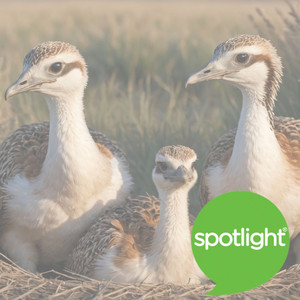
Well, the Grape Bustard is the world's heaviest flying bird.
Male birds can weigh up to 20 kilograms.
They can measure over a metre long.
The birds make a noise similar to that of a dog.
They can also live for 25 years.
This makes them one of nature's longest-lived birds.
The great bustard is also very rare.
Ornithologists estimate that fewer than 50,000 great bustards exist in the world today.
The New English Group, or colony, will help to protect the bird for the future.
The colony is the result of an international effort involving experts in Britain and Spain.
So British and Spanish ornithologists are working together.
Originally, the project involved ornithologists from Russia as well.
The first birds in the English colony came from Saratov in southern Russia.
But these birds often left. or migrated back to Saratov.
Birds from Spain left less often.
The first birds came to England in 2004.
More young birds have been brought to England every summer since then.
Life is also difficult for the great bustard in Spain.
Farming and expanding human populations are pushing the great bustard out of its natural environment.
Ornithologists estimate that about 30,000 great bustards survive in Spain.
The Russian ornithologists work with the farmers in central Spain.
Eggs can easily be destroyed by farming equipment.
So any farmer who finds eggs in his fields informs the ornithologists.
The ornithologists then rescue the eggs.
So what happens to the birds after they arrive in England?
Well, First of all, they need to be quarantined, that is, kept away from other creatures.
This makes sure that they do not carry any diseases into the country.
After this, the job of teaching the young birds begins.
The experts use a process called isolation rearing.
This means that the young birds do not have any links with humans.
Young birds often form an attachment to anyone who feeds and looks after them.
This is called imprinting.
In the wild, imprinting is very important.
It means that a young bird will always follow its parents.
But for the birds in England, imprinting would mean becoming attached to humans.
This would prevent them from learning to avoid humans later.
It would prevent them from becoming truly wild.
When the birds are about four months old, the project leaders release the birds into the wild.
The area for the birds is over 780 square kilometers.
The great bustards are slowly making the area their home.
But this is taking a long time.
This is because the birds have not been able to produce their own young.
A male great bustard is only able to reproduce when it reaches five years old.
Five years after the first great bustards came to England, the birds were finally ready to reproduce.
In early June 2009, the ornithologists announced success two baby great bustards had hatched from their eggs.
This was the first time that any great bastard had hatched in England since 1832.
David Waters is the director of the great bastard group.
He said, This is a great step forward for our project.
It is also great news for wildlife in the UK, for the Great Bustards and for me.
It has been a hard struggle to get this far.
But to see Great Bustards born here for the first time in 177 years.
By 2022, British ornithologists counted 20 nests in the wild.
They estimate that one-third of the great bustards were born and reared by wild parents in Wiltshire.
Ornithologists consider the population to be self-sufficient and growing.
The breeding program will continue.
The hope is that the number of great bustards will grow so that this species will remain on Earth.
Wildlife experts estimate that the world loses about 70,000 different plants and animals every year.
These creatures become extinct They no longer exist anywhere in the world.
This is a serious matter because nature depends on balance.
When one animal disappears, it has an effect on the whole environment.
Many experts believe that individual countries cannot solve this problem.
They believe that the international community needs to act together.
The Great Bustard project is an example of this sort of action.
But this alone will not save the birds.
Including the colony in the United Kingdom, the Great Bustard's population is still declining.
According to experts at Cambridge University, there are only about 30000 of these special birds left in the world.
More needs to be done.
But projects like the Great Bustard Project do offer hope.
People who enjoy wildlife hope that more such projects will develop in the future.
They hope that the world will become a safe environment for all creatures, great and small.
Have you seen a great bustard in the wild or in a zoo?
How do you respond to vanishing wildlife?
What gives you hope that some species will be able to recover?
What success stories for birds or animals have happened in your country?
What creatures no longer live in your country because of their extinction?
You can leave a comment on our website at wwwspotlightenglishcom.
You can also find us on YouTube Facebook TikTok, Blue Sky and X.
You can also get our programs delivered directly to your Android or Apple device through our free official Spotlight English app.
The writer of this program was from the Spotlight team.
The producer was Michio Osaki.
The voices you heard were from the United States and the United Kingdom.
All quotes were adapted for this program and voiced by Spotlight.
You can listen to this program again and read it on the Internet at www.spotlightenglish.com.
This program is called, The Great Bustard Returns.
We hope you can join us again for the next Spotlight program.
Goodbye.