Hey there, I'm Asma Khalid.
And I'm Tristan Redman.
And we're here with a bonus episode for you from the Global Story podcast.
The world order is shifting.
Old alliances are fraying and new ones are emerging.
Some of this turbulence can be traced to decisions made in the United States.
But the U.S. isn't just a cause of the upheaval.
Its politics are also a symptom of it.
Every day we focus on one story, looking at how America and the world shape each other.
So we hope you enjoy this episode.
And to find more of our show, just search for The Global Story, wherever you get your BBC podcasts.
Every day, 137 women and girls around the world are killed by an intimate partner or family member.
That's according to the most recent data from the United Nations.
In an effort to curb violence against women, Italy has now become the latest country to adopt a specific law around the murder of a woman on account of her gender.
Last month, the Italian parliament voted unanimously to introduce this term femicide, into the country's legal code.
Now there's ample debate about whether this new law will actually change the reality for women or whether it's purely symbolic.
But the law has strong support across political and ideological lines.
And a major reason is that Italy has been galvanized by a string of recent brutal murders of young women.
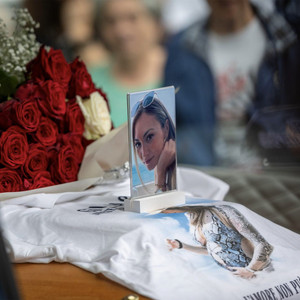
One of those women was Giulia Tramontano.
And coming up, we'll hear from her sister.
This was the first time I decided to tell a non-Italian channel about Giulia.
Maybe after this interview, people will know more about her.
From the BBC, I'm Asma Khalid in Washington, D.C.
And today on The Global Story, what does it mean for a country to officially recognize femicide as a distinct crime?
We'll be right back.
As I mentioned, one of the most highly publicized cases was Julia Tramontano.
She was repeatedly stabbed by her partner while she was seven months pregnant.
Her sister, Chiara, now lives in the Netherlands, and that's where we reached her.
Well, Chiara, thank you so much for taking the time to speak with us.
I cannot imagine how difficult it is to hash through all the details of this story, but we do appreciate you taking the time to talk to us.
Thank you for inviting me.
I love talking about my sister, although it's very painful, but having the chance to just say her name to me is very important.
So I'm happy to be here today.
Can we begin the conversation by having you just tell me about your sister, Julia?
What was she like?
She is, because I do love to use the present when I talk about my sister.
She's a very sensitive person.
She loves to help people.
She is kind.
She's gentle.
I say she's a rare flower in the garden.
What's the age difference between you two?
I was born in 1996 and she was born in 1994, so two years.
And so she was your older sister.
Do you remember her feeling like she was a maternal older sister to you all growing up?
I would say no.
She was not maternal.
I was behaving a little bit like I was the bigger sister.
And the reason is that I always recognized in Julia a great sensitivity which...
Could have also been dangerous for her kind of exposing her to a situation in which I just wanted to protect my sister.
So it was, I would say the situation was a little bit inverted.
What were the conversations with your sister like in the months prior to her murder?
So...
At that moment, Julia was already having some struggles with her boyfriend.
And it was a complicated period in which we were just I was just trying to be close to her because she was pregnant.
But still, we were... growing a little bit apart because of our opinion about her relationship.
You mentioned her partner.
Who was he and what did you think of him at that time period?
I didn't spend much time with him.
But in the few conversations that we had together I immediately realized yeah, this person is empty.
He was a person who likes to put himself first.
And that was immediately clear for me.
It was all about his work, his career, his needs, more than the need of my sister or their need as relationship, as a family.
That was, yeah. becoming something.
And so you all had grown up in Naples and you say, during this time period when she's pregnant with this partner, where was she then during that time period?
She was working as a real estate agent in Milan.
Did your sister share anything that felt unusual to her in the last few weeks of her life?
Did she raise any alarm bells about the relationship?
She was definitely in an outside tornado of emotions because a few weeks before she was murdered she had found out there was another person.
She was sharing with me all the messages that maybe she had found hidden on her partner's phone and some kind of other strange things like credit cards being used for gifts or hotel and stuff like that.
So she was definitely going through a thunderstorm.
Her relationship was coming to an end, but there was no red flag of violence.
She was aware that she would have soon taken a decision.
And she shared with me that that decision was to quit her relationship and just start over with the child alone.
When did you stop hearing from your sister?
When did you actually realize that she was missing?
I think back then it was a Sunday, and on Sunday we normally have a phone call all together, a video call in which we share what are we going to eat.
Because Sunday in Italy is a big thing, like you cook a lot.
And if you are not at home, then you call your mom and you take inspiration for what to cook.
But that Sunday, Giulia did not send any message.
After a couple of calls, I would say it was early afternoon, we realized, well...
It's very strange that we don't get any message since yesterday.
My mom was in Naples and Julia was in Milan.
It's kind of a tricky situation.
So she called my sister partner and she asked, where is Julia?
Where have you been today?
He said, yeah, well, I don't know, but I'm now coming home from work.
So I will check and I will let you know.
But 10 minutes later he called my mom back to say I'm going to the police station to report Julia's missing.
Julia's body is then found.
And in reading this story, I see that her partner confessed to the crime.
I cannot imagine how horrific this time period must have been for your family.
How did you find out that Julia's body was found?
Do you recall what that moment was like?
It is pretty clear in my mind.
It's, I think, one of those frames of your life that you will never forget because, after two days of intense research and looking for Julia, My brother and I, we went by car to the city of Milan, asking around in places where she used to go.
The day Julia was found, we parked the car in the street and then we continued walking.
And on the way to pick up the car, my brother actually recognized one of the police officers that we were used to talk and laugh with.
And my brother asked him, why are you here?
And who are all those people in this narrow street?
And that police officer just told my brother this is the moment to be strong, because in this street we found your sister body.
My brother told me it's finished.
It's finished.
We have to don't tell our parents anything because we have to find another way.
But just there was nothing else to do.
I'm so sorry.
So sorry.
I mean, how did you first learn who the suspect was in this crime?
I was watching a TV program very famous in Italy.
The translation in English would be, who has seen this person?
Together with the other journalists, we are under the house that the girl divides with her partner.
There were Bungerman journalists from this program actually filming some scenes at my sister's place and it was streamed live.
A few more hours and Alessandro will confess everything.
Suddenly, one of the journalists said we have to give the terrible news that Giulia's partner is officially suspected of murder.
And has been just picked up by police and is now at police station.
Chiara...
Several months pass after your sister's body is found.
And then, at the beginning of 2024, I see that a trial began and her partner Alessandro, was charged.
There was no femicide law on the books at that time.
He was charged with aggravated voluntary homicide.
I was reading among other accusations, including the non-consensual termination of the pregnancy.
What did you make of the specific charges and of the trial?
I do remember when the jury gave the verdict of life imprisonment and then they just listed all the aggravating factors.
I felt it's finished.
And with the end of the trial, I was afraid that the world would forget my sister.
I cried a lot.
I started shaking.
I remember I had to leave the room.
And I was overwhelmed by pain because I was coming to an end of a big fight.
And as such, at the end, I just, at the end of the fight, I was empty.
I did not win anything.
It was not the verdict that I would have thought of, because they did not recognize premeditation, which I do believe is said so much clearer because my sister had been poisoned for six months before being murdered.
Was that something you learned during the trial?
Yeah, it was one of the main points.
When Julia's autopsy was carried out, they found red poison in her liver.
In the previous six months she was poisoned with an increasing amount of red poison, which was given to her in tea prepared by her partner and in water.
Oh, gosh.
I'm so sorry.
If we look at what's transpired since the trial for your sister's murder, her case, along with another case in Italy of a woman by the name of Giulia Cecchettin, really seems to have been a moment of reckoning for Italy on the issue of violence against women.
I want to ask you about the law itself, the femicide law.
Just last month in November, the Italian parliament approved the official definition of femicide.
Do you think that having a law that differentiates femicide from murder changes something?
Yeah, I do think it changed something.
I do think it kind of speed up the trial itself, but I think this is still not enough to stop people from considering women a target.
And from this, I think, rather than a law, we need education in this country in which we really teach how to approach the other gender to prevent this kind of violence and hate.
I heard that you have a young niece, your brother's daughter, who's also called Julia, and she was born in the fall of 2024.
What's your message to her?
Don't live in fear.
Don't stop loving for the fear of being hurt.
I also wrote her a letter.
It's something I would love to read for her when she grows up.
I wanted her to know that her name is associated to a big, painful story, but this doesn't mean that she has to bring this burden.
She must be aware that the empty chair at the Christmas table is a big sign for us.
It's a sign of a hole, a tremendous, horrific hole that we're not able to fill anymore.
But it also represents love.
Julia, my niece, was able to fill a little bit that hole with her smile, with her words, to bring us back to life.
This story is unfortunately not an isolated case.
A few months after Chiara's sister was killed, another young woman by the name of Giulia Ciacatini was murdered by her ex-boyfriend.
That further sparked a national outcry in Italy around issues of violence against women.
That reckoning led to this new femicide law.
We wanted to know more about the other Julia story and the law itself.
So we called up the BBC's Sarah Rainsford.
She's based in Rome and she's been covering this all.
And I began our conversation by asking Sarah what this new law actually entails.
So it was a bill that was designed to make femicide, so the murder of a woman for being a woman, so very gender-specific femicide murder, a standalone crime.
So, whilst Italian law and international law has the crime of homicide from the word for man, femicide is distinctly about the murder of a woman because of her gender, so motivated by her gender.
And this law has very specific parameters.
Essentially, it's about defining a very specific crime, which is murdering a woman, and as an act of control, as an act of domination, as an act of subjugation, and so specifically, because she's a woman.
There's been quite a lot of discussion about the issue of gender violence in Italy for some time.
I have to say it's quite interesting.
I'm quite new to Italy.
And I noticed we have the TV on in the office and on the 24-hour news channel here.
I kept seeing the word femicide on the screen.
And there was an awful lot in the headlines about the murder of women.
And I started to think that Italy was, like an incredibly dangerous place to be as a female because it was so often so prevalent in the headlines.
But it comes from a discussion that's some years old but I think really caught the national headlines a couple of years ago with one article, very high profile murder, which was the murder of a woman, a young student called Julia Cheketin, who was killed almost exactly two years ago by her ex-partner.
So a boy that she had broken up with.
They were both students at university.
He wanted to get back with her.
He was very possessive, very jealous, very persistent.
And ultimately, he killed her.
The man was called Filippo Toretto and he committed this horrific, horrific murder, a very violent attack.
And then he went on the run.
And I think that's probably you know, to explain why it captured the, I suppose the nation so much.
He went on the run.
He disappeared after dumping Julia's body and was found eventually in Germany, in fact in a lay-by in his car, because he'd run out of petrol, run out of money.
So for a whole week, the nation was basically transfixed.
First of all, to find Julia and then to find her killer.
How was the crime viewed legally, not just in the court of public opinion, but how did the courts deal with it?
He was prosecuted for murder with aggravating circumstances, including his possessive and controlling behavior.
Hmm.
So in a way, there's quite a lot of discussion about whether this law changes very much.
I spoke, for example, to Julia's father Gino and I sort of said to him you know, would anything have been different for you had this law existed?
And he was pretty doubtful because, as he pointed out, Filippo is now serving a life sentence in an Italian jail.
But I think he thought it would have a symbolic purpose.
He thought it was a small but important step.
Well, what are the arguments in favor of having a separate offense, a femicide, if the case that essentially galvanized the nation, ultimately that man who was found guilty of it, is behind bars?
Nonetheless, regardless of there actually being a crime of femicide on the books,
Yes, I think it's about identifying femicide as a distinct crime with distinct characteristics.
And it's partly about, I think, giving it visibility and fuelling a discussion, in order to then try to tackle the problem at its root.
Because I think critics and supporters of the law both agree that this is not a crime that you can get rid of through punishment.
But it's about the need to tackle the root causes of femicide femicide of gender-based violence in society.
And I think also that's why the case of Julia Chikatine and other prominent cases I think were so important, because they did really start that debate.
And I think, just to mention one particular thing, Julia's sister Elena.
She made a speech the day after the murderer was captured and she talked about The fact that her sister's killer was not a monster, because monsters are outside of society.
But she said that her sister's killer was of that society.
She said he was the healthy son of a patriarchy.
Has the public largely been supportive of this new law?
Were there arguments against it?
I think the interesting thing about this law is that politically it had cross-party support.
But the people who are critical primarily that I've spoken to are people who say it doesn't go far enough.
Not because the law doesn't go far enough, but because you can't legislate away something like femicide.
So there's a lot of discussion about the need for changes in the education system here in Italy, and particularly the need for sexual and emotional classes education in the curriculum.
And there's a current fight over that.
So the right wing of politics here doesn't want to allow sexual and emotional education in school as an obligatory or mandatory course.
They want that to be only optional for parents have to have to agree to it.
And they don't want it for younger children.
Sari, you've mentioned that this law had cross-party support.
And so that makes me wonder, what was the Italian prime minister's role in all of this, Giorgia Maloney?
I find it curious and interesting.
I mean, there is a woman who is the head of state there in Italy.
Yeah, she is, although she's not seen as a feminist, particularly here in Italy.
But yeah, she is a woman, of course, at the very top of Italian politics, a very powerful woman here.
And she did and does back this law.
The critics would say though, this was gesture politics and this was the easiest thing that she and her party could do.
They point to the fact that there's no money attached to this law, so there's no kind of investment in any sort of educational projects or anything in terms of improving police responses to cases of domestic abuse, for example.
Yeah.
And that it's all about just shouting about femicide and not actually doing anything to address it.
So I think it's interesting to see how deep this will go in terms of actually changing anything in Italy.
The reason I ask that, Sarah, is that it made headlines globally when it was passed.
I mean, we here in the United States do not have a law on the books like this.
Are there other countries who have similar laws of this sort?
There are a few countries in the EU, very few, and a handful of countries worldwide.
So I think Italy definitely sees itself at the sort of vanguard of this.
And certainly, I think, Giorgio Malone's support for it, of course, helped push this through and create this law in the first place.
So I think it is interesting that it has become a cross-party thing, but certainly a law that was driven by women.
And then it was passed unanimously.
As the judge told me, the men were convinced to pass it.
The women led the way, she said.
I see.
I see.
You know we are.
We're talking about the case here today of Italy, and time and again here in the United States, we hear about murders being committed against women, often in the case of domestic violence being committed by their partners.
And that makes me wonder how severe the problem is in Italy compared to other countries.
Yeah, I don't think the problem here despite what I originally thought when watching those TV news headlines when I first arrived in Italy I don't think the problem here in this country is necessarily worse than anywhere else.
I think, the statistics.
It's very difficult to talk about statistics because every country defines this in different ways.
I think in Italy last year there was around about 100 and I think it was 116 women who were murdered and the interior ministry decided, by its own characteristics, that 106 of those women had been murdered because of their gender.
And that was before this law.
I think here we say it's one every three days, I think, in Italy.
And the vast majority of women who are killed in Italy are killed by a close relative or partner.
So it sounds like you're saying the situation of violence against women is not particularly more prominent in Italy.
And so that makes me wonder why Italy was, it seems, one of the first major countries to take this on and make it into law.
Yeah.
I don't think it's because Georgia Malone is a woman.
I don't think it's that facile.
I suppose the answer to the question is that, because there's probably quite a lot of disagreement about whether having a standalone law on femicide actually makes a difference to the statistics, the jury is still out, if you pardon the pun, on whether or not it will actually make a difference to the number of women being killed in this country.
And I think most people who criticise the law or who welcome it but think things need to go further would say that the problems are much more deep-rooted and just labelling something femicide doesn't delete femicide from society, that you have to tackle the problem at its roots.
And in Italy, it is a very unequal society.
You know, the macho culture is alive and kicking.
And I should just mention one thing.
In the last few days, there's a school near my house in Rome.
And I suddenly noticed that that school was smeared with graffiti all over the front about macho men and kind of Lots of feminist graffiti.
And I then discovered that actually there was a big scandal in this school because some boy, a boy in the school, had written on the wall in the toilets a list.
He called it a rape list.
And there was a list of girls' names.
Oh, good.
So there's this huge scandal in this school and now in another school as well in Italy.
The girls who are on the list.
Have actually some of them come out and spoken publicly and say it happened because they were speaking out for women's rights and for their rights as young women in Italy?
But I think it just shows you that you know the problem of education, the problem in the schools and the problem of young people, you know is the real focus now very much in Italian society.
And that debate is very alive.
So it has certainly ignited that debate.
Well, Sarah, thank you so much for taking the time to explain this all to us.
I really appreciate it.
My pleasure.
Thanks for having me.
Before we go, we wanted to bring you some final thoughts from Chiara, who we heard from earlier.
You'll recall that her sister's brutal murder helped galvanize the Italian public around this issue.
As I was wrapping up the interview with Chiara, she stopped me to explain why she had agreed to speak to us.
I felt ashamed of my life for quite some months, you know?
People saying, oh, I don't know what to say, stuff like that.
It's a burden, whatever you go.
You don't feel like sharing.
So when I wrote this book, I made an oath with the publisher and I said this will never be translated in another language.
And this was especially meant for not sharing my story in the Netherlands.
I wanted to be Chiara here.
This doesn't mean that Julia is not part of me.
But she doesn't have to be a victim of feminicide also in the Netherlands.
Because in the Netherlands, she can be still Julia.
Like I still have a sister.
She lives in Milan.
She has a child.
So maybe after this interview, people will know more about her.
And I hope this helps someone else.
So, yeah, thanks for having signed to know Julia.
I'm happy one more person knows her now and you will not forget her.
So I just made my point.
That's it.
That means a lot.
Thank you.
Thank you.
That was Chiara Tramontano.
And earlier we heard from the BBC's Sarah Rainsford in Rome.
This episode was produced by Valerio Esposito and edited by James Shield.
It was engineered by Travis Evans and our senior news editor is China Collins.
If you have any questions or suggestions for us, we really appreciate hearing from you all.
So please drop us a message.
Our email address is theglobalstoryatbbc.com.
Thank you as always for listening.
Hope you have a nice weekend and we'll speak to you again on Monday.