This is The Indicator from Planet Money.
I'm Waylon Wong.
And I'm Stephen Massaha.
It is the end of the year, which means it is a time of rushing.
Rushing to catch a flight home for the holidays, rushing for last-minute gifts and for Congress, rushing to find a solution to a health care deadline.
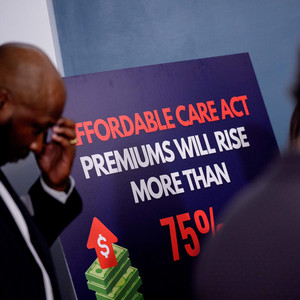
When the year ends, expanded subsidies for the Affordable Care Act, also known as Obamacare, will also end.
And that means the cost of insurance is about to get a lot more expensive for many people like Tricia Pena from Hermitage Tennessee.
This year, my premium for a very basic bronze plan for one person is $197.
Next month, it goes up to $1,280.
$1,280.
That is a more than $1,000 a month increase.
Trisha lost her job last year and decided early retirement was a better deal than trying to find a new job at 61.
She's in pretty good health, but she gets a lot of insurance subsidies because of her age.
Subsidies that are about to get cut.
I just can't in good conscience pay $1,300 a month for one person's insurance.
Despite this, Republicans have not been able to come together around one solution.
So we wanted to learn about how we got to this point, about the decision that got us here, what we have to lose and what the future holds.
And to do that, we are turning to a classic holiday tale.
Yes, today on the show we are getting a visit from the ghosts of Obamacare past, present and future.
This message comes from BetterHelp.
As a dad.
BetterHelp president Fernando Madeira relates to needing flexibility when it comes to scheduling therapy.
I have kids under 18, so time is very limited.
That's why, at BetterHelp, our therapists try to have sessions, sometimes at night, depending on the therapist, or during the weekend.
So I think that's what we need to tell the parents.
You're not alone.
We can help you out.
This message comes from Capital One.
Say hello to stress-free subscription management.
Easily track, block, or cancel recurring charges right from the Capital One mobile app.
Simple as that.
Learn more at CapitalOne.com slash subscriptions.
Terms and conditions apply.
This message comes from Charles Schwab.
When it comes to managing your wealth.
Schwab gives you more choices, like full-service wealth management and advice when you need it.
You can also invest on your own and trade on Thinkorswim.
Visit Schwab.com to learn more.
Our first ghostly guide is the ghost of Obamacare past, and they're taking us back five years to the COVID-19 pandemic.
A lot of people are losing their jobs because people weren't able to work in person.
That is no ghost.
That is, in fact, Cynthia Cox.
She conducts research on Obamacare for the healthcare news site KFF.
There was concern that, even with the Affordable Care Act being in place, that there could be a huge jump in the uninsured rate, since people might be losing their job-based coverage at the same time that there's a pandemic playing out.
So one way Congress tried to help Americans back then was with the American Rescue Plan in 2021.
Part of that law added more funding to tax credits meant to keep premiums down.
A year later, Congress extended that funding until 2025.
You know, the deadline we are rapidly approaching.
Yeah, and these bumped up tax credits ended up being a shot in the arm for Obamacare.
Cynthia says those more affordable plans caused the number of people getting coverage to double.
And with that doubling came, you know, more healthy people joining into the market.
More healthy people is exactly what you want if you're an insurance marketplace, because they help offset the cost of caring for people who are sick, which might sound like a raw deal if you're healthy, but Cynthia says the whole point of insurance is pooling risk.
We don't know when we're going to become the sick person.
And when we do become the sick person, that's when we can take out of the pool.
So big subsidies doubled enrollment.
Oh, is that a nip in the air?
I feel I can see the windows frosting over, which means it's time for the ghost of Obamacare present.
And Cynthia says for Obamacare today, the marketplace has really been thriving.
All those healthy people with insurance now play a big part in the marketplace's strength along with, you know, the subsidies themselves, keeping costs lower.
Whether it's enrollment or premiums or insurance company participation, you know like the market is functioning quite well in all of those respects.
Yeah, let's take each of those for a second.
More insurance companies than ever are in state marketplaces.
Average monthly premiums have been pretty stable the last several years.
And like we said earlier, enrollment in Obamacare has about doubled since 2021.
Of course, the worry right now is that the same healthy people boosting the market could leave when the expanded tax credits that pulled them in go away.
So what would happen if they go away?
And that brings us to the ghost of Obamacare's future, the future where Congress lets those tax credits expire and people who currently get the enhanced subsidies are going to face a huge price hike about 114 percent.
So basically what that means is that the amount that people pay each month out of their own pockets is going to more than double, on average.
If there's one thing we learn from A Christmas Carol, it's that the future is not written in stone.
After all, Ebenezer Scrooge changed after seeing his future.
Now that Congress is staring down a grim prophecy, there is still time for a last-minute plan to avert, or at least soften, this crisis.
It just needs enough votes to pass.
The Democrats have their plan, and it's basically keep the status quo.
So what the Democrats want is a clean extension of the enhanced premium tax credits that have been in place.
They are asking for a three-year extension.
I mean, of course, some of those Democrats would like to see a permanent extension.
But even that three-year extension just hasn't been able to get enough Republican support to pass.
They say it's too much government involvement in health care.
Republicans have been floating around their own plans, but those also have not been able to get enough support.
House Speaker Mike Johnson's plan is likely coming up for a vote soon, though this plan does not extend the subsidies.
One thing it does do is allow small businesses to come together and purchase health coverage as a group, ideally to get some of the same benefits.
Large employers have to keep costs down.
Democrats say this bill is dead on arrival.
And with the holiday recess approaching, it is just about guaranteed that the subsidies will expire without any alternative.
Of course, it is complicated.
But to understand just one important reason why, we need to bring back an old friend.
The ghost of Obamacare passed.
We need to go back to before COVID, before Obamacare was a law or even a bill, back to when it was still just a think tank dream.
The Heritage Foundation is this famously conservative think tank and it is opposed to Obamacare today.
But before the law passed in 2010, several heritage scholars pushed for an insurance exchange market.
And that is the very basis of what Obamacare is.
That's what these Obamacare markets are.
This is not single payer.
This is not, you know, Medicare for all or even a public option.
This is private insurance.
Yes, private insurance.
The Obamacare marketplaces are basically places to shop for insurance run by private companies.
Maybe there are government subsidies, but it is not government run insurance.
In fact, before there was Obamacare, there was Romneycare.
Then-Republican Governor Mitt Romney in Massachusetts at the time passed health care reform in 2006 based on this idea of a private insurance marketplace.
Romney even later said you don't get Obamacare without Romneycare.
And so I think that's been the challenge for Republicans in coming up with a replacement plan that this is a right-leaning law to begin with.
Arguably,
The Heritage Foundation disputes this connection to Obamacare's origins.
Still, that is the challenge for Republicans looking for a replacement.
And for 15 years, Republicans have failed to find an alternative with enough votes to become law.
Which leaves us at the end of our Obamacare carol.
And even after being visited by three spirits in the night, it does not look like Congress is changing course.
These subsidies are likely going away without any legislation to blunt the financial pain.
Still, Cynthia believes this is far from the end for Obamacare.
I think the marketplace will continue to function.
I think insurance companies will still want to participate.
I think premiums will be higher than they otherwise would be, but that most people will find a way to keep their coverage.
But that won't be true for everyone.
Remember Tricia Pena from Tennessee and her more than $1,000 upcoming premium hike?
I've made the decision to forego insurance.
Until it either becomes affordable again I turn 65 and get Medicare or possibly find a job that provides insurance, which of course derails the dream of early retirement.
Absent some late Christmas miracle, a lot more Americans are stuck with a similarly painful choice.
This episode was produced by Corey Bridges and engineered by Jimmy Keeley.
It was fact-checked by Sierra Juarez.
Kate Kincannon is our editor and The Indicator is a production of NPR.
This message comes from Vanta.
What's your 2 a.m. security worry?
Is it, do I have the right controls in place?
Or are my vendors secure?
Enter Vanta.
Vanta automates manual work, so you can stop sweating over spreadsheets, chasing audit evidence and filling out endless questionnaires.
Their trust management platform continuously monitors your systems, centralizes your data and simplifies your security at scale.
Get started at Vanta.com.
That's V-A-N-T-A dot com.
This message comes from Solodyne.
Yesterday's approach to storage can't meet the demands of today's AI ambitions.
Bigger, faster, and more energy efficient.
Solidime solid state storage solutions are optimized for AI.
Learn more at storageforai.com.