WBUR Podcasts, Boston.
Strong as a horse. Strong as an oak.
Strong as steel. You've probably heard at least some of these expressions, and the general gist of all of them is that strength is a physical thing.
It's all about size or heft.
But the truth is, strength is about much more than that.
And as we'll hear in today's tale, big strength can come in little sizes.
I'm Rebecca Shear, and welcome to Circle Round, where story time happens all the time.
Today, our story is called The Face Off.
It was inspired by tales from southern Africa, where it's been told among the Shona people of present day Zimbabwe, Zambia, and Mozambique.
Some really great people came together to bring you our adaptation of this story, including Kelly Jenrette and Lamar Richardson.
Grownups, you may know Kelly Jenrette from the CW's All -American Homecoming, and The Handmaid's Tale on Hulu, as well as the Netflix films Uncorked and All Day and a Night.
Lamar Richardson is an actor and Broadway producer who won 2024 Tony Awards for the new play Appropriate and the revival of the musical Merrily We Roll Along.
So circle round everyone, for The Face Off.
Long, long ago, before people came around, animals shared the earth as equals.
But there was one animal who thought he was better than all the rest.
And that animal was elephant.
Fellow animals, behold my gargantuan body, my thumping great feet, my tremendous trunk, who, among you puny critters, is anywhere near as large, powerful, and strong as I.
I dare say none of you, not a one.
As you can imagine, the other animals were quite fed up with elephants boastful ways.
That elephant is such a braggart.
And bully. Somebody oughta take him down a peg.
And yet, nobody did.
They were too afraid of getting walloped by his gargantuan body, trampled by his thumping great feet, or grabbed by his tremendous trunk and sent flying toward the heavens.
One morning, elephant was trundling toward the river, shaking the ground with every step when he came across squirrel.
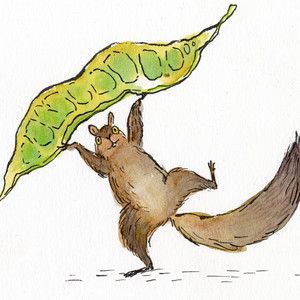
She was crouching in the middle of the path and nibbling the long, skinny seed pods that had fallen from an acacia tree.
Ho there! Bushy -tailed creature of small size and even smaller importance!
How dare you block my way!
Be gone at once! Squirrel froze mid -nibble.
Her first instinct was to do as elephant said and skedaddle.
But then she thought twice.
Because squirrel was a clever critter.
And suddenly she had an idea for how she might deflate elephants enormous ego.
Well good morning to you too, elephant.
Sheesh. You really do think you're high and mighty, don't you?
Think it? Elephant flicked his trunk.
I don't just think it, squirrel.
I know it. I am the greatest animal on Earth and I dare anyone to prove otherwise.
Well, in that case, consider your dare accepted.
By who? By me! I hereby challenge you to an eating contest.
An eating contest? Are you for real, squirrel?
This behemoth belly of mine is practically bottomless.
Take those acacia pods you're nibbling.
I can devour more of those pods in one day than you and your entire family can consume in one week.
So you say. But we squirrels have our own special strengths.
So how about we gather a whole bunch of acacia pods.
Then at first, like tomorrow, we meet in the clearing in the middle of the forest and we start eating.
The eating will continue all day long.
Come nightfall, whoever is still stuffing their stomach with acacia pods is the winner.
There was a long pointed pause as Elephant considered Squirrel's challenge.
Then his mammoth mouth stretched into a grin.
All right, squirrel.
At first like tomorrow, we shall hold an eating contest.
May the strongest prevail.
Squirrel spent all night gathering acacia pods.
And come morning, when the first rays of sun came streaming through the trees, she brought the pods to the clearing in the forest.
Elephant had not yet arrived, but Squirrel discovered she wasn't alone.
Word of her challenge had spread and the other animals had shown up to witness the big event.
Gosh, Squirrel. You really think you can do this?
Elephant's belly is so big he could fit an entire forest's worth of acacia pods inside.
How can you possibly beat him?
Don't worry, friends.
Elephant may have a bigger belly than I do, but I have more brains and I'm not afraid to - Well, look at this.
The gang's all here.
The ground quaked as Elephant stomped into the clearing, an overflowing basket of acacia pods clasped tight in his trunk.
I thought you and I would be alone, Squirrel, if you even bothered to show up.
But I am delighted.
We have some spectators to witness your colossal defeat.
I must say, these acacia pods are going to be sweet.
But victory? Victory will be even sweeter.
What do you think will happen when Elephant and Squirrel face off?
We'll find out how it goes after a quick break.
Support for the Circle Round Podcast comes from Indeed.
Are you hiring? With Indeed, your search is over.
Indeed doesn't just help you hire faster.
93 % of employers agree that Indeed delivers the highest quality matches compared to other job sites, and listeners get a $75 sponsored job credit to get your job's more visibility at indeed .com slash circle round.
That's indeed .com slash circle round.
Terms and conditions apply.
Need to hire? You need Indeed.
Welcome back to Circle Round.
I'm Rebecca Shear. Today, our story is called The Face Off.
Before the break, Squirrel challenged Elephant to an eating contest.
At the end of the day, whoever was still stuffing their stomach with pods of acacia seeds would be the winner.
When Elephant came thundering into the clearing, he arrogantly addressed the other animals who had shown up to watch.
I must say, you all are in for quite a show as Squirrel and I compete.
I would say that she and I are about to go head to head and toe to toe, but let's get real.
Her head isn't even as big as my tiniest toe.
Squirrel rolled her eyes.
Look, Elephant, as much as we are loving the jokes, can we please get going?
And perhaps our friends can kick things off by giving the command to start.
Though they may have to speak up, my ears are keen, but sometimes it's so hard to hear those incy -weensy insignificant little voices.
The other animals exchanged a look, then they took a breath and gave the command.
Get ready. Get set.
Go! Quick as a wink, Elephant and Squirrel began tucking into their piles of acacia pods.
Elephant had skipped breakfast, so he was extra ravenous and munched steadily.
Squirrel got off to a strong start as well, but with such a tiny stomach, it wasn't long before she slowed down and Elephant noticed.
Ho there, Squirrel!
Didn't you tell me just yesterday that squirrels have special strength?
Yet you can hardly cram another pod into that minuscule mouth of yours.
I meant what I said, Elephant.
We squirrels do have our own special strengths.
Whatever you say, Squirrel.
Whatever you say. Elephant eagerly went back to his eating.
He was so absorbed in his task that he didn't notice what Squirrel did next.
First, she took a quick glance around.
Then she flashed the other animals a mischievous grin before silently skittering away.
And the moment she disappeared through the trees, do you know what happened?
Her older brother scampered into the clearing and without missing a beat, he took his sister's place.
He grabbed an acacia pod from the pile and began to chomp.
When he ran out of room in his belly, another Squirrel brother took his place.
Then a cousin, then an uncle, then an aunt, all day long one hungry squirrel after another took their turn at the pile of acacia pods.
Elephant, meanwhile, didn't look up once.
Determined to win the contest, he just kept packing in the pods.
But as nightfall approached, his super -sized stomach began to gurgle.
He choked down another acacia pod, then grumbled to himself.
Oh, I'm feeling a little green at the gills.
Surely Squirrel isn't still eating, right?
She must have thrown in the towel hours ago.
For the first time in a long time, Elephant took a breath and a pause and glanced over at his competitor.
To his surprise and dismay, No!
There was Squirrel, her cheeks packed with acacia pods.
Why, Elephant! Gosh, you haven't looked up from that pile of pods all day.
How ya doing? Elephant couldn't believe his eyes.
Given how full he felt, how could Squirrel possibly have spent the whole day eating?
Well, you and I know the answer to that question, right?
She hadn't. She had taken her original place just a few moments ago, after hour upon hour of tag -teaming by her family.
Because Squirrel really did mean what she said the day before.
She and her fellow Squirrels had their own special strengths.
Strength in speed, strength in cleverness, and strength in numbers.
Elephant, of course, was in the dark about all of this.
The colossal creature felt a rush of envy, then fury, then queasiness.
I hate to say it, Squirrel, but my stomach is so swollen I can hardly move.
So? Yes, Elephant? Now that it's nightfall.
Go on. And now that you're the one still somehow stuffing pods into your belly.
I have no choice but to declare you the winner.
Squirrel smiled. Thank you very much, Elephant.
Like I said, we Squirrels have our own special strengths.
In fact, all animals have their special strengths too, not just you.
I hope in the future you'll come to see that.
And wouldn't you know it?
He did. After that fateful day when little Squirrel cut him down to size, Elephant worked hard to be kinder and more humble.
And once he finally swallowed his pride, everyone had to agree.
He was a whole lot easier to stomach.
Now it's your turn.
No matter what size we are, we all have our own special strengths.
Some of them are obvious and some are more hidden.
To help you remember your own special strengths, you can make your own strong box.
Find an empty tissue box and decorate it however you like.
Each day when you find yourself showing a strength, whether it's something you worked hard on or you're improving at or you're really proud of, write it down or draw it.
Then put your note or picture in your strong box.
Do this every day. And as your strong box fills up, take out your notes and pictures from time to time and share them with a grownup.
And if you'd like, share them with us.
Grownups, you can snap a photo of your Circle Round fan and their strong box and email it to circleround at wbur .org.
With your permission, we may include it in the Lion's Roar, the monthly newsletter of the Circle Round Club.
If you haven't yet joined our merry crew, you can learn more about this super fun opportunity for super fans like you on our website, wbur .org slash Circle Round.
This week's episode, The Face Off, was adapted by me, Rebecca Scheer.
It was edited by Dean Russell.
Our original music and sounds design is by Eric Schimelonis.
Our artist is Sabina Hahn.
Sabina has created a black and white coloring page for all of our Circle Round stories, and you can print them out and color them in.
Grownups, visit our website, wbur .org slash Circle Round, and click on Coloring Pages.
Special thanks to this week's actors, Kelly Jenrette and Lamar Richardson.
Actor and producer Lamar Richardson won 2024 Tony Awards for the new play, appropriate, and the revival of the musical, Marily We Roll Along.
Kelly Jenrette has starred on such shows as The CW's All -American Homecoming and The Handmaid's Tale on Hulu, as well as the Netflix films Uncorked and All Day and a Night.
And P .S., Kelly has also starred in two other Circle Round episodes, The Troop of Ten and The Extraordinary Pinecone.
You can find both stories on our website, wbur .org slash Circle Round, or wherever you listen to Circle Round.
Our featured instrument this week was the imbera.
You can learn more about this 3 ,000 -year -old instrument traditional to the Shona people and see a photo of Eric Shimolonis playing one on our website.
Again, that's wbur .org slash Circle Round.
Grownups, if you enjoy Circle Round, please leave us a five -star review on your favorite podcast app.
It helps other listeners find the show so we can make the Circle Round circle even bigger.
Circle Round is a production of WBUR, Boston's NPR news station.
I'm Rebecca Scheer.
Thanks for Circling Round with us.
Now that you've made it to the end of this Circle Round episode, we want to know, what's your favorite Circle Round story?
Thousands of fans just like you have been telling us about the Circle Round stories they like best.
Take a listen. Maybe one of their favorites is one of yours too.
And I like the part where everyone has ink marks on their hand.
My name is Davis. I live in Colorado.
My favorite Circle Round story is the full winds.
I like the part where the boy has the full winds to help him catch the fox.
My name is Emma, and I live in New Jersey.
My favorite Circle Round story is the Fairy Fort.
My favorite part is when the fairies approach the girl.
My name is Juniper, and I live in Portland, Oregon.
And my favorite Circle Round story is the lone dragon.
And my favorite part is when the dragon cries and Lynn hears it and comes back up the mountain.
My name is Rose. I am from Massachusetts, and my favorite Circle Round story is the little blue purple.
My favorite part is when they always change into animals.
Did someone mention a story you've missed?
Not to worry. Grownups, you can find all of our Circle Round stories, plus links to the Circle Round Club, picture books, coloring pages, and oh so more on our website, wbur .org slash Circle Round.