Thanks to LEGO Art for supporting PBS.
We've long resisted offering any definition of art on this channel.
In my mind, Ambrose Bierce was really onto something when he offered this entry in his 1906 Devil's Dictionary.
Art, noun, this word has no definition.
It's not that there aren't plenty of definitions out there.
It's just that I find them lacking in some way, or incomplete or so watered down that they're meaningless.
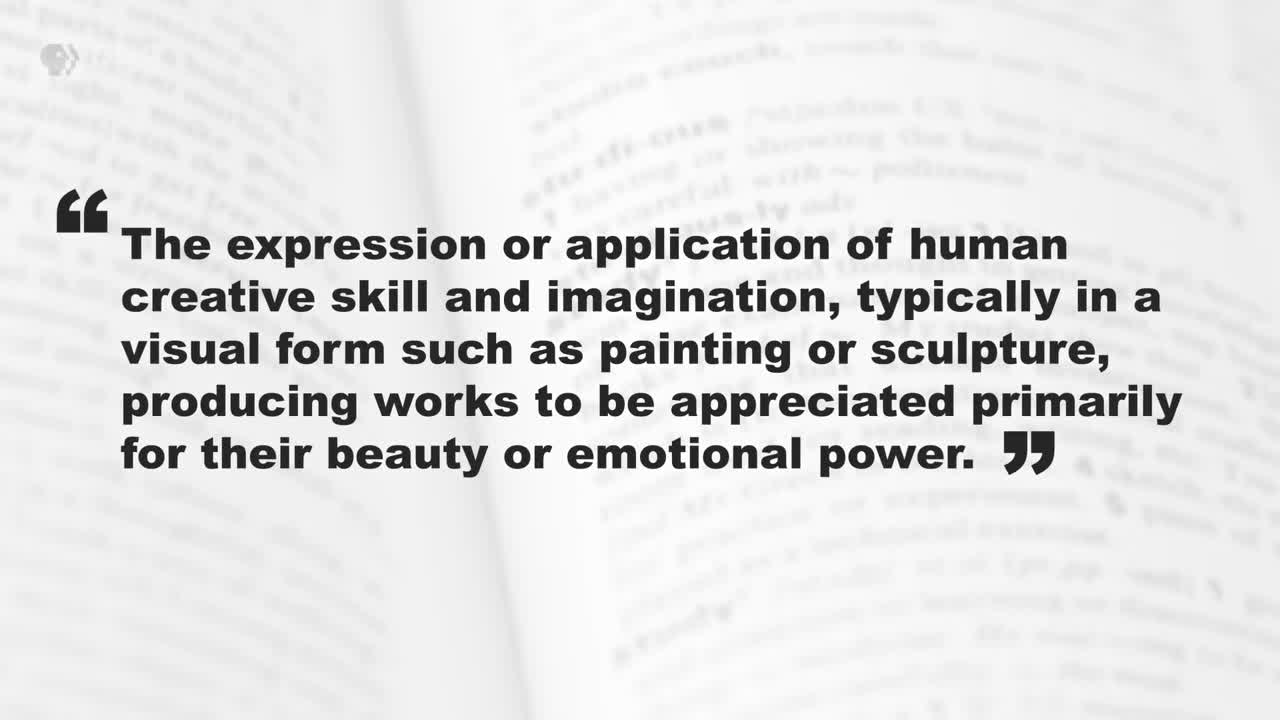
Take Oxford's, the expression or application of human creative skill and imagination, typically in a visual form such as painting or sculpture, producing works to be appreciated primarily for their beauty or emotional power.
Wait, human creative skill?
Do we really want to say other animals are incapable of making art?
And there are definitely artworks that I appreciate for neither their beauty nor their emotional power.
Like a Thomas Hirshhorn installation I can find thought-provoking, but not beautiful or emotionally powerful really.
To me, saying how you're supposed to respond confines the experience.
But is it impossible to define art? or worthwhile to even try?
For a while now, I've been gathering quotes about art from a range of writers and artists throughout history.
I'm going to share some of these with you, in the hope that we might gain some understanding of this nebulous idea called art, or that you might find a definition that resonates for you.
I tend to be a fan of the ones that are intentionally enigmatic.
Like James Baldwin's, the purpose of art is to lay bare the questions that have been concealed by the answers.
I like that it leaves the boundaries really wide.
Like, for me, the ancient Greek and Roman philosophers confine art too much.
Like Seneca, who said all art is but imitation of nature, which he could maybe get away with saying about the art of his time, but just doesn't hold up for me now when I see, let's say, this wonderful work by Nam June Paik, Magnet TV from 1965.
Aristotle set his terms a little more broadly when he said art completes what nature cannot bring to a finish.
The artist gives us knowledge of nature's unrealized ends, which I like for its proposal that art does something nature alone does not.
That art works from nature and extends it outward.
Because let's face it.
If there's a competition between the power of art and nature, I'm sorry, art.
It's just not really a contest.
I'm reminded of a quote often attributed to Marc Chagall.
Art is the unceasing effort to compete with the beauty of flowers and never succeeding.
But of course not all art is trying to compete with the beauty of flowers, nor simply reproduce what's already around us.
As Paul Klee stated succinctly, art does not reproduce the visible, rather it makes visible.
Put another way by Berthold Brecht art is not a mirror held up to reality, but a hammer with which to shape it.
It's the world-building aspect of art that many of us greatly enjoy, be it Toyin Oji Odetola's fictional portraits of aristocratic Nigerian families, or the immersive installations of Elio Oitesika or any other work whose new reality compels you, be it realistic or completely abstract.
Artists have put forward objects and experiences that are unlike anything naturally occurring in the world.
I like Chinua Achebe's description of art as man's constant effort to create for himself a different order of reality from that which is given to him.
Because art, after all, is not just a transporting device for those who experience it, but for its maker as well.
Twyla Tharp wryly observed that art is the only way to run away without leaving home.
In the delightfully titled book Vague Thoughts on Art from 1911, John Galsworthy explains it this way
What is grievous, dompting grim, about our lives is that we are shut up within ourselves with an itch to get outside ourselves.
And to be stolen away from ourselves by art is a momentary relaxation from that itching, a minute's profound and, as it were, secret enfranchisement.
And that brings us to my favorite explanations of art, which focus on this idea of art as a means of exchange.
John Dewey wrote extensively about this, calling art the most effective mode of communication that exists.
He explained, This, for me, is what art is all about.
An astoundingly skillful painting is great and all, but for me it becomes fully what it is by being taken in by others.
And I don't even just mean human others.
I think even penguins count.
In the words of James Turrell, art is a completed pass.
You don't just throw it out into the world.
Someone has to catch it.
Through art, we have the remarkable opportunity to step into the shoes of someone else for a while, to see the world as they see it or want to see it.
And in that process, we discover things about our own lives and worlds.
As Thomas Merton once said, art enables us to find ourselves and lose ourselves at the same time.
Louise Bourgeois phrased it another way.
Art is a way of recognizing oneself, which is why it will always be modern.
For me this means that not only can the artists recognize themselves in making the thing, but that the appreciator can find some aspect of themselves in their experience of the thing.
Even an artwork that is centuries old can be made modern in the way it is recognized and understood in the present.
And that brings us to one of the most famous aphorisms of all time art is long, life is short.
Or in its Latin translation from the original Greek ars longa, vita brevis.
Now, in its original context, it's often thought to mean that life is short and technique or craft can take a long time to perfect.
But it's most often invoked to say that art can last longer than the artist.
And art is usually designed or at least hoped to have a life independent of the artist.
I like the way Kerry James Marshall described his own aims in making.
What you're trying to create is a certain kind of indispensable presence, where your position in the narrative is not contingent on whether somebody likes you or somebody knows you, or somebody's a friend or somebody's being generous to you.
Like there's this hope that any person's art works without them being there to talk about it or promote it, or explain it.
Gerhard Richter once described art as the highest form of hope.
And it is indeed an act of extreme optimism, and even vulnerability, to create things that we admit we want to outlast us.
I like how William Faulkner once explained this aspiration.
The aim of every artist is to arrest motion, which is life, by artificial means and hold it fixed so that 100 years later, when a stranger looks at it, it moves again, since it is life.
This is exactly how I feel when reading a book or looking at art or listening to music from the past, thrown immediately and viscerally into a time and perspective different from my own, but no less real.
Through art, I recognize the humanity of countless other beings I'll never meet.
Nietzsche said, art is essentially the affirmation, the blessing, the deification of existence.
Art tells me that other people really exist and existed in the past, which I know rationally but I only feel through art.
For me, also embodied in that statement is the way art can function for the artist as well.
I, in making something, affirm my own presence in the world.
There are many ways art performs this win-win function, serving both the artist and the appreciator.
Sarah Z. described art as sustenance.
And it is sustenance for both artist and audience.
Dorothea Tanning said, art has always been the raft onto which we climb to save our sanity.
And that is also true for both artist and audience.
I think too about this 1968 remark by Ani Albers.
I have this very what-you-call-today square idea that art is something that makes you breathe with a different kind of happiness.
Which brings us to another aspect of art, a big one art as expression or an outing of what is inside you.
Dorothy Parker once described art as a form of catharsis, or the releasing of emotions that yield some form of relief.
Now this can be a gentle kind of thing, like when Henry Ward Beecher wrote Every artist dips his brush in his own soul and paints his own nature into his pictures.
Or it can be a more violent affair.
Georg Baselitz said, Art is visceral and vulgar.
It's an eruption.
Which feels about right when you look at Baselitz's work and also the work of many so-called expressive painters.
I think we tend to associate expression with big feelings, but it really just depends on who is doing the expressing and what is being expressed.
What is art?
Edvard Munch asked.
Art grows out of grief and joy, but mainly grief.
It's born of people's lives.
Oh Munch, we can tell it was mainly grief.
But this is another of art's remarkable capacities to bend and adapt to the whims and wills of its maker.
The artist Christo once said, the work of art is a scream of freedom.
And I love that.
For Christo and his collaborator Jean-Claude, that was expressed not through a literal scream or hectic jabs of paint, but through such breathtaking installations as this monumental valley curtain from 1972.
And a work of art isn't always an expression per se.
Sometimes it's the articulation of an idea not necessarily born of emotions.
Ralph Waldo Emerson described art as the conscious utterance of thought by speech or action to any end.
And that's why, for Joseph Beuys, even the act of peeling a potato can be a work of art if it's a conscious act.
Conceptual artist Sol LeWitt explained to us how ideas alone can be works of art.
All ideas need not be made physical.
A work of art may be understood as a conductor from the artist's mind to the viewer's, but it may never reach the viewer or it may never leave the artist's mind.
Which reminds me of two other statements on art.
One from Ed Ruscha, art has to be something that makes you scratch your head.
And another from Marshall McLuhan, art is anything you can get away with.
And art is indeed challenging at times.
It is now and it has been throughout history.
But that seems to be baked into the concept.
Francis Ford Coppola explained, an essential element of any art is risk.
If you don't take a risk, then how are you going to make something really beautiful that hasn't been seen before?
And again, that's risk for both the artist and those experiencing the art.
You have to take the risk along with the artist to find that new remarkable thing.
And art is powerful.
Even though it's made up, it can and has shaped my consciousness and changed my mind about things.
There are many quotes about the relationship between art and truth, like Picasso's, art is a lie that makes us realize truth, and Theodor Adorno's, art is magic delivered from the lie of being truth.
But my favorite of these is Wangechi Mutu's Art allows you to imbue the truth with a sort of magic, so it can infiltrate the psyches of more people, including those who don't believe the same things as you.
Empires and governments have understood the power of art and used it to varying ends.
But the power of art is also wielded by individuals and collaborating groups of individuals.
And that's part of what makes it such a compelling and fulfilling activity to engage in both the making of it and the experiencing of it, alone and together in groups.
It's hard to pin down this thing we call art because it's always changing.
As a concept, art is slippery and flexible and ephemeral.
Used to describe an enormous range of activities and objects and experiences.
In Albert Hubbard's words, art is not a thing, it is a way.
It's the open-ended, elastic definitions of art that get the closest to me to describing what it really is.
Duchamp once offered this one.
What art is, in reality, is this missing link, not the links which exist.
It's not what you see that is art.
Art is the gap.
I love that gap.
For me, that's where the magic happens.
It's that space between the art and the appreciator, the artist and the art.
It's the gap between my response to a work of art and your response to it.
It's the air between all of us as we make meaning out of the world around us.
I don't think we need a definition of art.
But if we did, I would think it would be all of these definitions and all of the many others not included here.
And then the challenge is to hold them all in our head at the same time, without deciding on any one of them.
Because each of us decides what this thing is called art.
This way, art can continue to shift and expand and cater to the needs of those who feel compelled to make it, whatever it is.
Deciding once and for all what art is would exclude those who come along and want to push it in a new direction.
It would limit what's possible now and moving forward.
It should be an open and evolving concept, capable of holding your definition of art along with everyone else's.
But I do have to warn you, you have to be careful, because art is a habit-forming drug.
What is art for you?
Let's talk about it in the comments.
Thanks to LEGO Art for supporting PBS.
LEGO Art is a LEGO experience where a piece of art can be built from scratch.
You can create Andy Warhol's famous screen print of Marilyn Monroe from 1967 as it was originally presented, including a tile with the artist's signature.
Or you can reimagine it in three different color combinations using the 3332 LEGO tiles included in the set.
This LEGO art set comes with a companion soundtrack of insights and details about Warhol from those who knew him, so you can listen as you build.
Once completed, LEGO art sets can be hung for display on your wall or, with the included brick separator, LEGO art can be recreated in a new way.
For more information, click the link in the description.
Thanks to all of our patrons for supporting The Art Assignment, especially our grandmasters of the arts David, Golden and Divide by Zero Collection.