Race the rudders! Race the sails!
Race the sails! Captain!
An unidentified ship is approaching!
Over. Rodger! Wait.
Is that an enterprise sales solution?
Reach sales professionals, not professional sailors.
With LinkedIn ads, you can target the right people by industry, job title and more.
We'll even give you a 100 dollar credit on your next campaign.
Get started today at LinkedIn .com slash results.
Terms and conditions apply.
Hi, I'm Raj Panjabi from HuffPost. And I'm Noah Myklesen, also from HuffPost. And we're the hosts of Am I Doing It Wrong, a new podcast that explores the all too human anxieties we have about trying to get our lives right.
Each week on the podcast, Raj and I pick a new topic that we want to understand better and bring a guest expert on to talk us through how to get it right.
And we're talking like legit, credible experts.
Doctors, PhDs, all around superheroes.
From HuffPost and Acast Studios check out Am I Doing It Wrong wherever you get your podcasts.
This podcast is brought to you by Aura.
Imagine waking up to find your bank account drained, bills for loans you never took out, a warrant for your arrest, all because someone stole your identity.
Hackers aren't waiting.
Why are you? That's why we're thrilled to partner with Aura.
Your personal data is a gold mine for hackers, and Aura helps lock it down.
Aura monitors the Dark Web, blocks data brokers from selling your information, includes a VPN for private browsing and a password manager to secure your accounts before criminals break in.
For a limited time, Aura is offering our listeners a 14 -day free trial plus a Dark Web scan to check if your personal information has been leaked—all for free at aura .com slash safety.
That's aura .com slash safety to sign up and start protecting yourself and your loved ones.
That's AURA .com slash safety.
Terms apply. Check the site for details.
Gwen, I finally did it.
I blocked my ex -boss on social media last week.
Not unfollowed, not muted, blocked.
And I swear, I felt like I just walked out of prison and into a spa.
Really? What prompted that decision?
Well, every time I posted something, I'd get this passive -aggressive comment like, interesting choice.
It felt like I was still under his microscope.
That's a common case of people pleasing.
Did you know that 76 % of adults admit to sacrificing their own happiness to avoid negative judgments?
Wow, that's a high percentage.
I mean, I've been there.
Watching movies I didn't like, working overtime without pay, staying in toxic relationships.
I do all to keep others happy." Very specific examples, Leo.
Totally random. Definitely not from my own life experience.
But seriously, here's what I realized.
No matter what you do, someone out there just won't like you.
I eat clean and some people call me boring.
I drink bubble tea and they say I have no self control.
So, yeah. I think it's time we make peace with not being everyone's cup of tea.
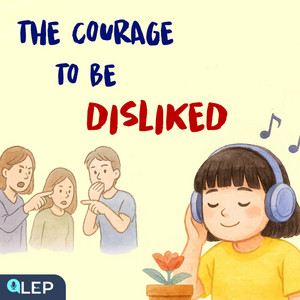
It's a common struggle, but it brings us to today's topic — the courage to be disliked.
It is inspired by the book by Ichiro Kishimi and Fumitake Koga, which is based on Alfred Adler's philosophy.
Sounds interesting.
Let's dive deeper into the topic.
Where does unhappiness come from?
Adler believed that all psychological issues, like anxiety, depression, even anger, stem from relationships.
He said our past doesn't determine who we are.
Instead, we act based on goals we're trying to achieve in the present.
Wait, wait, so he's saying we don't behave the way we do because of past but because of what we want now.
Like, I used to say I was bad at math because I failed in school, but according to Adler maybe I was just using that as an excuse not to try anymore.
Exactly. That's called teleology.
The idea that we move toward purposes not away from causes.
So your fear of math isn't about your grades.
It's about avoiding failure today.
Oh, and I thought I had a legit excuse all these years.
Guess I'm a goal -driven math And that's okay because Adler's real message is this, you are not a victim of your past. You are free to choose your actions right now.
Oh, this hits hard. When we started this podcast, I used to think, who's going to care what I say?
I'm just messing around while Gwen's over here quoting research papers.
Haha, you're giving me too much credit, but really that is exactly what imposter syndrome sounds like.
I don't deserve to be here.
According to Adler, those feelings come from comparison and disconnection from our true value.
So instead of building confidence, we're just collecting reasons to stay small.
No wonder we feel like fakes.
And the worst part?
We try to fake it until we make it, so much we forget who we really are.
Right? We spend so long acting confident, we never stop to ask, what if I'm already enough?
Exactly. Adler says we don't need to earn value.
We already have it.
Being imperfect doesn't make us unworthy.
It just makes us human.
Adler said we are all born small, weak, and dependent on others, so we grow up believing we need approval to survive.
That turns into a lifelong pattern.
If I please others, I'll be safe and accepted.
Okay, confession time.
In high school, I wore fake glasses for a year just to look smarter.
Every time I took them off, people were like, wait, you look weird. So I kept them on, Until I walked into a tree because I couldn't see properly." Oh, Leo.
That's literally Adler's idea of inferiority and overcompensation.
We try to cover up our insecurities instead of accepting them.
…And the more we rely on other people's opinions, the more we feel like we're never enough.
I have a friend who became a doctor.
Only because his parents wanted it.
Now he says he feels like a robot every day.
No passion. No meaning.
That's the danger of living by someone else's script.
Adler talks about life's three tasks, work, friendship, and love.
Happiness comes from freely choosing how we engage with all three.
I think I'm slowly figuring it out.
This podcast, it's my way of connecting, of feeling like I matter again.
Me too, Leo. And if even one person listening today starts to see their worth in a new way.
That's already more than enough.
So, Leo, let's talk about something we all deal with, relationships.
According to Adler, we usually have two core motivations in social interactions.
Either we seek approval from others or we try to make a contribution And that difference is huge.
I used to always seek approval, you know, trying to say the right thing, do what people expected of me.
It felt like I was constantly performing.
Same here, but when we only chase approval, we end up unhappy because we're living for someone else's expectations, not our own values.
For sure. It's like living in a house where everyone else holds the key.
Right? Like, if someone's upset with your decision, that's their emotional task, not yours.
Totally. I used to feel responsible for how other people felt about me.
If someone was disappointed, I took it personally.
But now, I ask myself, is this my task to fix or theirs to deal with?
That mindset really helps free us, because when we interfere with other people's tasks, we're actually stealing their growth.
And that's how toxic relationships often begin.
Speaking of which, I was in a relationship where I kept trying to please the other person.
I thought if I did everything right, they'd stay happy.
But I ended up losing myself.
I've been there too.
Adler calls this the win -lose mindset.
it. When both people try to control or change each other, it becomes a power game.
No one wins. And we stop living in the present.
We often replay past fights in our head, or worry about how the other person might react next time.
That's why Adler emphasizes living in the here and now.
We're not defined by the past. We have the power to choose our response in this moment.
And that includes letting go of the silent expectations we place on others.
Like, if If I do this for you, you should respond like this.
Yes. And when they don't, we feel hurt even though we never said it out loud.
That hidden need for validation leads to disappointment.
Hmm. You know what really flipped the script for me, Gwen?
I used to think the goal was to be liked.
Now I realize, it's way more freeing to just be...helpful.
Wow, that's a total switch from chasing applause to making a difference.
Sounds like you had your own little inner revolution, huh?
Get started today at linkedin .com slash results.
Terms and conditions apply.
Hi, I'm Raj Panjabi from HuffPost. And I'm Noah Michaelson, also from HuffPost. And we're the host of Am I Doing It Wrong, a new podcast that explores that all too human anxieties we have about trying to get our lives right.
Each week on the podcast, Raj and I pick a new topic that we wanna understand better and bring a guest expert on to talk us through how to get it right.
And we're talking like legit credible experts.
doctors, PhD's, all around superheroes.
From Hukpost and ACAST Studios, check out Am I Doing It Wrong wherever you get your podcasts.
Oh yeah, back when we launched LEP, I'd refresh our listener stats every five minutes.
I was like a human F5 button with anxiety issues.
I remember you once said, do I sound weird?
Like, maybe my voice reminds people of a broken carrot.
Hey, I was being vulnerably poetic, but seriously, it was exhausting.
Then I came across this research by Dr. Jennifer Crocker.
She found that when we focus on contribution instead of validation we become less anxious and more connected.
That makes total sense.
If we stop counting likes and start counting the lives we touch, life just gets lighter.
One hundred percent.
Now, every time we a new episode, I ask myself, will this help someone?
That question literally rewired my brain.
Suddenly, it wasn't about proving anything anymore.
Adler would totally high -five you for that.
He believed most problems are relational.
Stop competing. Start contributing.
It's like switching from playing a fighting game to a co -op adventure.
We don't need to win over others.
We just need to win with each other.
Which brings us to a challenge for our listeners, the Seven Day Live Your Values challenge.
Each day, choose one of your core values—honesty, kindness, creativity—and try to live it out in small ways.
I did this last month.
I listed five values—honesty, creativity, curiosity, kindness, and growth.
One day, I chose kindness, and bought my friend bubble tea without stealing a single sip, even though it was 98 degrees Fahrenheit and I was melting like a sad popsicle.
It's in those little choices where we feel most like ourselves.
If you're not sure what your core values are, ask, When do I feel most alive?
Your answer's usually pointing right at them.
And remember that you are not your resume.
You matter just because you exist, not because you've accomplished X or earned Y.
That hits deep. I used to spend three hours editing out every single ummmmm in our episodes.
I thought if I wasn't perfect, people wouldn't take me seriously.
That's so real, but perfectionism is Joy's worst enemy.
We can still be valuable, even with flaws.
Especially today, when social media makes it way too easy to tie our worth to likes, followers, or some ideal version of ourselves.
But here's the truth.
Your worth doesn't need to be proven.
It just is. And when we connect to that, we start living authentically.
Even if others don't approve.
Even if we mess up.
And if you've made it this far into this episode, I promise, you're already on that path.
So whether you're on a bus, in your room, or wrapped in a blanket like an anxious burrito...
Just remember that you don't need to be someone else.
Yeah, you can contribute, even while still figuring things out.
All right Gwen, before we wrap things up, how about we pick some keywords from today's episode?
Totally! It'll help everyone understand the ideas better!
Let's break down five words.
First up is approval.
It means when someone accepts or agrees with what you do.
Like when I finally cleaned my desk and you said, Good job!
That was approval, right?
Yes, Leo. For example, she always tries to get her parents approval by studying hard. Second word is value.
It means something important or meaningful to you.
Like honesty, kindness, or even bubble tea.
Okay? Maybe not bubble tea.
For example, kindness is an important value in her life.
Next, contribution.
That's something helpful you give to others.
Your time, ideas, or support.
Like when I bring snacks to the studio, that's a contribution, right?
For example, his ideas were a big contribution to the team project.
Fourth word is expectation.
It means what people think will happen or what they want you to do.
Like when people expect you to be perfect all the time, but surprise!
We're human. For example, she didn't meet her teachers' expectations this time.
And last one, imperfect.
It means not perfect.
And guess what? That's totally okay.
Honestly, that word is kind of beautiful because we all are.
For example, his speech was imperfect but it was honest and powerful.
OK. Before we go, we've got a couple of questions for you to think about.
Yup. And we'll answer them too.
What's one thing you've done just to get someone else's approval, even if it didn't make you happy?
In high school, I joined a science club just because my dad thought it…sounded smart.
I didn't enjoy it at all.
I once said yes to leading a team project even though I was already exhausted.
I just didn't want people to think I was lazy… What is one value you want to live by more starting this week?
For me? Honesty. Even if it's hard, I want to speak more honestly in every situation.
I'd say kindness. Not just to others, but to myself.
Like, not beating myself up when I mess up.
Now it's your turn.
What's one value you want to live out this week?
Drop your answer in the comments or say it out loud to yourself.
Either way, you're taking the first step.
So, what is the secret of true happiness?
It's about having the courage to be disliked.
To live your truth even when it's uncomfortable.
To stop chasing approval and start creating meaning.
And weirdly enough, that's when real connection starts.
Not when we impress, but when we show up as we are.
So go out there, live your values, be brave enough to be real.
And if someone doesn't like it, that's their problem.
That's the courage to be disliked.
Thanks for hanging out with us today.
If you love this episode, share it with a friend who might need a little courage boost. And if you didn't love it, that's okay, too.
But we'll be very happy if you like it.
See you next time. on the podcast, Raja and I pick a new topic that we want to understand better and bring a guest expert on to talk us through how to get it right.
And we're talking like legit, credible experts.
Doctors, PhDs, all around superheros.
From Huck Post and ACAST Studios, check out Am I Doing It Wrong, wherever you get your podcasts.
This podcast is brought to you by Aura.
Imagine waking up to find your bank account drained, bills for loans you never took out, a warrant for your arrest, all because someone stole your identity.
Hackers aren't waiting.
Why are you? That's why we're thrilled to partner with Aura.
Your personal data is a goldmine for hackers, and Aura helps lock it down.
Aura monitors the Dark Web, blocks data brokers from selling your information, includes a VPN for private browsing, and a password manager to secure your accounts before criminals break in.
For a limited time, Aura is offering our listeners a 14 -day free trial plus a Dark Web scan to check if your personal information has been leaked, all for free at aura .com slash safety.
That's AURA .com slash safety to sign up and start protecting yourself and your loved ones.
That's A -U -R -A dot com slash safety.
Terms apply. Check the site for details.
ACAS powers the world's best podcasts.
Here's a show that we recommend.
Hey, folks. It's Mark Marron from WTF.
It's been more than 15 years now and I'm still talking to all kinds of people in my garage every week sometimes it's Bill Burr sometimes it's Ariana Grande.
She just looks at me because she's always going like dad it's not that big a deal yeah i go sorry I lost my temper.
I go i still love you you know daddy has issues.
Are you afraid of it?
Of death? Well I don't I think about it all the time.
How are we here already?
Listen to WTF with Mark Maron twice a week on your favorite podcast app or get more WTF with a WTF Plus subscription.
Just go to WTFPOD .com and click Click on WTF Plus.