Chapter 10 The Call of the Wild.
One night Buck woke up suddenly and sniffed the air, his hair bristling.
From the forest came a call that was different than before.
It was a long, drawn-out howl.
He sprang through the camp where everyone was still asleep and ran through the woods.
As he moved closer to the cry.
He went slowly and carefully until he came to an open place among the trees.
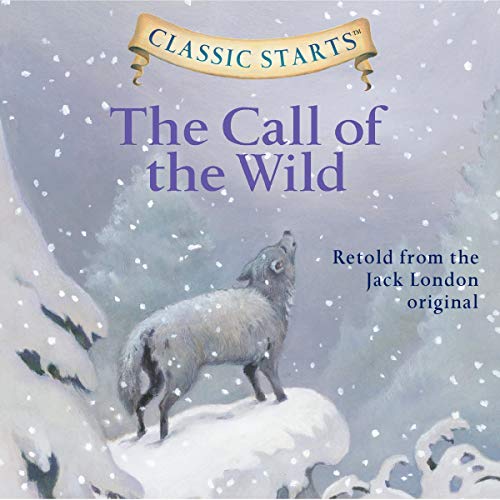
There, Buck saw a long, lean timber wolf sitting on its hind legs with its nose pointed to the sky.
Buck made no noise, but the wolf stopped howling and looked around.
Buck walked into the open half-crouching his body poised and ready to jump pale, straight and stiff.
Buck wanted to show that he could be friendly, but the wolf ran away.
Buck followed and easily caught up to him.
The wolf whirled around, ready to fight.
Buck did not attack.
Instead, he circled around the wolf and tried to show that he was friendly.
The wolf was suspicious and afraid.
Buck was at least three times larger than the wolf, and the wolf's head barely reached Buck's shoulder.
When he saw a chance, the wolf ran away, and Buck chased him again.
Buck always caught up to him, and he ran again until he was tired.
In the end, Buck got what he wanted.
The wolf, finding that he was not in danger, finally sniffed noses with him.
They became friendly and played with each other in a nervous, shy way.
After some time, the wolf started off at an easy run.
He wanted Buck to come along and they ran side by side through the night into the And Buck was happy.
He knew he was finally answering the call, running next to his friend who was like a brother to him.
They stopped by a stream to drink, and then Buck remembered John Thornton.
He sat down.
The wolf started on and then returned to him, sniffing noses and trying to encourage Buck to keep going.
But Buck turned around and started slowly back.
For an hour, the wolf ran by his side, whining softly.
Then he sat down, pointed his nose upward, and howled.
It was a sad howl and as Buck kept going he heard it grow fainter until it was lost in the distance.
John Thornton was eating dinner when Buck ran into the camp and jumped on him, licking his face, biting his hand in a friendly way, while Thornton shook Buck back forth and called him names.
For two days and nights, Buck never left the camp, never let Thornton out of his sight.
He followed him everywhere, watched him while he ate, saw him into his blankets at night and out of them in the morning.
But after two days, Buck began to feel the strange call in the forest stronger than ever.
Buck's restlessness came back and he could not stop thinking about the wolf and their run through the forest.
Once again, he took to wandering in the woods, but the wolf was not there.
He began to go out at night, staying away from the camp for days at a time.
Once he crossed over the mountain and wandered for a week looking for the wolf, hunting and eating as he traveled.
He never seemed to get tired.
He fished for salmon in a stream, and he even won a fight against a large black bear.
It was a hard battle and it made Buck feel like a fighter again.
Two days later, he hunted wolverines and caught two of them.
He felt like the best hunter in the world, the strongest animal.
He was proud and it showed in the way he moved.
Except for the brown color on his nose and above his eyes and the white hair across his chest, he looked like a gigantic wolf, larger than the largest wolf in the world.
Buck's father was a St.
Bernard.
So Buck inherited his size and weight from him, while he had inherited his shape from his mother, who was a shepherd.
His nose was long like a wolf's, but it was larger than the nose on any wolf.
His head was shaped like a wolf's head, but it was three times larger.
He was as cunning as a wolf, and he was as smart as a shepherd and a Saint Bernard.
All this, plus the experience gained in the north, made him as strong as any animal that was in the wild.
He could respond to sights and sounds as fast as lightning.
As quick as a husky dog could leap, he could leap twice as fast.
He could see a movement or hear a sound and respond in less time than another dog needed just to see or hear something.
His muscles were powerful and they snapped like steel springs.
There has never been such a dog, said John Thornton one day as he and his partners watched Buck marching out of the camp.
After he was made, the mold was broke, said Pete.
By dingo, I think so myself, Hans agreed.
They saw him marching out of the camp, but they did not see what changed as soon as he was hidden in the forest.
He stopped marching.
He became a thing of the wild, creeping softly.
He knew how to hide, to crawl on his belly like a snake and, like a snake, to leap and to strike.
He could catch birds in their nests, rabbits as they slept, or squirrels in the air as they jumped.
Fish were not fast enough to escape him.
Sometimes he enjoyed sneaking up on squirrels, and when he almost had them, he would let them go and watch them run away in fear to the treetops.
As the fall came on, more and more moose appeared, moving slowly down the valley.
Buck had already hunted a small one, but he wanted a larger and more difficult animal to catch, and he found it one day near the creek.
Twenty moose were traveling there, and their leader was a great bull moose with a mean temper.
He stood over six feet tall, and his antlers were seven feet from tip to tip.
His small eyes burned, and he roared with fury when he saw Buck.
Buck hunted and chased the moose for days, and while he did this, he felt a change happening in the land.
Other kinds of life were coming in.
He could feel it in the air.
He did not see or hear anything special, but he knew that the land was somehow different, that strange things were wandering there.
He decided to give up hunting the moose and investigate.
He started back to the camp and to John Thornton.
He broke into a run and went on hour after hour, never losing his way, heading straight home.
While Buck ran, he became more and more aware of something new.
There was something alive in him, different from what was there in the summer.
The birds talked about it, the squirrels chatted about it, and he could smell it in the wind.
Several times he stopped and sniffed the air in the morning, as if reading a message, and it made him run even faster.
He felt that something bad was happening or that it had already happened, and as he dropped down into the valley toward the camp, he moved slowly.
Three miles away, Buck found a new trail that made his neck hair bristle.
It led straight toward the camp and John Thornton.
Buck hurried on swiftly and silently, every nerve alert to what he sensed.
All the animals in the forest were quietly hiding.
He followed a new scent into a bush.
From the camp came the faint sound of many voices, rising and falling in a sing-song chant.
Creeping closer, Buck looked to where the cabin should have been and saw something that made the hair on his neck and shoulders stand up.
A tribe of natives known as Ehats were dancing around the cabin, which had been burned down.
Thornton and his partners had set up camp in the natives' territory without knowing that they would be seen as invaders.
The Yehats had attacked and won the fight easily.
They were celebrating their victory when they heard a roar and saw an animal rush at them that they had never seen before.
It was Buck, hurling himself at them like a hurricane.
He chased and hunted them, and it was impossible to fight him off.
He was moving too fast, and he was terribly angry.
The Yeehawts panicked and ran into the woods, calling Buck an evil spirit, and Buck felt evil as he chased after them.
After some time, Buck returned to the camp, which had been destroyed.
The men and the dogs were gone.
Buck could smell the place where Thornton had fought and lost.
All day Buck roamed around the camp, but he did not know what he should do.
He only knew that John Thornton was gone.
It left an empty space in him that was like hunger, but it ached and ached and he knew that food could not fill it up.
Sometimes he felt proud that he had been able to chase away the men who had invaded the camp.
He had hunted men and he realized they had been easier than the other animals he had hunted.
Men were only dangerous when they held weapons.
From then on, he would never be afraid of men again unless they held ropes, arrows, or guns.
At night, a full moon rose high over the trees while Buck lay sadly near the water.
He sensed something else moving in the forest.
He stood up, listening and sniffing the air.
Far away, there came a faint yelp, followed by several more yelps.
They grew closer and louder.
It was another call, and this time Buck was ready to follow it.
John Thornton was gone.
Buck had no more connections to the world of men.
A pack of wolves entered the clearing, and in the center of it waiting for them stood Buck.
They were amazed.
He was so large that they stood still for a moment and stared at him.
Then the bravest one of them leaped straight at Buck.
Like a flash, Buck fought back.
More and more of them tried to attack him, and he fought all of them off.
He did so well that after half an hour the wolves retreated.
They were tired and hurt.
Some were lying down, others stood watching Buck, and others were drinking from the water.
One wolf, long and lean and gray, approached cautiously, in a friendly way, and Buck recognized him as the one he had met before.
He was whining softly, and as Buck whined, they touched noses.
Then an old wolf, thin and battle-scarred, came forward.
Buck also sniffed noses with him.
Then the old wolf sat down, pointed his nose at the moon, and let out a long wolf howl.
The others sat down and howled, and now the call came to Buck, too.
He sat down and howled with them.
After that, the pack crowded around him, sniffing in a half-friendly, half-savage way.
The leaders carried the youngest ones and ran away into the woods.
The wolves followed, yelping together, and Buck ran with them, side by side with his wild friend yelping as he ran.
And here may well end the story of Bop.
The dog who had once loved nothing more than to lie in the sun in Judge Miller's big house in the lush Santa Clara Valley was now long gone.
But in the years afterward, the Yeehawts noticed a change in the wolves.
Some now had splashes of brown on their head and nose or had a white patch along their chest.
The Yihats also tell stories of a ghost dog that runs at the head of the pack.
They are afraid of this ghost dog because it is smarter than any animal or man and can steal from their camps, rob their traps and escape their best hunters.
Each fall, as the Yihats move through their territory, there is a valley that they never enter, and they tell sad stories of how an evil spirit came one year and chose to live in that valley.
In the summers, there is one animal that travels out of that valley.
It is a great wolf that is larger than any other.
He crosses through the forest and comes down into an open space among the trees.
Here, yellow dust and rocks lie on the ground around old, broken sacks with long grass growing around them and hiding them.
Here the great wolf thinks and mourns for a while, howling once long and sad.
Then he leaves.
But he is not always alone.
When the long winter nights come and the wolves follow their prey into the valleys, he can sometimes be seen running at the head of the pack through the moonlight leaping above the other wolves, his great throat howling as he sings the song.