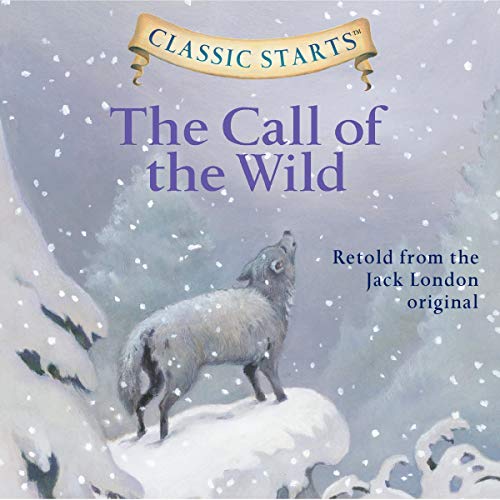
Chapter 2.
Snow.
As the days went by, other dogs came in crates at the end of ropes, some quietly and some barking and growling as he had come, and one and all he watched them accept the rule of the man in the red sweater.
Now and again other men strangers, came at the place where Buck and the other dogs were being held.
They talked excitedly to the man in the red sweater and asked him about different dogs, how strong they were and how much they cost.
Then the strangers took one or more of the dogs away with them.
Buck wondered where they went, for they never came back.
He felt scared, not knowing what happened to the dogs after they left, and he was glad each time when he was not sold.
Then, one day Buck was chosen by a small man named Perrault.
Perrault worked for the Canadian government.
His job was to deliver mail in the Arctic North and he knew the kind of dog he needed for the job and would pay well for it.
Perrault was excited when he saw Buck and he asked the man in the red sweater how much he would cost.
Three hundred and that's a special price for you Perrault, you being a good customer and all said.
The man in the red sweater.
Then, with a smile, he continued, I've been saving this one especially for you.
His name is Buck, and he's a fierce one, all right.
Just the kind of dog you need to get the job done.
Perrault grinned.
Considering that the price of dogs had gone up so much recently because of the gold rush, it was a fair price for such a fine dog.
With his long experience, Perrault knew dogs like an expert, and when he looked at Buck he could tell that he was one in a thousand.
Or maybe one in ten thousand. he said quietly.
Buck saw Perrault give the money to the man in the red sweater.
Then Buck and another dog named Curly, a good-natured Newfoundland, were led away by Perrault.
Curly and Buck left Seattle on a ship called the Narwhal.
They were taken below by Perrault and given to a large man named Francois.
These men were new to Buck, and even though he did not like them, he was able to respect them.
He learned that Perrault and Francois were fair and calm and that both men knew a great deal about how to handle dogs.
Between decks on the narwhal, Buck and Curly met two other dogs.
One of them was a big, snow-white dog.
He seemed friendly, but he had a way of smiling.
That meant he was really thinking up some mean trick.
Once, he even stole from Buck's food.
As Buck chased him, Francois got the food away from the dog first and gave it back to Buck.
The other dog Buck and Curly met wanted to be left alone.
Dave was his name and he just ate and slept or yawned between times and took an interest in nothing, not even when the narwhal crossed rough waters and rolled from side to side.
When Buck and Curly got excited and scared, Dave only raised his head.
He looked like he was annoyed.
He glanced at Buck and Curly, yawned and went to sleep again.
Many days and nights passed, and Buck noticed the weather was growing colder each day.
One morning, the ship was quiet and all the dogs became excited.
They all knew a change was coming.
Francois put them all on leashes and brought them on deck.
At his first step on the cold ground, Buck's feet sank into white, mushy stuff, very much like mud.
He jumped back with a snort.
More of this white stuff was falling through the air.
He shook himself, but more of it fell on him.
He sniffed it curiously. then lick some up on his tongue.
It burned his tongue a little bit, and in the next instant it was gone.
This puzzled him.
He tried it again with the same results.
The other dogs and people who watched this laughed at him and he felt embarrassed, but he did not know why.
It was the first time he had ever seen snow.
The snow was not all that Buck had to master.
Buck's first day on Daya Beach was a nightmare.
There was a new shock and surprise every hour.
He felt like he had been taken from a civilized society and thrown into a primitive world.
Here there was no sun-filled, lazy life like the one he had at Judge Miller's place, with nothing to do but loaf around and be bored.
Here there was no peace, no rest, not a moment's safety.
All around him was confusion and action, and at every moment there was danger.
He had to be alert all the time.
These dogs and men were not like the ones he had known in the past.
These were dangerous, and the only law they knew was the law of rope and faying.
He had never seen dogs fight like this, and his first experience taught him an unforgettable lesson.
While they were camped near the log store, Curly, in her friendly way, approached a husky dog.
He was the size of a full-grown wolf, but not half as large as she.
Without warning, the husky jumped and knocked her down.
It was the wolf's style of fighting to jump in, strike and jump away— but there was more to it than this.
Thirty or forty huskies ran to the spot and surrounded the two dogs in a silent, threatening circle.
Buck did not understand why.
Curly tried to fight the other dog, but he knocked her down again.
Then the other dogs closed in around her.
They were barking, biting, and scaring her.
This happened so suddenly and was so unexpected that Buck did not know what to do.
He saw a dog named Spitz stick his tongue out in the strange way he had of laughing.
Buck also saw Francois swinging a stick and running into the group of dogs to chase them away.
Three other men were helping him to scatter them.
It did not take long, but Curly was hurt, and Francois took her away.
It had not been fair, Buck thought.
So, that was the way of these dogs, was it?
Once down, they were all over you?
Well, he would see to it that he never went down.
Spitz stuck his tongue out and laughed again, and from that moment Buck disliked him more than any dog or man he had ever met.
Before he had recovered from the shock of seeing what had happened to Curly, Buck received another shock.
Francois attached an arrangement of straps and buckles to him.
It was a harness like the ones he had seen people put on the horses at home.
In the same way he had seen the horses work, so was Buck put to work, hauling Francois on a sled to the forest that was at the edge of the valley and returning with a load of firewood.
Buck did not like the work, but he was too wise to fight back.
He buckled down with all his strength and did his best, even though it was all new and strange.
Francois was stern with the dogs, and Spitz was their leader.
He and Dave were the most experienced dogs and they taught Buck by snapping and barking at him when he made mistakes.
Buck learned quickly from the two dogs and Francois.
Before they returned to camp, Buck knew to stop at Ho, to go ahead at Mush, to swing wide on the bends and to keep clear of the other dogs when the loaded sled shot downhill at their heels.
Three very good dogs, Francois told Perrault.
That Buck, he pulls like mad.
I'll be able to teach him quick as anything.
By afternoon Perrault, who was in a hurry to be on the trail with his mail delivery, returned with two more dogs, Billy and Joe.
He called them two brothers and both true huskies.
Even though they had the same mother, the brothers were as different as night and day.
Billy was good-natured, while Joe was the opposite, sour and brooding, with a constant snarl and a mean look.
Buck welcomed them.
Dave ignored them.
And Spitz bullied them.
Billy wagged his tail at first and then ran away when he saw that Spitz was mean.
But no matter how Spitz tried, Joe stood face to face with him, even though he was terrified.
Joe's mane bristled, his ears laid back, and he was snarling.
He looked so mean and scared that Spitz finally gave up.
But to make up for it, he continued to chase Billy.
By evening, Perrault added another dog to the group.
This one was an old husky, long and lean and gaunt, with a battle-scarred face and a single eye.
He was called Solex, which means the angry one.
Like Dave, he asked nothing, gave nothing, and expected nothing.
And when he marched slowly into their group, even Spitz left him alone.
He had one habit that Buck was unlucky enough to discover.
Solex did not like to be approached on his blind side.
Buck did this by mistake, and Solex whirled and barked at him.
Forever afterward, Buck avoided his blind side and never had any trouble with him again.
It seemed as if his only ambition, like Dave's, was to be left alone.