Ah!
If you ask me to point to a high watermark in the golden age of Hollywood, a single scene that encapsulates all the elegance that the old studio system was capable of, I might point to this scene in The Philadelphia Story from 1940, one of my favorite and one of the very best romantic comedies ever made.
In these seven and a half minutes, in these 17 shots, a group of artists, all at the top of their respective games, came together to produce magic in black and white.
The movie tells the story of Tracy Lord, an uptight Philadelphian socialite whose wedding is complicated by the arrival of her ex-husband, and a tabloid journalist.
Various hijinks ensue that ultimately forced Tracy to confront her past and reevaluate her relationships.
Just as important as the characters are the actors who played them Katharine Hepburn, Cary Grant and Jimmy Stewart the dreamiest of dream teams.
It was a comeback role for Hepburn, one she architected for herself.
At the end of the 1930s, she was dubbed box office poison after a number of flops.
So she left Hollywood for Broadway, where Philip Barry, a popular playwright, developed the original stage version of the Philadelphia story for her.
It was a massive hit, running for over 400 shows.
Hepburn's on-off boyfriend at the time, the business magnate Howard Hughes, bought and then gifted her the film rights to the play, which she then sold to MGM's Louis B Mayer at a discount in return for the power to choose the director, screenwriter and co-stars.
Besides being a great play, the Philadelphia story had a meta purpose for Hepburn.
She knew that audiences felt that she was too haughty, too cold, too smart, too dominant.
In other words, not sufficiently feminine by the warp standards of the time.
So she crafted a role in which she would be taken down a peg.
Because you'll never be a first-class human being or a first-class woman until you've learned to have some regard for human frailty.
But your sense of inner divinity wouldn't allow that.
This goddess must and shall remain intact.
You have everything it takes to make a lovely woman, except the one essential an understanding heart.
And without that, you might just as well be made of bronze.
And she is taken down a peg.
In scene after scene after scene, the character of Tracy Lord is criticized for exactly these qualities, to the point that we can't help but sympathize with her, as well as the actress who plays her.
It's a shame that Hepburn even had to be humbled in this way, but as an act of public relations it was masterful and it worked.
Hepburn took control of her career and gave it new life.
Which brings me back to this scene.
It takes place after these humiliations and scoldings, after Tracy drowns her sorrows with lots of champagne.
It's around 4 am on the morning of her wedding and she's with Mike Connor, the tabloid journalist played by Jimmy Stewart, who's taken a shine to her.
They're out on the terrace of Tracy's mansion and they're both heavily intoxicated.
This opening shot is already perfect.
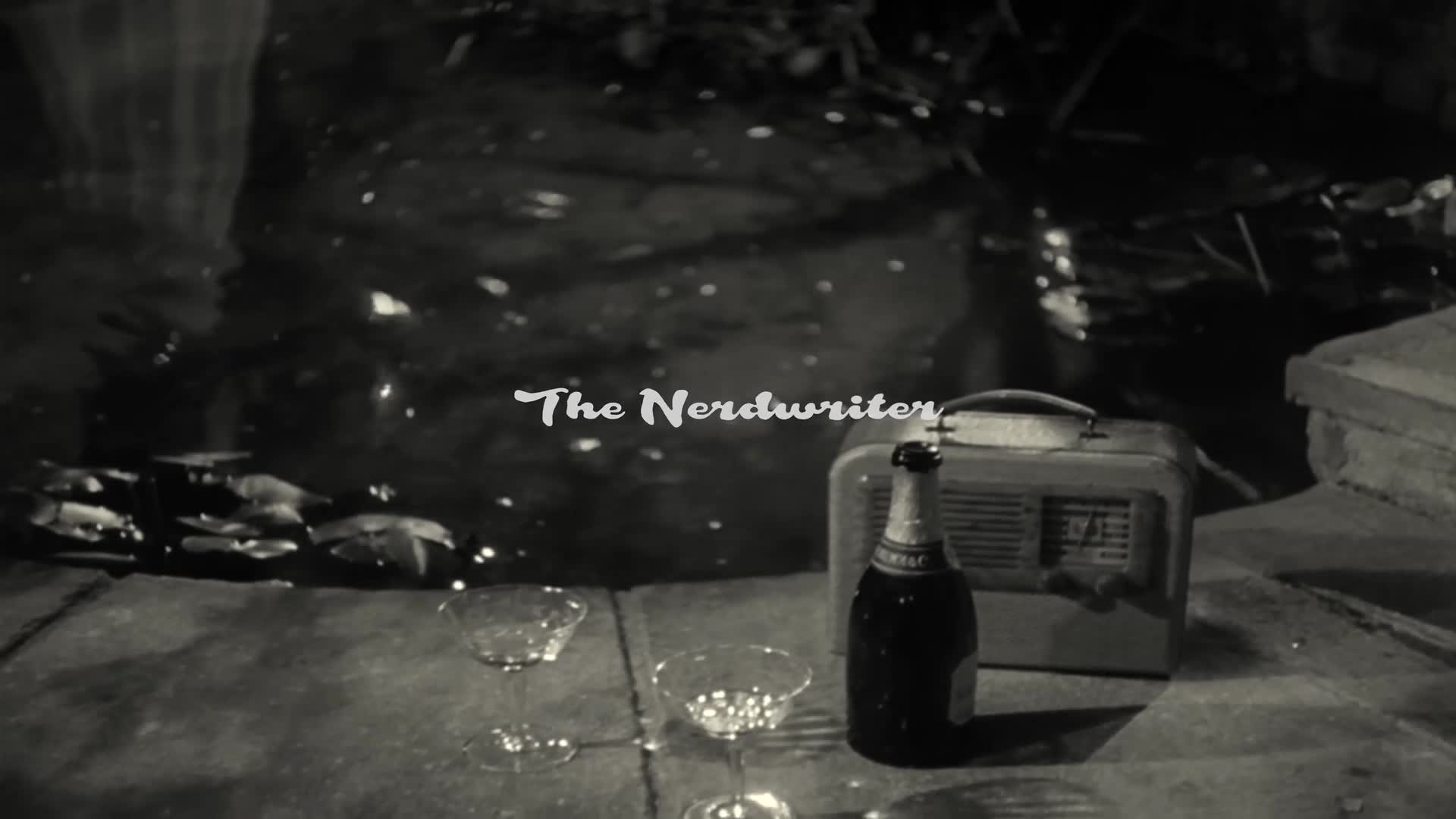
Starting with an insert of champagne glasses and a radio.
The camera tilts up to the dancing couple, then slowly dollies back a gentle glide that doesn't call attention to itself.
Now, that was the MO of director George Cukor and his cinematographer Joseph Ruttenberg.
Do what serves the story and the performances.
The insert gives you relevant information and the camera movement accentuates the dreaminess of the moment.
You can also see here the great work of art director Cedric Gibbons, who created and defined the lush, glamorous aesthetic of MGM movies in the Golden Age.
He won 11 Oscars for his work, and he also designed the Oscar statuette, which is crazy.
Here he creates the outdoors on a soundstage, a stately tree-covered terrace and the illusion of countryside in the deep background.
Ruttenberg, who won four Oscars himself, takes Gibbons' set and lights it in a way that actually looks and feels like night.
Ruttenberg was a master of dramatic lighting.
As his New York Times obituary says, he had a knack for making black-and-white photography seem almost three-dimensional.
Part of that is down to his affinity for shallow depth of field, which you can see here.
This also serves the story.
These two are drunk, absorbed in each other, to the exclusion of the outside world.
So Ruttenberg isolates them on their own plane of focus.
It's also a good opportunity to talk about the work of Adrian Greenberg, known simply as Adrian, a legendary costume designer for MGM, whose most famous work was probably on The Wizard of Oz.
Adrienne designed the perfect dress for Hepburn in this scene.
It gives her that look of a statue, what all the men in her life accuse her of being.
But in this two-shot, with the help of Ruttenberg's lighting, the dress glitters and flashes, heightening that sense of intoxication but also suggesting that there's something more to Tracy than cold, motionless marble.
And that's what this scene is really about, Tracy gradually letting her guard down.
Finally, this is where the writing really comes into play, with Donald Ogden Stewart retaining much of Philip Barry's excellent dialogue from the play.
The prettiest sight in this fine, pretty world is the privileged class enjoying its privilege.
This is a comedy of very witty people and, as Cukor said, their conversations are a kind of art in themselves.
But wit, as we know, can be a shield, and the real genius of the writing in this scene is how the witty, drunken banter gradually yields to vulnerability and sincerity.
You can't marry that guy.
George, I'm going to.
Why not?
Well, I don't know.
I followed before it at first, but you just don't seem to match up.
Then they're false with me.
Well, maybe so, but all the same, now, you can't do it.
No?
No.
Come around about noon tomorrow.
I mean today.
This is when Tracy accuses Mike of being a snob for unfairly judging her fiance, for a lack of tolerance and generosity.
Cukor's camera pulls back to put some distance between them.
Then you'll see in a few seconds he pushes forward again, as Tracy levels at Mike the same criticism her ex-husband leveled at her, realizing at last it's validity.
Your intolerance infuriates me.
I should think that of all people, a writer would need tolerance.
The fact is, you'll never, you can't be a first-rate writer or a first-rate human being until you've learned to have some small regard for human friends.
The heart of this scene.
What everything else is working to support is, of course, the performances.
And they are magnificent.
Hepburn, who knows this role inside and out, moves through a dozen registers of emotion with unbelievable finesse.
It's actually mesmerizing to watch.
What do you want?
You're wonderful.
It's almost a shame that, of the two actors in this scene, it was only Jimmy Stewart who walked away with the Oscar, though he earns it in the climax.
The only part, by the way, where Cukor uses close-ups.
The magnificence that comes out of your eyes and your voice, and the way you stand there and the way you walk.
You're lit from within, Tracy.
You've got fires banked down in you.
Hearth fires and holocausts.
I don't seem to be made of bronze.
No, you're made out of flesh and blood.
That's the blank.
Unholy surprise.
We're used to thinking about movies as the vision of one person an auteur, director but the studio system of Hollywood's golden age didn't really work like that.
As talented as Cukor was.
There's really no auteur here, but rather a collection of top-tier artists and craftsmen coming together to realize a great story and to elevate great performances.
The system, which in many ways function like a factory, produced a lot of mediocre movies.
But when the stars aligned as they did on the Philadelphia story, they were capable of producing magic too.
A kind of magic that is unique to its time, but timeless in its beauty.
It's not part of the pool.
It's just over the lawn and in the birch grove.
It'll be lovely now.
Put me in your pocket.
Hey, everybody.
Happy holidays, and thank you so much for watching.
This episode was brought to you by Squarespace, the all-in-one website platform for entrepreneurs to stand out and succeed online.
Whether you're just starting out or managing a growing brand, Squarespace makes it easy to create a beautiful website.
And now you can make a completely personalized website with design intelligence, combining two decades of industry-leading design expertise with cutting-edge AI technology to unlock your strongest creative potential.
And if you're selling something, Squarespace Payments makes that easy too.
It's compatible with popular payment methods like Klarna ACH, Direct Debit, Apple Pay, Afterpay and Clearpay.
Basically, a Squarespace site looks and feels professional, something that will impress all your customers and fans.
Head over to squarespacecom for a free trial and when you're ready to launch that site, go to squarespacecom.
Slash nerdwriter for 10 off your first purchase.
Thank you so much for an amazing year, and I'll see you guys in 2025.