Hi, Rebecca Shear here. Before we get to our story, exciting news.
Circle Round is going back on tour. with live recordings across the united states our first stop Sunday, October 5th in Parker, Colorado at the Pace Center.
And Circle Round Club members are invited to a special post-show meet and greet with me and composer Eric Shimalonis.
Get your tickets at wbur.org slash circle around and click on events.
We're announcing more tour stops soon, so stay tuned.
We look forward to circling around with you live.
Have you ever been teased about something?
We've all been there, and we all know that being made fun of is no fun at all.
In today's story, we'll meet a prince who learned that lesson the hard way. thanks to the wind, some fairies, and a very humble barber.
. . . I'm Rebecca Shear, and welcome to Circle Round, where storytime happens all the time.
Today, our story is called The Barber's Secret.
You can find versions of this folktale in many countries, from India to Korea to Ireland.
Some really great people came together to bring you this tale, including Noah Schnapp.
A terrific young actor some of you grown-ups may have seen on the Netflix series Stranger Things.
So circle around everyone for The Barber's Secret.
The Barber's Secret Once upon a time, there lived a king and queen.
The king and queen were deeply unhappy because they wanted a child, but were unable to have one.
Oh, my queen, a bouncing baby would be such a wonderful thing, and to have an heir to our throne.
Whatever will we do? I know not, my king.
Perhaps we can ask the fairies in the forest.
Maybe they'll know the answer. The king and queen left the palace and wandered deep, deep into the woods.
They walked past tall leafy trees and patches of wildflowers. past bushy-tailed squirrels and gracefully grazing deer.
At last, they reached the cave of the three fairies. the beautiful fairy, the intelligent fairy, and the wise fairy.
The king and queen got down on their knees and looked at the fairies with tears in their eyes.
Magical fairies. The king and I have been longing for a child of our own, but we cannot make it so.
Good fairies, please, tell us. Can you use your magic powers to help a desperate couple in need?
The fairies talked amongst themselves for a moment.
Then the beautiful fairy began to speak.
Your Royal Highnesses, we will give you a child, a son.
We will also give you three wishes. My wish is that your son is the most handsome in the land.
The king and queen smiled. A son, and the most good looking at that.
Next up was the intelligent fairy. My wish is that your son is the smartest of anyone in the kingdom.
The king and queen could hardly contain their delight.
Not only would their son be beautiful, he would be bright, too.
Finally, the wise fairy took her turn. She flapped her silvery wings and fluttered up to the king and queen, looking them straight in the eye.
And my wish... The fairy paused. The king and queen held their breath, excited for her to finish.
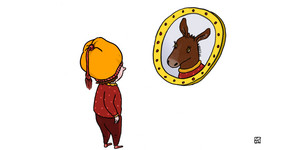
My wish is that your son has the ears of a donkey.
The king and queen's jaws dropped. Donkey ears?
Why would the wise fairy wish something so strange on their son?
But before they could ask any questions, there was a burst of light and all three fairies disappeared.
The king and queen were puzzled. But they were so happy to have a child on the way that they decided not to give the wise fairy's wish another thought.
Soon thereafter, the prince was born. And, just as the beautiful fairy and the intelligent fairy wished, He was a very handsome and smart little baby.
One day, when the prince was a toddler, he was playing chess with the king.
Looking at the boy, the king noticed something odd.
Not wanting to scare his son, he muttered under his breath.
Are those... donkey ears? Indeed. two small donkey ears had begun to sprout on either side of the prince's beautiful head.
The boy was so young, he didn't understand what was going on, so he wasn't bothered in the least.
But the king shuddered at the thought of showing the kingdom that his handsome, intelligent son had the ears of a donkey.
So he summoned everyone who worked at the palace. the butlers, the bakers, the gardeners, the tailors, and gathered them in the great hall.
Good sirs and ladies, as the king, today I issue the following decree.
From henceforth, the prince must always wear this hat.
The king's hand shot up into the air. In it, he clutched a red velvet cap sewn with extra space around the ears.
This hat must never, ever come off. Ever.
The prince must wear it, day and night, night and day.
Do you understand? The palace workers nodded, and the king dismissed them to their regular duties.
So, thanks to the king's decree, the handsome, intelligent prince began wearing the red velvet cap.
And as he grew from a toddler into a boy, he became even more handsome and intelligent.
He was constantly praised for his beautiful appearance and his razor-sharp mind, and he grew rather accustomed.
As a result, the prince became a vain young man, selfish and critical.
Soon, he was making fun of everyone around him.
Hey, you! Your jacket is torn. Don't you have time to pick up a needle and thread?
And you, that look on your face. Has anyone ever told you you look like a turtle popping out of its shell?
And so on and so forth. No one was good enough for the prince, it seemed.
In his mind, he was the only one without faults or flaws.
Now remember, the prince did not know about his donkey ears.
With each passing year, he wore his red velvet cap, and he never asked why.
Then, one day, the king decided it was time for his son's first haircut.
Someone find me the finest barber in the land.
The palace worker. tracked down a very gifted barber and brought him to the palace.
The barber carried all of his tools, his brushes, his combs, his razors, his scissors, in a little brown suitcase.
When the prince saw the barber, he noticed the little brown case was scratched and scuffed.
You're going to cut my hair using tools from that case?
Why, it's all scratched and scuffed. Definitely not fit for a prince as handsome and intelligent as I!
The barber shrugged. I am but a poor barber, your majesty.
I cannot afford to buy a new case. And besides, this one was given to me by my father.
He was a barber, too. It makes me happy to think of him using it long, long ago.
The prince rolled his eyes and sat down in front of the barber.
The barber draped a cape around the prince's shoulders.
He removed the prince's red velvet cap. He began to comb and clip the prince's long hair.
Then he stopped with a jolt, because underneath the boy's velvety locks, he saw two...
Donkey ears. Art. Are those? The king quickly rushed forward.
Hush, man. Just cut my son's hair. But those look like... They look like... I said, hush.
Remember. The prince had been wearing his red velvet cap since he was a tiny tot.
He had no idea what was hidden beneath, so naturally he was confused.
Papa, what is this man talking about? The king sighed.
It has long been a secret, my son. but you have the ears of a donkey.
Prince's hands sprang to his head. I do?
Yes, my dear boy. You are the most handsome and intelligent man in the land.
But you have donkey ears. The prince grabbed his red velvet cap from the barber and tugged it back over his head.
But Papa, if I'm to remain the most handsome and intelligent young man in the land, no one must know my secret.
The king swerved his head toward the barber.
He clenched his jaw. His eyes glowed as if on fire.
Now you listen, man, and listen good. If you tell anyone about what you've seen here today, if you tell anyone about my son's donkey ears, the prince's donkey ears.
I will banish you and your family from this kingdom.
Will you keep this secret? I... I will, your majesty.
I will keep this secret. Quickly, the barber put his tools back in the little brown suitcase As he hurried out of the palace, the king's words echoed in his mind.
If you tell anyone about what you've seen here today, I will banish you and your family from this kingdom.
The barber had a wife and three children.
They had nowhere to go if they were forced to leave the kingdom.
And yet, with a secret so big, how in the world would he keep it to himself?
We'll find out what the barber decides to do after a quick break.
Support for Circle Round comes from Indeed.
You just realized that your business needed to hire someone yesterday.
How can you find amazing candidates fast, easy, Just use Indeed.
There's no need to wait. You can speed up your hiring with Indeed. and Circle Round listeners will get a $75 sponsored job credit. to get your jobs more visibility at indeed.com slash circleround.
Just go to indeed.com slash circle round right now. by saying you heard about Indeed on this podcast.
Indeed.com slash circle round. Terms and conditions apply.
Hiring? Indeed is all you need. Thank you.
I'm Rebecca Shearer. Welcome back to Circle Round.
Today's story is called The Barber's Secret.
When we left off, the barber had sworn to keep the king's secret, that his son, the prince... had the ears of a donkey.
The king told the barber that if he shared the secret with anyone, The barber and his family would have to leave the kingdom.
For the next month, the barber didn't tell a soul.
Not his wife, not his three children, not any of the men and women whose hair he cut with the tools from his little brown suitcase.
But eventually, the barber could no longer bear it.
He had to tell someone his secret. He walked into the forest. the same forest the king and queen had entered before the prince was born.
He strolled past the same tall leafy trees and patches of wildflowers, past the children, of those bushy-tailed squirrels and gracefully grazing deer.
The barber stopped at a clearing in front of a cave.
Little did he know, it was the cave of the three magic fairies.
Stepping into the darkness, the barber touched the cool stone walls, took a deep breath, and hollered with all his might.
The prince has donkey ears. The prince has donkey ears.
Immediately, the barber felt better. He was so relieved to tell his secret to someone or... something, that he skipped all the way home, as if a weight had lifted from his shoulders.
But the barber departed so quickly that he didn't hear what happened next.
His words began to bounce around the cave. the echo growing louder and louder as it leapt among the cool stone walls.
The prince has donkey ears. The echo got so powerful that it jumped right out of the cave.
It flew through the forest and all through the kingdom.
The echo bounced off houses and schools. off cafes and shops, and with every bounce, people stopped what they were doing to listen.
As more and more people heard the echo, they began to wonder.
Was it true? Did their vain and conceited prince really have donkey ears?
Is that why he always wore that red velvet cap?
Soon, it was the prince who was being criticized.
After all those years making fun of other people, now he was the butt of everyone's jokes.
As he passed through the kingdom, he would hear, Hey, prince, my field needs planting.
Can you pull my plow? Hey, Prince, I have some extra oats and hay in the barn.
Want some dinner? Hey, Prince! Yaw! After a few months of this treatment, the prince decided enough was enough.
He gathered the people of the kingdom outside the palace.
Standing on the steps of the castle, He looked out at the throngs of men, women, and children.
He reached his hands up, and with one quick yank, he pulled off his red velvet cap The donkey ears immediately sprang up from either side of his handsome head.
The crowd gasped. My people, it's true.
I, your prince, have donkey ears. The crowd began to murmur.
I spent so long believing I was the most perfect young man in the kingdom.
I spent years believing you weren't good enough.
I criticized you, I made fun of you Every little flaw for every little fault went all this time.
The prince pointed to his ears. I have been hiding my own.
My people, my good, good people, I don't know if you can ever forgive me, but I offer you all of my deepest, most sincere apologies.
The prince hung his head, his donkey ears flopping down over his beautiful face.
I see now that being made fun of is no fun at all.
And with that, he began to cry. But as soon as the first tear streamed down his cheek and plopped onto the ground, Who should appear but the wise fairy, the one who wished the donkey ears on the prince in the first place?
Oh, little prince, now you see. If it weren't for those ears, you would have continued down the same road you were on.
Growing from a vain and critical boy into a vain and critical man.
You have learned your lesson, my prince.
You need donkey ears no more. There was a burst of light, and the wise fairy disappeared, as did the prince's donkey ears.
From then on, the prince was a good and compassionate man.
Instead of dishing out judgment and disapproval, he offered encouragement and assistance.
He even reached out to the barber and offered to buy a new case for his tools.
But the barber graciously declined. He really enjoyed using the same little brown suitcase that his father had. all those years ago.
The Prince was a new man, unrecognizable from the know-it-all youth he'd once been.
And whenever he heard someone criticizing others and making fun, he always would say the same thing.
Be careful my friend. You never know when you will get donkey ears.
Hmm. The prince in today's story did a lot of teasing before he realized he was hurting people's feelings.
After that, he showed more kindness. What are some things you can do to show kindness?
Think of at least three things and talk about them with a grown-up.
Then put them into action and spread more care and generosity out in the world.
We have a new story every week on Circle Round.
We don't want you to miss any. You can also visit our website.
WBUR.org slash circle round. Today's story, The Barber's Secret, was adapted by Jessica Alpert and me, Rebecca Shear.
Original music and sound design is by Eric Shimalonis.
Casting is by Amy Lippins, CSA, along with help from our executive producer, Jessica Alpert.
Circle Round's illustrator is Sabina Hahn.
Our intern is Chris Yulian. Special thanks to this week's actors.
Craig Wallace, Kimberly Schraff, Alexandra Templer, Anya Wielandsmith, Katasha Acosta, Tom Story, Ryan Haddad, Dolores King-Williams, and Noah Schnapp.
You can catch Noah Schnapp in Stranger Things on Netflix.
Season 2 comes out October 27th. Circle Round is a production of WBUR, Boston's NPR news station.
I'm Rebecca Shear. Thanks for circling around with us.