This message comes from U.S.
Bank.
Simplify how you do business with Business.
Essentials a powerful combination of no monthly maintenance fee checking and card payment processing.
Deposit products are offered by U.S.
Bank National Association, member FDIC.
This is the TED Radio Hour.
Each week, groundbreaking TED Talks.
Our job now is to dream big.
Delivered at TED conferences.
To bring about the future we want to see.
Around the world.
To understand who we are.
From those talks, we bring you speakers and ideas that will surprise you.
You just don't know what you're going to find.
Challenge you.
We truly have to ask ourselves, like, why is it noteworthy?
And even change you.
I literally feel like I'm a different person.
Yes.
Do you feel that way?
Ideas worth spreading.
From TED and NPR, I'm Manoush Zomorodi.
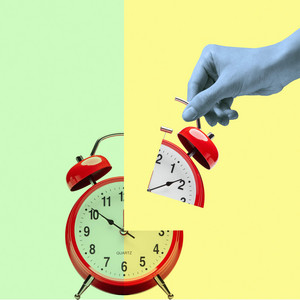
On the show today, how we shape our days.
So when you wake up in the middle of the night, do you look at the clock to know whether it's time to go back to sleep?
This is psychology professor Anne-Laura Selye.
When you wake up in the morning...
During the weekend, when you have the whole day for yourself, do you set an alarm clock?
Anna-Laure has a lot of these questions.
When you do your yoga in the morning, do you do yoga for a specific amount of time or do you do it as long as it feels good to do it?
And then after work, do you prefer to shop online or go to a brick-and-mortar store?
When you spend time with friends, do you decide when you meet and when you will leave them?
When you go to the beach, can you just sit and enjoy the view or do you check your watch?
And Laura says, depending on your answers, you might experience time one or two different ways and choose to use it in different ways, as events or by the clock.
So what are these styles?
Clock time people schedule out every moment of their day.
Anna waking up in the morning.
A classic clock timer prefers to stick to a schedule.
That dictates when she wakes up.
Ten minutes as she does every morning.
When she eats.
Then she proceeds to having breakfast for 20 minutes.
You get the idea.
Naturally.
On the flip side, an event timer moves from one activity to another when she wants to, when it feels like the right time to do so.
Now, of course, these are extremes.
Most people fall somewhere in the middle.
But as technology has advanced, as people and economies have become more interconnected, as work has become more regimented, there is an expectation that most of us live by the clock.
And you'd think that that would be a good thing.
Get us all coordinated, right?
We've been measuring time on a clock in increasingly granular units since thousands of years ago.
Think Stonehenge being the farther back we can go.
And now we measure time, we wear time on our wrists or on our phones.
Actually, we think we're reading time at least 150 times a day in our modern societies, if only because we are stuck to our phone screens.
I thought it was fascinating to think wait a minute.
In all this time and this reliance on the clock, no one has looked at what it does to us to keep looking at that thing.
That was my research question.
And my sense was it cannot be neutral.
When is relying on the clock optimal?
When is it suboptimal?
We mark our lives in hours, deadlines, and milestones.
But what actually moves us toward creating the life we want?
On the show today, rethinking how we shape our days.
Ideas about how we can stop chasing productivity and start asking what's worth our time.
For Anne-Laura Selye.
The unconscious ways we approach our everyday tasks says a lot about how we see the world.
So let's look at how adopting each of these scheduling styles affects how we feel about the world, how we think and how we behave.
Here she is on the TED stage.
So, focusing on clock timers, they slice time into quantifiable independent units that they use to fit their activities into.
And it's great to function like that because, the time units being independent, you can freely rearrange them over time, right?
So, for instance if, as a clock timer, I know that I take two hours to shop for groceries and two hours to shop for kids clothes, I can go to the supermarket in the morning and shop for kid clothes in the afternoon, or do the reverse.
And this arrangement of activities has provided a huge advantage to clock timers.
They can be flexible in scheduling and rescheduling activities as much as they want.
Now, it also comes with two implications, though.
Because the time units are independent, it means that they are not correlated, let alone causally related.
So my going to lunch with my friend does not cause me to go to the supermarket afterwards.
Right?
The second implication is that when you rely on the clock, you put control of your schedule outside of yourself.
And we know from psychology that when people do that, they tend to believe that things happen in the world as a result of fate, chance and powerful others more.
Now, if you look at even timers, we're looking at a very different animal events are interdependent, right?
They look more like a necklace.
If you need to move one of the events, you need to move a whole string of events with it.
Just like if you want to move a pearl, you need to move the other pearls with it, right?
And that means that it's likely to be associated with a bigger belief, a greater belief that things happen in the environment due to your own doing more.
Did this surprise you, any of the things that you found?
What surprised was the extent, the magnitude. of the effect.
That was remarkable.
The feeling of control, it's really important.
For instance, I went to an event of entrepreneurs in New York City and then I asked them to what extent do you think that your companies shape the world right?
And to what extent do you think that if you're successful, it's due to you versus chance?
And, sure enough, those entrepreneurs who relied on the clock more thought that their success was due to chance, more than those entrepreneurs who relied on event time.
So because of these differences in scheduling between clock timers and event timers, we found actually that clock timers recognize causality in the world at large significantly less than event timers.
Now, this is very important because it means that, since our event time ancestors were left behind and we increasingly relied on the clock to schedule our activities, we also began to perceive the world as a more and more disconnected place, a more and more random place, a more and more chaotic place.
Clock timers believe the world is more chaotic than even timers.
Now, if you think that's bad, there's actually worse.
We know that when people locate control externally rather than internally, it tends to make them feel less happy.
So we wondered, are clock timers less happy than event timers?
Well, if you think about it, event timers rely on their emotions.
Clock timers.
On the other hand, they don't need to be attuned to their emotions, because they surrender to the clock.
The problem is, psychologists now know that in order to be happy, we need to be attuned to our emotions.
And particularly, we need to be able to savor positive emotions.
That is a critical antecedent of happiness.
And what we find is that clock timers are less able and even timers to savor positive experiences.
Tell me more about this.
When you say that clock timers can't savor positive experiences as much as event timers.
If you rely more on your internal senses and better when you're event time rather than clock time, you savor more.
Everything.
And we find that literally with food.
So we find that the more clock time you are, the more likely you are to add salt and spices to your food, which we suppose is because you find that the spice-free dish is not tasty enough.
Even timers, they eat bread.
They taste every bit of bread.
And we found more generally that all the positive emotions that we feel, even time has filled them more, more intensity of every positive emotion and a better ability to sustain that emotion over time.
You and I go hiking.
We get to the top of that mountain.
The view is incredible.
We experience awe.
The even time you, let's make you the even time.
It's the good role.
You take it in, you go, wow, wow.
You just take it in, right?
The clock time me goes like, wow, okay.
All right, time to go down.
And we find that consistently.
We've found it repeatedly, across emotions, across samples, that the more you rely on the clock, the less you're able to savor.
And that obviously is extremely sad for well-being, right?
Do you think the person who is relying on the clock is in control?
Actually, we find precisely the opposite.
We find that the reason you rely on the clock is because you're not in control.
So it's a bit like a crutch.
We think that people who tend to prefer the clock have a harder time maybe, to connect with their internal sense.
We know that some people are less connected to their inner emotions than others.
In contrast to what we think of when we think of the clock time person, we think of that lawyer very much on top of things, punctual and there and almost anal about time and super in control, control freak.
Actually, not that much.
They need that external device to monitor themselves.
Is the takeaway message that you need to listen to your instincts, but also be flexible and adaptive to your surroundings when it comes to how you structure your day and perceive time.
The takeaway message is that both clock time and event time are awesome, number one, right?
I'm not claiming, we're not claiming that one is better than the other.
But indeed, one is better than the other at a given moment.
If I need to be in class at 9, clock time is better.
I'd better leave Paris at 730 to be trafficked to make sure that I'm in front of that amphitheater on time.
If I'm on that beach watching that sunset, even time is better.
If I'm playing with my child or my child is playing with another child, even time is better.
Children function in even time, little children, until they read time.
We teach them to read time.
Think of it, right?
It always cracks me up when I see parents of very young kids who are like honey.
Five minutes and we're leaving.
And you can see the child looking at them like, what does that mean?
Right.
No clue, right?
So a better answer is, honey, you play a little more and then we're going to go.
So you can still signal that you have to go soon.
But referring to minutes or to clock time, it makes no sense.
The takeaway is think that these two things exist and embrace what feels better for you at a given time.
That's Anne-Laura Selye.
She is a professor of behavioral sciences at HEC Paris.
You can watch her full talk at TED.NPR.org.
Today on the show, how we shape our days.
I'm Manoush Zomorodi, and you're listening to NPR's TED Radio Hour.
Stay with us.
This message comes from REI Co-op.
Don't be surprised when you're this season's best gift giver.
With REI's curated selection of outdoor gear, from top-rated running shoes to merino wool base layers, you don't have to guess.
REI makes it easy to find the gear that gets them out there.
It gets even easier with trusted advice and recommendations from REI's outdoor pros in over 190 stores.
So when you gift them something they'll actually use, you won't be surprised, but they will.
This season, give without guessing.
Shop in-store or head to REI.com.
This message comes from NPR sponsor, How to Be a Better Human, a podcast from TED.
TED speakers join host Chris Duffy for in-depth interviews on how you can be the best you with science, thought-provoking insights and more.
Listen to How to Be a Better Human wherever you get your podcasts.
Support for this podcast and the following message come from Lisa.
Lisa isn't just about sleep.
It's about impact.
They donate thousands of mattresses each year to those in need, while also partnering with organizations like Clean Hub to help remove harmful plastic waste from oceans.
Visit Lisa.com for 20% off mattresses, plus get an extra $50 off with promo code NPR.
That's L-E-E-S-A dot com, promo code NPR.
Until then, over 42000 businesses have future-proofed their business with NetSuite by Oracle, the number one cloud ERP, bringing accounting, financial management, inventory and HR into one platform.
With real-time insights and forecasting, you're able to peer into the future and seize new opportunities.
Download the CFO's Guide to AI and Machine Learning for free at netsuite.com slash story.
It's the TED Radio Hour from NPR.
I'm Manoush Zomorodi.
Today on the show, how we shape our days.
Many of us start off our day with a plan a plan to get through our email, our home repair tasks or that ever-growing to-do list.
And then, just as often, we fail.
And we think, you know, I didn't get anything done.
I must be doing this all wrong.
There must be a better way.
Yeah.
I was, on some level, looking for the silver bullet because I actually was quite interested in learning how to be less anxious and not feel so completely out of control and overwhelmed.
This is author Oliver Berkman.
Back in his 20s, an anxious and ambitious Oliver was a young journalist trying to meet his nonstop deadlines.
I was sort of locked into this mindset where it was always after the next deadline that I was going to finally figure out what I was doing and finally stop just subsisting on pizza and soda and finally stop ignoring my social life.
And I was thinking that there was going to be one system or philosophy, or book, or technique or gadget that was going to finally deliver me this sense of being on top of things and in control.
And all I had to do was follow that set of rules and life would be smooth sailing from then on.
Oliver tried method after method, from inbox zero to design thinking, and he wrote up his wry critiques of all these methodologies in a weekly dispatch for The Guardian, called.
This Column Will Change Your Life.
The name was tongue-in-cheek.
And as the years went by, he came to an existential conclusion.
If you look around for that for many years and you write about it and you read and test things out and you never find it, I think you begin to think maybe the question I'm asking is somehow the wrong question here.
Instead of asking how to optimize every day, he decided to ask, why bother?
The answer was profound.
Our lives are short, specifically they're finite, right?
And that finitude, that basic limitation really courses through.
You know all our lives and everything that we do in our lives.
But we spend a lot of time, a lot of effort trying to avoid it, trying not to think about it, trying to feel less limited than we are.
And I think a lot of the kind of quote unquote, bad things, self-help and productivity advice is ultimately helping in psychological avoidance rather than the job it should be doing, which is bringing the most richness and depth and meaning to the time that we do have.
Confronting his own mortality and giving up on productivity ironically launched Oliver's career as a self-help writer.
His first book, The Antidote, came out in 2012.
It critiqued positive thinking and encouraged people to, well, feel badly.
Perhaps one way of putting it is that it's good to experience failure and goallessness and unhappiness and all these things.
But I guess more so that a lot of what goes on in classic positive thinking is really to do with shutting out at least half of the human experience and sort of deeming it unacceptable.
He followed up in 2021 with the best-selling 4000 Weeks, the average time he estimated that each one of us gets on this planet.
For those maybe, who aren't familiar 4000 Weeks, and I don't say this to be glib, but it is as though the Grim Reaper wrote a productivity book.
Yes, the sort of overarching thesis is that both acknowledging and even embracing productivity our limited time and our limited control over how our time unfolds is actually a path to a much more fulfilling engagement with life.
I was trying to sort of synthesize all of that in the context of too many emails, endless to-do lists, feeling ever more impatient as the speed of society accelerates, but you're still stuck in a traffic jam or can't get a webpage to load, etc etc etc.
So it was really a way of relating differently to our kind of absolutely non-negotiable limitations as humans.
So that brings us to your latest book, which is Meditations for Mortals, Four Weeks to Embrace Your Limitations and Make Time for What Counts.
At first I thought this was going to be literally a meditation sit down, close your eyes, sort of thing.
But it's not that.
Tell us what the book's about.
Yeah.
For me, this book is much more about the sort of challenge of actually doing the things that you know you want to do with your finite time on the planet, right?
It's sort of going from the knowing to the doing.
And so I really wanted to try to write a book that you could sort of read, not wait to implement until your inbox is under control, because when's that going to happen?
But sort of read right in the perhaps influence how you handle life right here and now, instead of building up this whole perfectionistic notion of total transformation later, which is actually less effective anyway.
So it's actually not really transformation at all.
One of the things in particular that you talk about is this idea of having to make choices, that it feels like you know the world is your oyster, as the cliche goes, but actually sometimes you need to sit down and make some hard decisions and ask yourself some hard questions.
Would you mind reading us the passage that starts on page 47?
Sure.
Yeah, absolutely.
Looking at things this way indeed, you might argue that making a decision is the defining act of the limit embracing life.
As we've already seen, the fact that your time is limited, plus the reality that you can only ever be in one place at any instant, means that in every moment, you're opting not to take a thousand alternative paths through life.
From each of these paths branch another thousand alternatives, and so endlessly on, like a vast river delta, through which you could only follow any one of an immense variety of streams.
But only one.
That's why indecision can feel so oddly comfortable.
It's a form of postponement, a temporary avoidance of the painful sacrifices involved.
Put differently, it's a way of trying to dodge the inevitability of the consequences of your actions.
To make a decision, any decision, is to take ownership of the situation instead.
It takes a little willpower, but the reward is usually an immediate boost of motivation, as you withdraw your psychological energies from denial or avoidance and focus them on action.
Momentum starts to gather and each decision proves easier to take than the last.
I love that because I am a person who wants it all.
I'm incredibly greedy.
I want everything in life.
And that voraciousness is impossible.
It's impossible.
And I know you hear a lot from readers about how your thinking and your ideas affect them and how they implement them.
What are some of the things you hear about people when it comes to decision making and deciding that productivity might look different than they thought it would?
I mean, one of the things I'm at pains to say in that chapter and elsewhere is that this kind of spirit of facing up to decision and being willing to understand that you're always deciding anyway.
So the question is, are you going to do it?
The only question is are you going to do it consciously or are you going to pretend that you're not doing it?
I'm always at pains to emphasize that for me this is very much a kind of moment to moment kind of thing.
It's about little decisions.
It's about navigating through life in this spirit, not necessarily ever making grand gesture type decisions, but really about sort of the general bearing.
Now I guess that I do hear from people who've found that to be useful just on that day-to-day level, but I think you Some sort of selection bias means that I'm more likely to hear from people who've kind of made big life changes, as they put it, as a result of reading my book.
Now, maybe this is self-protective, but I have a theory that it isn't really just like I came along and changed everything for them.
I think that I'm really fascinated actually by this idea of permission.
It seems like all of us, definitely me included are constantly sort of looking for permission from some other source in order to sort of acknowledge what you already know, right?
So when I hear from people and I do hear from people who have left usually certain career paths but you know marriages in one time or another and made other big changes or committed to new paths or gone back to university or something like this, I am pretty confident this was a choice that they were very nearly ready to make.
This was something that had been sort of happening underneath the radar of consciousness.
And I think what I, where I step in sometimes or where my writing steps in there, is it it?
It kind of takes away one option, or one seeming option, which was that there might be a way of kind of just completely avoiding making a decision.
I think when you see that you're always choosing any way, it's very relaxing ultimately.
It's stressful at first, but then it's like, oh, okay.
Well, there isn't a version of this rest of my life that involves not sacrificing.
So the question is, which sacrifice am I prepared to make?
I mean, there's a risk, right?
Like there's a risk inherent in that you may not find a relationship that is better.
You may have regrets.
What do you tell people about that?
Well, I think that that sort of points to the deepest part of this for me, which is that although it is obviously very important whether you have a happy relationship and a successful career and all of these things, it's sort of ultimately most important that you lived with sort of openness to that possibility, that you took the plunge, that you bet on yourself instead of against yourself, and that you sort of stepped into life in its most intense kind of engagement and that ultimately you would rather have taken that risk and had it not work out than not to have taken the risk at all.
This is reminding me of my own experience with one of my kids who had to decide which college to go to.
And he kept being like, well, how do I know if it's the right decision?
And I was like, guess what?
No decision is ever right.
It's just that.
It's a decision.
And it's up to you to decide.
Yeah.
Yeah.
And I think, good job, mom.
I'd like to think that it helped.
Sounds like you're a brilliant mom.
It was hard for me.
I was like, God, I was like, is this right?
I don't know.
Again, parenting also not right.
Yeah, parenting is a whole, this is a whole domain for all these ideas and dilemmas, absolutely.
I think we're sort of in the terrain here of sort of existentialist philosophy, right?
I'm not an expert, but I think it's this idea that actually another version of what you said to your kid, I think, could have been that kind of what makes it the right decision is the spirit in which it's, which it's taken which um, which is yeah, that the full responsibility is taken for it.
That that was much as one can, that you do it in awareness of what you're giving up.
And i would add yes, i think you're absolutely right, like you do it on the basis of the best, like reasonably likely case scenario.
You don't, you don't just live, do it on the basis of pure sort of defensiveness against the worst case.
So that's been a big thing for me actually personally, you know this idea that what, what ultimately matters, is that I'm living in a certain way or engaging with life in a certain way, And that does matter ultimately more than any individual result that comes from that.
Although that can be very, very hard wisdom to stomach at many points in life.
Well, particularly now, when to be a successful author, which you are, requires not just writing books that people like.
It's much more than that.
It's having a presence.
It's creating quote unquote content.
It's audience engagement.
There's so many slightly nauseating terms that we can throw around about how you you know frankly make a living as someone who writes about ideas.
How are you?
How do you do that?
Yeah, I mean, stumblingly and imperfectly.
And like I think I have a better appreciation than I did about the fact that like, if there were 100 hours in each day and you had a team of 100, you could you could find work to be done.
Right.
So the more I feel my way into that, the easier it gets to just sort of be more true to what I'm interested in doing and to and I and then, and you know, write and post things that I feel have life in them for me.
And what you find?
What I've found again and again is that like, actually that's that works better anyway.
I think people are really hungry for, like the human and the real and the And I think what that points to for anyone who's involved in this kind of business is um is actually towards kind of embracing your idiosyncrasies and doing the things that you feel excited to do and not doing the things you feel less excited to do, and less focus on the kind of very strategically designed personal brand or picking one niche and then relentlessly staying in it for fear of diluting your message.
I'm curious what is giving you hope right now about how people are rethinking time and where they put their energy?
Because, you know, I'm also just watching.
People are saying oh, this is the end of social media, as they sort of.
There is a sense of disillusionment, but also a sense that you can't exist without it.
Tell me what you're hearing.
Yeah, it's really interesting.
I...
There is a healthy awareness that convenience has come with all these costs.
I do think you know I was so lucky to sort of be coming of age when personal computer technology was at the stage that it was full of promise but still fundamentally kind of.
You know, a machine in one room that you went to use for a while and then stopped.
But I feel like there's a new tone, like even just a while ago.
A few years ago people spoke about like digital detox, for example, in this spirit of kind of where you've just got to try to defend against total distraction and misery.
And now I do feel that people are understanding more that this is about stepping more fully into life, right.
Even just to be able to have that feeling that there isn't enough kind of human reality in your day because of the situation that you live in technologically, economically, even that represents a knowing about what's important.
And I think that is hopeful.
When we come back more with Oliver Berkman and how he's thinking about the AI siren.
Call to more efficiency.
On the show today, how we shape our days.
I'm Manoush Zomorodi and you're listening to the TED Radio Hour from NPR.
We'll be right back.
This message comes from NPR sponsor, U.S.
Bank.
With U.S.
Bank Business Essentials, you get more than just a bank.
You get a dedicated partner that provides you a powerful combo of checking and card payment processing with quick access to the money you've earned, proving that there is nothing as powerful as the power of us.
Visit usbank.com today to learn more.
Member FDIC.
Copyright 2025 U.S.
Bank.
This message comes from NPR sponsor Adobe.
Introducing the all-new Adobe Acrobat Studio, now with AI-powered PDF spaces.
Need to turn 100 pages of market research into five insights with a click?
Templates for a sales proposal that'll close that deal?
Or an AI specialist to tailor the tone of your market report?
You can do all that with the all-new Adobe Acrobat Studio.
Learn more at adobe.com slash do that with Acrobat.
It's the TED Radio Hour from NPR.
I'm Manoush Zomorodi.
Today on the show, how we shape our days.
We were just talking to Oliver Berkman, whose latest book is called Meditations for Mortals.
Four weeks to embrace your limitations and make time for what counts.
It's daily thought exercises about mortality and what humans can accomplish.
Something that AI is promising they can overcome.
There's something important about the kind of the effect of generative ai on certainly any industries that involve sort of you know, writing about things and talking about things, that is, there's something about those large language models that is exerts a a pressure towards the generic in quite a subtle way, like i'm not making the argument that that the only thing that chat gpt does is to regurgitate plagiarized sentences.
I think there's an argument there too, but that's a sort of simple version of this.
There's something about the whole way that those things work.
To the extent that I understand how they work, that is sort of exerting a force towards sameness.
And that you can, I believe, I hope, I think make a living, Setting yourself against that, rather than just joining the race to the most generic place.
So I'm having a very strange experience with it.
I'm actually really enjoying it.
And it's kind of messing with my head in that.
Yeah, I have to say at this point I do find that I really don't want to be using generative AI for any, but a very sort of specific, delineated set of tasks.
So I think there is this phenomenon where...
Convenience.
Things that strike us as very convenient have this repeating tendency to involve getting rid of not just the effort that we make, Wanted to save, but also the very kinds of friction and engagements that made the thing worth doing in the first place.
So I think that's an important distinction.
I feel like I can... sort of imagine and start to put different AI use cases into those two buckets.
Well, in this case, I'm just completely happy not to have that task in my life anymore.
But in the other case there could be quite a lot going on that I don't realise.
I will miss when it's not happening inside my own conscious mind.
For a long time there was this sort of debate going on which, on one side, had people claiming that, you know, an LLM would never be able to write a novel to a higher standard as a great human novelist.
And on the other side, kind of, you know, AI boosters saying like, that's ridiculous.
And I found myself realizing.
The really important thing for me in reading a novel written by a human is not that only a human could have written it.
It's the fact that a human did write it.
And it's the fact that I'm in some kind of relationship with a conscious emoting sensibility.
That's what matters the most.
And I'm always a bit flummoxed when AI people talk as if sentience.
This consciousness is kind of beside the point somehow, because it's the thing that gives meaning to everything we do.
So you're helping me articulate, not to be devil's advocate, but one of the things I'm starting to think about is not that it's sentient, but that it's collective, that actually, when I'm talking to an LLM, that it's you know.
The only thing it's basing its responses on is what humans have put in to begin with.
And so it's taking the essence of humanity.
That's not to say the best of humanity, but there is something it's pulling like the most intense flavors of humanity in some ways and giving them to me.
And that's For better or worse.
I find that really interesting, that it's almost like I'm not talking to a machine, but I'm talking to everyone.
Does that make any sense?
It does make sense, and I can see it.
But I guess to me it's kind of an averaging out in a way that I think is different than what you might mean by something collective.
Like if 100 people gather in a room and have a really interesting, well-structured sequence of conversations and debates.
That's one thing.
And on the other hand, there is that sense of just sort of averaging out.
You know, it's like you see things in magazines or whatever where they've sort of taken the average of 200 faces.
Yes.
And it's the imaginary person who results from that is always kind of basically good looking, because that's how how looks and attractiveness and averages work, but also kind of like there's something missing.
Yeah, it's like um, no unique identifying characteristics.
Yes, that spark the weirdness.
Yeah, totally i.
I want to um circle back to uh, a lot of these ideas.
I, as i read your meditations for mortals, i have to, not that i've figured it out, but some of these ideas i definitely felt like oh, that i that used to bother me when i was younger.
How much are some of these questions about just being a young person in the world and trying to figure out how, how to live a life?
I think that's a really good point.
Like, do you just have to kind of live for some years in order to come into these insights?
Is it something that just comes primarily through sort of amassing experience of being alive, with all its sort of failures and frustrations and and difficulties?
Um, i am much less anxious than i was and much less obsessed with trying to find a way to do absolutely everything, and much less um, anguished by sort of people-pleasing tendencies.
But 100, those things come back in a new form, in a deeper form.
So it doesn't stop.
And I really like a lot of writing in the Zen Buddhist tradition which focuses on this notion of saying that the problem that we encounter is thinking that there must be a solution to our situation.
So one of the quotes I use in the epigraph at the beginning of 4000 Weeks is from the American Zen teacher, Charlotte Jocko Beck, who says what makes it unbearable is your mistaken belief that it can be cured, and I really love the kind of bracing, cold blast of air that is, for me, encapsulated in that.
It's like the problem is not that you haven't figured everything out, got on top of everything, reached a position of perfect control.
The only problem is thinking that it was ever on the cards for you to do that.
I want to make the case and I deeply want to believe that it's precisely through this kind of acceptance that we are liberated to do the most that we could do, that live the most sort of accomplished and interesting and difference-making lives that we can.
So it's not at all about sort of sighing and resigning yourself to the fact that you can't do very much.
It's about seeing how vividly you can do a few things when you're no longer chasing these mirages of not really being finite.
That was writer Oliver Berkman.
His latest book is called Meditations for Mortals.
Four weeks to embrace your limitations and make time for what counts.
You can see his talks at TED.com.
We wanted to end our show with a different perspective on how we make decisions, about what we do every day.
Ayelet Fischbach is a professor of behavioral science who studies motivation.
And she says learning how to keep yourself going and avoid distractions and temptations.
It is something you can teach yourself.
Here she is on the TED stage.
A good friend has recently shared that she's feeling tired, like really tired.
Not, I did not get enough sleep tired, but something deeper than that.
She said she feels, and I'm quoting, as if I have lost my motivation.
She's so clearly dedicated to her job and conducts herself with professionalism and kindness.
She's a wonderful parent who cares for her children.
And she's very responsible when it gets to her finance and health.
She is not alone in feeling unmotivated.
Millennial and Gen Z employees tell me that they feel uninspired at work.
Some admit that they just don't care. all their employees tell me that they can't wait to retire.
Did America lose its motivation?
Well, the answer is no.
Terranaut, you cannot lose your motivation because you never owned it in the first place.
Motivation, and that shouldn't surprise you, isn't your car key or wallet.
So what is it?
Motivation is not about being strong, it's about being wise.
Let me explain.
To be motivated, you either change the situation or the way you think about the situation.
This is the science in one sentence.
You change the circumstances or the way you think about the circumstances.
So, if you want to be more physically active, there is no point in yelling at yourself.
I yell it, you should walk more.
Instead, I got a puppy.
She loves long walks.
Your journey starts with setting a goal.
My friend wanted to be motivated at work, so she identified a project she wanted to complete.
That was a goal, and it's a good motivation strategy.
Goals pull you.
The problem.
My friend identified a project she wished she had already completed, not something she was looking forward to doing.
Have you ever set a goal you wish you had already completed, but had less interest in actually completing?
In our research, we found that most goals are abandoned not because they are not important.
Most goals are abandoned because people don't enjoy pursuing them.
Your enjoyment is what predicts whether you will stick with the goal.
Okay, so you said a goal that is intrinsically motivated.
A couple of weeks passed and you have not been doing much lately.
How do you sustain your motivation?
How do you get from here to there?
Well, motivation is going to be high when we just start on something and toward the end, but it will decline in the middle.
We call it the middle problem.
My friend might start her project with much enthusiasm, then her motivation will decline.
Toward the deadline, it will pick up again.
She will regain her motivation.
A few years ago, we asked people who observe the Hanukkah holiday to let us know whether they were lighting the first candle on the first night, the second on the second night, the third night, so on until the eighth night.
Most people admitted to only lighting the candles on the first and last night.
They were procrastinating in the middle.
The solution?
Make middles short.
A monthly exercise goal, a weekly exercise goal, even a daily exercise goal, are easier because, as the end is near, it is easier to stay motivated.
If only Hanukkah was just two nights.
Some goals, let's call them temptations, should take less room on your plate.
However, instead of trying to push them out of mind, it might be wise to anticipate them in advance.
When you anticipate all the alcohol that will be served here later today, you can better control your consumption.
When I anticipate that my colleague is going to be upset.
I can better control my emotion in a heated debate at work.
In one study, when we reminded employees of all the times they will be tempted to take office supply for personal use, they were less likely to do that compared to those in the control group.
Anticipating temptations make you prepared and, hence, less tempted.
All right, what about the person sitting next to you?
Look at them for a second.
I will be waiting here.
Your friends, your family, and other people that you love are critical for your motivation.
They are your lighthouse.
And you are also important for them.
In your life, you walk with other people, maybe together you take care of your pet.
You walk in the presence of other people.
Maybe those are the people in your gym class or in your book club.
You hold goals for others, they hold goals for you.
This might be a good time to say thank you to the person sitting next to you.
I will be waiting here.
My friend came to me not only because I am a motivation scientist, but also because I'm her friend and as such, I wanted her to be successful.
You may wonder what happened to her.
Well, she stayed at her job.
Last time I saw her, her smile seemed bigger.
She did not find her motivation.
She learned how to motivate herself.
And so, know America, you did not lose your motivation.
Each of you is working hard, pursuing your dreams, balancing the different aspects of your life.
And it is so important, especially in the world we live in today.
So when you feel discouraged, when you feel unmotivated, remember motivation is not about being strong.
It is about being wise.
And now we are all wiser.
Thank you.
That was Ayelet Fishbaugh.
She's a professor of behavioral science and marketing at the University of Chicago and the author of Get It Done Surprising Lessons from the Science of Motivation.
You can see her full talk at TED.com.
Thank you so much for listening to our show today.
If you got something out of it, we would love to hear from you.
What did you like specifically or not?
Leave us a comment on Spotify or email us at tedradiohour at npr.org.
We read every comment and we love hearing from you.
This episode was produced by Katie Monteleone, James Delahousie, and Fiona Guerin.
It was edited by Sanaz Meshkenpour and me.
Our production staff at NPR also includes Rachel Faulkner-White, Matthew Cloutier, Harsha Nahada and Phoebe Lett.
Our executive producer is Irene Noguchi.
Our audio engineers were Simon Jensen and David Greenberg.
Our theme music was written by Ramteen Arabloui.
Our partners at TED are Chris Anderson, Roxanne Heilash, and Daniela Ballarezzo.
I'm Manoush Zomorodi, and you've been listening to the TED Radio Hour from NPR.
This message comes from Capital One with the Venture X card.
Earn unlimited double miles, a $300 annual Capital One travel credit and access to airport lounges.
Capital One.
What's in your wallet?
Terms apply.
Details at CapitalOne.com.