
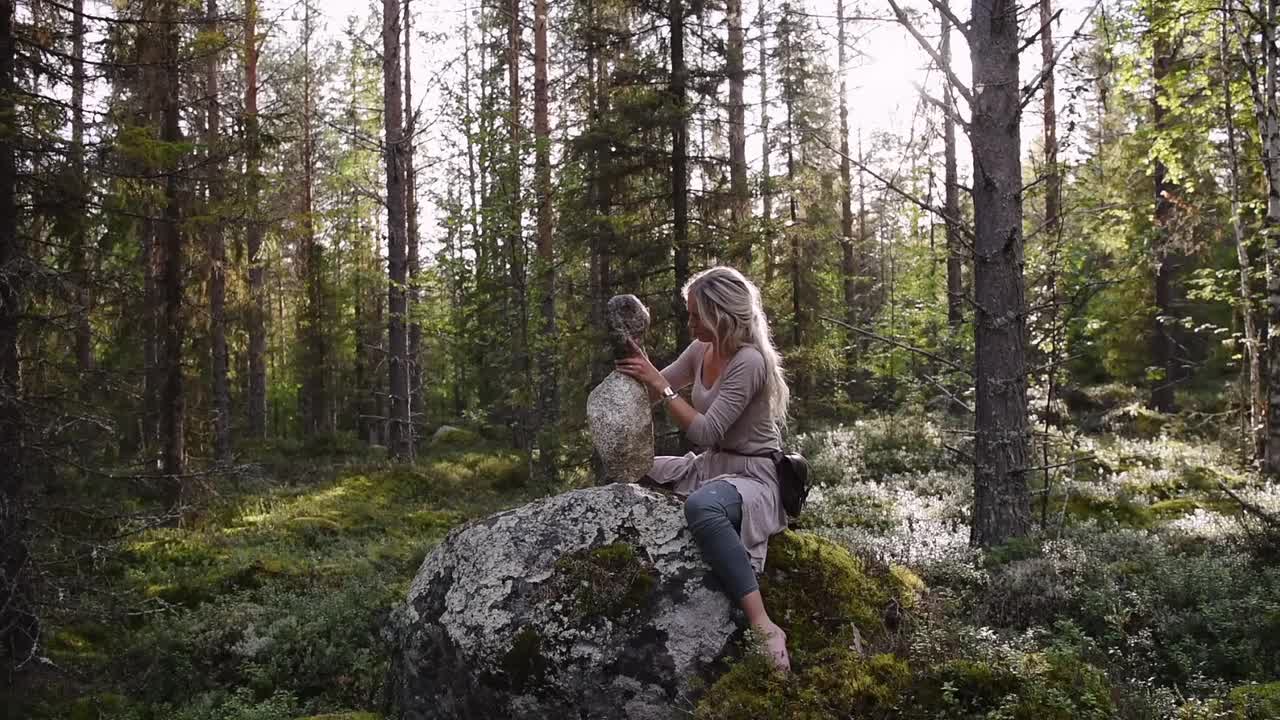
[The Art of Stillness: Finding Equilibrium Through Stone Balancing]-[The Art of Balancing Stones]
📋 Summary
Finding Inner Peace Through Stone Balancing
Stone balancing is more than just a creative hobby; it is a profound practice of self-regulation. As the practitioner notes, "I really love balancing stones. Mostly because I think it's such a great way to also balance myself." This dual process of creating something beautiful while simultaneously quieting the mind serves as a meditative anchor in an otherwise chaotic world. When searching for that "tiny, tiny little balance point," the practitioner experiences a state where "thoughts are completely silent," providing a much-needed reprieve from the constant movement of daily life.
The Philosophy of Impermanence
One of the most striking aspects of this art form is its inherent fragility. Even though "a little wind is enough to make it look like your sculpture never was there," the value lies in the process rather than the permanence of the object. The act of balancing acts as a counterpoint to modern life, appearing "so still and quiet in a world that is constantly moving." By accepting that the creation may vanish at any moment, the practitioner finds beauty in the ephemeral nature of the present moment.
Challenging Perceptions of the Impossible
Public reaction to stone balancing often reveals a limited worldview. Many observers claim that the work is "fake," "photoshopped," or held together by "glue." Rather than feeling discouraged, the practitioner views these accusations as validation: "it's a proof that there is so much more in this life than we could ever imagine." This skepticism serves as a powerful metaphor for human potential. If people dismiss stone balancing as impossible, it highlights how many other aspects of life remain unexplored simply because we have "already put the frames on what is possible and not."
The Path to Mastery: Intuition and Patience
For those interested in learning this craft, the advice is refreshingly simple: "go get out there, find some stones, play around and have fun." Mastery is not gained through rigid instruction but through experiential learning. Over time, practitioners "get to know the stones" and develop an intuitive sense of which shapes harmonize. Even when one spends significant time failing to balance a particular stone, the process is never wasted; one learns something new with every attempt.
The Mechanics of Gravity and Sensitivity
Technically, stone balancing requires an incredible degree of physical sensitivity. Because the balance point can be "really tiny," the adjustments required to stabilize the rocks are so subtle that they are "barely see-able with your eyes." Instead, the practitioner must "feel it with your hands." This tactile connection allows the individual to work in harmony with physics. When the elusive point is finally located, "the gravity will be there for you to hold your stones together," turning a precarious arrangement into a testament to patience, focus, and the hidden possibilities of the natural world.
Deep Learning with ListenLeap


