Welcome to spotlight.
I'm alice irazari and i'm andrew devis.
Spotlight uses a special english method of broadcasting.
It is easier for people to understand, no matter where in the world they live.
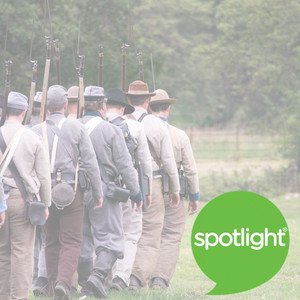
In 1861, hundreds of Southern soldiers surrounded Fort Sumter.
This large walled building was in South Carolina, in the United States.
Inside the fort, Northern soldiers stood on the walls.
These soldiers were from the same country.
But now they were pointing their cannons at each other.
Suddenly, southern soldiers began to fire their guns.
The fort shook with explosions.
The air filled with the smell of smoke.
The first battle of the American Civil War had begun.
The American Civil War was a conflict between the northern and southern states of the United States.
Different parts of the country fought in open war against each other.
This happened over 160 years ago, but the war shaped American culture in ways that are still important today.
Today's Spotlight is on the American Civil War.
There were many issues that caused the American Civil War but the biggest was the issue of slavery.
The United States was founded during a time when slavery was common.
Each state decided whether it would be legal to own enslaved persons inside their own borders.
These enslaved people were taken from Africa.
Slave owners forced them to work on farms or as servants.
The founding documents of the United States declare that each person is equal.
But slave owners did not consider enslaved persons fully human.
For a long time, people owned slaves in most states.
But soon, many people in the United States began to believe slavery was wrong.
These people called themselves abolitionists.
The abolitionists hoped to one day make slavery illegal.
By the 1830s, the abolitionists had partially succeeded.
Slavery was illegal in most northern states.
But the South had always used more enslaved persons than the North.
The South's economy depended on growing crops like tobacco and cotton.
Enslaved persons did most of the work to grow these crops.
Landowners in the South became rich because of the enslaved persons.
Many were not willing to change.
Some even believed it was their right to own other human beings.
The country was split between states that owned enslaved persons and states that did not.
There was no violent conflict between them.
But the United States was growing.
The country expanded into new areas.
And each side was afraid the other would grow too powerful.
The North tried to limit new slave states.
The South tried to expand slavery.
Then, in 1860, a man named Abraham Lincoln was elected president.
Lincoln was from Illinois, a state in the North.
Lincoln hated slavery.
In his speeches, he often talked about how he believed it was evil.
But Lincoln also did not believe he could end slavery right away.
Instead, he wanted to stop its spread.
In 1859 he spoke in the city of Chicago on the subject.
I do not wish to be misunderstood on the subject of slavery in this country.
I suppose it may exist for a long time.
Maybe the best way for it to come to an end peacefully is for it to exist for a while.
But I say that the spread and strengthening of it is a very different idea.
There we should in every way resist it as a wrong.
We should treat it as a wrong with the idea that it must and will come to an end.
Slavery may not have ended with Lincoln's election, but many southern states were afraid of Lincoln.
They saw him as dangerous.
After his election, many states decided they wanted to leave the country.
These 11 states tried to form a different country together.
They called themselves the Confederate States of America.
They elected their own president, named Jefferson Davis.
Lincoln did not recognize the Confederacy as a country.
And soon small battles began to break out.
The two sides began building their forces.
Then came the Battle of Fort Sumter.
Fort Sumter was on land that the Confederacy claimed.
But soldiers from the north still occupied it.
By attacking the fort, the south believed they were taking what was theirs.
But the north saw it as an attack on their country.
Soon the north declared war.
The two sides fought against each other for four years.
The fighting was extremely bloody.
Almost 3% of the country died in the fighting.
Both sides used new technology, like fast-firing guns.
Soldiers died by the hundreds.
Many who survived were injured in ways that could not be healed.
The North won the war.
And in 1864, the United States officially made slavery illegal.
The government gave formerly enslaved persons the right to vote and own land.
But the Northern victory came at a great cost.
Many southern cities were destroyed. and half a million Americans died because of the fighting.
And in 1865, President Lincoln was killed.
He was going to make many new laws about slavery.
He was trying to bring a new kind of equality.
But with Lincoln's death, many of these plans fell through.
In southern states, former slaves were supposed to be able to vote and own land.
But the local governments often prevented them from doing so.
Racist groups like the Ku Klux Klan would attack those who tried to vote, and many lived in conditions that were not much better than slavery.
Southern states also created laws called Jim Crow laws.
These laws separated white and black people.
They could not use the same restaurants.
They could not even drink from the same public water fountains.
It was not until 1965 that these ways of separating people were made illegal.
Today the United States continues to struggle with racial issues.
But the Civil War is an important part of its history.
It changed how people in the United States saw themselves.
And it paved the way toward equality.
Brooks D. Simpson is an American historian.
He wrote about the impact of the Civil War on the country's culture.
In some ways, America's Civil War has yet to end.
Its major figures live on in story as well as history.
Americans debate the war's meaning with passion.
They shape and reshape their understanding of the conflict to match their own beliefs.
The war shaped national identity, but the exact meaning of that identity is not always clear.
Still, the Civil War is the central event of American history.
It gave the nation, at a painful cost, a new birth of freedom.
The Civil War is a very large part of American culture, even now.
Is there a conflict where you are from that is similar?
Tell us about it.
You can leave a comment on our website at www.spotlightenglish.com.
You can also find us on YouTube Facebook TikTok, Instagram and X.
You can also get our programs delivered directly to your Android or Apple device through our free official Spotlight English app.
The writer of this program was Dan Christman.
The producer was Michio Osaki.
The voices you heard were from the United States and the United Kingdom.
All quotes were adapted for this program and voiced by Spotlight.
No AI or artificial intelligence was used in this program.
Spotlight programs are written, voiced and produced by real people for real people, no matter where in the world they live.
This program is called, The American Civil War.
We hope you can join us again for the next Spotlight program.
Goodbye.