© transcript Emily Beynon.
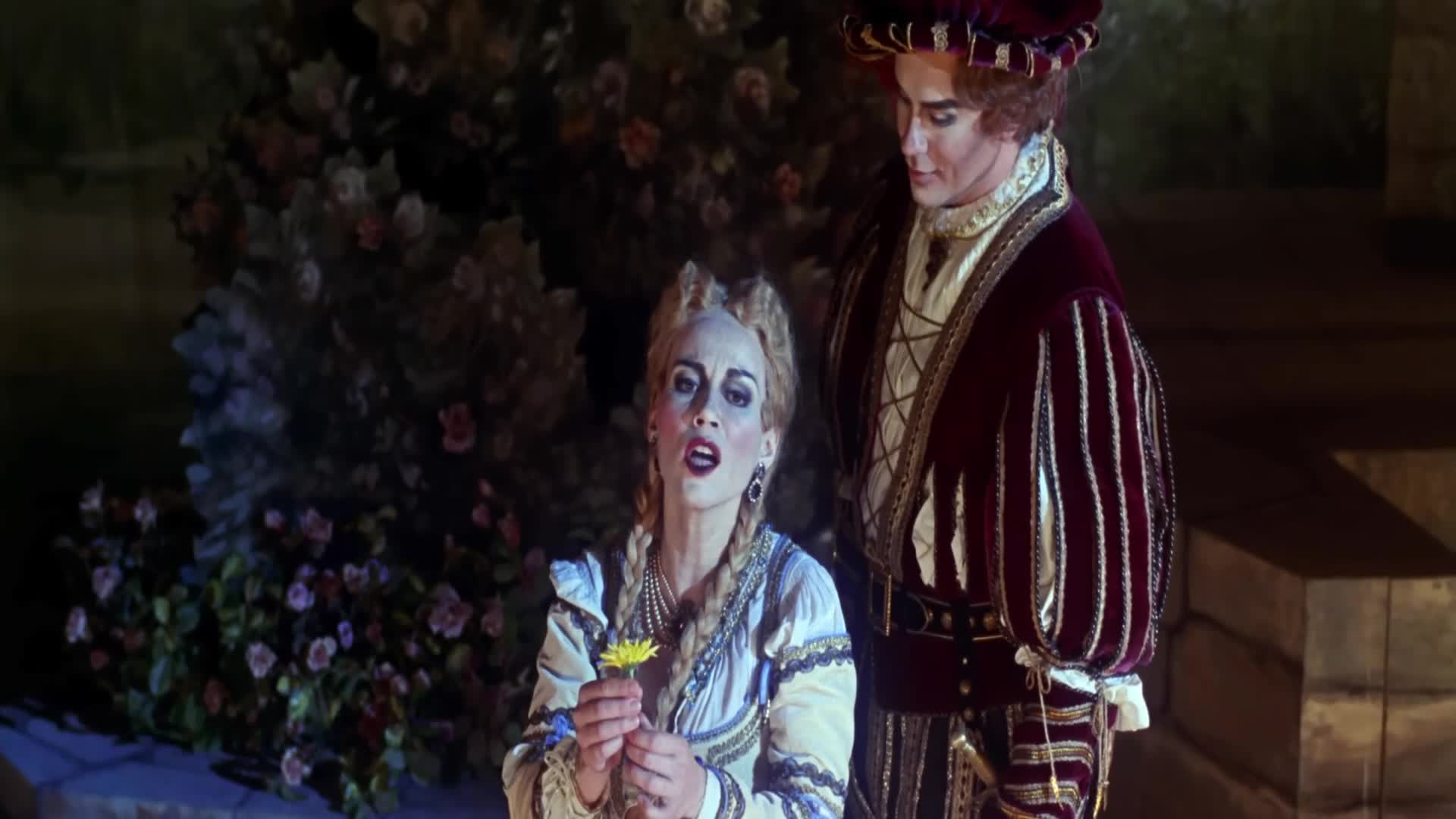
The first thing we see in Martin Scorsese's The Age of Innocence is an adaptation.
It's Charles Gounod's adaptation of Goethe's tragic play Faust into a grand opera.
Goethe's Faust is one of the most esteemed works in the history of literature, and Gounod's version was, for the better part of a century, the world's most popular opera.
But these two things are not the same.
In his adaptation, Gounod changed Faust radically, simplifying and removing most of its deep metaphysical ruminations to focus on the tragic love story between Dr Faust, an old philosopher made young and powerful by selling his soul to the devil, and Marguerite, the virginal maiden he seduces then abandons.
Gounod supplanted the intellectual with the emotional.
In other words, he made an opera, and big emotion is what opera does best.
In every adaptation across artistic mediums, there is a loss.
You lose something of the original, something vital.
But hopefully you gain something too, ideally something that the new medium is uniquely good at expressing.
Scorsese's The Age of Innocence from 1993 is, of course, an adaptation of Edith Wharton's 1920 novel of the same name, and it too loses important elements of the original things that lovers of the book like myself are sad to miss.
But it also gains quite a bit, and what it gains is uniquely filmic.
In certain ways, Scorsese's film is to Wharton's novel, as Gounod's opera is to Goethe's play.
One way to imagine adapting a novel into a film is as a process of setting words to music.
That's literally true in the case of soundtracks and musical scores, but it's also true in a deeper sense.
The cinematic form has a rhythmic melodious, emotionally charged quality that resembles the power of music.
And the great directors have tapped into this quality with lighting editing blocking, camera movement or, in the case of Martin Scorsese, all of the above.
I remember we played together.
How this brings it all back to me.
Consider this opening scene.
In the novel, the narrator describes the opera while ironically commenting on all the absurd rules and protocols of the rich society assembled to watch it.
Then she focuses in on Newland Archer.
The narrator shows us Newland's thoughts as he watches this seduction of Marguerite by Faust and then looks across the house at his soon-to-be fiancee, May Welland, a young woman who he believes to be as pure and naive as the young woman in the show.
The darling, Archer thinks.
She doesn't even guess what it's all about.
May is just too pure and too ignorant to understand the seduction for what it is.
Newlin does, of course, because he travels and reads books and thinks deeply.
He contemplated her absorbed young face and here is the key line with a thrill of possessorship in which pride in his own masculine initiation was mingled with a tender reverence for her abysmal purity.
What a sentence.
Wharton is so brilliant in the ways she puts us into Newland's mind, while at the same time dissecting and satirizing his arrogance, his sense of superiority.
We'll read Faust together by the Italian lakes.
He thinks, imagining all the paternalistic ways he'll educate his bride-to-be.
In Scorsese's version of the opening scene we get the same action but lose that wry, biting commentary on Newland and his society.
We lose the ironic distance of the narrator.
Scorsese does bring that narrator in briefly at the end of the scene, but for the first five minutes he plunges us into the world of 1870s New York, into the now long-demolished Academy of Music among the city's old money elite.
As Francois Sammarcelli says, the movie sets a different tone from the book.
To quote, trigger identification with the characters and produce emotion instead of underscoring the role of conventions.
Wharton immediately undercuts Gounod's opera.
Scorsese lets us feel it.
The whole first scene is operatic in its construction.
Michael Ballhaus' camera swoops around the house using every camera move imaginable pans tilts tracks dollies cranes, shots that combine all of these things.
Scorsese even invented a new technique to simulate what it's like to look through opera glasses.
This six-minute scene has 54 shots and 34 of them have camera movement of some kind.
In terms of duration, that's over 80% movement.
Basically, the scene is a dance designed to enchant the viewer.
In the novel, you, of course, can't hear the opera music.
The film, on the other hand, uses that music to achieve the same effect that Gounod achieved a heightening of emotion, and that emotion infuses the characters as well as us.
When Newland enters May Whelan's box he is, in the novel, quite standoffish in his first interactions with her cousin, the Countess Olenska.
He's somewhat shocked by her impropriety.
Does Daniel Day Lewis seem standoffish in his response to Michelle Pfeiffer here?
You kissed me once behind a door, but it was your cousin Vandy, the one who never looked at me.
I was in love with
No, he seems like a little boy, a bit startled, but utterly charmed.
With the twinkling music playing behind them, this moment feels like a meet cute.
What is Scorsese up to here?
In the novel, we're encouraged by Wharton's use of ironic distance to judge Newland Archer just as he judges May for being swept away or seduced by a love story that actually is a seduction, one that he believes she can't recognize.
But who's being swept away?
Who's being seduced in Scorsese's version?
Well, Newland Archer, for one, by Ellen Olenska, at least that's how it seems now, and us.
We, the audience, are being seduced by sound and image, by music and camera movement.
The irony of Newland's judgment of May in the book is that really he turns out to be the one who doesn't even guess what it's all about.
Falling in love with Elena Lenska.
He fantasizes about breaking away from his society, only to learn in the end how thoroughly trapped he is by its absurd conventions, by the actions of people he believed himself so superior to.
May, most of all.
Wharton ingeniously implicates the reader in Newland's fantasies by gradually reducing the ironic distance between narrator and protagonist as the book progresses, until we see the world through Newland's eyes.
Scorsese, on the other hand, implicates us from the start.
Now that's not to say he isn't making a comment on the society.
If we reflect on the opera scene, we can see that he is showing us the reality of this universe, suggesting that those in the audience are on their own kind of stage, observed and policed by their peers, that they are actors as much as those playing Faust and Marguerite, their choices limited by the script of social conventions.
Scorsese makes this plain when he turns the camera around on the stage and points it at the audience.
But the cinematic seduction ultimately proves too strong to resist.
Wharton implicates the reader by giving us access to Newland's thoughts.
Scorsese doesn't have this tool, but he has others the sheer emotional power of sound image and their combination.
It starts in the opera, but again and again, scene after scene, image after luxurious image Scorsese, Ballhaus and the other creative contributors bewitch us.
They sink us deeper and deeper into a zone of fantasy and desire.
So much of Scorsese's cinema, writes Leslie Stern, is about bringing into being imaginative worlds and the rituals necessary to sustaining those worlds.
The trick he has is to immerse us so thoroughly that we reach the limits of fantasy and forget that this is an imaginative projection.
When the fantasy is finally shattered in the scene where the underestimated May gently but decisively tightens the knot, it plays like a horror movie.
That's how it feels when our illusions are revealed for what they are.
Like Newland, we want to believe that we have control over our lives, that we're free to make any choice we'd like when, in fact, our menu of choices is much more limited than we're able to admit or even perceive.
Both Wharton's novel and Scorsese's film get us to think about how we as individuals relate to the web of our social world.
Scorsese does it in a different way than Wharton because he has to.
He's fully aware that a novel can't become a film without some loss.
But he knows too, and shows in the Age of Innocence, that there's a lot to gain in adaptation.
Hey everybody, thank you so much for watching.
This episode was brought to you by Squarespace, the all-in-one website platform for entrepreneurs to stand out and succeed online.
To get started, you can use Blueprint AI, Squarespace's AI enhanced website builder, to get a fully customized site in just a few steps, or choose from their library of professionally designed templates that are sleek and engaging.
Every website you make will be optimized for SEO, so you'll show up more often in search results.
And you can do so much within Squarespace, like creating members-only content videos, blogs or courses, basically creative work that you can monetize via one-time payments or subscriptions.
The bottom line is that Squarespace is going to make a home for your products or your work that looks and feels professional, something that will impress your customers and fans.
Head over to squarespacecom for a free trial and when you're ready to launch, go to squarespacecom.
Slash nerdwriter for 10 off your first purchase.
Thanks, guys, and I'll see you next time.