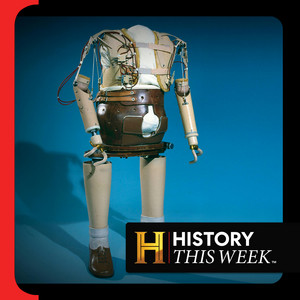
Hello History This Week listeners, it's Sally here.
As we are heading to the end of the year, I just wanted to thank you all for sticking with us these last five years.
We really do love bringing these stories to you every week and we cannot wait to keep it going in 2026.
If you like what you have been hearing, you can always support our work by subscribing to History.
This Week Plus, exclusively on Apple Podcasts.
You can also get email notifications and bonus content by signing up at historythisweekpodcast.com.
And of course you can follow us on Instagram or Facebook.
Thank you so much for listening.
We could not make this show without you.
Hey, Ryan Reynolds here for Mint Mobile.
One of the perks about having four kids that you know about is actually getting a direct line to the big man up north.
And this year he wants you to know the best gift that you can give someone is the gift of Mint Mobile's unlimited wireless for 15 a month.
Now, you don't even need to wrap it.
Give it a try at mintmobile.com slash switch.
Upfront payment of $45 for three-month plan equivalent to $15 per month required.
New customer offer for first three months only.
Speed slow after 35 gigabytes if network's busy.
Taxes and fees extra.
See mintmobile.com.
Hi, this is Joe from Vanta.
In today's digital world, compliance regulations are changing constantly and earning customer trust has never mattered more.
Vanta helps companies get compliant fast and stay secure with the most advanced AI automation and continuous monitoring out there.
So, whether you're a startup going for your first SOC 2 or ISO 27001, or a growing enterprise managing vendor risk, Vanta makes it quick, easy and scalable.
And I'm not just saying that because I work here.
Get started at Vanta.com.
History This Week, December 18th, 1970.
I'm Sally Helm.
The courtroom isn't your typical courtroom.
It's a converted casino on the premises of a mining company in the coal town of Alsdorf, Germany.
It has the look of a big hotel conference room.
Fluorescent lights, patterned wallpaper, and crucially, space enough for hundreds of people.
This trial should have happened in the district capital Aachen, but they couldn't find a courtroom big enough.
It's a big case.
The biggest case in Germany at the time, maybe the biggest case in the world.
It's about a horrifying medical disaster.
The thalidomide scandal.
Thalidomide, or ContraGen as it was called in Germany, was a supposedly safe sleeping pill that ended up not being safe at all.
Babies whose mothers had taken the drug were born with deformed limbs or sometimes with no arms or no legs.
Many of them died.
The drug harmed thousands of infants, and it also caused nerve damage in some adult patients.
This trial is a criminal case to try and bring the drug company behind thalidomide to account.
The defendants are five executives of that company, which is called Kemi Grunenthal.
The proceedings began over two years ago.
Today, the accused men watch from the front of the room as the judge announces that the trial is over.
And there's no verdict.
It all ends in a settlement.
The company will set up a fund of $27 million to help child victims of thalidomide.
And these men are free to go.
It's frankly hard to imagine people injured in utero before they've taken their first breath by drug companies who really were unbelievably cavalier and uncaring.
Today, how did thalidomide make it to market and become a historic medical disaster?
And who are the heroes who brought that disaster to an end?
You know, on History This Week, we spend a lot of time talking about people facing big moments.
Pressure, uncertainty, sometimes real turning points.
And one thing that always strikes me is nobody gets through these moments alone.
Support matters.
That's one reason I really like Rula.
Because taking care of your mental health shouldn't feel like navigating a maze.
If you pull a muscle, you go see a doctor.
But when you're trying to find the right therapist, suddenly it feels like searching for the Northwest Passage.
Slow, uncertain, and way more complicated than it needs to be.
And honestly, that's what stops a lot of people from getting help.
Rula flips that script.
They make therapy simple, affordable, and fast.
They work with most major insurance plans, and sessions can cost as little as 15, sometimes even zero, depending on your benefits.
I mean, $15 is the price of lunch, but this is investing in your headspace.
And Rula actually stays with you through the process.
They match you with one of more than 15000 licensed, vetted therapists and psychiatrists, not just whoever's available.
And they check in to make sure it's working.
You can book appointments, manage your schedule, even handle medication support, all in one place.
It's the opposite of those long, winding, historical sagas we typically cover on the show.
I've seen how much therapy can help people I care about.
Getting through a rough patch, finding clarity under pressure, just feeling more steady.
And I've definitely had weeks where I wish getting help were easier and faster.
And that's exactly the problem Rula solves.
Thousands of guys have already used Rula to finally get the care they needed.
Don't keep putting it off.
Go to rula.com slash htw and get started today.
That's rula.com slash htw.
Take the first step, get connected, and take control of your mental health.
What's up world, it's Von Miller, Super Bowl MVP, chicken farmer, and now host of Free Range.
This is a show where I go off the field and off the script.
We're talking what's hot in music, film, trending news, and everything blowing up your feed.
If you love football, you'll feel at home.
But if you're here for the vibes, the internet deep dives, the conversation, this is your podcast.
Join me every Wednesday.
Follow and listen to Free Range with me, Von Miller, everywhere you get your podcasts.
Introducing Meta Ray-Ban Display, the world's most advanced AI glasses.
With a full color display built into the lens of the glasses.
It's there when you need it and gone when you don't.
Send and receive messages, translate or caption live conversations, collaborate with Meta, AI and more.
Be one of the first to try Meta Ray-Ban Display.
Visit meta.com slash Meta Ray-Ban Display to book a demo and find your pair.
There are an estimated 3,000 thalidomide survivors alive today.
And that trial in Alsdorf, Germany wasn't the last time they sought justice in court.
About 10 years ago, a colleague and I decided we'd litigate for Australian survivors of the drug.
Michael Magazanik is a lawyer in Melbourne, Australia.
But it was emotional.
My partner and I had our first child just before I started litigating on thalidomide.
It made everything kind of very personal and very real.
The lead plaintiff in Magazanik's case was a woman named Lynn Rowe, who had been born without arms and legs after her mother Wendy, took thalidomide.
In the course of his research for the trial, Magazanik spoke to Wendy's obstetrician, who'd had to give her the terrible news.
He decided he just had to be frank and honest with Wendy.
And he went up and told her that she had a healthy daughter, but that her daughter had no arms and legs.
And there was a pause.
And Wendy said, well, we're just going to have to take good care of her.
The two of them were unbelievably impressive characters, and they've stayed with me.
Magasanik's clients won a large settlement.
And after the case, he decided to write a book about Lynn and about the history of thalidomide.
He learned a lot in the course of the trial, and he wanted to tell the story from the beginning.
The German company which invented or identified flutamide was called Grunenthal.
And Grunenthal is the offshoot of a German perfume and suck company.
And it was set up really by the parent company to get into pharmaceuticals and to make money.
Chemie Grunenthal was set up in Germany in the wake of World War II.
The economy was in ruins.
Lots of German companies were looking for new ways to be profitable.
And some German people were looking to escape from their recent pasts.
For example, Heinz Baumkotter, who was a notorious SS doctor at a concentration camp near Berlin, got a job at Grunenthal.
There were, in fact, several former Nazis working at Grunenthal, including one of the men on the scientific team that developed thalidomide.
Heinrich Mukter had performed medical tests on prisoners at the Buchenwald concentration camp and at Grunenthal.
He'd been put in charge of their drug development program and he'd also been promised a percentage of drugs that Grunenthal got to market.
So you take a doctor with a forceful personality and a wartime history of medical experiments and then you give him a medical laboratory, and it was he who set up a couple of other scientists to try to synthesize some new drugs, and it was they who identified a compound which they later called thalidomide.
At first, it wasn't clear that thalidomide was actually a medicine.
It looked kind of like a barbiturate, but the scientists weren't sure what it could do.
It wasn't much of a drug at all.
People have called it a drug that was in search of the disease.
Nevertheless, they patent it in 1954 and start testing it by 1955.
They test it first on rodents.
And it seems that no matter how much thalidomide the animals take, the drug isn't lethal.
The rodents don't die.
Thalidomide is deemed safe enough to test on humans.
In clinical trials, they test it on patients with everything from influenza to liver disease.
And they notice that a few of their test subjects are falling asleep.
Grunenthal realizes they might have something very marketable on their hands.
Barbiturates, which dominate the sleeping pill and sedative market, had a really big problem with those doses.
They led to accidental deaths and were used frequently in suicides.
So there was a bit of a hunt on for a safe sleeping pill and sedative.
And it seems like you can't overdose on thalidomide.
The drug gets approved for sale in Germany.
In a higher dose it was a sleeping pill and in a lower dose it was a sedative or anti-anxiety medication.
It's marketed as a bit of a cure-all.
It might treat everything from stage fright to insomnia to irritability.
Soon it gets approved for sale outside of Germany, too.
It wasn't so hard to get drugs approved back then.
Many countries didn't even have a central regulatory agency like the US's Food and Drug Administration.
Even though the FDA was flawed, it was at least something.
Other countries didn't have a regulatory authority like that.
For example, in Australia, The drug companies just allowed to sell the drug.
They didn't have to go get approval anywhere.
By 1960, thalidomide is being marketed in 46 countries.
It's selling nearly as much as aspirin.
But one place it's not yet being sold?
The United States.
That is Grunenthal's white whale.
They were just champing at the bit to get sales approval because they thought there were rivers of gold going to come to them from thalidomide in the United States and they desperately wanted approval.
But in the US, there is an FDA.
And at the FDA, a new employee has just started.
A woman called Frances Kelsey.
She had just arrived at the FDA.
It was her first new drug approval for consideration.
Kelsey had gotten her PhD in pharmacology before World War II.
During the war, she and her husband had been involved in the search for anti-malarial drugs.
At one point, they'd solicited ideas from the public.
She recalled years later that a vet in Texas sent in a proposed malarial cure which he tested on his secretary and he said he was now planning to test it on his cattle.
Kelsey's setup shows the relative value placed on women and cattle in Texas.
Kelsey is tough.
No-nonsense.
Independent.
And when this drug application gets to her desk at the FDA, She was concerned about the health of the fetus, a concern that didn't trouble some of the men in charge of the drug companies at the time.
Kelsey starts asking questions.
It was known at this point that drugs taken by pregnant women could affect the fetus.
But no one had tested those possible effects before bringing thalidomide to market.
And yet...
Sales pitch for thalidomide worldwide was that it was an ultra safe drug.
The iconic advertisement for thalidomide was a picture of a child standing on a stool, reaching into a medicine cabinet holding a jar which one is supposed to assume is thalidomide.
And the caption says, this child's life may depend on the safety of thalidomide.
Which was based on those studies first done in rodents, showing that it's very hard to overdose on thalidomide.
But what if a mom takes it while she's pregnant?
What about the fetus's safety?
Kelsey was just disturbed by the crazy safety claims that were being made for the drug.
And she said, no way, go back and do some more testing.
The drug company execs in Germany and the US distributors, they are not happy.
They hated Kelsey.
They vilified her.
They went behind her back to her bosses.
At one stage, they threatened defamation.
They asked her to be shifted off the application.
None of it works.
Kelsey stays steadfast.
She rejects their application for over a year.
She says the safety testing just isn't sufficient.
Even aside from the possible effect on fetuses, it's starting to come out that adult patients who take thalidomide might be experiencing harmful effects.
They started getting reports of peripheral neuritis, which is damage to the nervous system.
It was horrible itching and burning at the ends of the nerves and the fingers and toes.
Unsteadiness when walking.
Some people were so tormented, they ended up in psychiatric hospitals.
Despite these concerning reports, thalidomide is soon all over the world.
One of the doctors trialing the drug is named William McBride.
He's an OBGYN in Australia.
And in 1960 he accepts a request from the drug company Distillers they're the British licensor of thalidomide to try out this new drug.
He agrees.
And sometime after, he's working with one of his patients.
A pregnant woman suffering severe morning sickness.
He couldn't alleviate her symptoms and in desperation he gave her some disavowed tablets, which was the Australian name for thalidomide, and it quelled her morning sickness.
And so McBride became convinced he'd found the answer to morning sickness, and he started handing it out, as someone might have served like lollipops.
Then, very soon, McBride starts to see some really concerning things.
His patients start delivering malformed babies, and there's three in quick succession, all of whom have severe limb malformations and all of whom die quickly after birth.
McBride is distressed by this.
He wonders what could possibly be causing it.
One weekend in June of 1961, he's home studying medical journals and he says he has a eureka moment.
The distival.
It must be the distival.
He immediately notifies the Australian drug company Distillers, which has licensed the drug from Grunenthal.
The great tragedy of this whole episode is that Distillers sits on that information.
The Australian branch of distillers is really just a sales arm of the company.
About 50 years later, I found a couple of those by then elderly men who had worked at distillers.
These two men were very junior at the time.
And they told me the story, which is that yes, they got that report from McBride and that their bosses sat on that information desperately hoping it wasn't true.
And even while knowing about this report, they kept selling the drug, promoting it, pushing it out there.
By November, McBride still hasn't heard anything, so he takes matters into his own hands.
He writes a letter to the distiller's headquarters in the UK hoping that they might respond better than the Australian office did or just respond at all.
He puts the letter in the mail and waits.
Meanwhile, back in Germany, another doctor is also on the case.
Wittekind Lenz.
In many ways, Wittgen Lenz is sort of with Kelsey, the co-hero of this story in terms of the doctors.
Thalidomide is at this point very popular in Germany.
It's in medicine cabinets across the country.
And in early 1961, right around the time that McBride starts noticing the terrible problems with his patients in Australia, a mother and father in Germany come to see Dr Lenz.
He was consulted by a family about their baby with very unusual lean malformations.
And Leans at that point thought that the probable cause was a gene mutation.
Lenz is a celebrated pediatrician, not working specifically with thalidomide.
And it's not clear to him that there's a pattern here.
This looks like an isolated case.
But then In June 1961, came the visit that really changed Lenz's life, and it was a lawyer called Carl Schulte-Hillen who came to him because Schulte-Hillen's wife Linda, had given birth to a child with thalidomide malformations and almost at the same time Schulte-Hillen's own sister gave birth to a child with similar malformations.
Lenz promises to look into it.
He rang a couple of friends.
He was told that there were many more babies around with these malformations, and soon lens had whipped into action, determined to find what he called one single connection for all of these cases.
And it was really something of a detective, private investigator search rather than that of a doctor.
He's literally traveling around and looking at medicine cabinets, talking to mums, giving them a questionnaire, and initially lens wondered whether it was a new lipstick or a face cream.
Makazanik told us today it would probably be obvious sooner that a drug was to blame.
But back then, it wasn't so clear.
Lenz did ask about drugs, though, and he couldn't seem to find one that connected these babies.
And that's because those mothers thought of the sleeping pill they'd been taken as so innocuous that many of them didn't mention it because they'd been assured it was so super safe.
Lenz keeps looking.
And then, in November of 1961, he talks to the mother of a baby girl who'd been born without arms and she says she'd taken Contragan, which is the German name for thalidomide.
Then the next day, the father of another baby told Lenz that he blamed Contragan.
Lenz thinks this is a lead.
He visited more families.
By the 15th of November 1961, he'd gathered about 14 cases.
So by now Lenz was sure, and that's when he confronted Grunenthal.
Lenz calls the company.
He tells them what he thinks the drug is doing.
He says the company must take it off the market.
Then he goes in for a meeting.
And as he says, the Grunenthal representatives just showed no interest in the facts of what he said.
And they concluded the meeting by refusing to withdraw Flutamide from sale.
What's astonishing is that on that day, 20 November 1961, after Lenz has warned them that he believes it's maiming and killing babies, Grunenthal sends out almost 70000 copies of the pamphlet addressed to doctors, describing Evolumide as a safe medicine.
So now Lenz and McBride, thousands of miles apart, have raised the same alarm.
And they're not really comparing notes.
This is pre-internet. pre-fax machines, pre-email.
In those days, doctors communicated by letter and they met occasionally at conferences.
But even though they're not coordinating, these two doctors have uncovered the same thing and their efforts are about to combine to finally take thalidomide down.
Meet the computer you can talk to.
With Copilot on Windows, working, creating, and collaborating is as easy as talking.
Got writer's block?
Share your screen with Copilot Vision to help spark inspiration, and use Copilot Voice to have a conversation and brainstorm ideas.
Or maybe you need some tech help.
With Copilot Vision, Copilot sees what you see.
Let Copilot talk you through step-by-step guidance so you can master new apps, games and skills faster.
Try now at windows.com.
At Capella University, learning online doesn't mean learning alone.
You'll get support from people who care about your success, like your enrollment specialist, who gets to know you and the goals you'd like to achieve.
You'll also get a designated academic coach who's with you throughout your entire program.
Plus, career coaches are available to help you navigate your professional goals.
A different future is closer than you think with Capella University.
Learn more at capella.edu.
This is a real good story about Bronx and his dad Ryan, real United Airlines customers.
We were returning home and one of the flight attendants asked Bronx if he wanted to see the flight deck and meet Captain Andrew.
I got to sit in the driver's seat.
I grew up in an aviation family and seeing Bronx kind of reminded me of myself when I was that age.
That's Andrew, a real United pilot.
These small interactions can shape a kid's future.
It felt like I was the captain.
Allowing my son to see the flight deck will stick with us forever.
That's how good leads the way.
Just as Lenz is making his case in Germany in November of 1961, McBride in Australia is getting tired of waiting.
He goes back to Distillers.
Says, I told you about this months ago.
What have you done?
Why are you still selling it?
And so finally, Distillers writes to their headquarters in the UK and says we've gotten this report from an obstetrician about this drug possibly harming babies.
And it's that report in November 1961 which Distillers, forwards to Grunenthal and arrives at Grunenthal just in the midst of the fuss that Lenz is creating.
McBride's report cites six infant mortalities where the mothers took thalidomide.
That's on top of Lenz's already concerning evidence.
But unbelievably, that's still not enough for Grunenthal to agree to withdraw the drug.
What really seals the drug's fate is that the next morning a very popular German newspaper carries an article about Lenz's fears.
The writing is on the wall.
In rapid succession, thalidomide gets withdrawn from markets all over the world.
West Germany, then the UK and Australia, then Canada, months later.
Meanwhile, a team of lawyers has gathered in Germany to investigate Grunenthal's alleged negligence.
The case will take years to put together, in part because of the sheer scale of the damage.
They gathered thousands and thousands and thousands of documents.
And in 1967 the state authorities in Germany confirmed that it would pursue serious criminal charges in fact negligent manslaughter against nine Grunenthal executives.
By the end of the case, it's just five executives.
And throughout the trial, Grunenthal's lawyers are sharp and aggressive.
Amazingly, Grunenthal managed to find witnesses to assert that thalidomide did not cause nerve damage or malformations.
They got people along to say it was pure speculation that there was any connection between the two, which was completely bizarre.
Brindletail even tried to promote a theory that thalidomide might have actually been fetus saving rather than fetus naming.
That theory asserted that somehow thalidomide did not damage the fetus though, on the contrary, somehow allowed otherwise really badly damaged fetuses to survive until birth.
Dr Lenz testifies for the prosecution and gives devastating evidence about the victims and the families he'd seen.
But ultimately, Grunenthal manages to get his testimony thrown out as biased.
The case goes on for two and a half grueling years.
And finally, both sides agree to settle.
The lawyer at the trial representing the children's interests, one of those children was his.
And even he agreed to the suspension of the trial.
He said, we can't afford to spend time on legal problems at this stage.
We've got much, much bigger problems in terms of health and education.
German child victims receive a $27 million settlement, which works out to about $19,000 per child.
Adult victims with nerve damage receive about $1.1 million in total.
And there is no formal verdict.
So Grunenthal never admits guilt.
The trial was over with a massive silver lining for Grunenthal, which was that a 200 million mark fund was set up for the survivors.
But Grunenthal, courtesy of the gift of the German government, got a law preventing any more civil or criminal claims against the company.
No more civil or criminal thalidomide trials in Germany, though Grunenthal and its licensors would go on to pay another large settlement to victims in Australia and New Zealand.
That's Lynn's case that Magazanik litigated.
And in 2012, Grunenthal finally does issue an apology, but they stop short of admitting liability.
Translated from German to English, part of the statement reads, quote we ask that you regard our long silence as a sign of the shock that your fate caused in us.
It just enraged the survivors.
The idea that the company was so shocked by what had happened that it couldn't apologize, when the people really suffering the shock were the survivors and the mothers and the fathers and the family members.
The company is still around today.
They specialize in producing medications for pain.
As for the various heroes of the thalidomide story, Dr Lenz became the director of the Institute of Human Genetics in Munster.
Dr McBride's legacy was tarnished in later years by accusations of scientific fraud, and Frances Kelsey got a commendation from President John F Kennedy and went on to have a stellar career at the FDA.
Articles she wrote helped pave the way for modern-day drug testing procedures.
In large part in response to the thalidomide scandal, drug approval procedures got much tougher around the world.
Drugs intended for human use could no longer rely solely on animal testing to prove safety, and drug trials for drugs that could be taken by pregnant women had to provide evidence of safety for the fetus.
The silver lining, I suppose, from this unmitigated catastrophe was that it made drug regulation much more effective around the world.
And it also focused attention on the need for care when giving untested drugs to pregnant women.
New drugs are always risky.
But as we understand all too well in the age of COVID, they're also hugely important.
Sometimes we want them fast.
But science isn't always fast.
And the thalidomide disaster serves as an important reminder of why the safeguards we have now are so important.
Thanks for listening to History This Week.
For more moments throughout history that are also worth watching.
Check your local TV listings to find out what's on the History Channel today.
This episode was produced by McKamey Lynn.
History This Week is also produced by Julie McGruder, Ben Dickstein, and me, Sally Helm.
Our editor and sound designer is Dan Rosato, and our researcher is Emma Fredericks.
Our executive producers are Jesse Katz and Ted Butler.
Don't forget to subscribe, rate and review History This Week, wherever you get your podcasts, and we will see you next week.