This BBC podcast is supported by ads outside the UK.
life begins with the right homeschool education.
Learn more at abecahomeschool .com.
This summer, healthy habits could lead to big prizes during Symbiotica's Summer Giveaway.
Start with supplements that support how you feel and how you show up.
Symbiotica's Liposomal Glutathione and Vitamin C are a powerful antioxidant duo that support natural detox, glowy skin, and lasting energy.
It's just what your body needs during those long summer days.
Plus, right now, you have a chance to win a 2025 Rivian, a luxurious wellness retreat and a year's supply of products.
Head to Symbiotica .com slash summer sweepstakes to enter today.
This is the Global News Podcast from the BBC World Service.
I'm Janet Jalil and at 13 hours GMT on Thursday, the 24th of July, these are our main stories.
A deadly military flare -up on the Thai -Cambodian border will bring you the latest. Dozens of people are feared to have died in a plane crash in Russia.
And India and Britain sign a multi -billion dollar trade deal in what both sides are hailing as a historic agreement.
Also in this podcast… There is no reasonable explanation that I can say to my constituents ones is the reason the United States and the Trump administration is burning up over $10 million.
Why is the US destroying millions of dollars worth of contraception?
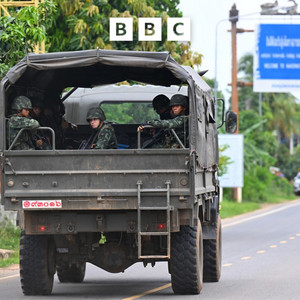
A long -standing, smouldering border dispute between Thailand and Cambodia has escalated dramatically.
With deadly military clashes breaking out, Thai officials say at least 12 people have died in the fighting.
Thailand has bombed Cambodia with fighter jets and closed its entire border with its neighbour.
Cambodian troops have fired rockets and artillery into Thailand.
Both sides blame each other for sparking the fighting.
A Thai foreign ministry spokesman said his country would defend itself.
The Royal Thai government is prepared to intensify our self -defense measures if Cambodia persists in its armed aggression and violations upon Thailand's sovereignty in accordance with international law and principles.
Neighbouring countries have called for a de -escalation.
I got more from our correspondent in Thailand, Jonathan Head.
who's at a hospital near the Thai -Cambodian border.
I'm actually outside Phnom Dong Rak Hospital.
This hospital was struck by rockets fired from the Cambodian side.
We've seen video of those rockets being fired from rocket launchers, but those rockets and artillery from the Cambodian side struck in many places along the Thai border.
There were several people injured here.
They've been evacuated now.
There have been a lot of soldiers around.
They've moved out of the way for now.
They're coming and going.
we keep hearing the regular boom of artillery most of it seems to be going out from the Thai side some we've heard coming from the other side and we know that Thai fighter jets have also been bombing targets inside Cambodia at certain points throughout the day different point from this quite a long way along the border about 150 kilometers in here one convenience store was completely destroyed by rocket and that's where most of the fatalities on the Thai side were six people killed there.
We've had many thousands of civilians evacuated from villages, schools evacuated.
It's a very very tense situation and in some ways it seems absurd when you think that the point of dispute are a few slivers of forested territory that nobody really normally bothers with but over the past few weeks this dispute has escalated.
It's been whipped up by a war of words on both both sides, to the point now where it's quite difficult for the governments to de -escalate.
I mean, both sides are accusing the other of acts of aggression.
There's not a whole lot of diplomacy going on.
And there's an awful lot of soldiers here on very high alert.
And as we've heard, quite a lot of shooting and artillery.
And just explain to us why you think it's being whipped up by both sides.
We know what the real point of escalation was.
There's been tension on the border for the whole of this year.
And it's where Thai and Cambodian soldiers interact over parts of their border that are disputed.
And there have been sometimes shouting matches, sometimes it got a bit worse than that.
There was a shooting incident in late May when one Cambodian soldier was killed.
At that point, it seemed as though the commanders on both sides were ready to sit down and try and soothe things.
But last month, the former Cambodian leader, Hun Sen, who's still a very powerful figure, leaked a private conversation with the Thai Prime Minister Petongtan Sidawat, in which she was basically appealing to his friendship with her family and criticised her own generals.
That is very damaging for her.
She's been suspended by the Constitutional Court, deeply embarrassed the government.
And everyone's wondering quite what Hun Sen's motives were.
He's, of course, positioning himself as a defender of Cambodia's national interests.
Cambodia is a small country with a very troubled history and fields often and overshadowed by its big neighbours, but he has completely burnt the friendship he had with the Shinawatra family and certainly that embarrassment and the political crisis it caused has brought us to this very, very tense standoff between the two countries.
Jonathan Head, a plane carrying around 50 people has crashed in eastern Russia with everyone on board feared dead.
Aerial footage showed the fuselage of the Soviet -era plane on fire.
As we record this podcast, rescue crews on the scene have not found any survivors.
Our Europe regional editor Paul Moss gave us more details.
The plane appears to have crashed in a densely forested area of the mountainside.
What we're told is it had already made one attempt to land unsuccessfully and had come round for a second attempt when the aircraft crashed and what I think is particularly interesting is that TASS, the Russian news agency, is saying that this aircraft was nearly 50 years old and also that it had long -standing problems. In 2018, it overran a runway, hit a lightning mast and damaged its wing.
It had also suffered three other malfunctions involving the generator and the radio.
Now, as you say, they're still looking at the possibility of pilot error.
It's too soon to say what caused the crash.
But I think this information about the state of the aircraft's history, is certainly going to, to say the least, raise eyebrows.
Because Russia does have a poor aviation safety record. It does indeed.
And that's got particularly bad in the last few years, because Russia is, of course, under sanctions since its invasion of Ukraine.
And that means two things.
First of all, Russian airlines can't buy new aircraft from the West as they used to.
And we know that particularly the Far Eastern based airlines tend to use older aircraft like like this one, which was nearly 50 years old.
But there's another problem.
It means that Russia can't buy spare parts for its aircraft. Now, that's particularly serious for its Western aircraft like Boeings and Airbuses, but even its Russian planes need Western components.
And that has led to repeated warnings that Russian aviation is more unsafe than it used to be.
Last year, we know of more than 200 incidents involving Russian planes.
That's not just crashes.
That involves things like emergency landings.
But we also know that this is a worry for Russia, because when negotiators went to America this year to try to get sanctions lifted, one of the things they specifically asked for was a lifting of sanctions on American aviation.
It is obviously way too soon to start speculating about what caused this plane to crash.
But it does come at a time when there have been these warnings about the safety of Russian aviation.
Formos it's a trade deal that's being hailed by both sides one the world's fifth biggest economy the other the world's sixth biggest for India it shows decades of protectionism are in the past for Britain it provides a much -needed post -Brexit boost the Indian Prime Minister Narendra Modi has signed the deal in the UK hailing it as a historic milestone his enthusiasm echoed by the British Prime Minister Keir Starmer.
This is a historic day, a landmark moment for both of our countries.
It is a deal that will bring huge benefits, boosting wages, raising living standards and putting more money in the pockets of working people.
It is good for business, cutting tariffs and making trade cheaper, quicker and easier.
I asked our political correspondent Rob Watson how big a deal this deal was.
It's a big deal, and it isn't.
I mean, it's a big deal in the sense that tariffs are massively lowered for many Indian products into the UK and vice versa.
So it should increase trade between the two countries by several billion dollars a year, so not to be sneezed at.
I mean, why say it isn't as well is that one has to bear in mind that they are not massive trading partners.
And just to give you one sort of rather stark figure, It's estimated that this deal will increase Britain's GDP by 0 .1 % by 2040.
That's compared to the loss of something like minus 4 % from Brexit.
But to put this in a sort of broader context, though, and why it is important and been hailed as historic, I think it does mark part of a generally very warm period in relations between India and Britain, perhaps the warmest, the most cooperative since independence in 1947.
I was going to ask about that, because how tricky was this deal to negotiate, given that troubled past that they've had as colonial power and colony?
It's a cracking question.
And I think the short answer is very difficult.
I mean, partly, of course, because India has always been, up until fairly recently, fairly protectionist. It thought about protecting domestic industries, particularly things like cars, textiles, technology and services.
is, and of course, because Britain's focus was primarily on its very close, intimate relationship with the European Union.
So all of those things went together and concerns about threats to jobs and industries in both countries, all of that has made it immensely difficult.
But if you think about it, other pressures of pushing them towards this, I mean, I think India and Britain are keen to be seen as in favor of free air trade in a world where actually that trend is somewhat in reverse.
But the British prime minister did have to get around concerns that the deal would trigger a big influx of immigrants from India, especially as the issue of immigrants was a big factor in Brexit.
Absolutely huge. And as far as I can make out that this deal does not in any way increase the number of visas that will be provided to Indian workers potentially.
And I think that, of course, had been a big concern.
That's not going to happen.
There are going to be some tax breaks for Indian workers in the UK on short term contracts, but that applies to workers from lots of other countries.
But I think the big concession that India really would have wanted that is more visas, more Indians working in the UK.
As I've read the deal, that is not going to happen.
Rob Watson. In Haiti's capital, Port -au -Prince, gangs now control 90 % of the city.
The police are outnumbered and outgunned, and government authority has all but collapsed.
More than 4 ,000 people have been killed in the past six months alone.
Cuts to US aid are compounding the crisis, leaving already vulnerable communities without food or healthcare.
The violence Violence has forced more than a million people to flee their homes.
But it's women and children who are suffering the most. One in five victims of sexual violence is a child.
Noelle Almagaffey has gained rare access to the streets of Port -au -Prince.
The names of those interviewed have been changed to protect them.
And just to warn you, this report is very distressing.
I'm in a safe house in the suburbs of Port -au -Prince.
It's home to dozens of young women and girls.
They're victims of the most heinous crimes, exposed far too early to the cruelty of mankind.
We've come here to interview women who are victims of sexual violence, but I'm blown away by how young they are.
Young girls holding on to babies.
The youngest victim of rape is 12 years old and the eldest is only 19.
They raped and beat me.
Sometimes I think about ending it all.
Helen was 17 when she was captured.
She's now 19 years old and a single mother.
They made me do things and said they'd kill me if I didn't agree.
But then I felt pregnant.
They told me to abort the pregnancy, but I said no. This baby could be the only one I ever have. In Haiti, rape has been used to terrorise and subjugate entire communities.
One in three young women here are victims of sexual violence.
Port -au -Prince is the worst place in the world to be a woman.
Lola Castro is the regional director for the World Food Programme in Haiti.
They suffer from direct violence because they are exposed, both in the centres as well as in the streets, to the men that are attacking them because they are powerless to defend themselves.
In another women's shelter, I listen to more stories.
A pattern emerges of rape, murder and arson.
They raped me. I had my six -year -old with me.
They raped her too.
Our neighbourhood was ambushed.
I went back home only to find my mum.
My mom, my dad, my sister, all were murdered.
They killed them and then burned the house down with them inside.
We travel to Delmas 30, the scene of a recent gang attack.
The entire neighborhood is now in ruins.
This is Rodrigue. He's going back for the first time since the attack, and he's taking us with him.
We're being escorted by vigilantes.
civilians who are trying to keep the neighbourhood safe.
It's a maze of alleyways.
At every open space we have to run to avoid being spotted by the gangs.
Finally, we reach the ruins of Rodrigue's home.
This is my bedroom.
This is the kids' room.
We had a good life here.
there were so many victims people killed they carried them out in wheelbarrows people were hacked to death so many victims so we've just heard some shooting and we've been told that it's probably the snipers from the bank but we're worried that the gangs may retaliate at any moment so we're going to leave we're deep in gang territory i meet vag a leader within the vivingsam coalition they control most of the capital and this is their battleground i mean look around you people have been uprooted from their homes civilians have been killed women have been raped do you have any remorse when we're
fighting we are possessed we are no longer human woman.
We become the devil.
We are people when like this you sit and talk to us, but if we're cornered, we'll come out swinging.
Sometimes I kill people without even seeing them.
They get shot and they die.
These chains I'm wearing belong to the people I've killed.
I take them and wear them to command the spirit of the dead.
JANE FERGUSON - The gangs control over 90 percent of water prints.
People live them in fear that their neighborhood will be targeted next.
As Haiti continues to battle itself, its people are desperate for some relief, longing for a life of peace and not just survival.
That report by Noël Almagafi in Port -au -Prince.
Still to come on this podcast. Why do boys get good balls, get a referee, get good coaches and And why girls not?
Just by asking the question, everybody goes like, hmm.
Women's football is on the up.
But how do you turn a women's team into a successful business?
As a parent, you wear many hats.
At dinner, you're the chef.
When your kids play, you're the ref.
And let's face it, you're basically a full -time chauffeur.
Fortunately, when it's time to wear your teacher hat, A Beccah Makes Things Easy.
Our proven, flexible homeschool curriculum is designed to let your kids retain and build on the knowledge they acquire, setting them up for success later in life.
A Beccah. Learning for life begins with the right homeschool education.
Learn more at ABeckahomeschool .com.
Now I'd like to introduce you to Meaningful Beauty, the famed skincare brand created by iconic supermodel Cindy Crawford. It's her secret to absolutely gorgeous skin.
Meaningful beauty makes powerful and effective skin care simple, and it's loved by millions of women.
It's formulated for all ages and all skin tones and types, and it's designed to work as a complete skin care system, leaving your skin feeling soft, smooth, and nourished.
I recommend starting with Cindy's Full Regiment, which contains all five of her best -selling products, including the amazing Youth Activating Melon Serum.
This next -generation serum has the power of melon leaf stem cell technology.
It's melon leaf stem cells encapsulated for freshness and released onto the skin to support a visible reduction in the appearance of wrinkles.
With thousands of glowing five -star reviews, why not give it a try?
Subscribe today, and you can get the amazing Meaningful Beauty system for just $49 .95.
That includes our introductory five -piece system, free gifts, free shipping, and a 60 -day money -back guarantee.
All of that available at MeaningfulBeauty .com.
This summer, healthy habits could lead to big prizes during Symbiotica's summer giveaway.
Start with supplements that support how you feel and how you show up.
Symbiotica's liposomal glutathione and vitamin C are a powerful antioxidant duo that support natural detox, glowy skin, and lasting energy.
It's just what your body needs during those long summer days.
Plus, right now, you have a chance to win a 2025 Rivian, a luxurious wellness retreat, and a year's supply of products.
Head to Symbiotica .com slash SummerSweepStakes to enter today.
This message comes from Greenlight.
Ready to start talking to your kids about financial literacy?
Meet Greenlight, the debit card and money app that teaches kids and teens how to earn, save, spend wisely, and invest with your guardrails in place.
With Greenlight, you can send money to kids quickly, set up chores, automate allowance, and keep an eye on what your kids are spending with real -time notifications.
applications join millions of parents and kids building healthy financial habits together on green light get started risk -free at greenlight .com slash iheart the u .s government is going ahead with plans to destroy nearly 10 million dollars worth of contraception which was bought by the u .s agency for international development for clinics around the world it's being stored in a warehouse in belgium where it was due to be sent to clinics mixing countries where contraception isn't easy to access.
USAID was dismantled and its projects closed down soon after Donald Trump was re -elected.
The government says the decision was taken because it could not sell them to any eligible buyers in part because of American rules that prohibit sending USAID to organisations that help to provide abortion services.
They also say that most of the contraceptives have less than 70 % of their shelf life left before they expire and that rebranding and selling them could cost millions of dollars.
The U .S. senator for New Hampshire, Jeanne Shaheen, has introduced legislation to stop the destruction.
My colleague Priya Rai asked her why this was such an important issue for her.
We know that there are almost $10 million in supplies, commodities that would help protect and promote women's health.
And what the Trump administration is planning to do with those even though they're not close to their expiration date, is to incinerate all of them when we know how many women could benefit from having access to those life -saving family planning supplies that women in crisis depend on.
And it's women in so many parts of the world.
Normally, U .S. family planning assistance reaches over 47 million women and couples every year.
It prevents 8 .1 million unintended pregnancies, 5 .2 million unsafe abortions, and 34 ,000 maternal deaths.
So these are really important supplies that could make a huge difference for women around the world.
And not only there's that aspect of it, so I think it's contrary to what I believe the values of the United States are, but it's also just wasteful You say that there is plenty of shelf life left on the supplies.
We're told, though, that most of the supply of the contraception has less than 70 % of its shelf life left. So can you give us some context to that?
up. Whoever's giving you that information is either not being honest or they just don't know because I sent a staff person there and most of the supplies that she saw had an expiration date of 27 and as far out as 2031.
So this is not material in this location in Belgium that is going to expire.
There is no reasonable explanation that I can say to my constituents is the reason the United States and the Trump administration is burning up over $10 million.
And in fact, I've had this exact conversation with the Deputy Secretary for Management at the State Department.
So he knows that that's not factually correct.
What response did you get?
I didn't get a response.
The other issue that's been reported is to do with difficulties in being able to sell it on or give the supplies to other countries or companies because of U .S. laws, particularly around abortions.
These are family planning supplies.
They have nothing to do with abortion.
That is, again, another excuse that the administration is using to try and provide some sort of an explanation for why they're incinerating over $10 million in family planning supplies that women need around the world.
And so what are you trying to do to stop the destruction of the medicine?
And is it realistic to hope that it doesn't happen?
You know, I have introduced legislation with one of my colleagues that would prevent the administration from destroying those kinds of commodities that have already been paid for by taxpayers.
We're talking to NGOs.
We're talking to other governments, trying to encourage them to talk to the Trump administrations.
So I'm hopeful that someone in the administration will get the message that this is not what is in keeping with the values of the United States.
It's not what Congress supports.
We had the House committee just approved funding for family planning.
It's been a consistent position of the United States.
And so it certainly doesn't make sense to me.
and it's not. I mean, the president keeps saying he's combating waste, fraud and abuse.
Well, this is the epitome of waste, fraud and abuse.
U .S. Senator Gene Shaheen.
With the election of Donald Trump and his threatened tariffs, there had been hopes that this would help to improve the sometimes fractious relationship between China and the EU.
But at a summit in Beijing with the Chinese leader Xi Jinping, the European Commission President Ursula von der Leyen highlighted the EU's concerns over trade amid fears that cheap subsidized Chinese goods could overwhelm European markets and its concerns over Beijing's tacit support for Russia's war against Ukraine.
The summit is supposed to celebrate 50 years of China -EU diplomatic ties but expectations are low after it was reduced to a single day at Beijing's request. With more here's Stephen McDonald in Beijing.
The sticking points, of course, are things like Europe wants to get access to China's rare earths.
China wants to sell more electric cars into Europe without tariffs on them.
Now, it looked like when Donald Trump launched his global tariff chaos on the world, that China and Europe were going to come together quite quickly on these fronts.
But it it has stalled really.
And it could be because both of them are at the moment too busy trying to nut out their deals with the US with these tariff deadlines on the horizon.
But now they're looking to one another and saying, well, we too have to sort this all out.
And the messages we're getting from the readouts from the Chinese side are pretty positive, though.
I mean, here's one thing that's interesting.
According to the readout from the Chinese side, President Xi underscored the importance for China and the EU to be both constructive forces for multilateralism openness and cooperation.
Now what's that code for it's like we're not like the US we're not like Donald Trump we both support multilateral institutions and free and open trade and this is where China will be trying to get Europe closer to them and saying look we can cooperate operate.
We can set up a different relationship than we both have with the US.
And they're hoping that this sort of goodwill somehow at some point generate a breakthrough on trade.
Stephen McDonnell, women's football has been dominating the sports pages this week.
And this weekend, we'll see international champions crowned in both Africa and Europe.
But soon it will be back to the club game where women's teams must compete for investment and coverage against the much more lucrative men's game.
In the Netherlands, a new women's team is just a few weeks away from playing its first game.
And as Matthew Kenyon reports, its founders believe it can be a successful business as well.
I'm in a bar in Rotterdam surrounded by football fans.
It is, in some ways, the traditional Dutch sporting experience.
Everyone's decked out in orange.
The beer is flowing.
This is Bar Laney. It's named after the first woman to score an international goal for the Netherlands and she's sitting over there, actually.
And it is thought to be the only bar in Europe focused on women's sport.
For now, Bar Laney is a pop -up.
Once the current Women's Euros football competition comes to an end, it's going to close.
but the founders are hoping that the enthusiasm for women's football that they've captured here is going to translate into the long term and that's true of the founders of another institution as well an altogether bigger and perhaps riskier investment because at the start of the new Dutch women's domestic season in September there's set to be a new name on the fixture list a women's only top flight club called Hera United I believe you always should ask why are we doing things like this and it's the same in football.
Why do boys get good balls, get a referee, get good coaches and why girls not?
Just by asking the question everybody goes like hmm.
This is Barbara Barendt, one of the co -founders of Hira United.
We accept the status quo.
Well, some people don't start questioning it and then you already see the change.
We're talking in an office in Amsterdam's historic Olympic Stadium, where Hero United have their headquarters and will play some matches.
Susan van Tienen is another co -founder.
She's responsible for the business side.
It's not only about building the business of football.
It's about that we are actually creating a movement.
That is that we stimulate every girl to be a hero.
And then I think that also resonated with the investors.
They also have seen, if you love football, you can see the impact also from the Euros on massive groups.
And we believe if we can give that attention to female football, it has a ripple effect.
In the men's game, obviously, a vast amount of money comes pouring in from television rights and media rights more generally.
That's not the case in the women's game.
So where does the money come from?
Is it individual sponsors that you have to go around and knock on people's doors and say, we want you to sponsor us?
Yes. I think the business case there is built similar to the men's game.
And we also look at other countries and obviously, also depending on the country, depending on the club, somewhere around 10 to 30 percent comes from media rise.
And we have to fix that.
There is potential.
The timescale has been astonishingly tight.
They first started thinking about this in 2023 and have only a few weeks left to the start of their inaugural season.
And Hera hasn't just been a financial challenge.
They had to get a change in rules from the Dutch football authorities to allow a single -sex club to join the professional ranks.
And, of course, they had to get a team together, so they've done a deal with one of the traditional professional clubs, Telstar, to take over their women's set -up.
What we're basically doing is showing the rest that by focusing on this women's and girls' game, you can really build a solid business case.
And actually, we can hand it over to other clubs if they want to follow our example.
And maybe one day in the not -too -distant future, Bar Laney in Rotterdam will be packed out with fans watching Hero United in the Women's European Champions League.
A dream, perhaps. That report by Matthew Kenyon.
Now, do you struggle to meet the target of 10 ,000 steps a day that's long been recommended for us to stay healthy?
Well, if you do, here's some good news for you.
A global study suggests that walking only 7 ,000 steps a day still gives many of the same health benefits, significantly cutting the risk of disease.
Here's our health reporter, Philippa Roxby.
If you've got a phone or a fitness tracker, you're probably checking your steps each day.
Reach 10 ,000 and you feel smug.
Why? Well, we've been told it's the number to aim for, the threshold for health gains.
But a review of previous studies in medical journal The Lancet, involving data on 160 ,000 adults worldwide, suggests a target of 7 ,000 steps brings plenty of health benefits too, including reducing the risk of heart disease, dementia, depression, cancer and falls.
The research found that even modest step counts of 4 ,000 per day were linked to better health compared with very low activity of 2 ,000 a day.
For most health conditions, the benefits tended to level off beyond 7 ,000 steps, although there were additional advantages to walking further for the heart.
The review can't prove that daily steps alone reduced the risk of disease.
Some of the findings were based on only a small number of studies.
But they say encouraging people to track their steps is a practical way to improve their health, and adding a step count target into official exercise guidance could be useful for everyone.
Philippa Roxby, so if you've been listening to this podcast while walking, we hope this has put an extra spring in your step.
And before we at the Global News Podcast team go for our own walk, just time to let you know that there will be a new edition of the Global News Podcast later.
If you want to comment on this podcast, you can send us an email.
The address is globalpodcast at bbc .co .uk.
This edition was mixed by Jonathan Greer.
The producers were Arianne Kochi and David Lewis.
The editor is Karen Martin.
I'm Jeannette Jalil.
Until next time, goodbye.