The weather is finally, finally getting warmer, which means it's time to pick up some new outfits for the summer.
I've been wearing the same shorts, the same tees for a couple of years and it was time to make a move.
So I gave my summer wardrobe an upgrade with Quince.
I picked up a pair of their khaki shorts, which are just the right length.
They're a good cut, not baggy or awkward like shorts I've worn in the past. I also got a nice sweater polo from Quince, something that's good for weather that's warmer but not quite hot.
It's genuinely really substantial quality and did not break the bank at all.
Everything at Quince is priced 50 -80 % less than what you'd find at similar brands, and Quince only works with factories that use safe, ethical, and responsible manufacturing practices and premium fabrics and finishes.
So treat your closet to a little summer glow -up with quince.
Go to quince .com slash history for free shipping on your order and 365 day returns.
That's Q U I N C E dot com slash history to get free shipping and 365 day returns.
Quince .com slash history.
Each spring 23 Pulitzer Prizes are awarded for distinguished journalism, books, drama, and music.
It was disbelief and pride and life changing.
My name is Nicole Carroll, and I'm a member of the Pulitzer Board and host of Pulitzer on the Road, the official podcast of the Pulitzer Prizes.
In each episode, winners reveal how much labor and risk, heart and imagination go into creating their prize -winning work.
We'll talk with novelists and reporters.
We found stuff that no one had heard before or found out.
It was exciting. Critics and playwrights.
I do not want to live in a world where we don't go on a stage and tell the truth about who we are.
And columnists who've risked their lives to speak truth to power.
What moral right would I have to call on my fellow Russian citizens to stand up to the Putin dictatorship if I didn't do it myself?
The second season of Pulitzer on the Road premiered March 10th.
Follow and listen on Apple Podcasts, the Odyssey app, Spotify, or wherever you get your podcast. The History Channel original podcast. History This Week, May 16, 1920.
I'm Sallie Helm. The streets of Rome are crowded with cars as tens of thousands of people make their way towards St. Peter's Basilica.
A reporter observing the scene says you can spot cardinals behind some of the car windows decked out in their crimson robes, plus the occasional Monsignor in purple.
On foot, all streaming in the same direction, there are monks and nuns and ordinary people.
Some of Rome's children have clambered up the colonnades to try and get a look.
They're all here to honor a person who none of them has ever met, because she lived 500 years ago.
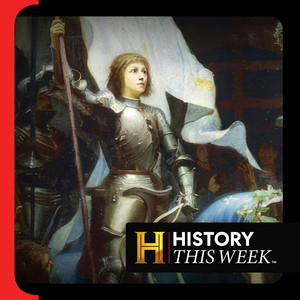
A French teenager named Joan of Arc.
Joan's feats in battle—and her visions of God—are the stuffs of legend.
And today, the Catholic Church will give her its highest honor.
Where Joan will be canonized, made a saint.
The basilica is illuminated by thousands of bulbs and thousands of candles.
There are tapestries and pictures of Joan, swathes of regal crimson fabric, a choir singing in Latin.
Any new saint would merit celebration.
But the devotion to Joan is different, fervent and passionate.
Especially in France, where she is still revered for her bravery.
Pageants will be held around the world today, children dressed in medieval garb reenacting scenes from Joan's life.
While in the Basilica, the pope describes Joan's death.
Mounted on the stake, he says, whispering in flames in a final scream, the names of Jesus and Mary, she flew to heaven.
Today, Joan of Arc.
Her name is so famous that it's almost hard to remember that she was a real person.
So who was this teenager?
How did her faith turn the tides of a seemingly endless war?
her? And why, during her lifetime, did thousands adore her, while thousands more wanted her dead?
History This Week is now in its sixth season — kinda crazy!
— and we love bringing you these stories.
All of our work is supported by the ads you hear on the show, but if you don't want to hear those ads, we're now introducing History This Week Plus, available exclusively on Apple Podcasts.
For just $2 .99 per month, you'll get all of our new episodes without any of the ads, and we'll be adding ad -free versions of our older episodes too.
So subscribe now and get your first week free.
History This Week Plus, exclusively on Apple Podcasts.
Starting a business can seem like a daunting task unless you have a partner like Shopify.
They have the tools you need to start and grow your business.
From designing a website to marketing to selling and beyond, Shopify can help with everything you need.
There's a reason millions of companies like Mattel, Heinz and Allbirds continue to trust and use them.
With Shopify on your side, turn your big business idea into...
Sign up for your $1 per month trial at Shopify .com slash special offer.
I'm Emma Greide and I've spent the last 20 years building, running and investing in some incredible businesses.
I've co -founded a multi -billion dollar unicorn and had my hand in several other companies that have generated hundreds and hundreds of millions of dollars.
The more success I've had, the more people started coming to me with questions.
How do you start a business?
How do you raise money?
How do I bounce back from failure?
So it got me thinking, why not just ask the people I aspire to the most, how did they actually do what they do?
I'm so incredibly lucky to know some of the smartest minds out there, and now I'm bringing their insights along with mine, unfiltered directly to you.
On my new podcast, Aspire With Em, Agreed, I'll dive into the big questions everyone wants to know about success in business and in life.
Through weekly conversations, you'll get the tangible tools, the real no BS stories and undeniable little hacks that actually help you level up.
Listen to and follow Aspire With Em, Agreed an order to see podcasts available now, wherever you get your podcasts.
Artists of all kinds love Joan of Arc.
Mark. You can find her in Voltaire poems, Mark Twain novels, Shakespeare plays, Tchaikovsky operas.
And opera Nancy Goldstone says that is no surprise.
It's the best story in all of history.
It really is. Wow, why do you say this is the best story in all of history?
So a 17 year old young woman out of nowhere appears at the court of the king and changes Is this the course of the Hundred Years' War?" That's a pretty good story.
We begin in 1429. France is about 80 years into what is now called the Hundred Years' War.
It's a fight between English and French kings over who will rule France.
Armies have been tramping across the land, slaughtering each other.
Fields have become mass graveyards.
Terrorized peasants are just trying to survive.
The English say their king should have the throne in France.
The French are divided.
They disagree among themselves over who is the rightful king, and those disagreements have become violent.
Joan is also living at a time of a civil war in France.
France is as polarized then as we are today.
One group in France supports Charles the 7th.
He's known as the Dauphin, which means he's the son of the most recent French King.
Another group of Frenchmen opposes him.
They're led by the Duke of Burgundy and known as the Burgundians.
They've allied themselves with the English.
So it's the Burgundians and the English versus the Dauphin and the French. They cannot agree on anything.
Every time the Burgundians say, white, the Dauphin site is black, OK?
And they are struggling for power in the midst of this.
The Dauphin and his side are not doing well.
They haven't won a battle in a while.
He's lost territory in northern France, and even worse, the English have laid siege to an important city on the Dauphin's frontline, the city of Orléans.
Its inhabitants are slowly starving.
The Delphin is about a hundred miles away.
He could send an army to help push the English out of Orléans, but he's scared.
Look, from the ages of six to ten he was someone who the Burgundians tried to capture, tried to kill him.
He wasn't protected.
Paris wasn't like you see in Amélie in Paris.
It I was a dangerous city.
There was chaos everywhere.
They're fighting in the streets.
They're severed heads on pikes.
So he's very afraid.
Charles is losing his confidence.
Kings in the Middle Ages believed they ruled by divine favor.
But now he's wondering why would God allow a king to be defeated over and over again?
Maybe God has abandoned me.
Maybe I've fallen from His grace." The Dauphin's supporters are losing confidence, too.
They yearn for a miracle.
And around this time there have been some prophecies circulating.
Prophecies predicting a dramatic turn of events that will restore the Dauphin to his strength, push the English out of France, and deliver the people from their strife.
Prophecies that say a virgin maid will rise up to save them.
And that prophecy acted like a want ad, position for mystic open at the royal court, qualified candidate to apply at your local church. One perfect candidate lives in a small village called Domrémye, a 16 -year -old named Jon, Jean in French. she calls herself Jean LaPousselle, or Joan the Maid.
For years now, she has been having visions, bright lights, and the voices of saints.
At first, the voices tell her to live a quiet, pious life.
Then they start to speak of more ambitious things.
A lot of people in the village of Dom Rami know about Joan and her visions and it doesn't faze them.
It was a common thing because there was no medication.
Every little town had somebody who saw visions or heard voices.
And when Joan's voices begin to urge her to take up arms for the Dauphin, a lot of people in her town think that makes a lot of sense.
The people in Joan's immediate vicinity are Dauphin supporters.
But Burgundians control the territory all around her town.
So she and all her neighbors have felt the horror of the war firsthand.
The Burgunians keep trying to take over that area, and they keep stealing Joan's family's cattle and attacking the villages, and so she does grow up with this war.
And then the prophecy, which could have been written about Joan the maid.
She has mystical visions.
She says they come from a heavenly source.
and they're telling her to support the Dauphin.
Perfect. So Joan is vetted and sent to the royal court.
The Dauphin is definitely not expecting her.
He's got no idea where she came from.
She just shows up. He doesn't welcome Joan with open arms. They don't automatically treat her as heaven sent.
We spoke about this moment with Charity Urbanski, a medieval history professor at the University of Washington.
She said the Dauphin is desperate.
Remember, it's important that he liberate Orléans to have any chance of winning this war and being officially crowned king of France.
And, lo and behold, here comes this woman — straight from the prophecy — saying that she can save him.
But the Dauphin is also skeptical.
Because when it comes to heaven -sent voices, Because there is always a question.
Is this a good spirit?
Is this a bad spirit?
How do you tell the difference?
Is this person holy or a heretic?
And so members of the defense court interrogate Joan, trying to suss that out.
And she says, look, when I first started hearing these voices, I had the same question.
What Joan does have to say about her voices is that first the Archangel Michael came to to her.
She was 13, and it scared her.
And she says she was afraid that rather than being the Archangel Michael, he might, in fact, be a temptation sent by the Devil.
But Jones says, the visions came with signs that convinced me of their truth.
And they've given me a divine mission.
Not just to drive the English out of France, but also to see Charles crowned.
Right answer, that is exactly what the Dauphin wants to hear, but not so fast. In order for the prophecy to hold, Joan has to be a virgin maid.
The Dauphin has to confirm it.
He has her physically examined by matrons to make sure that she is in fact a virgin, as she claims, because a big part of Joan's claim to sanctity is her chastity and virginity.
She passes the examination, but there's one more thing that's giving the Dauphin's advisors pause.
It has to do with the way Joan looks.
She's a young woman with short hair who wears men's clothes.
That probably would have been a bit of a shock for the people at court.
Right? Gender roles were pretty strictly dictated.
Wearing the clothing of the opposite gender was strictly prohibited by canon law.
It goes back to a prohibition in Deuteronomy 22 .5, I believe it is.
Charity Urbanski says Joan herself explains this in very practical terms. She's just traveled hundreds of miles from home, and protecting her virginity was a top priority.
According to Joan, it protects her essentially from sexual assault.
Male clothing was a lot harder to get off of somebody, let's put it that way.
There were lots of ties and knots that had to be done.
Female clothing, a skirt could easily be lifted.
Finally, the examiners decide that Joan is for real.
She seems to be very pious, very devoted.
We can't find anything wrong with her.
give her some men and send her to Orléans and see what happens.
Send her to Orléans into the heart of the Hundred Years War with her own detachment of troops.
I asked Nancy Goldstone about this.
It is amazing, this moment, because it's like, why would they think a 16 -year -old girl with no military experience, they should bring her to war just because she wants to come.
Well, she's their messenger from God.
She's their representative from God.
And, you know, she's kind of more the mascot at that point.
They don't think she's going to fight really.
But, you know, the real problem with the French army effort was that they were completely psyched out by the English.
They thought they were going to lose and they needed something to change the momentum of the battle.
So, on April 29th, Joan and her troops approach the city of Orléans.
The English troops are besieging it.
They're camped around it in the countryside, doing everything they can to keep supplies out of the city.
Now, Joan wants to attack these English enemies right away, but the soldiers convince her, No, we're carrying all this food and all these supplies.
First, we need to save the civilians living here.
The people in Orleans are starving, they've been eating rats, they've been eating their dog.
I mean, it's a terrible situation.
One of the French commanders creates a diversion while Joan and her troops ride toward the city's eastern gate.
She finds it unprotected, so she enters the city unopposed.
She's on a white horse carrying a banner patterned with lilies and an image of Christ flanked by angels.
Her banner is very religious so this looks like a crusade.
How do the people of Orléans react to her?
Oh, they love her! Can they love her?
The people of Orléans are stunned.
They've heard prophecies about a savior in the form of a virgin maid, and now here she is, bringing the food they so desperately need.
They pour into the streets and reach out to touch her as she passes.
They treat her like a vessel of God.
But the French commanders still don't entirely trust Joan.
She is, after all, a teenager, who up until recently, has been living a quiet life in the French countryside.
And so when on May 4th, one of the French commanders decides that it's now time to attack the English, Joan is not informed.
Joan is asleep, doesn't even know.
They leave her at home, but she wakes up, and she realizes there's a battle going on and they didn't tell her.
So she gets her squire to put on all her stuff and she gets on her horse.
She's not a good rider.
She's just learned how to ride.
And she's hanging on there as fast as she can to get to the battle.
A medieval battlefield is a dangerous place to be, with its multiple ways to be maimed or killed.
Pipes. Arrows. Cannonballs.
Swords. Joan rides alongside the other French commanders and wades into the fight.
She doesn't use her sword, but she rallies the troops with her bravery.
And by the end of the day, an English fort outside the city has fallen to the French. That's the first time the French have a battlefield.
They still have to fight more, but they won that one.
So then they got a little confidence going and then they have all these other battles.
Three days later the French attack another nearby English fort.
Joan is once again cutting through the fray when an arrow finds a seam in her armor and strikes her on the shoulder near the neck.
She's actually wounded.
She gets off her horse, she cries, she prays for like five minutes and then she gets right back on and goes to the front and they all fight for her.
And it was amazing.
That's why it's such an amazing story.
Because all they really needed was a little, you know.
Just a little. And they get it from Joan.
After a week and a few more battles, the French have driven the English from Orléans.
The Dauphin, 100 miles away, is hearing about these astonishing victories by letter.
The messengers are coming so fast that they don't have time to read one before the next one comes and says, well, it's good news.
And then the next one and the next one.
It was, they couldn't even believe it.
They lost for so long.
And here all of a sudden, they're just winning and winning and winning.
It was fabulous. The French commanders are all behind Joan now.
In fact, they want her to lead them right on to their next big battle.
The military men said, we should go to Paris right now and take that city too, and she didn't let them do that.
She said, no, our next job is to get the king crowned at Reims. She says that is the next part of the Divine Plan.
Here's Charity Urbanski.
Part of Joan's mission, the mission that she claimed to have, was not just to drive the English out of France but also to see Charles crowned, to lead the Dauphin into the traditional site of the coronation of French kings, which was really important ideologically.
It's the place where all the French kings have been anointed with holy oil to begin their reigns.
Jones says the coronation has to be there.
And after all, the Dauphin's whole mission is to be seen by everyone as the legitimate king of France.
So it was incredibly important that they made it all the way to Reims, which keep in mind was deep in the heart of English territory.
It's a risky move. It might end in disaster.
But Joan is convincing.
And so, the Dauphin and his troops fight their way to the Cathedral of Reims. On July 17, he is crowned, with Joan standing beside him.
Noble king, she says, God's will is done.
And she begins to cry.
Getting him crowned was a massive political coup, right?
And to have Joan by the Dauphin side at that moment proves the veracity of her divine mission.
Four months ago, almost no one had heard of this 17 year old maid from an obscure rural village.
Now, she's an honored guest at the King's Coronation.
The newly crowned Charles grants Joan's requests that her hometown of Domremy be exempt from paying taxes, an arrangement that will hold until the French Revolution, 360 years later.
He even bestows the status of nobility on her and her family.
The king is grateful for all she's done, but he's also getting jealous.
Charles is quite happy to have Joan revive the morale of the French troops.
And he's not entirely happy to have someone sharing the spotlight with him.
You know, the French really do see Joan as a savior and honestly that kind of competes with Charles' status as king.
So I think the rift between the Dauphin, or now Charles VII, and Joan seems to start happening fairly quickly after the coronation.
Joan is now ready to take Paris, recapture it from the English.
But Nancy Goldstone says Charles has a different vision.
He doesn't want to fight.
He prefers to negotiate, if he could.
So he stalls. And stalls some more.
When the king finally orders an attack on Paris, it's too late.
The English have dug in.
They were able to repel the French forces.
Joan's presence at that battle means nothing.
They lost. They lost badly there.
Joan and her troops retreat to a town further north, only to find it under siege.
Ever courageous, Joan rides out to attack the Burgundian forces.
And while she was out there, she got pulled down by her cape, off her horse and captured.
And so is she then expecting to be rescued?
That's what should have happened.
But what did happen is quite different, and much, much worse for Joan.
May, 1430. The maiden Joan of Arc has been captured by enemy forces by the Burgundians.
And if she had just been any old person that would have been it for her.
It wasn't normal to negotiate for the release of regular soldiers.
Professor Charity Urbanski, generally however if somebody of great military importance had been captured it would have been normal for the King to negotiate a ransom for their release.
Joan has been of the utmost military importance to the French army.
She has also been declared a member of the nobility, and she is a potent symbol to the people of France.
We might expect that Charles would have tried to negotiate for her, but we don't have any evidence that he did.
Instead, the Burgundians sell Joan to the English.
she's made to stand trial before an English -backed church tribunal.
Really, this is a show trial.
They are trying to discredit Joan in any way that they can.
Because the English want to install their own king in France, so they need to take down the Dauphin.
And now, they have before them this girl who's been telling everyone that God is on the Dauphin's side.
They want to make it clear that Joan's message is not to be trusted.
She's making all this up.
Or she is hearing voices, but those voices are not the voices of angels or saints.
They are the voices of demons.
They draw up a list of some 70 charges against her.
They accuse her of witchcraft. This goes back sort of to the siege of Orléans where the English had basically said that that they had been bewitched, and that was the reason that they had been defeated.
They charge her with heresy.
They say, she killed people.
That's a sin. She says, no, I never used my sword. I only carried my banner.
I rallied the troops.
I maybe gave instructions, but I didn't actually kill anyone.
And they point to her male attire.
I think the clothing is so important because it's really one of the visible manifestations of the heresy that they're accusing her of.
It's the thing that you can see.
Everything I have done is at God's command, Joan tells her inquisitors.
And if he had ordered me to assume a different habit, I should have done it.
She is put to months of questioning by these theologians who are trying at every turn to trip her up, to get her to admit to some heretical belief anything they can find to discredit her.
And she manages to evade every trap they lay for her.
It's really remarkable.
And so they're very frustrated.
Through months of imprisonment and through these intense interrogations, Joan remains remarkably composed.
She's completely loyal to Charles, dedicated to her mission, and sure of herself.
If they push her on a question that she doesn't want to answer, she tells them, next, like, I'm not answering that.
Move on !" Joan is desperate to escape.
One day she jumps from the Tower where she's been imprisoned.
She survives the Fall, but is knocked unconscious and locked up again.
Her Inquisitors try to use that act to discredit her, too.
They say, Were you trying to commit the Sin of taking your own life?
And she says, essentially, As a prisoner, of course I'm going to try to escape." In May of 1431, a year after her capture, Joan is brought before a court to hear her formal charges.
Ultimately, like this list of 70 initial charges are winnowed down to 12 that they feel like they can, you know, they've gotten to stick.
At this point, Joan is tired.
She's been sick. She's kind of coming to this low point and one day they basically take her out to see scaffold they've erected for her and they say essentially you know we found you guilty on these charges if you objure your heresy we will welcome you back into the church but if you do not we're going to execute you as a condemned heretic.
In her weakened state before the scaffold meant to kill her Joan complies.
Here's Nancy Goldstone.
They get her to sign a confession she doesn't know in what it says, and she signs it with the X. They take that as being the retraction.
They put her in a dress.
A dress, because one of the charges had to do with her heretical clothes.
She repented, put on the dress, and they said, eh, not so fast, you got to go back.
And they chain her up again, and they stick her with the same awful guards in the castle.
There are a few different stories about what happens next.
but in the one Nancy Goldstone believes?
One night when she goes to bed, she doesn't sleep in her dress, so the guards take the dress away and return the men's clothing to her.
And her choice in the morning, because you have to get up to go to the bathroom, you have to go outside, is either to get up and go out there naked in front of all these people or put on the clothes that are there.
So she puts on the clothes that are there to go out to the bathroom, and they say, Oh, she relapsed!
She put on the men's bows again.
That's what they get her on.
They say— You relapsed.
You relapsed. Wow! You relapsed your heretical ways.
A few days later, a friar comes to her cell to hear her confession and give her the sacrament.
Then she's taken to that scaffold, tied to a stake and surrounded by kindling.
Two preachers give sermons condemning her sins, and Joan the Maid is burned alive.
Over two decades more, Charles continues to wage war on the English until France is victorious in 1453.
Charles, now universally recognized as king, turns his thoughts back to Joan of Arc, the girl he'd abandoned.
The French hold another trial for Joan in 1455, though she's now been dead for 20 years.
This time, no one is trying to discredit her.
Quite the opposite.
It's partly because the French really do remember Joan as a heroine and a martyr to the French cause.
But it's also partly politically motivated, wanting to make sure that there was no shadow of doubt cast over the legitimacy of Charles VII's coronation.
Over the centuries, her legend only grows.
Until, in 1920, she is finally canonized and becomes Saint Joan.
Joan the Maid, when she lived, was a walking paradox—at times fiery and impulsive, at others calm and composed, mystical yet pragmatic.
An illiterate country girl who led thousands of loyal troops and essentially crowned a king.
Charity Urbanski says this complicated Joan is a window on her time.
She is a really interesting case study in some of the contradictions of the middle ages, right?
She arises at a time when there are very strict gender expectations for women, when a French peasant girl wouldn't have been expected to do any of these things, and yet she's able to.
So I think she helps us understand the society more deeply rather than just seeing it as this completely hierarchical and sexist society.
Yes, all of those things are true, and yet we have Joan.
Thanks for listening to History This Week.
For more moments throughout history that are also worth watching, check your local TV listings to find out what's on the History channel today.
If you want to get in touch, please shoot us an email at our email address, historythisweekathistory .com, or you can leave us a voicemail 212 -351 -0410.
We really love to hear from you.
Special thanks today to our guests, Nancy Goldstone, author of The Maid and the Queen, The Secret History of Joan of Arc and Charity Urbanski, Associate History Professor at the University of Washington.
For more on Joan's story, we recommend Helen Caster's book, Joan of Arc, a History.
This episode was produced by Julia Press.
It was story edited by Jim O 'Grady and sound -designed by Dan Rosato.
History This Week is also produced by Corinne Wallace, Chloe Weiner, and me, Sally Helm.
Our associate producers are Hazel Mae and Emma Fredricks.
Our senior producer is Ben Dickstein.
Our supervising producer is McKemmy Lynne.
And our executive producer is Jesse Katz.
Don't forget to subscribe, rate, and review History This Week, wherever you get your podcasts.
and we will see you next week.