From The New York Times, I'm Michael Barbaro.
This is The Daily. For years, even as fentanyl killed Americans at an astonishing rate, Mexico has claimed that it was doing everything it could to crack down on its production.
This week, President Trump began using punishing new tariffs to test that claim.
Today, my colleague, Mexico City Bureau Chief Natalie Kitroev, on the surprising result of Trump's strategy.
It's Thursday, March 6th.
It's weird being on the mic as a guest, but here we are.
Um, I don't know how to address you.
It's so weird. I know.
I was kind of wondering how you were going to handle that.
How about we just do it normal -like?
Okay. Yeah. Hey, Natalie.
Hi, Michael. Natalie, tell us the story, the kind of improbable story of how you ended up inside an illegal fentanyl lab in Mexico.
So I'm the bureau chief here in Mexico City.
And for a really long time now, I've been obsessed with the fentanyl problem.
Obviously, we know that in the United States, fentanyl has just been a scourge for years.
I know. I was kind of wondering how you were going to handle that.
How about we just do it normal -like?
Okay, yeah. Hey, Natalie.
Hi, Michael. Natalie, tell us the story, the kind of improbable story, of how you ended up inside an illegal fentanyl lab in Mexico.
So, I'm the bureau chief here in Mexico City, and for a really long time now, I've been obsessed with the fentanyl problem.
Obviously, we know that in the United States, we end up in the hands of Americans every single day.
I found it extremely important to see with my own eyes exactly how it's made step by step.
Right, but of course, the challenge is getting inside.
I assume the kind of places in Mexico that make fentanyl don't offer tours.
So how did you even begin to try to get in one?
Yeah, I mean, it wasn't easy.
These are, as you said, illegal labs.
This is happening underground.
This is clandestine.
How do you break into a network that is run by cartels, by powerful organizations that are responsible for death and destruction across the country?
Or should I add, should you even try to make it into a separate question?
No, but I mean, you should.
You have to if you want to understand this thing, right?
And yes, there are risks, obviously, but there's no way to really get inside this business without seeing it for yourself.
And so my colleague, Paulina Villegas, and I started making trips to Sinaloa.
Sinaloa is a state in the northwest of Mexico.
It is a major hub of cartels by powerful organizations that are responsible for death and destruction across the country.
Or should I add, should you even try to make it into a separate question?
No, but I mean, you should.
You have to if you want to understand this thing, right?
And yes, there are risks, obviously, but there's no way to really get inside this business without seeing it for yourself.
And so my colleague Paulina Villegas and I started making trips to Sinaloa.
Sinaloa is a state in the northwest of Mexico.
It is a major hub of global fentanyl production, and it's the home base of one of the most dangerous and powerful criminal organizations in the world, the Sinaloa Cartel.
We knew that we had to make inroads in this state in order to get into a lab because these are the guys that really dominate production, according to U .S.
law enforcement. So we started to go there.
We started reporting.
We made contacts within the cartel.
We did interviews. We talked to leaders.
We talked to cooks, meaning the people who actually make the fentanyl.
And, I mean, there were so many obstacles that kept preventing us from getting into a lab.
We had an inroad here.
It was shut down. An inroad there.
It had just been busted.
And then, finally, in the middle of December, we got in.
So tell us about that.
So the original plan was to go into this lab in the morning, but there was a problem.
The cooks who were inviting us to see the process told us that they had just gotten busted.
And so they needed to move locations and they were going to put a makeshift lab.
We didn't really know where at that point, but, you know, several hours later, then hours later, then into the evening, we find out that it's going to be in the center of the capital city where we are, Kulia Khan.
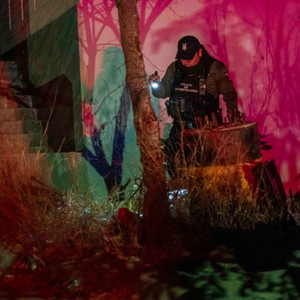
so we drive to this location and it's a busy street i mean there's taco stands outside people are walking around it's not you know a deserted area in the middle of nowhere i mean it looked like any other house and as far as i could tell all the people walking by had absolutely no idea that inside what looked like a normal house was an active fentanyl lab at that point When we go in, it's pitch black, and we immediately smell a very, very intense smell.
It's like a strong smell of chemicals.
And our contacts that we're working with say, this is the textbook smell of fentanyl.
And at the end of this pitch black kind of hallway, we see two 20 -something guys.
They introduce themselves.
They say we can bring in one phone and one camera.
But we agree that we're not going to publish any recordings that have their voices on them or photos that might identify their faces.
And we start getting suited up at this point.
And what that means is we're putting on hazmat suits.
We're putting on our gas masks.
We put on gloves. We're preparing to come in contact with a very toxic substance.
We walked down the hall with them and then we went in.
bugs with powder in them but apart from that, the lab, finally we made it into a kitchen, we're watching them cook and they've just started the beginning of the process.
And I realized that we're in what's a really basic kitchen, I mean there's not a lot of advanced equipment here.
I'm watching the The fumes come off two pots that are on a regular kitchen stove.
They have two pots on the stove that, you know, are being heated with liquid.
They have trays with chemicals on them.
They have jugs with powder in them.
But apart from that, there isn't that much to it.
It looks like any other kitchen.
And I saw one of the cooks just blend it all together They're using, like, a regular hand blender blackened decker that you could just buy at a store.
And the pots look like any pots that you would find in a Mexican kitchen.
They have beers that they're clearly drinking while they do this.
At one point, one of the cooks asks the other one for this essential chemical ingredient, and the guy turns around to the food pantry and pulls out a jug of it that's just next to hot sauce and other stuff that you might actually use to make food.
Wow. So right now he's adding blue to the powder mix because it's going to be pressed into those blue M30 pills.
And they're handling this blue powder that is close to what would be pressed into a pill.
And you can just see the blue seeping in.
This is the kind of pill you see on American streets, these baby blue fillet, easy to produce.
We dye it blue if the client wants it blue.
So it was just remarkable how commonplace all of this seemed to them.
So when you leave this lab, what are you thinking?
What has this unlocked for you in your understanding of Mexico as this hub, as you said earlier, of fentanyl production?
I think the main takeaway that I had leaving the lab was this is a drug that is extraordinarily easy to produce in almost any conditions.
And once you get the product, the amount that you need to make a lot of money if you're the cartel or if you're a user to potentially kill you is tiny.
I mean, the U .S. government says that people who have not been exposed to fentanyl could be killed by the amount that fits on the tip of a pencil.
And in this kitchen, in this makeshift lab, I had just seen that tip of the pencil thousands of times over.
Now, I guess what you're saying about the ease of production makes me wonder why it has to be done in Mexico.
Why can't this same process occur in Texas or Brooklyn, for that matter?
Yeah, I mean, Michael, obviously you could theoretically make fentanyl in Texas, but the conditions are not as good as they are in Mexico.
There's an entire infrastructure that really supports this.
The Sinaloa Cartel.
So this is an incredibly powerful experience of fentanyl on American streets across the border.
They have years worth of experience in industrialized drug production.
They've done this with a ton of different products, including meth, which is another synthetic drug.
So they have experience in making drugs out of chemicals.
They also have a lot of experience corrupting the Mexican government.
The last time there was a major crackdown on drug cartels, the security chief that led that crackdown ended up being convicted in an American court for taking bribes from the Sinaloa cartel.
So this is an incredibly powerful, experienced organization that has the wherewithal and the resources to do this.
And the Mexican government has not been effective at stamping that out.
So a key ingredient here that explains why Mexico is the Mexican government's inability slash unwillingness to truly take on and crack down on these cartels.
Right. I mean, and this has been an open question in Mexico and in the United States for years.
Is it capacity? Is it ability?
Or is it willingness, as you say?
And it's kind of difficult to know because it hasn't been happening and it's hard to disentangle the reasons why.
But at the time that I'm visiting this lab, the U .S.
is preparing to inaugurate Donald Trump, and he pretty quickly makes it very clear that he thinks he knows why.
I've informed Mexico and Canada that they will have to step up and stop the illegal aliens and illegal drugs from pouring into our country.
I have to stop. It's that Mexico is a woman.
I like her very much.
We've had good relationships, but we have to stop fentanyl from coming in, whether I like somebody or not.
The government absolutely needs to do more or there will be consequences.
Right. Trump's argument throughout the campaign and once he's elected is basically Mexico chooses this situation and it can do a heck of a lot more.
Exactly. And as soon as he finally takes office, I'm not happy with Mexico or I'm not happy.
He just starts lobbing attack after attack on Mexico and he's really turning the heat up.
President Sheinbaum is a woman.
I like her very much.
We've had good relationships, but we have to stop fentanyl from coming in, whether I like somebody or not.
There's this threat in the air about a potential for U .S.
military forces to do targeted strikes on drug labs and cartels in Mexico.
Eventually, the administration officially designates the cartels as terrorist organizations?
And most importantly, I'll be putting the tariff of 25 % on Canada and separately 25 % on Mexico.
Trump says he's going to impose massive, devastating tariffs on Mexico unless they get this problem under control.
And I wonder, based on this lab you saw and based on all the reporting you have done, what you made of Trump's actions as they were unfurling, and if you thought it stood any real chance of changing the fentanyl realities on the ground in Mexico.
But even though I was really skeptical, I wanted to go back into a lab to see whether all of these threats, whether all of the pressure that Trump had put on Mexico had led to real changes, whether any of this actually made a difference.
We'll be right back.
So, Natalie, when you went back to Sinaloa to try to assess whether anything had changed post -Trump's inauguration, what did you find?
It was really remarkable.
The dynamics, it seemed, had completely changed from the last time we were there.
I mean, this was still a very dangerous place.
There was a lot of violence.
But when we started talking to our cartel contacts, they told us there was basically no production of fentanyl happening in the city.
it had totally plummeted.
Fallen off a cliff.
I mean, they acknowledged that production was happening elsewhere in the country.
It's not like fentanyl stopped being made in Mexico writ large.
But here, things had slowed to a near halt.
We met the two cooks who had invited us into their labs.
They said, no, we shut everything down.
There is such an intense crackdown by the government right now, and we're under so much scrutiny and pressure.
that we're not cooking anything.
We didn't meet them.
More at lightsonenergy .org.
My name is Carlos Prieto, and I'm one of the people that help make The Daily.
As part of a reporting on immigration, we heard from this woman crossing one of the most dangerous stretches of land on the whole planet to get to the United States.
I knew that she was from Venezuela, which is where I'm also from.
But what I found out is that not only was she from the same city that I grew up in, but she was also from the same neighborhood.
She was describing parks and plazas and streets where I spent a lot of my childhood.
She was a woman that I might have encountered at some point in my life.
It made me feel an extra responsibility to find a way for our listeners to feel like they understood her and her story.
What makes The Daily special is that we try to understand every story with that level of closeness so that our listeners can really connect with the humans in the middle of a news event.
If this is the kind of journalism that you like and that you care about, the best way to support it is by subscribing to The New York Times.
So Natalie, when you went back to Sinaloa to try to assess whether anything had changed post -Trump's inauguration, what did you find?
It was really remarkable.
The dynamics, it seemed, had completely changed from the last time we were there.
I mean, this was still a very dangerous place.
There was a lot of violence.
But when we started talking to our cartel contacts, they told us there was basically no production of fentanyl happening in the city cartel.
So there was a lot of activity.
At one point, we go to meet with a higher production was happening elsewhere in the country.
It's not like fentanyl stopped being made in Mexico writ large.
But here, things had slowed to a near halt.
We met the two cooks who had invited us into their labs.
They said, no, we shut everything down.
There is such an intense crackdown by the government right now, and we're under so much scrutiny and pressure that we're not cooking anything.
We didn't meet them inside a lab.
They met us at our hotel room, and they said, we're not doing anything right now.
We're actually firing employees.
We're saving money.
We're trying to sell our cars and other property to try to make up for lost income because nothing is going on here.
There is no lab for you to visit this time around.
Huh. And we saw firsthand the crackdown that they were so afraid of.
Spoke on it later. At one point, we're driving down the street.
Where? Where? And these police trucks pull up.
These guys just start spilling out of them, and they're scaling the walls of this house.
Suddenly, they're on the roof.
All right, we're literally watching a raid on a house go down.
We just drove up on it.
There's a police car and, like, a kind of military -style tank -like car.
It's very clear to us that something is going down.
There's officers just all along the street.
L members and a lot of security experts who have been studying this for a long time.
Now, we have to keep in mind, Claudia Sheinbaum, the new president, had come into office about a month before Trump was elected and then eventually started making these threats.
So she had signaled early on that she was more willing to take on the cartels head on aggressively than her predecessor.
So we don't know how much of this might have happened without Trump anyway, because she was willing to change the approach.
But I think it's pretty clear that the amount of progress, arrests, raids, lab busts, the pace of these actions is something that we've not seen in recent history in Mexico.
One analyst told us we've seen in one month what we might have seen in years.
Of all the things Trump did, I'm curious which in your reporting stands out as ultimately being the most effective as we think about just how aggressive Mexico's government has been.
I'm going to guess it's the threat of tariffs, but I'm curious what you found.
Yeah, I mean, obviously the threat of military intervention in any way, even if it's just targeted strikes, is anathema in Mexico.
But the threat of tariffs has long seemed much more credible.
I have to say, of the two, I think the tariff threat is the one that really spurs the action because there's a deadline.
I mean, last month, Trump essentially gave the Mexican government 30 days to show results on security, to deliver him the progress he wanted to see on fentanyl.
And when there's a deadline, I mean, people hustle to meet that deadline, especially if has shocked the Mexican law enforcement system into action and in so doing, seemed to expose that the Mexican government was capable of doing a lot more than it had been.
Yeah, I think that's what it looks like to a lot of people, a lot of regular Mexicans, a lot of cartel members, and a lot of security experts who have been studying this for a long time.
Now, we have to keep in mind, Claudia Sheinbaum, the new president, had come into office about a month before Trump was elected and then eventually started making these threats.
So she had signaled early on that she was more willing to take on the cartels head on aggressively than her predecessor.
So we don't know how much of this might have happened without Trump anyway, because she was willing to change the approach.
But I think it's pretty clear that the amount of progress, arrests, raids, lab busts, the pace of these actions is something that we've not seen in recent history in Mexico.
One analyst told us we've seen in one month what we might have seen in years.
Of all the things Trump did, I'm curious which, in your reporting, stands out as ultimately being the most effective as we think about just how aggressive Mexico's government has been.
I'm going to guess it's the threat of tariffs, but I'm curious what you found.
Yeah, I mean, obviously the threat of military intervention we've given you, these capos, what more could we possibly do?
Well, what's the answer?
I mean, in theory, could they do more?
Well, I mean, it's unclear.
Nobody knows exactly what Trump wants.
Threat is the one that really spurs the action because there's a deadline.
I mean, last month, Trump essentially gave the Mexican government 30 days to show results on security, to deliver him the progress he wanted to see on fentanyl.
And when there's a deadline, I mean, people hustle to meet that deadline, especially if, you know, on the other side of that is potential economic ruin.
So I do think that was really motivating here.
I mean, what's fascinating about what you're saying is that it seems to confirm to a degree the Donald Trump thesis, which we've talked about a fair amount on this show with some of our colleagues, that tariffs are a kind of everything, every issue tool potentially.
But what's tricky is the question of whether they're stronger as a threat or as a reality.
And as we're talking to you, the United States has made the threat of tariffs against Mexico a reality.
We don't know how long it's going to last, But the U .S.
has put into place tariffs on Mexico.
They could be rolled back in the coming hours or days.
But that makes me wonder if Trump is happy with what Mexico has done so far or thinks they can go a lot further when it comes to cracking down on fentanyl.
How do you see it and how do the leaders in Mexico see it?
Well, the leaders in Mexico are just absolutely baffled about these tariffs.
They do not understand this would have made a real difference.
And I was proven wrong by the reporting.
It very much has made a difference.
But we have no idea, actually, what the Mexican government may be able to accomplish as it tries to stave off this government had been seeking to prosecute in the United States.
These are major figures that had been given over to the U .S.
government. And the Mexicans are saying, wait a minute, we've gone hard on these cartels.
We've given you these capos.
What more could we possibly do?
Well, what's the answer?
I mean, in theory, could they do more?
Well, I mean, it's unclear.
Nobody knows exactly what Trump wants.
And it's a mystery whether there are actual benchmarks here or not, or whether the goalposts are just going to keep moving and moving and moving.
And there is some suggestion that they might reach a deal soon.
But the reality is that this pressure is horrific for Mexico.
Mexico is incredibly dependent on the U .S.
economy, on being able to access U .S.
markets. This could potentially push the country into a recession.
And so Claudia Sheinbaum and her government are going to do absolutely everything they can to get out from under this.
And if that means more security gains, I think they're looking at how they can possibly do more because they feel like they have their foot completely on the gas at this point.
And they still got hit with the tariffs.
So in theory, Trump's approach, as it gets more and more punitive, it may keep exposing all the things that Mexico...
...satisfy his demands.
Because if they reach a deal on tariffs, then what?
Right. Has the incentive for Mexico to pursue this crackdown gone away?
Right. And... the damage that the United States is willing to do to Mexico's economy in the pursuit of finding out just how much it can do about Fennel?
Yeah, I mean, it remains to be seen.
I mean, I told you that I was skeptical at the outset that this would have made a real difference, and I was proven wrong by the reporting.
It very much has made a difference.
But we have no idea, actually, what the Mexican government may be able to accomplish as it tries to stave off these tariffs, get out from under them.
Keep in mind, the Mexican government has been busting labs across the country, but the most intense crackdown has been mainly concentrated in this one state, Sinaloa.
It's a really important state.
It's a major hub of fentanyl production, but it's just one state.
This drug is made all over the country.
And, you know, if you imagine this crackdown spreading, it requires a lot of resource.
It requires a lot of troops.
It requires a lot of intelligence, and it requires a lot of willingness sustained over a really long period of time to make a difference.
There is also huge demand for this drug in the United States that really hasn't been addressed.
And so it is hard to imagine that even this push, even a sustained push, could entirely stamp out the production of this drug without a lot of other elements coming into play.
And likewise, stopping fentanyl.
We'll be right back.
Continue the pressure.
And for how long can Trump really keep Mexico in this position of trying to satisfy his demands?
Because if they reach a deal on tariffs, then what?
Has the incentive for Mexico to pursue this crackdown gone away?
Right. And are we looking at a period of potentially several years of these threats and uncertainty and upheaval?
Or is this all just going to go away tomorrow if they reach a deal?
But no matter what happens, it does feel like the clear lesson from your...
Mayor Johnson, is Denver a sanctuary city?
Folks use that term differently.
I can tell you what Denver does.
We do not... Okay, I take that as a yes.
Mayor Johnson, no, yes or no, I take that as a yes.
During a contentious hearing, House Republicans accused the Democratic mayors of New York, Denver, Boston, and Chicago of making their cities less safe by harboring criminal immigrants and refusing to fully cooperate with the president's efforts to crack down on illegal immigration.
In response, the mayors defended their policies, said that they were following federal immigration law, and told House Republicans that Congress itself had the power to make their cities safer, but so far had failed to do so.
If you wanted to make us safe, pass gun reforms, Stop cutting Medicaid.
Stop cutting cancer research.
Stop cutting funds for veterans.
That is what will make our city safe.
Today's episode was produced by Caitlin O 'Keefe, Claire Tennesketter, and Carlos Prieto, with help from Nina Feldman.
It was edited by Lisa Chau and Lexi Diao.
Contains original music by Dan Powell and Pat McCusker.
And was engineered by Alyssa Moxley.
Our theme music is by Jim Brunberg and Ben Landsberg of Wonderland.
That's it for The Daily.
I'm Michael Barbaro.
See you tomorrow. ...and Ben Landsberg of Wonderland.
That's it for the Daily.
I'm Michael Barbaro.
See you tomorrow.