N P R This is The Indicator from Planet Money, I'm Waylin Long.
I'm damn Woods. And I'm Adrian Ma.
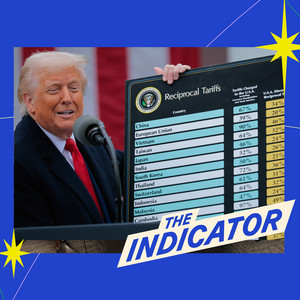
After last week's tariff announcement, almost anyone involved in business is still processing the news.
This is an extraordinarily steep and widespread increase in taxes.
And it's not clear if tariff rates are here to stay or are some kind of opening salvo in trade negotiations.
And that's before we even start on retaliatory tariffs from other countries.
Yeah, and if you are an American business importing goods from another country, whether it's China, Switzerland, Nicaragua, I mean, really just throw a dart at the map.
Chances are, you are gonna have to pay more tariffs.
If you are on an island that is only penguins, you got to be hit by these tariffs.
The penguins, that's true.
Throw a dart at a penguin and that penguin will be tariffed.
Now, we have spoken to a lot of business people on our show ahead of these anticipated tariffs.
So, how are they reacting now that the big tariffs are here?
Today on the show, they tell us how they're feeling about the latest and largest wave of tariffs.
Support for NPR and the following message come from Indeed.
Just realizing your business needed to hire someone yesterday?
Speed up your hiring right now with Indeed.
Claim your $75 sponsored job credit now at Indeed .com slash indicator.
Terms and conditions apply.
Psychologist Dolly Chug studies the lengths we will go to protect the way we see ourselves.
We care about whether we're seen as a good person, whether others see us as a good person, and whether we feel like good people.
Ideas about our self -image.
That's on the Ted Radio Hour podcast from NPR.
These days, there is a lot of news.
It can be hard to keep up with what it means for you, your family, and your community.
Consider This From NPR is a podcast that helps you make sense of the news.
Six days a week, we bring you a deep dive on a story and provide the context, backstory, and analysis you need to understand our rapidly changing world.
Listen to the Consider This podcast from NPR.
So we're focusing on how these tariffs are being felt by businesses.
And we're going to start off by revisiting with a couple of business owners that we talked to previously on the show.
I talked to Kimberly Vacarella, she thought she was past the worst of the tariff drama.
She is the founder and CEO of Bog Bag.
It's an American company that makes these boxy tote bags you can take to the beach. And so we talked to Kimberly for an episode in December and her bags are made in China.
And you know the additional 20 % tariff on China that Trump had announced in March?
Kimberly thought the tax would not go higher than that.
And then Liberation Day happened.
I caught up with her the day after.
No, I was with my husband who also works with us here at BogBag.
So we were watching it together in disbelief.
I was nauseous and holding it in today, still.
Nauseous. That's strong.
I know, and making these bags in the US isn't an option for Kimberly.
She told us there just isn't the expertise or machinery domestically.
So she's been looking for a factory in Southeast Asia, somewhere outside of China.
And she recently put in a test order with the manufacturer in Vietnam she's hoping to work with.
This new tariff announcement has thrown this math into disarray because Vietnam is getting a whopping 46 % tariff that could wipe out a lot of the savings Kimberly was hoping to get by working with a factory outside of China.
Right, because the new tariff on China, when you add it together with the previously announced tariff, that's at least 54 % which is not far off from the Vietnam rate.
And these numbers could change again.
Kimberly, of course, wants them to go lower.
And we're hoping that this is all a bad joke or a power play, and then hopefully things will calm down.
But we don't know. You know it's very uncertain.
And in the very short term, Mother's Day is coming up.
That typically brings in 30 % of bog bag sales for the year.
Kimberly says these new tariffs could put a damper on that.
So it looks like a lot of moms will be getting homemade gifts this year.
A little macaroni necklace!
Alright, next we're going to jump to Darian for another business owner that we've spoken to on the show before.
Yeah, a few weeks ago we heard from Daniel Harberger.
He runs a dog toy and treat business, woof!
Daniel, we meet again!
We meet again, under interesting circumstances.
I called him up the day after the big tariff announcement from President Trump.
Daniel was frustrated.
It is a gut punch to have to pivot so quickly with such meaningful tariff increases, with very little heads up.
He knew the tariffs were coming, but not of this magnitude.
And his whole strategy had been to diversify his supply chain, right?
Kind of like the bogbag strategy?
Getting dog toys and treats made in China, Southeast Asia, Latin America.
Yeah. Vietnam was actually his plan B2.
Probably a lot of people's plan B.
But with that enormous 46 % tariff announced for Vietnam that you mentioned Weyland, that country is looking unviable.
It was definitely one of our backup options and now we have to rely on Plan C and Plan D and Plan E and just roll with the punches.
Plan C, Costa Rica and Colombia.
Is it named after the country?
Yes. Plan E is Ecuador.
The Dominican Republic, Ecuador.
Literally, as we're talking on the phone, three of my team members are on planes to to come up with good alternative supply chain options.
We've got to jump through some hoops and hold our breath and see what happens.
Now it's worth mentioning Daniel does have some production in the US, but it's a lot more expensive here.
He says there isn't the infrastructure for manufacturing that's affordable for the business.
Overall Daniel seems like he just didn't want to be thinking about tariffs and alternative factories so much. The really frustrating thing about all of these tariffs is that they're just a massive distraction.
We have to shift all of our attention to swapping countries and changing supply lines and figuring out what customers we're going to lose and what customers we're going to keep.
That's the same work that almost every other company in the United States is going to have to face somehow now.
Thank you so much for sharing your insights and I hope we can meet again under circumstances that are perhaps less rocky.
Well hopefully we can do a – we'll do a pet segment one day about all the amazing things about four -legged friends.
Okay, Adrian what do you have?
I have reached out to not one business owner but actually somebody who works with a lot of small and medium size business owners.
My name is Juan Palerano and I'm the CMO of Swap Commerce.
So Juan's company, Swap, works with businesses, helping them with the e -commerce part of their operations?
About 80 % of our brands are apparel brands.
And these businesses he works with are going to be affected by Trump targeting what are called de minimis goods, which I believe is Latin for, eh, it's so tiny you don't worry about it.
That's what Julius Caesar said about the Eyes of March. Yes.
That got him. Don't fact -check me on that.
Just thinking about the Roman Empire.
Don't worry about it.
So, under the current rules, a shipment of goods worth $800 or less is considered de minimis, and therefore not actually subject to tariffs.
This exception has been a huge reason why Chinese -based companies like Tiemu and Xian have been able to sell their clothing in the U .S. super duper cheap.
Right. They don't have to pay import tax.
That is a huge advantage.
But, along with all the tariffs that were rolled out last week, Trump also signed an stating that in May, this de minimis exception will be eliminated for goods coming from China and Hong Kong.
I mean, that is huge for Timu and Xian's business models.
Totally. I mean, they'll have to rethink how they sell to U .S. customers.
But importantly, this change would also hit U .S.-based companies that source goods from China.
And Wan says this is a huge deal.
Any package that comes into the country, you can say at a base level is going to get charged at least 30 percent more.
But recently, Juan's company, SWAP, surveyed about 100 US businesses asking, how are these tariffs going to impact you?
Many said they could actually threaten the survival of their very business.
And that's why a little over half the businesses they asked said they're considering moving their supply chains to the US.
In the words of Trump, if you don't want to pay the tariffs, move your factories to the US.
That is what he wants, right?
But, Juan says he's kind of skeptical that this will happen en masse.
While you might have the best intentions and potentially want to align yourself with the Trump administration and move things domestic, that's not something that you can do overnight.
Moving a supply chain from China to the U .S. could take years.
And Juan says this is especially because when it comes to things like clothing manufacturing, the U .S. is way behind Asia.
And a lot of things just won't move to the U .S. I'm thinking things like, I don't know, cinnamon or mass banana plantations.
Vanilla beans. Yeah.
So what I'm very curious to know is how this plays out and what's the strategy long term?
This episode was produced by CoopercatsMcKim.
It was engineered by Siné Lofredo and fact checked by Sierra Juarez.
Kate Kincannon is her editor and the indicator as a production of NPR.
Hey, it's a Martinez even as the host of a news show, it can be hard to keep up with the headlines.
That is why we make the Up First podcast. Every morning in under 15 minutes, we cover three major stories with context and analysis from reporters around the world so you can catch up on a little tapasando while getting ready, making deciuño or going to work.
So listen to the Up First podcast from NPR.
Do you remember when discovering a new artist felt like finding buried treasure, at All Songs Considered, NPR's music recommendation podcast, we put that kind of magic back into discovering new tracks.
We're here to make the hunt for new music easy, delivering you the cream of the crop from every genre.
We'll help you make music feel fun again only on All Songs Considered from NPR.
Oh, hey there. I'm Brittany loose.
And I don't know, maybe this is a little out of pocket to say but I think you should listen to my podcast. It's called, It's Been a Minute and I love it.
And I think you will too.
Over the past couple months, over 100 ,000 new listeners started tuning in.
Find out why. Listen to the It's Been A Minute podcast from NPR today.