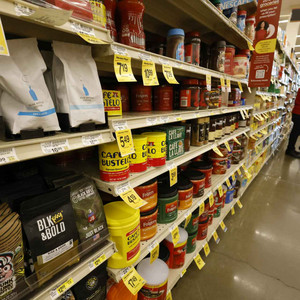
From beans to bananas, Washington's tariff rethink.
The administration is now understanding the supply chain of fresh fruits and vegetables.
It'll make a big difference for our programs, especially the upcoming lychee program we have in South Africa.
Welcome to World Business Report from the BBC World Service.
I'm Sam Fenwick.
In a plan to help American families with their weekly shop.
The White House is hinting it'll cut import duties on everyday items like coffee and bananas.
But when will shoppers feel the difference?
And we head to India, where it's a different story.
Food prices are falling.
Bill has been getting a bit more expensive lately.
Rising import costs and new tariffs have pushed up prices for everyday items like coffee and bananas.
But now the treasury secretary, scott besant, says that some relief could be on the way here.
He is speaking to fox news on wednesday.
You're going to see substantial announcement over the next couple of days.
In terms of things we don't grow here in the united states you know coffee, coffee being one of them bananas, other fruits that that will bring the prices down very quickly.
Now, inflation in the US has risen every month since April when the tariffs were introduced.
In September, it hit 3%.
And in the same month, the Consumer Price Index showed that banana prices were up nearly 7 from a year earlier.
Ground brief.
Beef, rather, had risen by about 13%.
Roasted coffee, nearly 20%.
Let's hear from two fruit importers now.
First, you'll hear from Nick Bunnell.
He is a CEO of Seasons Farm Fresh and he imports tropical fruits.
Currently, most of the countries that we import fruits from are only having a 10% tariff.
If the tariffs are removed, then it'll have a marginal impact on business, potentially with a small price reduction.
However, for the countries like Brazil and South Africa which have a 50 and 30 tariffs, it'll make a big difference for our programs, especially the upcoming lychee program we have in South Africa.
This is Jaime Chamberlain of Chamberlain Distributing in Nogales, Arizona.
We are importers of Mexican fresh fruits and vegetables, and we have been for the last 55 years.
I have to say that today's comments of Secretary Besant were encouraging.
I think the administration is now understanding the supply chain of fresh fruits and vegetables that the United States has not only with Mexico but with other countries throughout the world.
And I think it's very important that fresh fruits and vegetables do not have tariffs to pay.
I would like to see them at zero tariffs.
You heard there from Nick Bunnell and Heimer Chamberlain, both importing fruit into the US.
Well, listening to that is Brendan Doherty.
He is the co-owner of Signal, a coffee roaster and cafe, and they're based in California.
He's joining us today from San Francisco.
Thanks for being with us, Brendan.
For those of you who... Thank you, Sam.
Yes.
For those of us that don't know, just tell us how much coffee comes from Brazil and how has that affected your prices.
So it's 30% of the world's coffee supply.
And for us in the United States, it's a massive amount of the coffee that gets consumed here.
One of the issues of the tariffs is it's created a tremendous price distortion already.
But what was happening before that was Brazil had a shortfall in their crop.
And so prices were already shooting up before this 50% proposed 50% tariff was announced.
So I was looking back at my prices.
We paid $3.30 a pound in 2024 for unroasted coffee.
That coffee would, if I purchased today, would be $8 a pound unroasted.
And have you managed to pass that off?
Have you managed to pass that price on to your customers or have you absorbed that higher cost in some way?
We've absorbed some of it.
So that three 30 has gone up to five 60 with a 40%, you know, like a 40 cent tariff.
That's the price I paid earlier this summer.
We buy six months of coffee at a time.
So we're currently isolated from the tariff shock, but we What it does for us is force us to have to find different coffees from other countries.
We just can't absorb the 40% difference between Mexico, Guatemala, and Brazil.
It doesn't justify.
Do your customers like coffee from different parts of the world?
They do.
They do.
And we're a roaster that features coffees from around the world.
East Africa Indonesia, central america.
Um, we purchase at probably the highest grade of coffee.
We're a specialty roaster and people come to us for really delicious coffee.
Okay, but the prices that yeah, the prices that would have to come out of uh, eight dollar pound coffee is, you know, like 10.
$10 or $15 a cup.
It's ridiculous.
No one wants to pay that price for a coffee.
Brendan, stay there because I want to talk about the wider economy and bring Susan Schmidt in.
She's portfolio manager at Exchange Capital Resources in Chicago.
There's more economic data out on Wednesday, isn't there, Susan?
More Americans are struggling to keep up with car payments, with the number of people more than two months behind in loads now at a highest in over a decade.
Those figures are from Fitch ratings.
What do they tell us about households in the US and how they're coping right now?
Well, it tells you that there's ongoing stress at the consumer level, and particularly at low income consumers.
So we're seeing not only these Fitch ratings but other data like rising credit card debt among the lower income consumers, because things are costing more.
And so they're having to spend more.
They're ending up putting it on debt.
Those months and era of savings that we had during COVID have gone.
Savings are no longer a part of it.
Now we're really focused on credit card debt, looking to see how we can borrow to sustain this.
And we've seen that student loan bills have returned after the pandemic pause.
And that could also cause a strain, couldn't it, on household budgets?
Absolutely.
I think budgets overall are really adjusting.
And with the uncertainty of tariffs, prices are still moving quite a bit.
And so nothing seems to have settled out yet.
Those ongoing issues with prices make it difficult for the consumer to figure out how to plan their weekly shop.
Where can they spend?
Where can they get the best value?
And we're going to see even more stress here, I suspect, as we move into the holidays, as we come through November and December and get into that difficult period of the year where we want to buy gifts for others.
There's increased holiday spend.
That all puts a pressure on the consumer wallet.
Brendan, do you see that consumer pressure affecting what people are spending and how much they're willing to spend when they come and visit your coffee shops?
We do.
We do.
We see people reducing the number and microeconomic thing, but we see people reducing the number of trips or reducing the add on item, the pastry that goes with it.
They're.
They're not giving up entirely the treat that we provide for them, but they are reducing the number of times that they come in.
Brendan, thank you very much for joining us there.
Brendan Doherty from Signal Cafe Coffee Roasters in San Francisco.
Susan, the conversation seems to be now that the Democrats will use the economy as a key issue in the midterms that are coming up.
But what traction can they have with voters when inflation was so high during the Biden administration?
Well, voters have a very short term memory, much like investors in the market.
They really focus on Current dynamics, what's going on?
Am I happy or am I not?
And I think we're seeing that with the current administration's approval ratings.
So President Trump and the current administration are seeing declining approval ratings among the American consumers as people are concerned about the economy.
And so the approval ratings there continue to see downward pressure.
I think as we move into midterm elections, obviously the economy also always becomes a big topic.
I think the Democrats will have to have a tough argument ahead of them as to why they're going to need to do more.
President Trump himself is going out, I think really on the forefront of the topic now, as we just heard.
And you mentioned, with Scott Besson coming out saying here are things we can do something for the consumer, trying to find immediate things of gratification, to get some aid and relief going the consumer's way.
How tough is it for people at the moment?
We're seeing overall an average economy that's just a little bit struggling.
Peel back a layer and you're seeing that it's getting really tough because it's a bifurcated consumer.
We have the people at the top, those premium consumers who probably have money in the stock market, and the stock market's done very well this year.
So they're feeling very confident.
They're spending more.
At the same time, we've got that lower income consumer who is looking at the increased costs at the grocery store, the increased share of wallet that has to go towards just maintaining their household, and higher interest rates.
And they're feeling a squeeze.
That's the economic data that you're referencing, Sam, that's showing up.
And we're seeing that there is a big difference between those two stratas of consumer.
Susan, stay with us.
We'll come and talk to you again in a moment.
But we're going to move to India now where it is a very different story.
Inflation has hit its lowest level in a decade, just 025 in October, the weakest since records began in 2015.
The big reason for that?
Food prices are falling fast.
Vegetables alone are down more than 27% compared with a year ago.
And recent tax cuts on everything from dairy to personal care products have also added to the slowdown.
These people spoke to us in September when the tax cuts came in.
If the tax bill comes down, so automatically our pocket will allow to spend some more.
I'm hopeful that it works as per plan.
If it does, of course, it's going to be beneficial for all of us.
Well, I've been speaking to Mahavi Arora.
She is the chief economist at MK Global in Mumbai.
And she told me how surprising this figure is for Indian consumers.
We were expecting it to be close to around 026.
So literally a 0.1% pitch point.
Surprise is not a big deal for us.
But we were expecting it to be the series low on account of two factors.
One, the favorable base effect.
Two, food inflation trending lower than the usual.
And three, the GST cut implementation, which is also disinflationary in nature and which is also not fully passed on in the month of October, which means the November month will also have a degree of GST disinflation.
Okay.
Shall we talk about what's caused this in kind of two sections?
The first, I suppose, has caused the sharp fall are food prices.
So food prices have dropped quite significantly, haven't they?
Why is that?
Generally, you see food inflation specifically led by vegetables fruits, pulses to be generally lower.
We also have seen oilseed prices coming off globally, and we are also benefiting out of that.
So I think to some extent, it's a blend of all.
But generally November December, January months starting in October, actually you'd see relatively lower perishable goods inflation which benefits food inflation overall.
And food inflation is a big chunk of Indian CPI basket.
I mean, vegetable prices in particular, fallen by like 27.5%.
I mean, that seems like a huge figure.
Yes, yes.
See, there's also a base effect because last year they were a tad higher.
So we've enjoyed the favorable base effect of last year.
But even sequentially this year we've seen vegetable prices to be a tad lower than their usual monthly seasonal factors.
So there's probably a better food management, better production.
All of that has also benefited vegetable prices on a sequential basis, beyond just the seasonal factors and the base effect which has led to the yearly inflation being such a low number.
Now, the other thing that's playing into these inflation figures are tax cuts.
And they've been introduced to kind of counteract US tariffs, haven't they?
Can you explain that?
I wouldn't be very sure whether that would be there to counter the US tariffs.
Of course the timing can be a little, probably more coincidentally, but the GST or the goods and services tax reforms were being discussed for almost two years.
It so happened, you know, the timing sort of coincided.
Nonetheless, this essentially has implied that tax incidence for the consumers actually comes down on an average.
And that was the policy intent which also has led to a disinflationary effect on retail inflation in India, because on net consumer durables, auto sector, certain food categories have actually become a cheaper on an average compared to what they were, you know, a quarter ago.
So that effect is also playing out.
But the growth effect is yet to be seen.
So as to say whether it is actually countered the tariff impact.
Nonetheless policymakers, of course, have used this time in a very opportunistic way to ensure that sentiments are not going right and there could be an impact owing to tariffs.
At least consumerism could be boosted at the margin to ensure that the growth doesn't slump dramatically.
Mahavi Arora there, economist at MK Group, and she was talking to us from Mumbai.
You're with World Business Report from the BBC World Service.
Now one in four people around the world regularly skip meals, even as millionaire wealth hits a record high.
And that's the warning from a new report released ahead of next week's G20 summit in South Africa.
And although global inequality between countries has fallen, and that's thanks largely to to China's rise, the gap within many countries is widening, leaving millions feeling trapped and unable to move.
I've been speaking to Joseph Stiglitz, Nobel Prize winning economist and chair of the panel behind the report, about what's driving this inequality emergency and what he wants G20 leaders to do.
I began by asking him how different economies tackle inequality.
Inequality is a choice.
It's not the result of the the laws of nature, as it were, but of the policy choices that different governments have taken.
So Brazil was successful in reducing its inequality because they had good education programs, good hunger programs.
The United States does not have a good public health program.
And that means that not only does the United States have a lower level of life expectancy than in any other major advanced country, But there are huge disparities in life expectancies, and those get translated into disparities in productivity, and that gets translated into disparities in wages.
Your report says that the COVID pandemic, the war in Ukraine and a new global tariffs war have created a perfect storm, driving poverty higher.
Which of those shocks do you think has done the most damage?
I think the pandemic... had a dramatic effect.
Some countries were affected much more.
Some countries, like the United States, had more resources to respond and keep the economy going.
And actually, at that moment, rather than inequality increasing, there was actually a decrease.
But the cost of that after the pandemic and now, we're still paying for it, aren't we?
Oh, very much so.
But another aspect of the pandemic that was...
I think, so vicious in a way was we had vaccine apartheid.
So that was a case where an international policy access to vaccines had a very big effect in increasing inequalities between certain countries and others.
Some would argue that the way to kind of close the gap in inequality is to tax higher earners.
But there are concerns about that, aren't there?
Because that could actually slow growth of the economy.
The first thing is that those at the top, actually today in most countries, are paying a lower percentage of their income and taxes than those below.
And that is depriving our society of resources that we really need.
So they should be taxed more?
They should certainly pay as much tax as those who are not as wealthy.
There's no justification.
There are concerns though, aren't there?
That if you do increase a wealth tax, then those wealthy individuals might leave the country and therefore putting more burden on the taxes paid by those that are on lower incomes.
Now, the evidence is very strongly that mobility has been greatly exaggerated.
Just to give you one example anybody in New York could move down to Puerto Rico and, rather than paying typically 50 to 60 percent of its marginal tax rate, could pay 4 percent in Puerto Rico.
They're not doing that.
Why?
Well, part of the reason is they have family, they have business in New York.
The people at the very top are trying to instill a sense of fear that they would move in order to keep their taxes lower.
You know, I understand why they want to pay less taxes.
Everybody would, but I don't understand why they don't want to pay their fair share of taxes.
So the solution then, it sounds like from your opinion, is tax people appropriately.
But also you have to have the policies in place to ensure that the money that's coming into the government goes to the right places to help with health, to close the gap of inequality.
And that would maybe drive the economy.
Very much so.
In fact, that's one of the important insights of our report.
And that is that pro-equality policies actually enhance overall economic performance, that what is a concern is both the extremes of inequality that we have today and the manner in which inequality is generated.
If you have inequality that arises as a result of monopoly power, as we see in so many areas of technology, that raises prices and lowers income at the bottom but inhibits good economic performance.
If you invest in people, make sure they have the education health, nutrition they need to be productive.
That enhances economic growth.
Inequality can be really bad for economic growth.
Pro-equality policies can be really good.
That was Joseph Stiglitz, the Nobel Prize winning economist.
And if China's rapid growth helped narrow inequality gap, globally.
It's now facing new challenges at home.
The government is encouraging young people to spend more to boost the economy, but that's proving difficult at a time of falling exports, a property crisis and record youth unemployment.
As our China correspondent now reports, Stephen McDonald, he's in Beijing, where the country's youngsters are tightening their belts instead.
It's lunchtime in Beijing, and workers at this shopping and office district just east of the foreign ministry have poured into the street and are in search of some food along Chawai Nanjing.
It's an area with lots of small service sector businesses, as well as retail, wholesale clothing and some big chain outlets.
I'm here to try and get an idea of the attitudes of younger people when it comes to their purchasing patterns in the China of 2025.
Ask one young woman if it's more important for her to save or spend money at the moment.
Right now, making money is more important to me.
I actually need to expand my income sources and cut my costs.
She works in insurance and says she's now earning less than she used to.
I changed jobs and it doesn't pay well.
Also, I don't know for how long this new job can sustain me in the future.
A bad economic environment like this makes people feel down because we are not earning very much.
This woman's comments encapsulate three of the big reasons why the Chinese government is finding it hard to get younger people to consume more.
They're worried about job security.
Their wages are stagnant or going down.
They don't feel good about their future prospects.
A young man who works in the food and beverage industry says there are low-level jobs available, but that it's hard to find decent work related to his specialty area.
Some of my friends are unemployed, still living at home and looking for a job.
They had all kinds of majors at university, from financial services to product sales.
The economy is a bit off right now.
I hope it gets better so we can all have a better life.
And is he optimistic that this will happen?
No.
I'm not very optimistic.
The United States has a problem with consumers binge buying on their credit cards using money they don't have.
In China, it's the opposite challenge.
People are already inclined to save rather than spend, and this only increases when there are perceptions of tough times ahead.
Helena Löfgren has been studying China's consumption patterns for the Swedish Institute of International Affairs and believes this economy is relying too heavily on selling products overseas in a time of geopolitical uncertainty.
People save more than they consume, and you need the consumption to make up a bigger share of the economy than it's doing today in China.
So you have a very export-oriented and investment-driven economy, and...
What we see now is that these parts are too big for the economy to stay healthy.
Vloggers have exploded across China's social media platforms, filming themselves showing young people where they can buy cheap clothes, cheap food, cheap everything.
It's feeding into a kind of minimalist consumption subculture for an age with so much uncertainty.
And with would-be customers waiting for the price of goods to keep falling, desperate companies keep slashing their prices.
This is driving deflation, which is also dragging down growth.
The government might have to expand the social safety net, get graduate wages back up or find another way to spread optimism amongst China's youth.
If it does nothing, the stresses will continue to grow on an economy already under considerable pressure.
That was Stephen McDonald there reporting from Beijing.
Susan Schmidt is still with us.
You talked at the beginning of the programme about the gap between rich and poor in the United States.
You've heard about the young pulling back their spending in China.
Is this a story that's really affecting one certain generation?
Well, I think we're seeing it impact the younger generation worldwide, but the impact is then being expressed via different cultures.
As we just heard, the Chinese are more prone to saving.
The American consumer is prone to credit card usage and credit card debt when needed.
And so, when they feel economic stress, we see credit card usage go up in the US.
We see consumers in China pull back and spend less.
I think, as we've got this current global economy happening, looking at the individual regional drivers are certainly important.
But overall what we're seeing is a right-sizing, a trying of the world to get back into a normalized economy as we come back after COVID.
Remember that that has long cycles in the economy, and we really shut everything down.
We're seeing that disruption in supply chains slowly even out and then an aging population also impacting all of this.
Younger consumers, and The younger generation certainly is having a harder time finding jobs, establishing households, dealing with higher insurance or higher interest, rather the cost of insurance, all of that.
It's making it tough for them versus what we saw 10 or 20 years ago.
Susan Schmidt, thank you so much for joining us today on World Business Report.
Portfolio Manager at Exchange Capital there.
That's all we have time for for this edition.
The producer was Victoria Holland.
Just a reminder to subscribe to our podcast.
Search for World Business Report wherever you get your podcasts.
Until next time, thanks for listening.
Bye-bye.