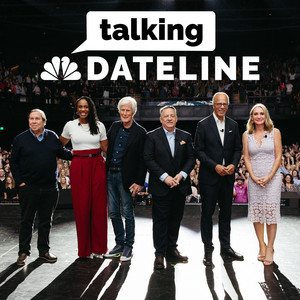
We have a special edition of Talking Dateline for you this week. a music venue in Nashville.
Lester Keith, Josh Blaine, Dennis and I answered questions about what it's like being Dateline correspondents, interviewing murderers victims, families and detectives.
We got personal too, reflecting on life on the road and the stories that have stuck with us long after an episode has aired.
The hosts who asked us the questions call themselves Dateline devotees, but you know them better as actors and real-life husband-and-wife duo Annette O'Toole from Virgin River and Michael McKean of Better Call Saul and the Spinal Tap movies.
Before they got down to the questions, they played a montage of some memorable Dateline moments.
Here's Talking Dateline from Nashville.
Without any further ado, we would like to meet the dream team that makes Dateline Dateline.
Would you like?
All right.
All right.
Here we go.
You've all met some extraordinary people over the years.
Yes, confronting killers.
Consoling family members.
Let's take a look.
How do you want us to think of and remember Anton?
As a good child.
A good son.
A good citizen.
Ed, I don't give a sweet flying about that.
I don't care.
I kind of care.
Which you do care.
That the family has a chance to get some closure.
That they have been begging you for.
They don't know where their child is.
Do you believe Jennifer is alive?
I do.
Against all circumstantial evidence or common understanding?
I'd like not to discuss this.
What do you say to people who say these are crocodile tears?
He's putting on a show.
This is all an act.
Oh.
If you had nothing to do with this, if you're innocent.
I'm done.
We're done.
We're done.
I'm not doing this.
OK. you. you, you arrogant . you.
How's that?
We're going to want to hear more about that in a minute, Josh.
I think primarily we would like to know, I would like to know one thing.
Do you consider yourselves news reporters or are you storytellers?
Every news reporter is also a storyteller.
I mean, this is absolutely about the storytelling.
But this is also the news business.
You know.
It's why there's been an enormous amount of of discussion on social that I've seen about, why we and one of our competitors run the same story on the same day.
And the answer is, I don't want to get beat.
When it's ready, it runs.
I don't want to run a week after somebody else after you guys already know how it comes out.
So, I mean, we are in the news business and we want to be right and we want to be first.
And we want to tell a story that you guys pay attention to which, based on your reactions to that video, you clearly do.
Also, by the way, I thought that guy was going to kick my ass.
Michael, I for one feel more of a storyteller.
I remember years ago we were in a production meeting.
We were screening one of our stories.
It must be back 20 years ago.
And with this long in-the-weeds discussion, when are we going to introduce the stuff about the blood evidence and the DNA, and what part of the story?
And I said, guys, forget about it.
We're telling you, it's not about the murder.
It's about the marriage.
It's about the people involved.
How did somebody end up dead on the kitchen floor?
That's our story, not what the crime scene guys put together.
We certainly need all that, but I think that's why Dateline distinguishes itself from some of the other shows.
It's about the people.
I've spent both worlds for quite a while doing nightly news and Dateline.
Now I'm full-time at Dateline, having fun, by the way, I should point out.
But there is a difference in the pace.
A nightly news story, a typical, it was maybe a couple of minutes, you had hours to put it together.
These programs, we have months sometimes And so you can really create a storytelling element.
We're still journalists, as Josh points out.
We're still news people.
But it's just a way that people can step inside the shoes of the people we're covering.
But also to that point Lester, I think that you know I always say that I have been a Dateline viewer longer than I've been a Dateline correspondent.
And so it's been very interesting to kind of peel back the curtain and look at our fact checking process.
Right.
I mean the same thing that we would do on a nightly news to your question about are we, you know, news reporters or storytellers?
I mean, it is an extensive fact-finding process.
We have a tremendous team that makes sure every detail is correct.
All of our facts are buttoned up, and that is a very big backbone of what we do.
Do you ever fight over stories?
Like, who's going to get what?
Among ourselves?
Yeah.
I would say just more jealousy.
I can't believe we got that story.
I wanted that story.
But no, we don't fight over them.
Have you ever seen a story break in the news and say, ooh.
I want that.
I'm thinking of the Gilgo Beach Long Island murder.
Are you working on that?
Yeah.
I was on that story from like many, many, many years ago.
When it was the missing girl story.
Yeah, yeah.
Before we knew it was Gilgo Beach.
A lot of these stories will follow for three, four, five, ten years or more.
We are eventually able to put them on the air.
I've had multiple.
Develop and develop and develop.
Like, I've had multiple pregnancies on the same show.
That's going to bear some explanation for another session.
Why do you think this show resonates with so many people?
I think it's a lot of things.
I think we've figured out how to tell a story in a way that you guys appreciate and find captivating, which is no small achievement after all these years.
There aren't a lot of things on television that have been on for as long as we have, so we've got to be doing something, right?
I've said this before.
I did not see true crime taken off.
Dateline started, said to me, we want to do hour-long murders.
This was in like 2005, 2006.
I was like, really?
Like, really?
Okay.
And then I did one.
And I was like, all right.
That was...
That was a better experience than I thought it was gonna be, and I'm still in touch with that mom from the first story.
So these stories resonate with people.
They do, and you know there's something really foundational about human beings and that we all, From the time we're very small children, we need to know where the dark places are and we need to be able to keep ourselves safe from the dark places and know what's under the bed.
And a lot of these stories have to do with that very topic.
The need to be aware of what people are capable of, the need to be aware of what they're also capable of.
On the positive side,
These are explorations of human nature which are far more illuminating to me anyway, than than almost any other kind of news reporting.
Have you achieved any kind of insight into the overriding question that we always wind up asking ourselves as we watch, every week, as we do?
We look at each other and we go, how could he do that?
How could they?
Why didn't they just get a divorce?
Yes.
Well, what is there about that particular person's ego that puts him at the center of the universe and able to erase anything in his way?
Is there any kind of person you've looked into a lot of? a lot of pairs of a lot of dark eyes.
Have you come across anything?
I mean Jack Olson had these theories about the extra Y chromosome which is found in murderers, but nobody really knows why and how they can do it.
Any insights?
Save us.
I mean I wish I could tell you that there is a type, but I mean it is and you guys know this.
I mean it is astonishing to see what people are capable of with someone who they once loved, someone who might be currently the parent of their children.
And they're thinking only about themselves and their own needs.
I mean, you think you're gonna take your kid's other parent and they're gonna be fine?
Do you think about that?
But I think the thing is that so many people think that they're going to get away with it.
They think that they've been able to outsmart police, outsmart the system, outsmart people who may have been watching.
So I think that narcissism does play a large role.
They're so confident in whatever it is that they've pulled off that they really think they're going to get away with it, and the lies that they've told.
And they forget there's a camera everywhere.
It's remarkable.
Even when I was just in the newsroom at Nightly News, a story would come across.
I'm like, does this person not watch Dateline?
Is it possible, really?
Dude, the phone, leave it at home.
Or if you delete something from your phone, it doesn't go away.
They'll still get it. commit a crime in Texas and drive to Oklahoma and that was the end of it.
Those days are over.
A long time ago.
Do you ever get pushback from law enforcement?
I mean, I'd say 95 of the time.
You're dealing with very competent law enforcement and people who become obsessed long after their retirement with a certain case.
But on the moment, do you ever feel like They're telling you you're intruding.
They're telling you that your story is irrelevant.
Only if they haven't finished with their work, generally speaking.
They want to be able to do what they need to do first, and then they're usually pretty happy to do it.
When we tell them that this isn't going to air until they're done.
That generally makes them a little more cooperative.
And we love highlighting their good work.
And on the flip side, we also sometimes have to highlight bad work too.
You know, it's not always...
Perfect.
I think also sometimes, I mean, we get to show them as people.
We get to show law enforcement detectives as people, right?
Bring out some of the emotions that they bring to the case.
Show how these cases oftentimes go home with them.
Why there's this one that they just couldn't let go.
And so I think it also kind of, you know, We can see them through a prism.
It shows a different side of law enforcement than you might get on your nightly news.
As a percentage of the number of people who become emotional and cry during an interview...
Detectives rank high.
Oh, they cry all the time, the detectives.
No emotions about their cases, and understandably so because they care about them so deeply.
I did one story where the detective it was 25 years and he was retired and I said what did you do when you found out that they finally caught the killer?
And he said I went and bought a rose and some roses.
I went to the family.
I gave them some roses and then I went to her grave and put the roses on her grave.
Wow.
This is from a detective.
Sure.
There are those rare cases that kind of end on a verdict where we're looking at each other going what the hell is going on here?
Have you ever had any of those where you really thought they got it wrong and there's nothing you can do about it?
Yes, yes.
Quite a number of them, actually.
I think we all have a few.
We think the jury got it wrong, but we won't tell you.
Yeah, well, I found that you don't come out and say it.
But we're feeling it at home, and we're feeling you feel it too.
You lay it all out, and then people can see for themselves what they ought to think.
There are cases in which I think I'm not sure what happened, but I couldn't have voted to convict on this.
But those are rare.
Usually I mean look prosecutors, by the time they go into a courtroom, the deck is almost always very heavily stacked in their favor.
And that's what they all do.
That's why, you know, when it comes to murder cases, prosecutors have records like 23 and one.
I mean, they almost always have the cards before they go in there.
When we come back we answer some more questions from Michael and Annette and also take a few from the audience.
Plus, Josh tells us about the time he got a voicemail from none other than OJ Simpson.
So we have some questions for all of you, some things that Mikey and I want to know.
You're going to start, right?
There was a show a long, long time ago on TV.
It was called You Are There.
And it was hosted by Walter Cronkite.
There were no gags.
He would magically interview Brutus right before he stabs Julius Caesar.
He would interview Napoleon right before they attacked Russia.
They would go into these moments of history and they would cover them like a news story.
And he would be there and first person interviewing the people involved.
Is there any moment in history that you'd love to send a Dateline crew to?
In my mind, no question.
I would go to Fall River, Massachusetts and meet Lizzie Borden.
Ah, Lizzie Borden.
Do you remember Lizzie Borden took an ax, gave her, you can all say that, right?
Well, she went to trial, and there's immaculate records of the trial, all the testimony.
It was a terrific book a few years back.
She was acquitted.
She was found not guilty.
Wow.
But do you think she did?
It would be a great Dateline story.
Do you think she did it, or do you think Dateline could have figured it out?
I think they couldn't prove it, and that's the story we have all the time, right?
Yeah.
I'd go to Dallas and find out who was waiting for John Kennedy.
Yeah.
Anybody else have a history?
Murder? special murder they'd like to cover.
Should we go all the way back to Lincoln?
JonBenet.
JonBenet Ramsey.
Well, that's so recent.
Martin Luther King.
Kind of.
O.J.
I think someone might have been there for that one.
I could have done enough on that.
I'll tell you, now that we're talking about OJ, you guys may not remember this.
In between the criminal trial where he was acquitted and the civil trial where he got that big judgment.
He was just in LA and kind of like living his life.
And one of the things that happened then which probably nobody remembers.
He was playing golf and he's finished his round and he's I think he played alone or with some people he just met there and he's taking off his golf shoes and a guy walks up to him with a gun and says give me your money.
And OJ says to him, you watch the news?
I spend it all on my criminal defense.
And the guy's like, You're lying, give me your money.
This is all Simpson's telling of the story and Simpson grabs the gun and they struggle for a second and the guy runs away.
He jumps in his car, he drives off.
Simpson jumps into his car and follows him.
And calls 911.
What?
And says to the 911 operator, this is OJ Simpson.
I'm in my white Bronco.
I'm not making any of this up.
And I'm following a guy who's trying to kill me.
And the 911 operator says, I'm sorry, again?
And then they say what they say to everybody in that situation, which is give us a description of the car, pull over, we'll take over.
But they don't find the guy and he vanishes.
So, we do the story on Dateline.
It was on a Sunday, back when we had a Sunday show.
And it wasn't a whole show, it was like seven or eight minutes long.
And we had some.
We had his story.
He had spoken to somebody not us, but he'd spoken to somebody, so I didn't actually talk with him.
But so we do the story, and because it's not exactly the most trustworthy complaining witness in the history of the criminal justice system, I attributed everything he said.
I was like.
Simpson claims the man pulled a gun and Simpson says they then struggled over the gun and Simpson says the guy then ran away.
The next morning I come into work after this thing has aired and I got voicemail on my phone.
Back then you couldn't get it remotely because it was like the dark ages.
And my first voicemail begins and it's clearly him.
It begins, Josh Mankiewicz, this is OJ Simpson, and you're a son of a bitch.
And then he goes on ranting at me for sounding in my story as if I didn't believe him.
Why would anyone not believe him?
And then voicemail cuts him off.
And he calls back.
And he leaves another message, and about halfway through the other message, he's lost his venom.
He's like, anyway, just wanted to call, you know, goodbye.
But for like a year, Josh Blank was, this is OJ Simpson, you're a son of a bitch.
I played that for everybody who came in the office.
Like a moron, I didn't save it.
Because now it's like the ringtone or something, right?
Oh, yeah.
Eventually it went away.
Yeah.
Oh, my God.
There you go.
Wow.
Well, I have a very silly question for the ladies.
You always look so fantastic on the show.
I'm just like, who does your clothes?
Do you do them yourselves?
Just me.
Just you?
I do my hair, my makeup, and my clothes.
You do everything?
Everything.
And you do blame?
You do it too?
I do my own clothes, my hair.
And my makeup, I do get a little bit of help.
But honestly, it takes a lot of magic.
Andrea and I were just talking about this with...
What, six kids between us?
We're tired.
A lot of us.
You have the lion's share.
Well, we have eight.
We have a total of eight kids.
Wow.
We're tired a lot of the time.
And so there are the magical bag things we put under our eyes to kind of give us more life and breathe more life into it.
When you're working, who takes care of all these kids?
I have a nanny.
I have a nanny who comes during the day.
But you leave.
You leave your home.
And my husband is home at night, yeah, for his job.
So he takes over when... And the kids are at what ages?
Mine are 6 to 16.
Oh, my God.
And mine are 4 and 1.
Four years old and one year old.
What?
So do you have to take them with you, or what do you do?
No, the content isn't quite appropriate.
They're a little too young, but I do.
I leave them at home, Nanny and my husband, and we trade off.
My mom comes in.
Like, you just...
It takes a village.
It really takes a village.
Especially since we travel as much as we do.
And when you go to these places because sometimes you go to really tiny little places do you just stay in a Motel 6?
What do you do?
Oh, sometimes.
Oh, yeah.
It's, you know...
It runs the gamut.
Never know what you're going to get.
And like eating, because there must be just like hamburgers and stuff.
Sometimes.
Sometimes it's McDonald's.
Sometimes it's nothing.
And then sometimes you might get a really nice meal.
I will say that we get to see the most interesting corners of America in this job.
I mean, places that you would not necessarily go.
I went to North Dakota for the first time in my career. from North Dakota.
Shout out to North Dakota.
So, I mean, some places that so many of us would not naturally go to, we get a chance to see.
And not only see, but really get familiar with.
Right.
Because you're talking to people there.
You're meeting people in diners.
They know us and talk to us.
So you get a really good taste of these places.
It's one of the great perks of what we do.
It really is.
You get to see the country probably like nobody else does.
And the world.
And you're famous when you go there, right?
Because do people really want to talk to you because of, you know, they know you from TV?
Gradually a little more as time went by.
Early on, not at all.
You're completely anonymous, wandering around, looking around the corner.
SNL changed that for Keith.
Are you still in touch with Bill Hader?
You know, he's such a lovely, lovely man.
He's awesome.
Bill Hader is a delightful guy.
Yes, he is.
And we met one time when they filmed the occasion.
And I was surprised by how shy he was and how sort of...
He was really nervous to meet me.
Well, you're his hero, Keith.
I mean, come on.
We're nervous to meet his idol.
But we're not the only ones with questions.
Our audience here has some questions.
And the first one comes from another Annette.
Annette G. from Memphis, Tennessee.
So I guess this is for each one of you.
What is your favorite episode by someone other than you?
Ooh.
That's a good one.
Oh, you saw a clip of it, Andrea, with the guy who's... Oh, crying in oxygen.
Nicholas Rossi.
He's a character.
Yeah, and he's...
And in between then and now, he's been convicted.
He just got, he was convicted twice in Utah for rape.
The payoff was so spectacular with that guy in the little mask and everything.
Andrea, that was amazing.
Fantastic.
He's a character.
Anybody else want to?
I like the Lori Vallow interview.
That was so good.
Wow.
Just riveting.
Strangest day ever.
Yep.
Which one?
Laurie Valadie.
Oh, my Lord.
That day, I walked away thinking, I've ruined my career's over.
This is the worst interview ever.
Because you couldn't get an answer out.
Because she dodged and she jumped and she was a weaver.
But she's a very unusual woman, that.
It was phenomenal to see.
And yet, I would go back and do it again.
It was...
It was weirdly enjoyable and terrifying and awful at the same time.
Coming up in the final part of our conversation with Michael and Annette, we discuss the emotional toll of the stories we tell and the stories we can't forget.
When you speak with the victims' families, is it ever too much?
Do you ever feel like, I don't know if I can do this?
I can't take this.
Yes.
All the time.
Every single time.
It's the hardest thing we do.
Yeah.
I would imagine so.
And I never lose sight of the fact that this...
The show is not coming from a writer's room.
These are real life people who've had the worst experience in their lives. knocking on the door.
We've got our cameras.
We want you to sit down and tell us the worst thing that ever happened to you.
Why do you think they do?
Why do they?
It's trust.
And I'm really struck by that trust.
I mean, I...
I've taken to telling people when I interview them, either before or after I'll say I know that this is the most unnatural thing in the world.
You're sitting down from me, somebody that you barely know, and talking about the worst moment in your lives, And that amount of trust isn't lost on any of us, I think.
And so I really think that it sometimes takes opening yourself up, showing them that we're not robots, right?
That we have emotions that we understand and we empathize.
But it also speaks to the level of trust they have in each of us, but also the trust that they have in Dateline and what our show represents, what we stand for, and knowing that we are going to tell the story right and treat it with the respect it deserves.
And, you know, unless it's a famous case... who might get a minute on their local news.
This is a way of us to tell the audience not just how the person died, but how they also lived and who they were.
I think that does appeal to families.
I think it becomes a cathartic experience for many of these people to sit down and talk with us long form, because they've talked to police officers, but they just want this much information.
They've talked to the DA office.
We come in and say, tell us about your life.
So it's about your life and try to understand.
And the thing you've got to remember and I know that we all do remember this is that when our story airs, we go on to the next one.
But they're never getting over this, the people that we talked with.
And also we get the opportunity to be across from the killer where a lot of times these killers do not take the stand.
So a prosecutor never gets a chance.
They don't even talk to the police most of the time.
And so the only time they cross-examine is by us.
We get to cross-examine them.
And also, it's kind of like for the family too, right?
Because you're asking these really important questions to the person that... took their loved one.
What is your most memorable story that has stuck with you?
Also, do you keep in touch with any of the family?
That's something I'm sort of curious.
In my case, many of them.
I spent two and a half days in prison. at Angola maximum security prison and that sticks with you.
It was a story really about mass incarceration, And when you meet someone who was sentenced to life and they're standing there and they're 86 years old, still in prison, it's hard to see it through the same lens.
But that was a...
A compelling story.
Scary on some levels because we had more freedom than I thought we'd have perhaps behind bars.
And when you were in there, you met a guy who was mad at me.
Right?
I think we did.
That's right.
Everybody's mad at you.
No, that's right.
Offending killers everywhere.
I'm walking through a cell block and this guy, he's got his hand outside the cell and he sees us walking by.
He goes, hey, hey, hey. and he wanted to complain about your story.
I can't remember what the story was about.
But I'm like, I don't take requests here, you know.
No, it was undoubtedly a reasonable request.
He's a murderer.
Which, by the way, that's a badge of honor, having people be so mad at you all the time.
Murderers, that is.
Well, that's quite an honor.
Yeah, I know who that was.
I knew right away who that was when he said that.
And he's right where he should be.
Well, we're lucky.
It's an amazing show.
You give us so much.
It's such a treat to get to be together.
Give it to them.
Come on.
Give it to them.
And thanks to you two for being here and for being our loyal viewers.
That's it for Talking Dateline this week.
We had so much fun meeting everyone in Nashville and answering questions.
Remember, if you have a question for us, you can send us a video on social media at DatelineNBC, or you can leave your question in a voicemail at 212-413-5255.
Thank you.