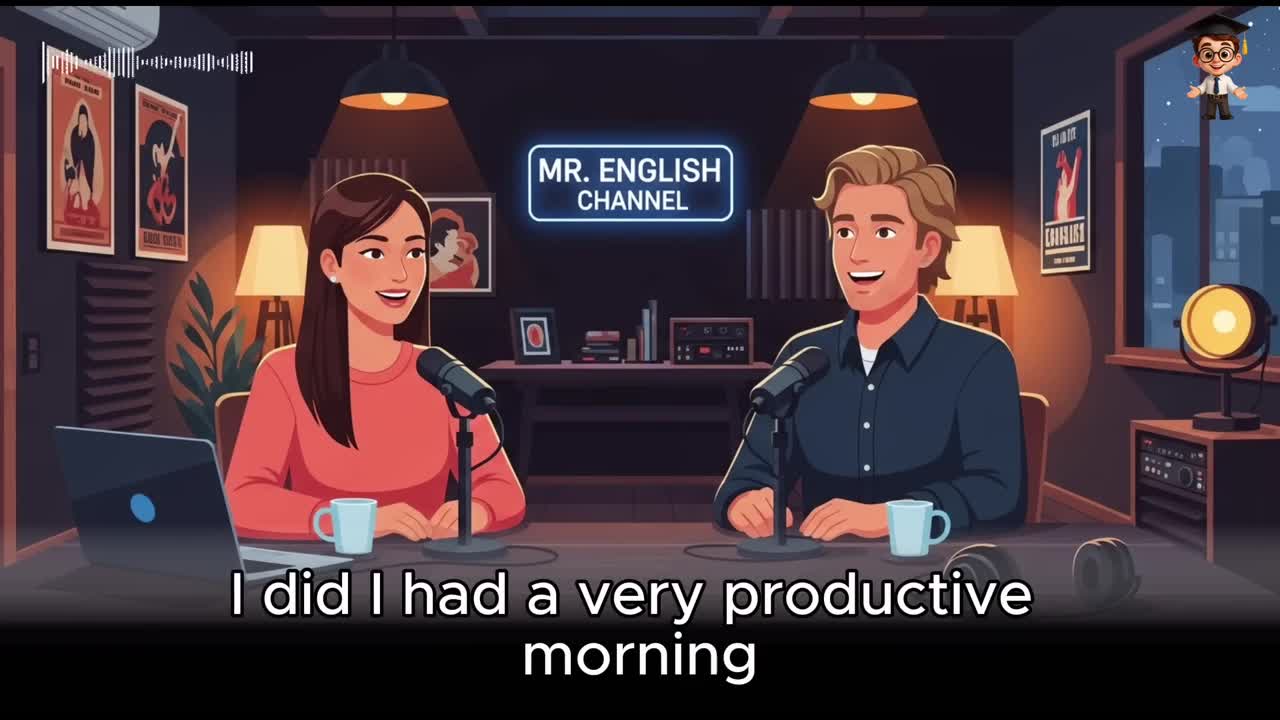
Hello everyone and welcome back to Mr. English Channel, where learning English is easy and fun.
I'm Emily.
Hello Emily.
Hi everyone.
It is so good to be here today.
I am feeling very energized and ready to talk.
I can see that, Paul.
You have a very big smile on your face.
Did you have a good morning?
I did.
I had a very productive morning.
But before we talk about my day, we have to welcome our listeners.
Yes, you are right.
Welcome, everyone.
We are so happy you are listening to our podcast today.
We have a very special episode for you.
We do.
Today, we're talking about how to describe your day.
This is so important because we do it every single day.
Exactly.
When you meet a friend, they ask, how was your day?
Or what did you do today?
You need to be ready to answer.
Yes, and it is not just for friends.
At work, your boss might ask about your schedule, or maybe you are writing in a diary.
I love writing in my diary.
It helps me practice my English, too.
That is a great tip, Emily.
But wait, before we get into the details, we have a small favor to ask our friends listening.
Oh, yes.
If you like our chats, please click the like button right now.
It helps us so much.
And please subscribe to the Mr. English channel.
We want to help you learn English every week, and subscribing is the best way to stay connected.
Yes, and share this with your friends.
If they are learning English, they can listen and learn with us.
Thank you, everyone.
Okay, Emily, let's start.
To talk about our day, we should probably start at the very beginning, right?
The morning.
My favorite part of the day if I have coffee.
Know you love your coffee.
So let's look at the morning routine.
What is the first thing you do?
Well, I usually wake up at 7 am, but I don't get out of bed immediately.
Oh, what do you do?
Do you check your phone?
Yes, I do.
I know it's a bad habit, but I check my emails and the news for five minutes.
Then I get up.
I understand, I am the opposite.
My alarm goes off at 6.30 a.m. and I jump out of bed.
I like to start my day fast.
Wow, Paul.
6.30 is very early.
You are a morning person.
I am.
First, I drink a big glass of water.
Then I put on my running shoes and I go for a short run.
A run?
Before breakfast?
That sounds difficult.
It was hard at first, but now I love it.
It makes me feel awake.
After my run, I take a shower and get dressed for work.
That is a very active start.
For me, after I get out of bed, I go straight to the kitchen.
I need my coffee.
While the coffee's brewing, I make my breakfast.
What do you usually eat for breakfast, Emily?
Is it something healthy?
Usually, yes.
I like oatmeal with fruit, or sometimes toast with eggs.
It gives me energy for the morning.
That sounds delicious.
I usually have a smoothie with protein and spinach.
It is green, but it tastes good.
Green smoothies are very popular.
Okay, so we have wake up, get up, have breakfast, and get dressed.
These are great A1 words.
Yes, but since we're talking to our B2 level friends today, we can use better words too.
Instead of get dressed, we can say prepare for the day.
I like that.
Or instead of I eat breakfast, you can say I have a nutritious meal to start my day.
Exactly.
And then there's the commute.
Emily, how do you get to work?
I usually take the bus.
It takes about 20 minutes.
I like the bus because I can read my book or listen to a podcast.
That is a good use of time.
I drive my car.
Sometimes there's a lot of traffic, which is a bit stressful.
Oh, I hate traffic.
When the bus is late, I feel a little frustrated too.
We all do.
Now let's talk about the middle of the day, work and study.
This is where the day gets busy.
Yes, my work day starts at 9 a.m.
The first thing I do is check my to-do list.
A to-do list is essential.
I have one on my computer.
I look at my most important tasks first.
Me too.
I try to do the hard things in the morning when my brain is fresh.
For example, today I had to write a long report.
Oh, a report.
Like the one I had to do with Tom and Sarah?
Yes, but hopefully with less stress.
I spent two hours writing.
Then I had a meeting.
Meetings can be long.
How was yours?
It was good.
It was a brainstorming session.
We talked about new ideas for the podcast.
I love brainstorming.
It is so exciting to share ideas with the team.
It is.
But after the meeting, I was very hungry.
Lunchtime.
Ah, lunch.
Do you bring your lunch from home or do you go out?
I usually bring a salad or a sandwich.
It's cheaper and healthier.
I eat in the park if the weather's nice.
That is lovely.
I often go to a small cafe near my office with my colleagues.
We talk about our weekend or the news.
It's a nice break from the computer screen.
It is important to step away from the desk.
If I stay at my desk all day, I get a headache.
Agree, in the afternoon I usually have more meetings or I answer emails.
Sometimes the afternoon feels very long.
Yes, around 3 pm.
I often feel a bit tired.
I call it the afternoon slump.
The afternoon slump, that is a perfect name for it.
What do you do to get more energy?
I have another coffee.
Or I eat a small piece of dark chocolate.
Coffee and chocolate.
You have a very sweet routine, Emily.
I usually stand up and stretch.
Or I walk to the water fountain to get a drink.
Moving your body is a great idea.
Okay, so we talked about the morning and the work day.
What about the end of the day?
That's the best part.
I finish work at 5 30 pm.
I feel a sense of accomplishment when i finish my tasks.
Yes, i love the feeling of closing my laptop at the end of the day.
What do you do immediately after work?
Well, on tuesdays and thursdays i go to the gym.
I do a yoga class.
It helps me relax.
Yoga is wonderful for relaxation.
I usually go to the supermarket on my way home to buy ingredients for dinner.
Do you like cooking, Dinner Call?
I do.
I find it very therapeutic.
Tonight, I am making pasta with vegetables.
Mmm, I love pasta.
I am going to have a simple dinner tonight, maybe soup and bread.
After dinner, I like to unwind.
Unwind is a great word for our listeners.
It means to relax after a busy time.
Yes, unwind.
I unwind by watching a movie or reading.
Sometimes I call my mom or a friend for a chat.
That's nice.
I usually listen to some music or play a video game for half an hour.
It helps me forget about work.
And then the final part of the day, the nighttime routine.
Yes.
Before I go to sleep, I always prepare my clothes for the next day.
It saves me time in the morning.
That is so smart, Paul.
I should do that.
I usually spend some time doing skincare.
I wash my face and put on some cream.
It feels very fancy.
Self-care is important.
Then I get into bed.
I try to read a paper book, not my phone.
The blue light from the phone is bad for sleep, that is true.
I try to keep my phone in the other room.
I usually fall asleep around 10 30 pm.
I'm usually asleep by 10 o'clock.
I need my eight hours of sleep.
Wow, you really are disciplined, Paul.
I try, but sometimes I stay up late watching a good series on TV.
We are human, after all.
Exactly.
Now, Paul, let's give our listeners some tips on how to connect these ideas.
Great idea.
When you talk about your day, you shouldn't just say a list of sentences.
You need connector words.
Yes.
Instead of saying I wake up, I eat, I go to work, you should use words like first then, after that and later.
Right.
For example, first, I wake up, then I have my coffee, after that, I get ready for work.
It sounds much more natural.
And for a B2 level, you can use even better connectors.
Like following my morning routine, I head to the office.
Or once I finish work, I usually go to the gym.
Oh, once is a very good word.
Once I arrive home, I start cooking.
Another tip is to talk about how you feel during the day.
Don't just say what you did.
Yes.
For example, I had a very productive morning, but I felt quite exhausted by the afternoon.
Or I was thrilled because I finished my big project today.
Using feeling words makes your English sound much more advanced.
I agree.
It makes it a story, not just a list.
People like stories.
They do.
So, Paul, let's practice.
Can you describe your perfect day?
Not a normal day, but a perfect one.
Oh, a dream day.
Hmm.
Well, on my perfect day, I would wake up without an alarm clock.
Oh, yes, that is the best feeling.
I would wake up at 9 a.m.
The sun would be shining.
First, I would have a long, slow breakfast on a balcony with a view of the ocean.
Wow, the ocean.
What would you eat?
Fresh fruit, pancakes with maple syrup, and very good coffee.
Of course, the coffee.
Then I would go for a long walk on the beach.
I wouldn't check my phone at all.
No emails, no news, just the sound of the waves.
That sounds so peaceful.
What about the afternoon?
In the afternoon, I would meet my best friends for a big lunch.
We would sit outside and laugh for hours.
That is the best.
Friends make every day better.
After lunch, I would take a nap in a hammock.
Do you know what a hammock is, Emily?
Yes, it's like a bed made of net or cloth that hangs between two trees.
I love naps in hammocks.
Then, in the evening, I would watch the sunset with a big bowl of pasta.
And finally, I would watch a funny movie and go to sleep feeling very happy.
Ah, that sounds like a dream, Paul.
My perfect day is similar.
I would spend the morning in a big library or a bookstore.
Oh, you love books.
I do.
I would find a cozy chair and read for three hours.
Then I would go to a flower market and buy lots of colorful flowers for my house.
That sounds very beautiful and calm.
In the afternoon, I would go to a cooking class.
I want to learn how to make French pastries.
Can I come to your perfect day?
I want to eat the pastries.
Yes, you can be the official taster, then in the evening i would have a dinner party for all my friends, with music and dancing.
Wow, that is a very active, perfect day.
I love it.
Yes, it's fun to think about, but even on a normal busy day, there are always good moments, you are right, like this chat.
This is a very good part of my day.
I agree, Paul.
Talking to you and our listeners is the highlight of my Tuesday.
Highlight.
That's another great word.
The highlight is the best or most important part of something.
Exactly.
Well, we have talked a lot today.
I think it's time for a little recap.
Good idea.
Let's see.
What did we talk about?
Oh, we started with the morning routine.
Yes.
We used words like wake up and get up.
And we talked about how important breakfast and coffee are.
Especially for you.
Then we moved to the workday.
We talked about to-do lists and meetings.
And the afternoon slump.
Don't forget that.
It's when we get a little tired after lunch.
Right.
And then we talked about how to unwind in the evening, like cooking, exercise, or watching TV.
We also shared some great tips for our B2 learners, using connectors like first, then and after that to make the conversation flow.
And my favorite tip, adding feelings.
Don't just say what you did, say how you felt about it.
It makes you sound much more confident.
Yes, and finally, we shared our perfect days, ocean views and bookstores.
It was a wonderful conversation, Emily.
I hope our listeners enjoyed it as much as I did.
Me too.
Now we want to hear from you.
Yes.
Please leave a comment below.
We have two questions for you today.
First, what is the highlight of your day today?
What made you happy?
And second, what is one thing you do every day to unwind after work or school?
We love reading your stories.
It's a great way to practice your English writing.
It really is.
And before we go, please don't forget to subscribe to Mr. English Channel.
And give us a like if you enjoyed this episode.
It helps more people find us.
Share this with your family or your friends who are studying English.
Let's grow our community.
Thank you so much for listening today, everyone.
You are doing a great job with your English.
Yes, keep practicing every day.
Even five minutes of English can make a big difference.
Well, that's all for today.
I'm going to go and have another coffee now.
Of course you are.
And I'm going to go and check my to-do list.
Goodbye, everyone.
Bye-bye.
See you next time.