This is The Indicator from Planet Money.
I'm Darian Woods.
And I'm Waylon Wong.
Pennies are everywhere.
They're between our couch cushions and on the floor of our cars.
They're in fountains and junk drawers.
And there's even a penny on Mars.
If there is, like, other life out there...
That's the thing maybe that they would find about the United States.
Christina Schutt is the executive director of the Abraham Lincoln Presidential Library and Museum in Springfield, Illinois.
And if some alien were to pick up that penny on Mars, it would be holding an artifact from 1909.
That's the year that the penny's design was changed to put Abraham Lincoln on it.
And fun fact, he was the first American president to be put on a circulating coin.
If the one thing that you know some other life form knows about us is Abraham Lincoln, like that's a pretty good representation of what's the best of us, right.
And so, I don't know, that's kind of cool to me.
So the penny with its image of Lincoln has made it all the way to outer space.
But it has also reached a different kind of final frontier.
Last month, the U.S. government minted the very last penny.
There are still around 300 billion pennies in circulation.
That's almost nine bucks for every person in the U.S.
But the coin's 232-year run is coming to an end.
On today's show, we trace the penny's long decline and pay tribute to this humble bit of American currency.
This message comes from AT&T.
America's first network is also its fastest and most reliable.
Based on RootMetrics, United States Root Score Report 1H2025, tested with best commercially available smartphones on three national mobile networks across all available network types.
Your experiences may vary.
RootMetrics rankings are not an endorsement of AT&T.
When you compare, there's no comparison.
AT&T.
This message comes from ADP.
ADP knows.
Any new technology, any old competitor, any trendy thing, even a trendy thing that everyone knows isn't a great idea, but management just wants us to give it a try for a bit can change the world of work.
So, whether it's a last-minute policy change or adding a new company holiday, ADP designs forward thinking solutions to help businesses take on the next anything.
ADP, always designing for people.
We wanted to talk to somebody who was there when the penny first started to become a problem.
So we called up Ed Moy and when we got him on the line, he didn't waste any time.
It is really nice to meet you and get you on the phone.
So I would give you a penny for your thoughts, except that pennies are worth four cents.
So you're getting a bonus.
You have the penny jokes coming already, and I love it.
Ed served as the director of the U.S.
Mint from 2006 to 2011.
The Mint is the government office in charge of making money.
Literally, it produces and circulates currency.
Ed's interest in coins started way before he joined the government.
His immigrant parents ran a Chinese restaurant when he was growing up and he started manning the cash register at age 10.
When I was bored I would paw through the change drawer and pick out coins that looked all silver or just unusual designs.
And that began kind of a lifelong interest in the coin area.
And this is the story about America.
Little did I know that fast forward 40 years later I would become director of the United States Mint.
The job of the Mint is to make enough circulating coins to meet demand within the economy.
And Ed says the office tries to do this at no cost to the taxpayers.
And that means it shouldn't cost more to make a coin than the face value of that coin.
The best case scenario is when a coin's face value is more than the production cost.
Then the government makes a profit.
There's even a special term for that profit, seniorage.
This money goes to the Treasury's general fund to help pay down the national debt.
In 2006, Ed's first year on the job, the US Mint was making money on dimes, quarters and dollar coins.
But it was losing money on nickels and pennies.
In fact, 2006 was the first year that the cost of making a penny went above one cent.
Ed remembers it going to 1.4 cents.
This is the run-up toward the financial crisis.
And the economy was still kind of hot in 2006.
So base metals started increasing in price.
And all of a sudden, this penny that was made of 97.5% zinc, 2.5% copper, started creeping up above one penny to make.
So I started consulting with Congress saying costs are going up.
Congress has the constitutional authority to regulate currency.
And Ed remembers that lawmakers did not see the increasing cost of penny production as an urgent problem.
Producing coins was still profitable overall.
And losses from the penny, then and now, were super small compared with the federal budget.
You know, an $80 million loss?
It's a rounding year of a rounding year in the federal government.
Yeah, so the federal budget is around $7 trillion.
So $80 million out of $7 trillion.
That's like one cent, one penny out of $875.
Still, Congress gave Ed the green light to study cheaper ways to make the penny.
And he considered some alternatives, but they didn't pan out.
Swapping in a cheaper metal like steel would still cost more than one cent per penny.
And switching to non-metallic materials was also impractical.
Ed left the Mint in 2011.
He didn't get to finish that study on what to do with the penny.
And by then, the cost of making it had gone from around 1.4 cents to 2.4 cents.
Demand for pennies was also declining as people used less cash.
That was up to my successor to deliver that report to Congress.
And every other successor has had to deal with this problem.
By last month when the Mint announced it was producing the last penny.
The cost to make the coin was 37 cents.
Ed says he understands why the government finally made the call.
It wasn't a surprise that eventually someone's going to have to make that decision.
We have enough pennies.
It's time to end the production of pennies.
A lot of people are totally over the penny.
They throw them away or just let them sit around in jars.
But we did find someone who really treasures this little guy.
My name is Robert Wexler, and I'm an artist.
And for more than two decades now, I've been focusing on the U.S. penny.
And I just finished 100,000 penny cube.
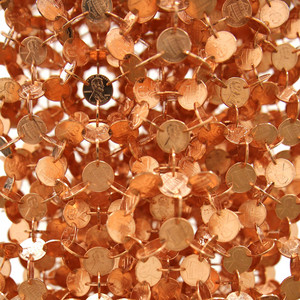
Robert cut notches into 100,000 pennies.
Then he slid them together to form a 3D lattice.
The sculpture took him seven years to finish and it's on display at Wellesley College in Massachusetts.
I was worried that the penny would be canceled and removed from currency before I finished, because if I finished the piece after that, it would be nothing but a memorial to the penny.
And I didn't like that idea because for me, it has a lot more to say.
This coin has fascinated Robert ever since he was a kid and his grandfather would pretend to pull a penny out of his ear.
He kept those coins in an orange Tupperware container because they felt magical to him.
For his art, Robert needs a lot more than Tupperware containers of pennies.
So he orders them in bulk from his bank.
They really don't like doing it because they're heavy and they take up space in the vault.
And they insist that you pick them up immediately.
But they can't tell you when they're going to arrive, because they don't want you to know when their bank truck is going to be there because, for security reasons,
Oh, my gosh.
Because what if you pulled off a heist?
Exactly.
You just have to be on call for when the pennies arrive.
Right.
The hassle is worth it for Robert, though.
He still finds Wanda in the penny.
There are these like lowly guys, gutter things.
You know they live in muck and they're exposed to unspeakable filth.
But that has this incredible effect in that they um, they do turn blue and green, but they also turn like these spectacular oranges and reds, or these like really lovely waxy blacks, and it's so unique and special and just it's like a little world.
So what's to become of all the pennies still circulating in the world?
Well, Robert will take them to use in his art.
Former U.S.
Mint Director Ed Moy saves them in a coin jar until he has enough to deposit at the bank.
And back at the Lincoln Museum in Illinois, volunteers set out pennies for schoolchildren to find on the ground.
Executive Director Christina Schutt says they've given away more than 200000 pennies in the last couple of decades.
It's really cute seeing kids like three and four-year-olds running around the plaza looking for the penny to find it.
And it gives the volunteers great delight and joy, because then they get an opportunity to talk about how Lincoln really is everywhere.
He's coming out of your ear.
That will explain the waxy patina that Robert's finding.
The black wax.
Yes.
Unspeakable filth, Darian.
You know what, though?
The gift shop at the Lincoln Museum no longer accepts pennies.
How about nickels?
I hear these lose even more money now than the penny did.
Yeah, last year it cost the mint close to 14 cents to produce a nickel.
That's more than double its face value.
So, I don't know, maybe we'll do a nickel obit next year.
Dropping like flies.
This episode was produced by Julia Ritchie with engineering by Sophie MacArthur.
I was fact-checked by Corey Bridges.
Kate Kincannon is the show's editor, and The Indicator is a production of NPR.
This message comes from BetterHelp.
The holidays bring traditions and joy, but they can be tough, too.
Therapy helps you care for yourself so you can truly show up for what matters most.
Visit BetterHelp.com slash NPR for 10% off.