NPR. This is the Indicated from Planet Money.
I'm Paddy Hirsch. And I'm Adrian Ma.
In the recent past, we haven't really thought about unions as being particularly powerful.
But over the past 12 months or so, we've seen unions from Starbucks workers to auto workers rack up a series of successes.
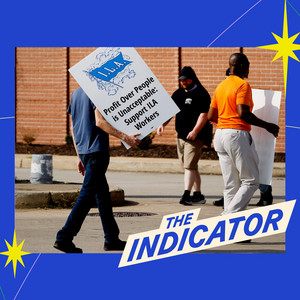
Yeah, and in the last few days, of course, we've seen the Longshoreman's Union face down the United States Maritime Alliance.
So unions appear to still have some mojo.
And this, despite the best efforts of business over the years, to neuter organized labor.
And those efforts really began with something we heard a lot about while the Longshoreman strike was on.
The Taft -Hartley Act.
On today's show, we'll learn what the Taft -Hartley Act is, why it was created, and why it is still such a thorn in the side of unions today.
That's coming up after the break.
Follow up and we bring you along to hear what we learned.
Get closer to the issues, the people, and your vote at the NPR Elections Hub.
Visit NPR .org slash elections.
It's a high -stakes election year, so it's not enough to just follow along.
You need to understand what's happening so you are fully informed come November.
Every weekday on the NPR Politics Podcast, our political reporters break down important stories and backstories from the campaign trail.
So you understand why it matters to you.
Listen to the NPR Politics Podcast wherever you get your podcasts.
The International Longshoreman Association's accord with the United States Maritime Alliance is not a done deal.
In fact, it's only a partial deal.
They still have to agree on things like the use of automated equipment and other stuff.
And if they don't reach an agreement by January 15th, the strike could resume.
Throughout the strike last week, we kept hearing about something called Taft -Hartley.
The president should invoke Taft -Hartley, the pundits said.
The president himself said he didn't believe in Taft -Hartley.
So what the heck is Taft -Hartley?
So this is an act from 1947 that basically clawed back some of the rights and privileges that had been given to unions and organized labor just about 10 years earlier.
This is Beth Akers.
She's an economist at the right -leaning think tank, the American Enterprise Institute.
She says Taft -Hartley was a response to the National Labor Relations Act, also known as the Wagner Act, which Congress passed a decade before.
Wagner enshrined union rights and freedoms for workers.
It was kind of a peak moment for organized labor.
And they took advantage of it.
Several years later, we saw this huge wave of strikes.
And strikes are really a mechanism that unions have to exert pressure on employers, to use those collective bargaining rights to get the outcomes that they're looking for.
A wave of strikes is kind of an understatement.
More like a tsunami of strikes.
They started in March 1945 when film crew workers walked off the job in Hollywood.
Oil workers were next, followed by auto workers, electrical workers, meat packers, steel workers.
We were in a period of readjustment.
Betsy Stevenson is a professor of economics and public policy at the University of Michigan.
And part of a period of readjustment involves workers saying, okay, what about me?
What am I going to get?
That simple question led to strikes in critical industries, as well as numerous general strikes.
By the end of 1946, more than four million American workers had participated in strike action.
And this had huge consequences for the economy.
GDP fell to negative 11 % in 1946, from 8 % two years previously.
Inflation, meanwhile, rose to 14 % in 1947, from 8 % the previous year.
So, needless to say, this was the downside of these strikes.
On the upside, for workers, they scored some big victories in terms of pay and conditions.
And maybe not surprisingly, business leaders were kind of horrified by this.
They began to pressure Congress.
They said the Wagner Act had given unions too much leeway and that labor needed to be rained in before it crippled the country.
They said Wagner essentially had to be moderated.
And Beth Aker says the result of that was Taft -Hartley.
The Wagner Act basically put in place guardrails that said that collective bargaining can exist.
Taft -Hartley was really in response to that, recognizing that, yes, we want collective bargaining to take place to protect the rights of workers.
But it has to be tempered by the fact that when unions behave in this way and they use striking, it can't impose negative costs on the nation.
And we kind of got to claw that back a little bit and make sure that there's balance in that as well.
Taft -Hartley was named after the two Republican politicians who sponsored it.
And while you might think that this would be the kind of legislation that would be voted on right down party lines, you'd be wrong.
Democrats supported it in large numbers.
The Democratic president at the time, Betsy Stevenson, says, did not.
President Truman vetoed the bill.
He labeled it arbitrary, drastic, harsh, dangerous.
But tell us how you really feel, Truman.
So many negative words.
So negative. But it didn't really make a difference.
There was so much bipartisan support for this bill that Truman vetoed it, and then Congress overruled that veto.
And this act Taft -Hartley did a number of things, like banning closed union shops and other tactics unions used in the past.
So it gave all sorts of powers to employers that they didn't have before.
In many ways, it neutered the unions.
But it did one very specific thing that reveals why everybody was talking about Taft -Hartley last week.
Beth Akers says it gave the president, under Section 206 of the Act, the power to stall a strike.
The president cannot snap his fingers and say, go back to work or don't strike.
But there is an executive power that they can appoint aboard, which would then ultimately result in a federal court stopping the strike from happening.
For a cooling off period of 80 days.
A cooling off period where both parties were forced back to the negotiating table.
And in the unions case, back to work.
Because the thinking goes that when a strike occurs in a strategically vital sector, like container ports, the stakes for the entire economy merit special attention.
Betsy Stevenson says in the case of the dockworker strike, it's not just about one company.
They're like a linchpin to the whole economy.
And there's a whole bunch of companies who are affected.
And then when we start to think about what economists would call here externalities, the ways in which this negotiation spills out and spreads out throughout the economy.
Strikes can affect all sorts of companies, many of which may be only peripherally associated with the sector whose workers have struck.
As those other companies suffer, so they cut costs and maybe lay off workers.
Spending decreases and that affects more companies and the negative spiral continues.
And then there are the potential effects on inflation.
Inflation typically comes when you just have more people who want to buy stuff than there is stuff to buy.
It's really that simple.
You clog up the port and you're going to have a bunch of people who want to buy stuff and the stuff's not going to be there.
And that's going to push up the prices.
Since it was created, Section 206 of the Taft -Hartley Act has been invoked by a president 37 times to deal with striking workers in a range of industries from steelmaking to maritime work.
But it's had mixed results and that's because presidential intervention only delays a strike.
It doesn't necessarily stop it.
About half the time presidents have invoked this Section 206, the parties worked out their differences.
But nine times workers went ahead with a strike.
So this may only delay a strike that's inevitable.
And that may be part of the reason why President Biden told reporters that he's not a believer in Taft -Hartley.
It just doesn't work that well.
The other part of the reason, of course, is that he's a Democrat, a union supporter, a big union supporter.
During the successful auto workers strike last year, he was the first president in history to join a picket line.
Now, Vice President Harris, the Democratic candidate for president, is a union supporter too, of course.
And actually so is the other candidate, former President Trump, who has said some pro -union things but also has sort of contradicted himself at times.
But on the face of it, this is a big difference from 1947 in the way that Republicans view unions.
And maybe in the way they view Taft -Hartley too.
The Republican Party's different, and that has led it to attract more union members.
And union members really dislike Taft -Hartley.
We are in a situation where union votes could go to either candidate, and so both candidates are worried about angering the unions.
Unions seem to be having a little bit of a moment right now.
I mean, for the first time in a long time, they've got strong allies on both sides of the political aisle, or at least they seem to.
And over the last year, they've succeeded in getting many of their demands met in strike after strike.
I mean, who knows, maybe their next target will be the piece of legislation that every union member loves to hate.
Taft -Hartley. This episode was produced by Julia Richie with Engineering by Quay C.
Lee. It was fact -checked by Sierra Juarez.
Kate Kincannon is our editor.
The indicator is a production of NPR.
This election season, you can expect to hear a lot of news, some of it meaningful, much of it not.
Give the Up First podcast 15 minutes, sometimes a little less, and we'll help you sort it out.
What's going on around the world and at home?
Three stories, 15 minutes, Up First every day.
Listen every morning, wherever you get your podcasts.
For a while now, you've probably been hearing about book bands, how they're gaining momentum everywhere in Texas, in Missouri, Florida, and Pennsylvania.
On the Code Switch podcast, we're taking a look at why.
Why are so many books suddenly considered so dangerous to kids?
Listen to our new series on the Code Switch podcast from NPR.
This Hispanic Heritage Month, Code Switch sits down with Mexican Cuban -American journalist and author Paula Ramos to discuss the rise of U .S.
Latinos to the far right.
It's a small but growing shift in American politics.
Paula Ramos thinks she knows what's behind it.
Listen on the Code Switch podcast from NPR.